Executive Overview: The Illusion of Agentic Readiness
In the evolving landscape of 2026, the promise of "agentic commerce"—where AI autonomously handles customer inquiries, product discovery, and purchase execution—has moved from theoretical whitepaper to tangible infrastructure. Shopify, leading the charge, has effectively "switched on" the machinery for millions of storefronts. Yet, a new, extensive audit of 122 top-tier Shopify merchants reveals a jarring disparity: while the plumbing for a transaction is largely operational, the "intelligence" layer required to actually resolve a purchase decision remains critically broken.
As Slobodan Manic recently posited, the current trend of stripping websites down to text-only "markdown mirrors" for AI consumption often removes the very interactivity that drives conversion. The resulting site becomes little more than a digital brochure served to a user—or an agent—eager to act. Our audit confirms this thesis with empirical data: Shopify has successfully installed the actions, but the merchants have failed to provide the necessary context, rules, and semantic structure to make those actions meaningful. In short, most stores are "ready by default," but they are failing the real-world test of answering a customer’s query.
Detailed Chronology: From Infrastructure to Implementation
The transition to agent-ready storefronts was not a gradual merchant-led migration; it was a top-down platform update. On August 5, 2026, Shopify enabled WebMCP (Model Context Protocol) tools for every Liquid-based storefront. This meant that, overnight, millions of merchants became "agent-capable" without writing a single line of code.
However, as our testing in late September 2026 confirms, this rollout created a dangerous misconception. If ecommerce teams measure their readiness by the presence of an agents.md file or an active MCP endpoint, they are merely tracking Shopify’s deployment schedule, not their own commercial maturity.
Our testing process followed two distinct paths:
- The Server Route (UCP): We interacted with the Universal Commerce Protocol (UCP) endpoints to evaluate if an agent could create, read, and cancel a checkout.
- The Browser Route (WebMCP): We monitored how agents navigated the live storefront, specifically looking for the "semantic floor"—the labeling and accessibility of buttons, inputs, and selectors that dictate whether an AI can reliably "press" the right button.
While Shopify’s tools for managing a checkout are robust—successfully handling 74 out of 74 test cases in our simulation—the "buy button" is only the end of a long, often opaque, decision-making chain.
Supporting Context & Metrics: The Semantic Floor Crumbles
The primary technical failure point for AI agents is not the checkout; it is the product page. For an agent to buy, it must navigate product variants (size, color, material). If these selectors are not properly labeled, the agent is effectively flying blind.
Our audit of 68 accessible product pages revealed a systemic breakdown in semantic markup:
- 47% of stores contained at least one unlabelled form input.
- 65% of stores using dropdowns for product options provided no labels, making it impossible for an agent to distinguish between a "Size" dropdown and a "Color" dropdown.
- 19% of stores lacked a functional "Add to Cart" control in the server-side HTML.
These metrics mirror the findings of WebAIM’s 2026 accessibility audit. The irony is that the fix for AI agents is identical to the fix for human users relying on screen readers. A labeled size selector, a named <button>, and a live region to announce "Item added to cart" serve the accessibility requirements of human users while simultaneously providing the high-fidelity signals required by an AI agent.
The "Ready by Default" Trap
Perhaps most alarming is the performance of the store’s own policy tools. We queried 88 stores with standard, high-intent buyer questions. The results were suboptimal:
- "What is the return window for this item?" Only 70 of 88 stores provided a usable answer.
- "What does shipping cost to Boston?" 0 of 88 stores provided a usable answer.
- "Can I cancel an order after placing it?" Only 2 of 88 stores provided an accurate, actionable response.
The data suggests that while the information is present on the website, it is locked behind prose-heavy policy pages that the agent cannot parse into actionable logic. When the agent cannot find an answer, it often hallucinates or returns irrelevant information (such as shipping FAQs when asked about returns), creating a disastrous customer experience.
Official Insights: The Accountability Gap
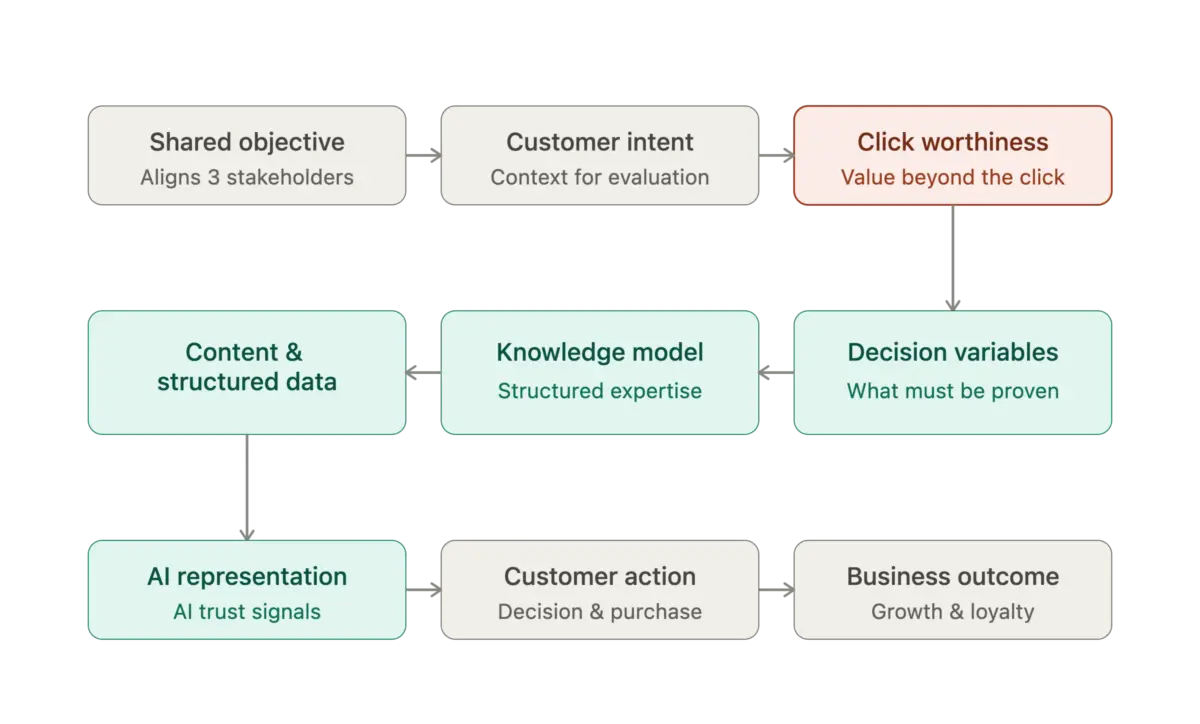
The breakdown in performance stems from a fundamental organizational issue: Accountability Silos.
When we categorized the missing information, it became clear that the responsibility for "Agent Readiness" spans departments that rarely coordinate on web infrastructure:
- Fulfillment: Owns pickup availability and delivery estimates.
- Legal/Customer Service: Owns return windows and used/open-box policies.
- Order Management: Owns cancellation logic.
The web team—the only ones currently focused on SEO and site performance—is tasked with the technical implementation of the storefront, but they lack the authority or the data to enforce business logic across the organization. Consequently, while the catalog is technically "ready," the commercial policy layer is invisible to the agent.
Crucially, our audit found that the UCP (Universal Commerce Protocol) currently lacks an operation to cancel or amend an order. The protocol defines a permission scope for these actions, but provides no actual execution method. This means even the most advanced AI agent on the market is currently impotent if a customer changes their mind post-purchase.
Future Outlook: Building for the Agentic Era
To transition from "brochure" to "agent-ready storefront," merchants and platforms must pivot their strategy.
What Shopify Must Prioritize:
- Standardized Policy Schemas: Shopify should push for a mandatory structured data format for returns, shipping cut-offs, and cancellation windows, moving this data out of prose and into machine-readable fields.
- Standardized Fulfillment Data: Integrating real-time pickup and local inventory data into the UCP would solve the "invisible pickup" problem that currently plagues retailers with physical footprints.
- Operational Hooks: Expanding the UCP order specification to include native, agent-callable cancellation and modification tools is the logical next step for the platform.
What Merchants Should Implement Immediately:
- The "Agent Query" Audit: Ecommerce teams should treat their site’s policy tool as a customer service representative. Run
curlrequests (as documented in our methodology) to see exactly what an agent receives when asking about shipping, returns, and cancellations. If the output is a link or a generic FAQ, the agent will fail the customer. - Structured Data Overload: Ensure all product variants, return windows, and shipping policies are expressed as structured data (JSON-LD or Schema.org). Do not rely on LLMs to "scrape and summarize" your policy pages; provide the raw data in a format the agent can query directly.
- Stable Inventory Identifiers: Avoid deleting and re-creating product IDs in your feed. When an ID changes, an agent’s historical context is destroyed. Keep inventory IDs stable to ensure that an agent can re-verify availability even after a delay.
Conclusion: The Decision-Making Frontier
The current state of agentic commerce is a triumph of infrastructure but a failure of logic. Shopify has done the heavy lifting of building the "callable" surface. However, "callable" is not the same as "completable."
For an agent to be truly useful, it needs to move beyond simple checkout execution. It needs the merchant’s internal rulebook: the nuances of "free returns coverage," the specific cut-off times for local pickup, and the reality of whether an item can be modified post-purchase.
As we move into late 2026 and beyond, the brands that win will be those that realize their website is no longer just a destination for humans, but an API for intelligent agents. The brochure era is ending. The era of the autonomous storefront requires an unprecedented level of data cleanliness and organizational alignment. The question for merchants is no longer "is my site ranked?" but "is my site intelligible?"
The infrastructure is ready. The data, however, is not. The race to fill that gap starts now.