Executive Overview
For nearly three decades, the foundational equation of the internet was delightfully straightforward: create a website, optimize it for search engines, capture the click, and convert the visitor. Organic search traffic served as the digital economy’s lifeblood, dictating marketing budgets, enterprise valuations, and the daily operations of millions of businesses worldwide. Today, that economic model is fundamentally broken.
Recent data reveals a jarring macroeconomic shift in digital marketing: AI crawlers, language model agents, and retrieval-augmented generation systems now visit corporate websites thousands, and sometimes tens of thousands, of times more frequently than they did just a few years ago. Yet, remarkably, they do not send back a single human visitor.
This decoupling of web traffic from web crawling signals the dawn of Answer Engine Optimization (AEO). In this new paradigm, consumers bypass traditional search engine results pages (SERPs) entirely. Instead, they turn to generative engines like ChatGPT, Perplexity, Claude, and Google AI Overviews to receive synthesized, conversational answers directly. Consequently, your next customer may never reach page one of Google, let alone visit your homepage.
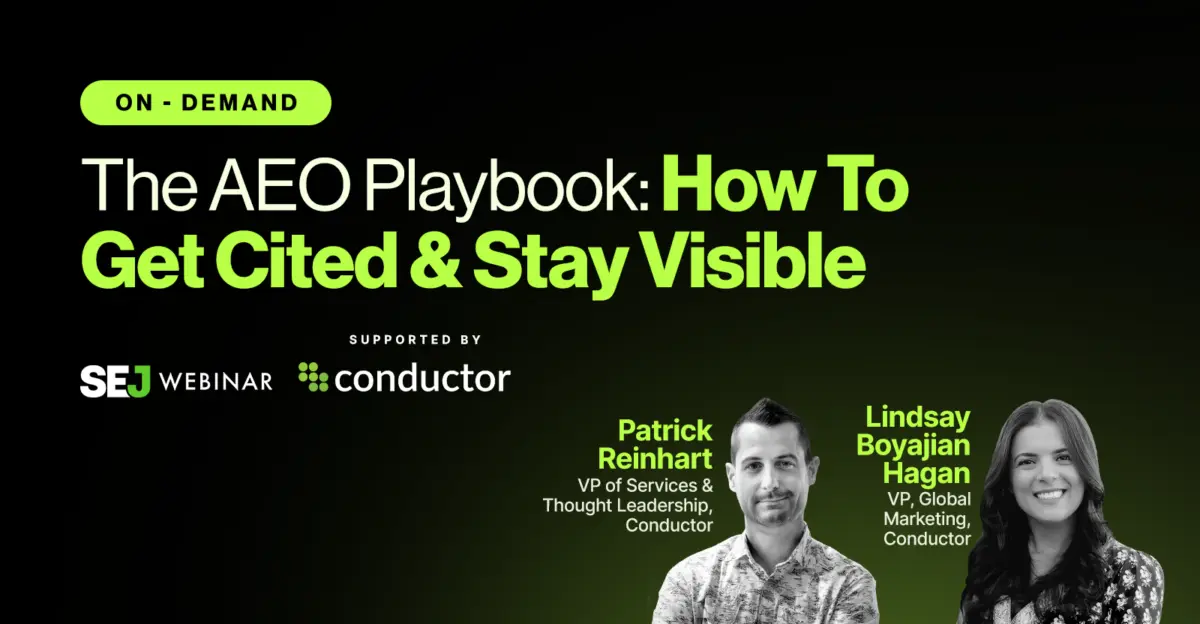
To unpack this seismic transition, Search Engine Journal recently hosted an exclusive webinar featuring Conductor executives Pat Reinhart, Vice President of Services and Thought Leadership, and Lindsay Boyajian Hagan, Vice President of Marketing. Together, they detailed the operational blueprint brands must adopt to survive and thrive in an ecosystem where visibility no longer depends on clicks, but on algorithmic citations.
Detailed Chronology of a Shift: How the Web’s Physics Changed
To understand the current crisis in organic traffic, marketing leaders must first recognize that the fundamental physics of the internet have been rewritten.
The Old Economic Model vs. The LLM Era
Historically, search engines operated on a transactional reciprocal model. Google’s crawlers would index a site, determine its relevance, and dispatch a human visitor via a blue hyperlink. For every crawl, a measurable trickle of traffic flowed back to the publisher.
In the era of Large Language Models (LLMs), that reciprocity has vanished. Automated bots scrape entire domains, parse unstructured data, ingest proprietary research, and train neural networks—all without driving a single session to the source. Conductor’s internal analysis of Google Search Console data illuminates this divergence vividly: impressions are steadily climbing to all-time highs, while organic clicks are experiencing a downward trajectory.
More consumers than ever are actively searching for solutions to complex problems. However, rather than navigating to external blogs, comparison sites, or corporate landing pages, they are reading the definitive answer generated directly inside the LLM surface.
During the webinar, Pat Reinhart addressed the uncomfortable truth facing executive boards and marketing analytics teams:
"The goal here is not traffic, because traffic is going to naturally go down as people are educating themselves on LLM surfaces."
This realization demands an immediate overhaul of corporate reporting structures. If CMOs continue to anchor their quarterly reviews and executive dashboards to organic sessions and pageviews, they are measuring success with a metric that no longer reflects reality. Modern digital leaders must transition their reporting toward share-of-voice, citation frequency, and brand sentiment metrics within AI ecosystems.
Supporting Context & Metrics: Navigating the New Rules of Discovery
As the mechanics of search evolve from keyword matching to contextual semantic synthesis, traditional search engine optimization (SEO) tactics are rapidly losing their efficacy. Brand survival now hinges on mastering three critical structural shifts: prompt dynamics, brand sentiment, and content gap exploitation.
1. The Death of the 4-Word Keyword
For over twenty years, keyword strategy was defined by brevity. Marketers chased high-volume, short-tail terms—typically running three to four words—such as "best running shoes" or "enterprise CRM software."
Generative AI has utterly shattered this constraint. According to Conductor’s data, the average AI prompt submitted by a modern buyer runs approximately 23 words. This dramatic expansion in query length carries profound implications for digital strategy.
A 23-word prompt is not merely a search string; it is a hyper-specific scenario. Consider the difference between a consumer typing "running shoes" into Google versus an AI user prompting: “I am a long-distance runner with wide feet who frequently trains on rough urban concrete and wet asphalt; what lightweight neutral shoe provides maximum arch support without causing blistering?”
A standard keyword strategy cannot capture this nuance. LLMs parse this rich context and recommend whichever brand has explicitly structured its digital footprint to answer those exact specificities. To win in this environment, brands must build a custom prompt index—mapping out the infinite variations of complex buyer scenarios before developing a single piece of content.
2. Moving from Mention to Recommendation
Not all citations carry equal weight. When an LLM references your brand, the context of that mention dictates its commercial value. Conductor maps brand citations across a spectrum, with the ultimate objective resting at the very top: a disproportionately positive recommendation.
It is one thing for ChatGPT to acknowledge that your software exists alongside twenty competitors; it is entirely another for the model to explicitly state, "For enterprise-grade security and automated workflows, Brand X is the leading authority and the most reliable solution in the category."
Achieving this level of endorsement requires treating brand sentiment as a core search problem. Interestingly, Conductor’s cross-platform data reveals a fascinating operational insight regarding where LLMs source their highest-authority validation: YouTube is currently the number one most-cited external domain across all major LLMs. Video content, rich transcripts, and multi-modal information are heavily favored by algorithmic models attempting to verify real-world utility and consumer trust.
3. Capitalizing on the Reddit Signal
One of the most counterintuitive findings presented during the webinar involves the sudden ubiquity of user-generated platforms like Reddit within AI answers. When an LLM cites a Reddit thread for a product category or technical problem that your brand should ostensibly own, it is sending a glaring distress signal.
Lindsay Boyajian Hagan clarified this mechanism for attendees:
"LLMs only really cite Reddit when there’s no other good source out there. So if you see Reddit, that’s a good indicator that the LLM is craving content."
Pat Reinhart reinforced this assessment bluntly, noting that AI systems are programmed to never return a blank response. If an LLM is forced to quote an anonymous discussion board, it proves that no corporate brand has produced a definitive, authoritative answer to the user’s prompt. For agile marketing teams, seeing Reddit cited in your industry vertical is an open invitation to dominate the conversation by publishing superior, structured, and factual content that the model can ingest and prioritize.
Official Statements and Strategic Insights
The transition from traditional SEO to Answer Engine Optimization has forced digital leaders to rethink long-held assumptions regarding technical optimization, content freshness, and domain authority. During the live Q&A session, Reinhart and Boyajian Hagan addressed the most pressing questions facing modern marketing teams.
On Tracking at Scale
When asked how marketing teams can possibly track brand recommendations across thousands of distinct AI prompts without drowning in data, Reinhart advised against total microscopic surveillance. Teams that break tracking down into manageable, digestible thematic chunks consistently outperform those that attempt to monitor everything simultaneously, which inevitably leads to analytical paralysis.
On Content Freshness and Update Strategies
Addressing the perennial question of whether digital marketers should artificially update publish dates on refreshed content to satisfy LLM freshness signals, Reinhart offered a performance-based rule of thumb: if a page consistently earns citations and high visibility, leave it be, regardless of its chronological age. Superficial date changes do not fool advanced retrieval algorithms; true contextual utility and continuous value addition are the only freshness signals that matter.
On the Irrelevance of Traditional Backlinks
Perhaps the most provocative statement of the session centered on the future of link building. While acknowledging that backlinks retain some historical utility for traditional search engine crawlers, Reinhart dismissed their importance for generative AI visibility:
"I don’t think backlinks have much importance at all. I haven’t built a link in like 20 years and I’ve never had a problem getting a site to rank."
Instead of obsessing over link equity, modern optimization requires focusing on structural clarity, schema markup, semantic richness, and direct brand authority across multi-channel ecosystems.
Future Outlook: The AEO Maturity Model
As digital discovery completes its migration toward generative engines, the commercial landscape will divide cleanly into two categories: visible authorities and the digitally invisible.
The integration of AI Overviews into standard search engine experiences means that even casual users are becoming accustomed to receiving complete, synthesized answers without ever clicking through to a publisher’s domain. For enterprise brands, mid-market companies, and nimble startups alike, the mandate is clear.
Success in the AEO era requires progressing through a defined maturity model:
- Auditing the AI Landscape: Abandoning short-tail keyword lists in favor of a comprehensive 23-word prompt index.
- Optimizing for Semantic Context: Restructuring existing digital assets—and expanding into high-authority formats like YouTube—to provide undeniable proof of category leadership.
- Closing the Content Gaps: Monitoring where LLMs are forced to rely on forums and user-generated discussions, and deploying authoritative brand content to capture those algorithmic openings.
- Transforming Analytics: Shifting executive scorecards away from vanity traffic metrics and toward AI share-of-voice, positive recommendation frequency, and sentiment analysis.
Brands that cling to the old economics of the internet will find themselves shouting into an empty void—getting crawled ten thousand times a day while watching their pipeline dry up. Those that adapt to the physics of Answer Engine Optimization will ensure that when the machine speaks, your brand is the only answer it delivers.