By: Jon Small
Edited by: Dan Bova
Published: November 13, 2026
Executive Overview
In a monumental shift that redraws the battle lines of the multi-billion-dollar food delivery industry, McDonald’s has officially designated Uber as its "preferred delivery partner" for all digital orders placed through the proprietary MyMcDonald’s app. This strategic alliance spans 14 major international markets, including the United
States, the United Kingdom, Canada, and France.
Until now, the fast-food titan notoriously divided its app-based delivery volume between its two primary logistics rivals: Uber and DoorDash. By handing the inside track exclusively to Uber for native app orders, McDonald’s has dealt a significant blow to DoorDash, altering the competitive landscape just as both tech giants aggressively maneuver for market share supremacy.
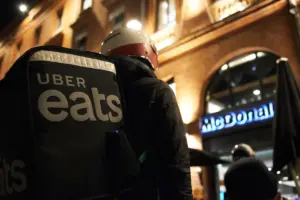
For the average consumer sitting at home craving a late-night Big Mac, a mid-day Quarter Pounder, or a post-work McFlurry, the operational transition will largely occur behind the scenes. When a customer launches the McDonald’s mobile application to order a meal for delivery, the logistical fulfillment will default predominantly to the Uber platform, executed by an Uber courier.
However, the implications of this agreement extend far beyond the logistics of dropping off a bag of fries. The deal establishes Uber as the exclusive delivery and rideshare rewards partner for the fast-food behemoth. Under this umbrella, loyalty program participants can directly cross-pollinate their consumer habits, trading their MyMcDonald’s Rewards points for lucrative discounts on Uber rides.
Crucially, this partnership unlocks direct access to more than 45 million U.S. loyalty program members for Uber—a massive, high-intent consumer base that the rideshare and delivery titan can leverage in its ongoing, ferocious war against DoorDash. According to recent market data from Consumer Edge, DoorDash maintains a formidable grip on the sector, controlling roughly 59% of total delivery-app spending in the United States.
This alliance is not an isolated business transaction; it is a calculated salvo fired amidst an escalating corporate arms race. Just weeks prior to this announcement, DoorDash made headlines with its ambitious plans to acquire Instacart. Uber, refusing to cede ground, countered swiftly with a high-profile Amazon Prime delivery integration. Now, by locking in the world’s largest fast-food restaurant chain as a preferred partner, Uber has cemented its offensive strategy, setting the stage for a dramatic reshaping of how global consumers interact with convenience technology.
Detailed Chronology: How the McDonald’s-Uber Deal Came Together
To understand the magnitude of the November 2026 announcement, one must trace the evolutionary arc of the relationship between global quick-service restaurant (QSR) leaders and third-party delivery aggregators.
The Early Days of Digital Fragmentation
When food delivery apps first exploded into the mainstream consciousness during the mid-2010s, McDonald’s initially took a cautious, exclusive approach with select providers. However, as the market matured and consumer expectations shifted toward ultimate convenience during and after the global pandemic, McDonald’s recognized the danger of tying its brand exclusively to a single logistics pipeline.
To maximize geographic coverage, speed, and reliability, the fast-food giant adopted a multi-app strategy. When customers used the official MyMcDonald’s app, their orders were routed dynamically behind the scenes to whichever delivery fleet—whether Uber Eats or DoorDash—could fulfill the request most efficiently. This fragmented approach insulated McDonald’s from dependency on a single platform, but it left the delivery giants constantly fighting for a larger share of the Golden Arches’ massive order volume.
The Strategic Pivot
Behind closed doors throughout much of 2026, leadership teams at McDonald’s corporate headquarters in Chicago began re-evaluating the operational friction and missed cross-promotional opportunities of a split-delivery model. As loyalty programs became the holy grail of retail and restaurant retention, executives realized that deeply integrating an ecosystem-wide rewards platform would yield higher customer lifetime value than a generalized, fragmented logistics approach.
Conversations intensified between McDonald’s global digital strategists and Uber executives, focusing on how to seamlessly merge food delivery fulfillment with broader consumer lifestyle services, such as rideshare mobility. By consolidating preferred status onto a single platform across 14 key international territories, McDonald’s could streamline its technological integrations, negotiate better enterprise terms, and offer its massive customer base unified perks.
The November 2026 Unveiling
The culmination of these quiet negotiations broke into public view in early November 2026, when international financial outlets, spearheaded by Bloomberg, reported that McDonald’s was poised to crown Uber its sole preferred partner for native app orders.
By November 13, 2026, the deal was official, sending shockwaves through Wall Street and Silicon Valley. While the ink dried on the multi-country agreement, industry analysts immediately began picking apart the strategic fallout for DoorDash, which found itself edged out of its prized co-exclusive arrangement within the world’s most popular fast-food app.
Supporting Context & Metrics: The High-Stakes Delivery Wars
The timing of McDonald’s partnership with Uber is far from coincidental; it is a direct reflection of a hyper-competitive delivery market characterized by aggressive consolidation, technological diversification, and relentless battle for consumer wallet share.
Market Share Realities
To grasp why this deal is such a monumental coup for Uber, one must examine the macroeconomic data of the food delivery sector. According to comprehensive market intelligence data provided by Consumer Edge, DoorDash remains the undisputed heavyweight champion of the U.S. delivery-app economy, commanding an imposing 59% market share of total app spending.
Uber Eats, while a formidable global player with a robust international footprint, has continually fought to close this gap in its home market. By securing preferred status for McDonald’s native app orders—and thereby tapping directly into an engaged pool of over 45 million U.S. loyalty members—Uber gains a high-volume pipeline that can sustainably siphon order frequency away from competing platforms.
It is worth noting structural nuances: everyday consumers will still be able to open the standalone Uber Eats app or the DoorDash app and order a McDonald’s meal directly from those third-party marketplaces. However, capturing the native ecosystem—the orders initiated directly inside the MyMcDonald’s app—represents the pinnacle of brand-loyal transaction volume, carrying lower customer acquisition costs and higher margins.
The Escalating Corporate Arms Race
The delivery wars of late 2026 are escalating into a broader battle for digital lifestyle dominance. Every major player is aggressively expanding its perimeter to capture adjacent consumer spend:
- DoorDash’s Aggressive Moves: In late October 2026, DoorDash stunned the retail and tech sectors by announcing expansive plans to acquire Instacart, a move designed to consolidate grocery delivery dominance and cross-sell restaurant options to household shoppers.
- Uber’s Counter-Offensives: Refusing to be outmaneuvered, Uber launched a landmark strategic integration earlier this month with Amazon Prime, embedding rideshare and delivery perks deeper into the world’s largest e-commerce subscription ecosystem.
- The Loyalty Economy: In this climate of tit-for-tat corporate dealmaking, the McDonald’s partnership serves as Uber’s strategic anchor. By bridging MyMcDonald’s Rewards with Uber One and Uber rideshare credits, Uber is constructing a defensive moat that locks consumers into a circular ecosystem of eating, traveling, and shopping.
Official Statements and Industry Perspectives
The announcement drew immediate commentary from executive leadership, highlighting the profound operational scale and strategic vision underpinning the agreement.
Addressing the media and investors, Andrew Macdonald, President and Chief Operating Officer of Uber (noting for the record that he shares no familial relation to the fast-food chain), did not mince words regarding the scale of the achievement.
"This marks our broadest expansion with McDonald’s to date," Macdonald stated, emphasizing the complex international coordination required to roll out the preferred partner framework across 14 diverse regulatory and consumer markets simultaneously.
From McDonald’s perspective, the decision to streamline app delivery is anchored in elevating the digital customer experience. While corporate representatives have kept detailed financial terms of the multi-year agreement confidential, executive disclosures emphasize that the partnership is designed to reduce friction in order fulfillment while supercharging the utility of the MyMcDonald’s loyalty ecosystem.
Independent retail analysts have universally praised the move for both brands. By aligning with Uber’s expanding ecosystem—which now touches everything from local grocery drop-offs and retail partnerships to global mobility and Amazon Prime integrations—McDonald’s ensures its digital infrastructure remains at the absolute cutting edge of QSR technology.
Future Outlook: What This Means for Your Next McFlurry Order
As the dust settles on this landmark agreement, what does the future hold for everyday consumers, delivery drivers, and the broader competitive landscape?
1. The Consumer Experience
For the average customer, the shift will feel seamless, yet deeply rewarding over time. If you habitually order through the MyMcDonald’s app, you will increasingly see your meals delivered by Uber couriers. More importantly, as the cross-platform rewards integration rolls out more broadly, loyal fast-food consumers will find themselves accumulating points that translate directly into savings on their daily commutes via Uber rides or discounted weekend trips. The friction between ordering dinner and booking a ride home is officially dissolving.
2. The Driver Ecosystem
For delivery workers and rideshare drivers operating on the Uber platform, this deal translates to a substantial, steady influx of high-frequency order volume. McDonald’s is arguably the most ubiquitous pickup destination in the world; cementing preferred status means a predictable, continuous stream of delivery ping notifications, bolstering earning potential for drivers navigating an increasingly competitive gig economy.
3. The Broader Market Battle
Looking ahead into the remainder of 2026 and into 2027, DoorDash will undoubtedly feel pressure to respond to Uber’s entrenchment with the Golden Arches. As the boundaries between restaurant delivery, grocery retail, and mobility services continue to blur, standalone apps are no longer enough. Ecosystems are winning the day.
The partnership between McDonald’s and Uber is a watershed moment proving that in the modern digital economy, scale, loyalty integration, and strategic alliances dictate the winners and losers. For your next late-night craving or afternoon McFlurry, the yellow "M" on your phone screen is now inextricably linked to the black-and-teal Uber interface—marking a new era of convenience delivery supremacy.