Executive Overview
The rapid transition of Large Language Models (LLMs) from experimental novelties to enterprise-grade production infrastructure has exposed a massive engineering blind spot: how we test software does not match how LLMs behave.
Traditional software engineering relies on deterministic unit tests. Programmers write code, assert precise inputs and outputs, and expect exact parity across thousands of build runs. However, LLMs are inherently probabilistic, context-dependent, and non-deterministic. A minor prompt edit, a foundational model swap, or a subtle change to a retrieval database can quietly fracture application performance without throwing a syntax error. By the time end-users discover these regressions, troubleshooting the root cause becomes an expensive archaeological dig.
LLM evaluation bridges this gap, acting as a rigorous regression-testing loop adapted specifically for outputs that vary on every execution. By transforming ad-hoc spot-checking into systematic data-driven pipelines—complete with automated test cases, calibrated scorers, and continuous tracking—engineering teams can catch degradations before they ever reach production. This guide explores the end-to-end framework of evaluating LLM applications, from choosing foundational scorers and designing reliable LLM judges to auditing Retrieval-Augmented Generation (RAG) architectures and complex multi-turn AI agents across the release lifecycle.
Detailed Chronology & Structural Evolution of LLM Testing
To understand modern LLM evaluation, we must examine how testing methodologies have evolved alongside the capabilities of generative architectures.
Phase 1: The Era of Ad-Hoc Spot-Checking
In the early days of prompt engineering, validation was entirely qualitative. Developers manually queried a chat interface, read three or four outputs, and decided if the model "looked fine." This approach works during local prototyping, but collapses at scale. Because natural language admits countless paraphrases, human spot-checking is fundamentally subjective and unscalable. An answer such as "You can return shoes within 30 days" and "Returns are accepted for a month after delivery" are semantically identical, but automated string-matching tests would fail one of them.
Phase 2: Static Overlap Metrics (BLEU, ROUGE, and Exact Match)
Recognizing the limitations of human inspection, early pipelines imported traditional natural language processing (NLP) metrics like BLEU, ROUGE, and exact string matching. While these metrics successfully automated testing, they fundamentally misunderstood semantic nuance. Overlap metrics count shared $n$-grams against a reference string. Consequently, a brilliant, highly accurate paraphrase of a reference text routinely scores poorly simply because it uses different vocabulary. Conversely, grammatically flawed text that happens to recycle keywords can achieve high scores.
Phase 3: Embedding-Based and Semantic Similarity Metrics
The introduction of dense embedding models—such as BERTScore and cosine similarity metrics over vector spaces—marked a major leap forward. By comparing the directional vector embeddings of tokens rather than their literal character strings, these systems began to accurately capture paraphrasing and semantic equivalence. Yet, they still hit a hard ceiling: they require a strict ground-truth reference and remain entirely blind to subjective nuances like tone, contextual safety, or whether a specific factual claim is genuinely supported by an underlying source document.
Phase 4: The Modern Era of LLM-as-a-Judge and Programmatic Evaluators
Today, the industry has standardized around a multi-layered evaluation stack. Recognizing that language models themselves are uniquely equipped to evaluate linguistic nuance, engineers now deploy programmatic code assertions alongside sophisticated "LLM-as-a-Judge" systems, Question-Answer Generation (QAG) frameworks, and G-Eval probability-weighted metrics. Testing is no longer treated as a post-deployment gate, but as a continuous, automated regression pipeline running across pull requests and live production traffic.
Supporting Context & Core Framework Components
Every robust evaluation pipeline is built upon three foundational pillars: a curated dataset of inputs, objective scorers that grade outputs, and a centralized historical record tracking score shifts over time.
1. Choosing the Right Scorers
A scorer evaluates a specific test case (input, output, and optional context or reference text) and returns a quantitative or qualitative verdict. Scorers generally fall into three categories:
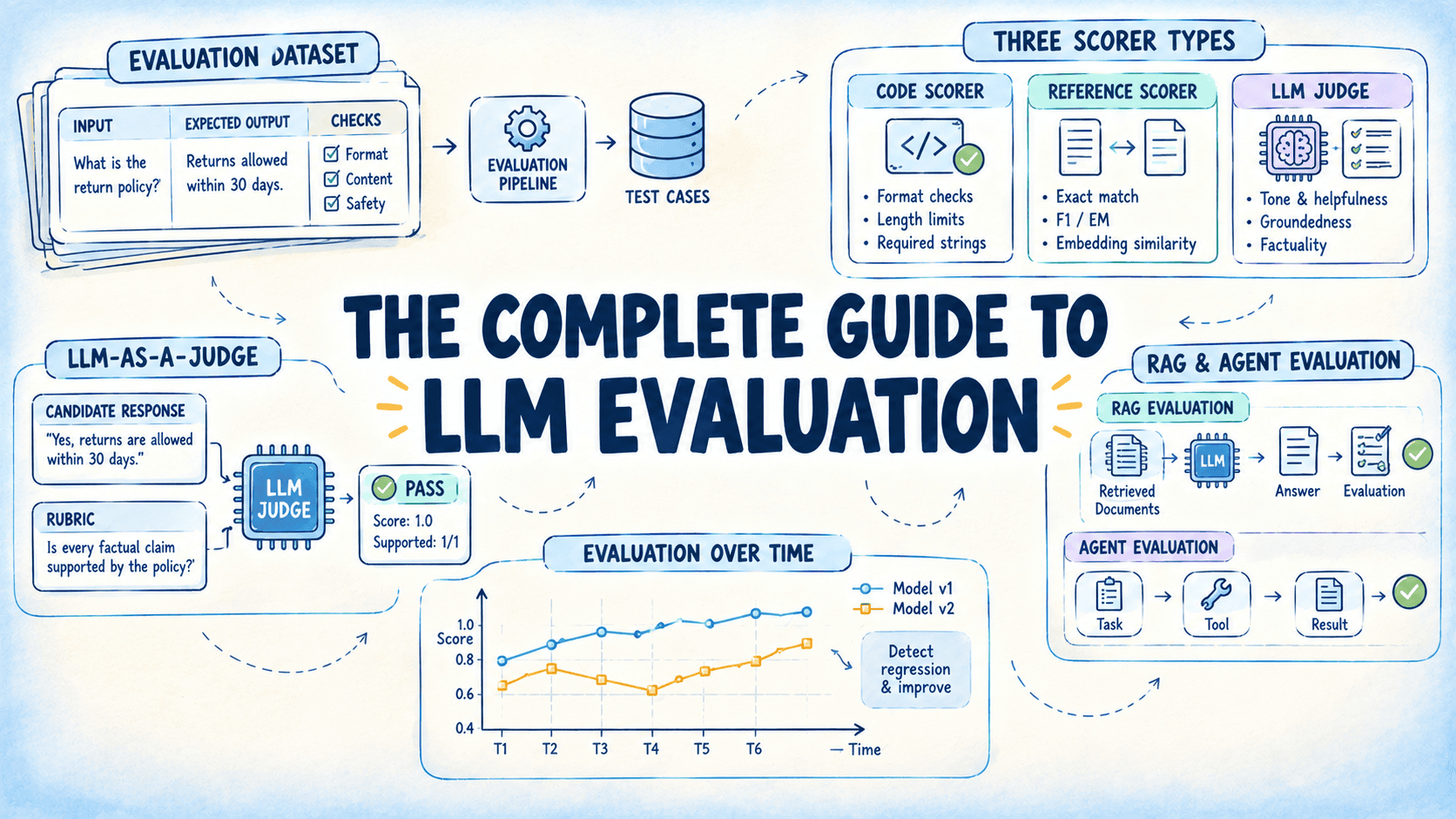
| Scorer Category | Grading Mechanism | Best Suited For | Real-World Example |
|---|---|---|---|
| Code Scorers | Deterministic logic & regex | Strict formats, length constraints, required strings | Verifying valid JSON parsing, or ensuring output is under 120 words. |
| Reference-Based | Comparison against known answers | Objective queries with single, definitive correct facts | Exact match, token F1-score, embedding cosine similarity. |
| LLM Judge | Model-driven rubric application | Subjective qualities like tone, helpfulness, and groundedness | "Is every factual claim in the response directly supported by the provided context?" |
Engineering Best Practice: Always prioritize code scorers wherever a hard rule applies. They cost nothing, execute instantly, and return 100% deterministic results. Reserve expensive LLM judges exclusively for complex criteria that deterministic rules cannot express.
2. Mastering LLM-as-a-Judge Setups
When deploying an LLM as a judge, its role is vastly narrower than a general-purpose generator: it reads a structured rubric and a candidate answer, and then emits a strict verdict. To ensure these judges do not fall victim to vague criteria, their prompts must be meticulously engineered to include four non-negotiable components:
- A precise definition of the evaluation criterion.
- Explicit inputs the judge is permitted to access.
- A step-by-step reasoning procedure.
- A strict, machine-readable output format (e.g., JSON).
Consider the following production-grade implementation of a faithfulness judge for a customer-support policy bot:
import json

RUBRIC = """You are grading a customer-support answer for faithfulness.
Policy: context
Question: input
Answer: answer

Steps:
1. List each factual claim in the Answer.
2. For each claim, decide whether the Policy supports it.
3. Verdict: PASS if every claim is supported, otherwise FAIL.

Respond with JSON only:
"claims": ["text": "...", "supported": true], "verdict": "PASS""""

def judge(case, answer):
    response = call_llm(RUBRIC.format(answer=answer, **case), temperature=0)
    return json.loads(response)
By forcing the model to generate its step-by-step reasoning (claims) before outputting the final verdict, the judge conditions its decision on explicit evidence. Furthermore, setting the sampling temperature=0 reduces sampling noise, though floating-point nondeterminism across API providers can still occasionally cause edge-case flips. For critical safety criteria, running an odd number of judge passes and taking the majority vote eliminates residual variance.
3. Advanced Evaluation Techniques: QAG and G-Eval
Asking an LLM to "rate this answer from 1 to 10" yields notoriously unstable results because models lack a stable internal numerical scale. Advanced frameworks solve this through structured design patterns:
- Question-Answer Generation (QAG): Instead of asking for arbitrary numbers, the judge evaluates closed yes/no questions derived from individual factual claims. The mathematical score is then calculated deterministically via code:
$$textScore = fracsum textsupported claimstexttotal claims$$
This confines the LLM to pure classification—a task language models perform with maximum reliability. - G-Eval: Designed for subjective criteria like coherence or narrative flow where discrete claims cannot be counted, G-Eval uses an automatic chain-of-thought prompt to decompose criteria into step-by-step pipelines. It computes the final score via a probability-weighted summation of output token log-probabilities (e.g., tokens 1 through 5). This prevents the model from collapsing onto a single favorite number and provides granular resolution (e.g., a score of 4.4 instead of a blunt 4).
4. Mitigating LLM Judge Biases
Research consistently documents systemic cognitive biases in LLM judges, including:
- Position Bias: In pairwise comparisons ("Is A or B better?"), judges routinely favor whichever answer appears first. Mitigation: Run every comparison twice with swapped positions and discard any trial where the verdicts do not invert.
- Verbosity Bias: Judges frequently conflate longer, more complex answers with higher quality, rewarding fluff. Mitigation: Explicitly append "Do not reward length" to your rubric and test against length-matched datasets.
- Self-Enhancement Bias: Models tend to award higher scores to outputs generated by models from the same architectural family. Mitigation: Always utilize a judge model from a completely different model family than the system under test.
To guarantee reliability, teams must calibrate their judges against human labels. Label a golden set of 30 to 50 outputs manually, run your automated judge across the exact same set, and measure alignment using Cohen’s Kappa ($kappa$):
from sklearn.metrics import cohen_kappa_score
kappa = cohen_kappa_score(human_labels, judge_labels)
A kappa score above $0.6$ indicates substantial inter-rater agreement. If kappa is low, inspect the disagreements, refine your prompt rubric, and treat your labeled set as a permanent regression test suite for the judge itself.
Evaluating RAG Systems and AI Agents
Complex architectures like Retrieval-Augmented Generation (RAG) and autonomous AI agents require specialized, decoupled evaluation strategies.
Deconstructing RAG Performance
A RAG system couples a retriever (which fetches context) with a generator (which drafts the response). Because these components fail independently, they must be scored separately:
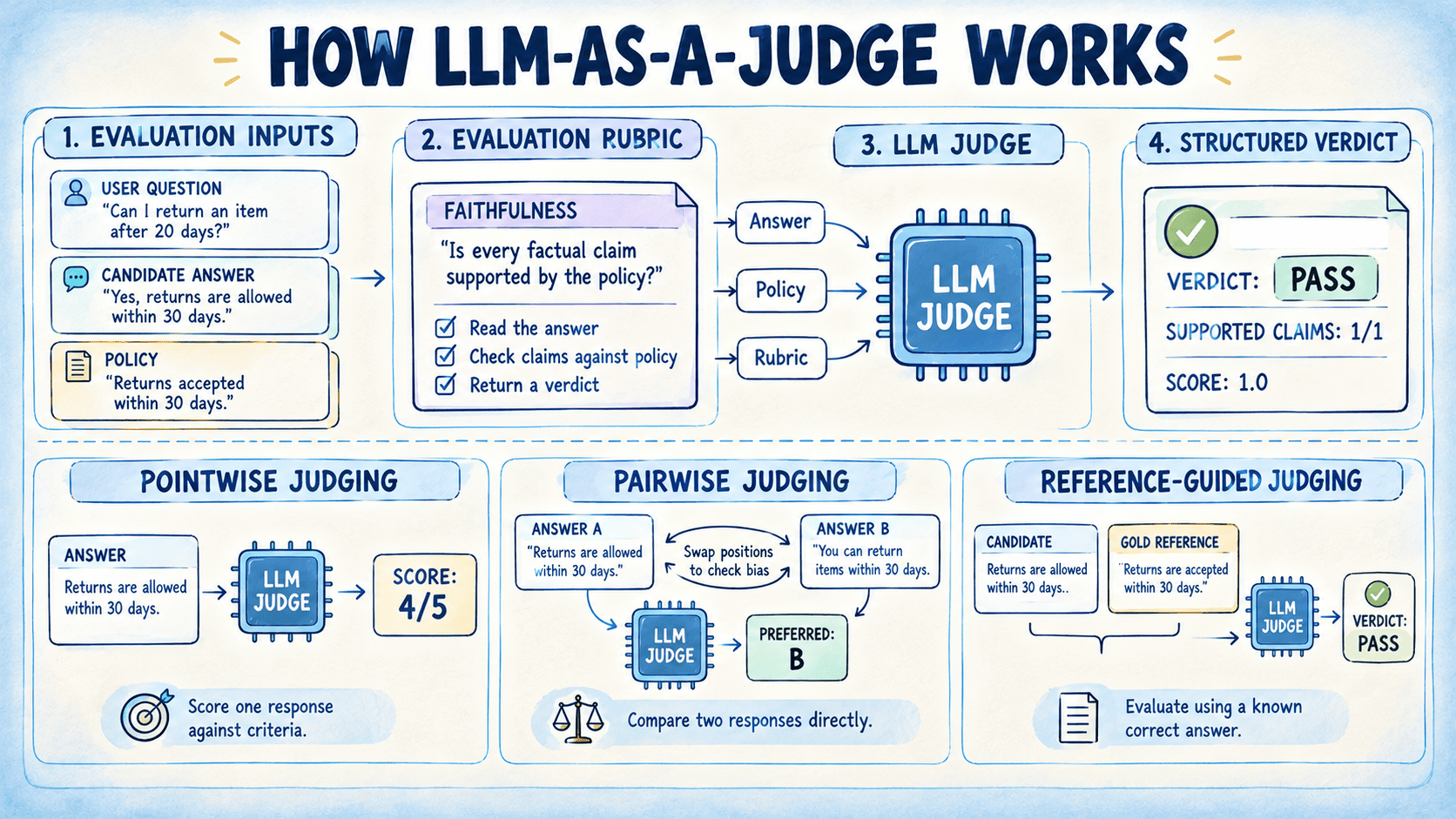
- Retriever Evaluation:
- Context Precision: What fraction of the retrieved documents are actually relevant to the query?
- Context Recall: Did the retrieval engine fetch all necessary documents required to answer the query?
- Generator Evaluation:
- Faithfulness: Are all claims in the generated answer strictly backed by the retrieved context? (Prevents hallucinations).
- Answer Relevance: Does the final output directly address the user’s original prompt without drifting?
When faithfulness is high but context recall is low, the generation model is remaining grounded in insufficient data—meaning you must fix your retrieval pipeline. Conversely, high precision paired with low faithfulness indicates that the retriever fetched pristine documents, but the generator hallucinated claims outside the source text, pointing to a prompt or model tuning failure.
Evaluating Agents and Multi-Turn Conversations
Autonomous AI agents introduce tool-calling, iterative planning, and execution loops. Evaluation must expand beyond single-turn responses to measure holistic task completion:
- Task Completion Rate: Did the agent successfully achieve the user’s underlying goal, or did it return fluent, polite replies while leaving support tickets unresolved?
- Tool Correctness: Did the agent select the correct API or tool for the sub-task?
- Argument Correctness: Did the agent pass accurately formatted parameters and arguments into those tools?
- Trajectory Efficiency: How many unnecessary loops, dead-ends, or redundant tool calls did the agent execute before arriving at a solution?
Running Evaluations Across the Release Cycle
An evaluation framework is only as valuable as its integration into the software deployment lifecycle.
1. Offline Evaluation (Pre-Shipment)
Before merging code to production, engineering teams must execute an offline test suite against a versioned "golden dataset" consisting of 25 to 50 representative queries. This dataset must cover normal operational requests, adversarial injections, structural edge cases, and off-topic queries the bot is explicitly programmed to decline.
Release criteria should be written directly into CI/CD pipelines (e.g., GitHub Actions): defining minimum passing score thresholds, enforcing a maximum allowable regression against the current production baseline, and demanding 100% clearance on safety guardrails before a pull request can be merged.
2. Online Evaluation (Post-Shipment)
Once code ships, continuous online evaluation samples live production traffic. Operating via reference-free checks (measuring real-time faithfulness, tone adherence, formatting compliance, execution latency, and token cost), online monitoring captures edge cases that offline datasets never anticipated. Every production failure discovered via online monitoring should be instantly converted into a new test case within your offline golden dataset, ensuring your evaluation suite grows smarter with every user interaction.
Summary & Strategic Implementation Matrix
To operationalize LLM evaluation successfully, engineering teams should follow this structured implementation matrix across their deployment lifecycle:
| Stage | Operational Action | Recommended Metrics & Techniques |
|---|---|---|
| Scorer Selection | Deploy code rules where deterministic logic applies; reserve reference-based checks and LLM judges for semantic tasks. | Regex/Schema validation, Exact Match, F1, LLM Judge. |
| Judge Rubric Design | Define explicit criteria, allowed inputs, step-by-step instructions, and strict JSON output formats. | Temperature set to 0; majority voting across odd-numbered runs. |
| Judge Scoring Design | Decompose complex criteria into checkable facts, graded scales, or pairwise comparisons. | QAG (supported claims ratio), G-Eval (probability-weighted scoring), Position-Swapped Pairwise. |
| Judge Calibration | Audit judge alignment against human-labeled benchmark datasets. | Cohen’s Kappa ($kappa > 0.6$), cross-family model selection, position swap validation. |
| RAG Auditing | Discouple retriever performance diagnostics from generator evaluation. | Context Precision, Context Recall, Faithfulness, Answer Relevance. |
| Agent Testing | Audit overarching task completion prior to inspecting intermediate agent behaviors. | Tool Selection Correctness, Argument Validity, Trajectory Efficiency. |
| Offline Pipelines | Execute versioned golden test suites within automated CI/CD pull request gates. | 25–50 curated golden cases, holdout sets, strict regression limits. |
| Online Monitoring | Audit live production streams to catch distribution drift and novel adversarial inputs. | Reference-free faithfulness, latency tracking, cost monitoring, automated failure-to-dataset ingestion. |
By treating LLM evaluation with the same engineering rigor traditionally reserved for mission-critical backend software, organizations can tame probabilistic outputs, eliminate silent regressions, and ship reliable, enterprise-ready AI applications with absolute confidence.