Executive Overview
For many engineering teams, the introduction of vector search into an architecture happens on a quiet Tuesday afternoon. A developer issues a single CREATE EXTENSION command on an existing PostgreSQL database. Suddenly, relational data and high-dimensional embeddings share the same table rows. A single SQL query seamlessly executes both metadata filtering and approximate nearest-neighbor (ANN) similarity search.
For months, this setup handles the workload gracefully. Then, the inevitable vendor pitch arrives in the inbox, warning that the organization is hurtling toward a performance wall. The sales pitch insists that maintaining scale requires an immediate migration to a “real,” purpose-built vector database. Rarely do these competing claims come accompanied by empirical benchmarks or reproducible data; they rely instead on intuitive assertions and enterprise confidence.
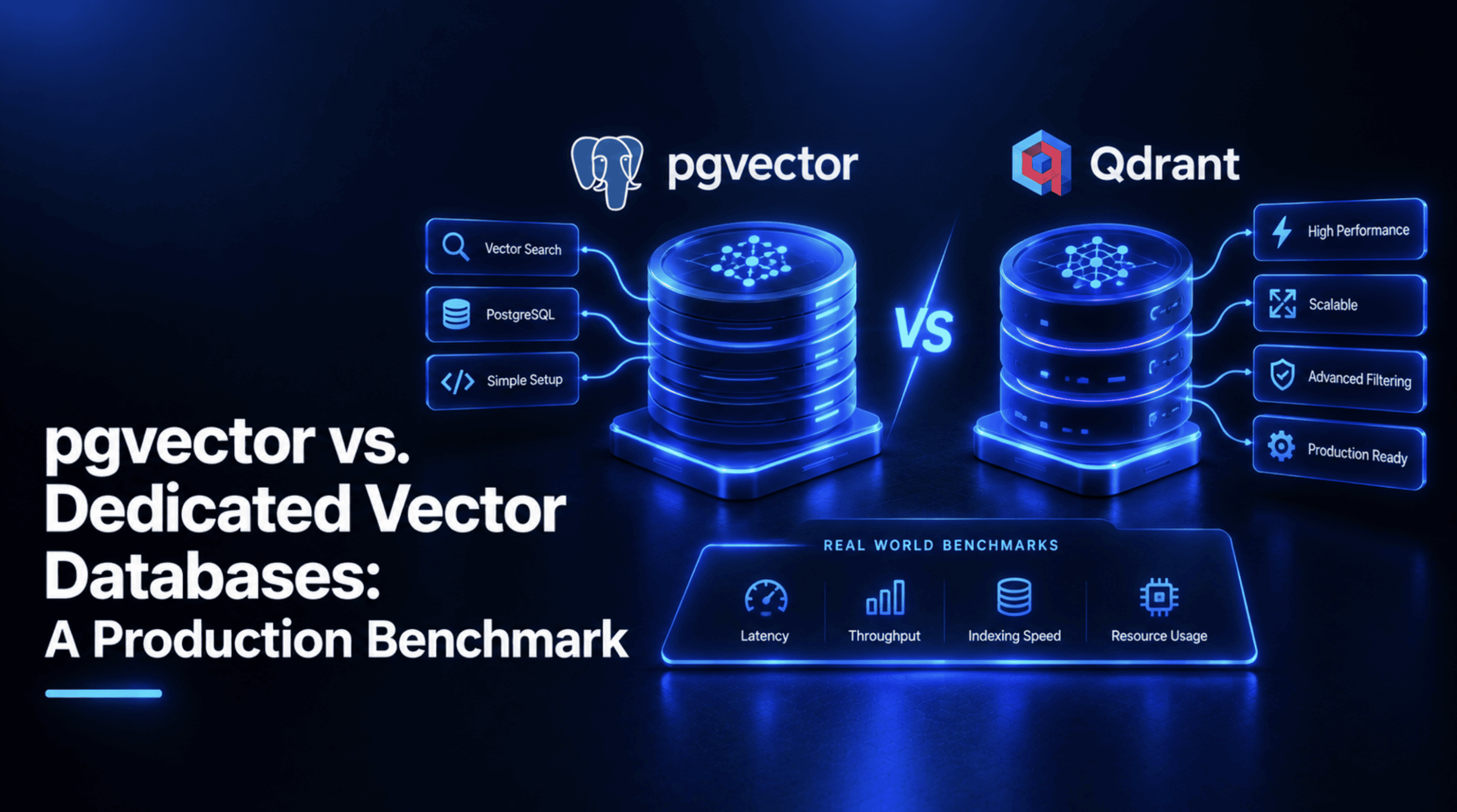
This information vacuum—where strong opinions outnumber hard numbers—prompted a definitive investigation. By measuring pgvector against a dedicated, purpose-built engine (Qdrant) under both local and production-grade environments, this article strips away the marketing hype. The empirical data reveals a nuanced architectural reality: neither tool is universally superior. Instead, engineering teams face a pragmatic trade-off between transaction-safe relational unification and purpose-built tail-latency optimization.
Detailed Chronology of the Vector Search Architectural Divide
The evolution of vector search mirrors the broader history of data management specialization. When generative artificial intelligence and large language models (LLMs) catalyzed the demand for semantic search, retrieval-augmented generation (RAG), and recommendation systems, the industry faced an immediate technical constraint: traditional relational databases were not engineered to index multi-thousand-dimensional floating-point vectors efficiently.
Phase 1: The Rise of Purpose-Built Silos
In the early wave of the generative AI boom, the default architectural paradigm favored dedicated vector databases. Startups and enterprise teams alike spun up separate services—such as Pinecone, Qdrant, Weaviate, and Milvus—to handle embeddings.
While these platforms provided optimized storage engines, advanced metadata filtering, and specialized HNSW (Hierarchical Navigable Small World) indexing out of the box, they introduced a major systemic tax: dual-database architectures. Maintaining a distinct vector database alongside a primary relational database (such as Postgres or MySQL) required complex synchronization pipelines, dual-write transaction management, independent backup strategies, and additional network hops for every unified query.
Phase 2: The pgvector Counter-Revolution
Recognizing the friction of managing distributed polyglot persistence layers, the open-source community rallied around pgvector. Initially released to bring vector similarity search directly into the world’s most popular open-source relational database, pgvector matured rapidly.
By version 0.8.6 and supporting PostgreSQL 13 through 17, pgvector introduced native vector column types, exact and approximate nearest-neighbor search, and broad distance metric support (L2, inner product, cosine, L1, and Hamming). By co-locating embeddings with relational records in the same row, pgvector eliminated synchronization drift and allowed developers to execute complex joins and similarity searches within a single ACID-compliant transaction.
Phase 3: The Empirical Reckoning
As production workloads scaled from thousands to tens of millions of vectors, the architectural debate intensified. Vendors argued that general-purpose databases would inevitably buckle under memory pressure and CPU-bound index traversal during high-concurrency queries. Conversely, database traditionalists maintained that modern hardware and specialized extensions (such as pgvectorscale) rendered separate vector databases redundant for the vast majority of enterprise use cases.
Supporting Context & Metrics: A Hands-On Local Benchmark
To understand the operational mechanics of both approaches, we can construct a reproducible local benchmark comparing pgvector (running on PostgreSQL 17 via Docker) against a containerized instance of Qdrant.
The Experimental Setup
- Environment: Local machine running Docker and Docker Compose, Python 3.10+, allocating 8GB of RAM.
- Dataset: 100,000 synthetic vectors at 1,586 dimensions (matching OpenAI’s
text-embedding-3-smallstandard), normalized to unit length for accurate cosine distance comparison. - Indexing Strategy: HNSW indexes configured with identical hyperparameters (
m = 16,ef_construction = 64) to ensure a fair algorithmic comparison.
# snippet: synthetic vector generation and normalization
import numpy as np

NUM_VECTORS = 100_000
DIM = 1536
rng = np.default_rng(seed=42)
vectors = rng.normal(size=(NUM_VECTORS, DIM)).astype(np.float32)
vectors /= np.linalg.norm(vectors, axis=1, keepdims=True)
Both systems ingest the dataset smoothly. When querying these systems locally with a held-out set of 200 query vectors, both pgvector and Qdrant return results in the low single-digit to tens of milliseconds range.
However, this local exercise reveals an important truth: 100,000 vectors on a laptop is too small a scale to drive production decisions. At this volume, both systems perform so efficiently that the underlying performance delta is negligible. Real architectural bottlenecks only emerge when data volumes and concurrency reach true production scale.
Production-Scale Performance Analysis
To evaluate how these architectures perform under genuine enterprise pressure, we examine independent, methodology-transparent benchmark data (such as Tiger Data’s rigorous evaluation of 50 million Cohere embeddings at 768 dimensions on matched AWS r6id.4xlarge hardware).
Note on Methodology: The PostgreSQL implementation in these large-scale benchmarks utilized pgvector plus pgvectorscale, an extension incorporating the StreamingDiskANN index. This distinction is vital; vanilla pgvector and pgvector augmented with Timescale’s indexing extensions exhibit different performance characteristics.
| Performance Metric | pgvector + pgvectorscale (99% Recall) | Qdrant (99% Recall) |
|---|---|---|
| p50 Latency | 31.07 ms | 30.75 ms |
| p95 Latency | 60.42 ms | 36.73 ms |
| p99 Latency | 74.60 ms | 38.71 ms |
| Throughput | 471.57 QPS | 41.47 QPS |
| Index Build Time (50M) | 11.1 hours | 3.3 hours |
Analyzing the Trade-Offs
The empirical data shatters the binary narrative that one system is universally superior. Instead, it highlights a classic systems-engineering compromise:
- Throughput Victory for pgvector: At 99% recall, PostgreSQL paired with pgvectorscale delivered 11.4 times the query throughput of Qdrant (471.57 QPS vs. 41.47 QPS). For applications bound by read concurrency and heavy batch processing, the relational ecosystem demonstrates remarkable leverage.
- Tail-Latency Advantage for Qdrant: Conversely, Qdrant maintained a decisive edge in tail latency. Its p99 latency was 48% faster (38.71ms vs. 74.60ms), ensuring that outlier queries under high load experienced significantly less jitter. Furthermore, Qdrant constructed its HNSW index roughly 3.4 times faster than the Postgres-based configuration.
Crucially, both systems successfully maintained all measured latency percentiles under 100 milliseconds at 99% recall across a 50-million-vector corpus. This proves definitively that a relational database can operate effectively at multi-million-vector scales without collapsing.
Official Guidelines: When to Choose Which Architecture
Choosing between pgvector and a dedicated vector database should never be driven by marketing narratives. Instead, architectural decisions must map directly to workload requirements, operational maturity, and data scale.
When pgvector is the Right Choice
- Scale Under 5 to 10 Million Vectors: For the vast majority of applications, data volumes do not exceed single-digit millions. On competent hardware, pgvector handles this scale effortlessly.
- Transactional Consistency (ACID): If your application requires atomic updates—such as modifying a user record and their associated embedding in a single database transaction—pgvector eliminates the possibility of distributed race conditions and sync drift.
- Existing PostgreSQL Infrastructure: Organizations that already employ DBA teams experienced in tuning, backing up, and monitoring PostgreSQL can add vector search via an extension without expanding their operational footprint.
- Moderate Concurrency Profiles: Workloads characterized by steady, predictable query volumes rather than tens of thousands of concurrent search requests per second fit naturally within Postgres’s process model.
When to Reach for a Dedicated Vector Database
- Massive, Hyper-Scale Corpora: When datasets scale to hundreds of millions or billions of vectors, purpose-built distributed systems (such as Milvus or Qdrant) distribute storage and memory overhead more efficiently.
- Strict Tail-Latency SLAs under Heavy Filtering: If your application enforces rigid sub-40ms p99 latencies while executing complex, highly restrictive metadata filters concurrently, purpose-built engines maintain superior performance stability.
- GPU-Accelerated Indexing Requirements: Organizations seeking hardware acceleration for massive index construction pipelines will find native support in dedicated distributed engines like Milvus.
- Zero-Ops Infrastructure Preferences: Teams lacking dedicated database administration bandwidth often benefit from fully managed, serverless vector databases (such as Pinecone) that abstract away operational maintenance entirely.
Future Outlook
The boundary between relational databases and specialized data stores continues to blur. As PostgreSQL extensions evolve and vector indexing algorithms become more memory-efficient, general-purpose databases will continue to capture market share in the AI application stack. Simultaneously, dedicated vector databases are expanding horizontally, incorporating hybrid search (combining BM25 keyword search with dense vector retrieval) and advanced metadata filtering to encroach on traditional database domains.
Ultimately, engineering leaders must resist the temptation to adopt architectural complexity prematurely. For teams already anchored in PostgreSQL, pgvector provides a pragmatic, transaction-safe, and high-throughput foundation that satisfies the demands of most production workloads. For those operating at hyper-scale with unforgiving tail-latency SLAs, purpose-built engines remain an indispensable tool. The right choice is determined by empirical workload realities—not vendor proclamations.