Executive Overview
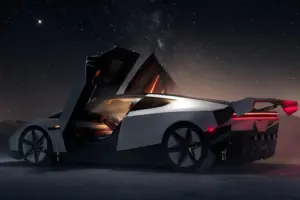
Few vehicles in modern automotive history have occupied such a contradictory space as the second-generation Tesla Roadster. It is simultaneously a masterclass in marketing and showmanship, and a cautionary tale regarding chronic production delays. When Tesla CEO Elon Musk took the stage during a mid-October special event to re-unveil the redesigned sports car, the presentation featured genuine theatrical flair: a prototype Roadster scaling a vertical C-shaped suction ramp before using rocket boosters to gently float back down to Earth.
Yet, beneath the spectacle of cold-gas thrusters and gravity-defying stunts lies a heavy shroud of skepticism. Tesla has slated the vehicle for a 2028 production window, attaching a staggering $250,000 price tag to the elite "Thrust" trim level. For many observers, industry analysts, and long-suffering deposit holders—some of whom have had $50,000 tied up in the vehicle since its initial 2017 unveiling—this re-announcement triggers a profound sense of déjà vu.
This comprehensive report examines the tumultuous history of the second-generation Roadster. We trace its evolution from a 2017 "hardcore smackdown to gasoline cars" to its current status as a distant, rocket-assisted promise. We will also explore the complex intersection of corporate delays, Elon Musk’s polarizing political maneuvers, and the mounting pressure from high-profile reservation holders who are running out of patience.
Detailed Chronology: From 2008 Origins to the 2028 Horizon
To understand the weight of the current Roadster saga, one must look backward before looking forward. The Tesla brand was built on the chassis of the original Roadster, a vehicle born in a vastly different era of automotive electrification.
The Genesis: The 2008 Original
Released in 2008 and manufactured in limited numbers, the first-generation Roadster was originally conceptualized by Tesla co-founder Martin Eberhard. Long before Elon Musk bought out Eberhard and his partner Marc Tarpenning, it was the raw premise of an electric sports car that drew Musk’s attention and initial investment in 2004. Crammed intricately into the modified chassis of a Lotus Elise, the original Roadster proved that a battery-powered vehicle could achieve an impressive 244 miles on a single charge. It served as the technological proof-of-concept that birthed the modern EV empire.
The 2017 Unveiling and the "SpaceX Package"
Nearly a decade later, in November 2017, Tesla shocked the automotive world by revealing a completely redesigned Roadster. Musk positioned the vehicle as a definitive strike against the internal combustion engine, promising blistering performance specs: 0 to 60 mph in 1.9 seconds and a top speed exceeding 250 mph.
By February 2018, Musk upped the ante, promising an optional "SpaceX package." This purported upgrade would integrate roughly 10 small rocket thrusters seamlessly around the vehicle’s body to dramatically enhance acceleration, top speed, braking, and cornering capabilities. Reservations opened immediately, requiring steep down payments ranging from a $50,000 base deposit to the full $250,000 upfront cost for the Founders Series.
The Cascade of Delays (2020–2024)
The initial production target of 2020 came and went without a single customer vehicle rolling off the assembly line.
- July 2020: During an earnings call, Musk assured investors that production would commence within 12 to 18 months. Later that year, in an interview with Joe Rogan, Musk admitted that the company’s priority had shifted toward the development and production of the Cybertruck.
- Early 2021 to Late 2023: As supply chains strained and corporate focus fractured, the timeline steadily slipped. Musk pushed the target to 2022, then to 2023, and subsequently allowed the deadline to drift indefinitely through 2024, converting the Roadster into an automotive punchline.
The 2025 Re-Commitment and the October Stunt
Following years of silence and mounting public backlash, Tesla officials began hinting at a resurrection of the project in early 2025. This culminated in the October showcase, where Tesla officially pegged 2028 as the definitive production year for the car—complete with the newly detailed "Thrust" trim level, which features working cold-gas thrusters.
Supporting Context & Metrics: The Human and Financial Cost
The delays plaguing the Roadster cannot be evaluated in a vacuum. They coincide with a tumultuous period for Tesla as a corporate entity and for Musk as a public figure.
The Political Diversion and Reputational Fallout
The years spanning 2023 to 2025 marked a radical transformation for Elon Musk, whose public persona shifted from a tech visionary and environmentalist icon to a polarizing political figure. This trajectory reached its apex when Musk assumed a leadership role in President Donald Trump’s newly formed Department of Government Efficiency (DOGE).
The aggressive federal budget cuts spearheaded by the DOGE initiative drew severe international scrutiny. By July 2025, a study published in The Lancet projected that the sweeping federal cuts could result in catastrophic public health outcomes by the end of the decade. Although Musk vigorously disputed these findings, the reputational blowback was immediate and severe.
Tesla experienced widespread global protests, culminating in tanking sales metrics across key European and North American markets. By May 2025—dogged by corporate turbulence, family drama, and falling stock values—Musk stepped down from his role at DOGE. During this period of intense corporate triage, luxury vanity projects like the Roadster were understandably relegated to the back burner.
The Investor and Consumer Backlash
Tesla’s prolonged silence turned the Roadster into fodder for pop culture and internet memes. High-profile early adopters grew increasingly vocal about their stagnant investments.
Prominent tech YouTuber and frequent Musk interviewer Marques Brownlee voiced the frustrations of thousands on his Waveform podcast in September 2025, noting:
"Tesla has been sitting with my 50 grand for eight years and hasn’t done anything with it."
Brownlee was far from alone. Other prominent tech figures, including OpenAI CEO and former Musk business associate Sam Altman, joined the chorus of high-profile investors whose substantial deposits had yielded nothing more than digital receipts and broken promises.
Official Statements and Corporate Posture
Tesla’s official stance during the October event was defined by an aggressive push to re-establish credibility. Rather than shying away from the project’s history of missed deadlines, company executives leaned heavily into theatrical demonstrations to convince the market that the engineering hurdles of a rocket-powered sports car are actively being solved.
"We enter production in 2028," Musk declared to the audience during the showcase. "Actually, for real."
Despite the viral success of the suction-ramp stunt and the formal introduction of the $250,000 "Thrust" tier—which explicitly integrates cold-gas thruster technology derived from SpaceX engineering—Tesla has yet to provide concrete milestones for prototype testing, structural safety homologation, or factory retooling. Industry analysts note that while the stunts generate immediate social media engagement, they do little to solve the fundamental manufacturing bottlenecks that continue to plague Tesla’s auxiliary product lines, such as the long-delayed Tesla Semi.
Future Outlook: Will 2028 Finally Deliver?
As the automotive industry looks toward the latter half of the decade, the question facing potential buyers is no longer just technical, but existential.
Can Tesla successfully transition a stunt-ready prototype into a street-legal, mass-producible reality by 2028? The engineering challenges of integrating high-pressure cold-gas thrusters into a consumer vehicle—ranging from federal safety regulations to payload weights and insurance classifications—are staggering.
Furthermore, Tesla must overcome the severe erosion of trust among its core consumer base. For nearly a decade, early adopters have acted as interest-free lenders to the corporation. Asking those same consumers—and prospective new buyers—to lock up hundreds of thousands of dollars for another four years requires a level of brand loyalty that has been severely tested by years of broken promises and political controversy.
Ultimately, a launch event without a firm, legally binding delivery date is merely marketing. Until the first production-spec Roadster rolls off an active assembly line without the safety net of a pre-scripted stunt, the vehicle remains what it has been for years: an intoxicating dream driving upside down on a boulevard of broken expectations.