Executive Overview
In a move that marks a significant evolution in its data monetization strategy, Google has officially updated its privacy policy to allow personal data from Gmail, Google Photos, and Google Drive to influence personalized advertising. This change, which took effect on October 16, 2026, fundamentally alters the boundaries between private user data and commercial outreach.
The update specifically targets users who have opted into "Personal Intelligence"—a feature integrated into Gemini and AI Mode in Search. By connecting these personal repositories to Google’s generative AI ecosystem, users have essentially granted the company the ability to synthesize their private digital lives into granular advertising signals. While Google maintains that it does not scan the raw content of these files to serve ads, it acknowledges that summaries, excerpts, and inferences drawn from them are now fair game for its advertising algorithms. This development represents a shift from "contextual" advertising based on search queries alone to "hyper-contextual" advertising based on an individual’s personal itinerary, shopping history, and visual media.
A Detailed Chronology: The Road to AI-Driven Personalization
To understand the gravity of this change, one must look at the timeline of Google’s evolving stance on data privacy.
The 2017 Turning Point
For years, the industry standard for privacy was defined by Google’s 2017 decision to stop scanning the contents of free Gmail accounts for advertising purposes. This move was widely lauded as a commitment to user privacy, establishing a clear wall between the email inbox and the ad server. For nearly a decade, this wall remained largely intact, even as Google’s advertising business grew more sophisticated.
The Genesis of Personal Intelligence (January 2026)
The current shift began in January 2026, when Google introduced "Personal Intelligence" as a Labs experiment. Targeted initially at Google AI Pro and AI Ultra subscribers in the United States, the feature was marketed as a revolutionary personal assistant. By connecting Gmail and Google Photos, the AI could "understand" a user’s life—referencing flight confirmations, hotel bookings, and travel photos to provide bespoke search results.
The March Expansion and the Ad-Free Promise
When Google expanded the feature in March 2026, it explicitly assured users that the Personal Intelligence experience would remain ad-free. However, the company left the door ajar, noting that it expected ads to eventually function within this connected ecosystem.
The October 2026 Policy Update
The pivot occurred on October 16, 2026. The revised privacy policy explicitly adds an exception to the long-standing rule that Drive, Gmail, and Photos data would not be used for ad personalization. The new language states: "Unless you choose to make data from these services available to other Google services that support personalized ads." This phrasing shifts the burden of consent to the user, effectively turning the "Personal Intelligence" opt-in into an advertising data sharing agreement.
Supporting Context: How Connected-App Signals Work
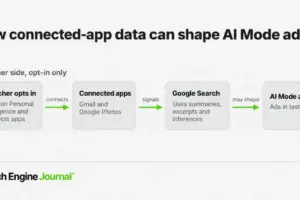
The mechanism by which this data informs advertising is nuanced. Google is not displaying a picture of your living room to a third-party advertiser, nor is it reading your emails to a marketing agency. Instead, the process relies on the synthesis of metadata.
The "Inference" Engine
When a user searches for a product—for example, a "winter coat"—AI Mode does not simply look for keywords. It cross-references the query with the user’s "Personal Intelligence" data. If the user has a flight to Chicago in March confirmed in their Gmail, and photos of similar trips in their Google Photos library, the AI synthesizes these data points. The ad algorithm then serves products tailored to a cold-weather Chicago itinerary, rather than a generic winter coat.
Google’s help documentation clarifies that the system uses:
- Summaries: Distilled versions of your documents or communications.
- Excerpts: Specific segments of data relevant to the query.
- Inferences: Logical conclusions drawn from your habits, such as your preferred clothing brands or recurring travel patterns.
Boundaries and Limitations
Google has established certain guardrails to mitigate privacy concerns. For instance, the system is designed to avoid direct matching with raw content. However, for the privacy-conscious, the "My Ad Center" toggle is no longer a catch-all solution. Turning off ad personalization in the account settings does not disconnect the data stream for AI features. To stop this data flow, a user must manually disconnect their Gmail and Photos from the Personal Intelligence feature within their Google settings.
Advertiser Implications: The "Black Box" of AI Mode
For the advertising community, this update creates a paradox. While the targeting potential is arguably the most precise in the history of digital marketing, the control mechanisms are currently non-existent.
The Lack of Targeting Toggles
Advertisers hoping for a "Target based on Gmail context" checkbox in Google Ads will be disappointed. There is no new audience segment, no dedicated reporting, and no specific bidding control for these signals. The targeting remains an automated, algorithmic black box. Campaigns are only eligible for these personalized placements if they are already using Performance Max, Shopping, or Search campaigns with broad match.
The Visibility Deficit
The lack of transparency is a significant hurdle for marketers. Advertisers have no way to know if a conversion was driven by a user’s flight confirmation or simply by the general quality of the ad. Furthermore:
- No Attribution Transparency: Google does not report on whether connected-app signals were the deciding factor in ad delivery.
- No Placement Controls: Advertisers cannot opt-out of appearing in AI Mode if they want to participate in other search-based advertising, meaning they are essentially at the mercy of the algorithm’s decision-making.
The Human Element: Training and Review
One of the most controversial aspects of this policy update is the confirmation that data processed by AI Mode is subject to human review. Google’s help documentation explicitly states that a subset of data—including summaries and excerpts from connected apps—is reviewed by human reviewers to refine and train generative AI models.
This means that while the AI acts as the middleman, the privacy of one’s personal data is contingent on the rigorous security and anonymity protocols governing these human reviewers. For many users, this creates a psychological barrier to adoption that no amount of convenience can overcome.
Future Outlook: A New Paradigm of Search
As we look toward the remainder of 2026 and into 2027, several questions remain. Google is in the process of replacing its legacy "Web & App Activity" and "Search Personalization" controls with a new, consolidated set of settings: "Search Services History" and "Personalized Recommendations."
The Expansion of "Search Services"
The definition of "Search Services" is expanding to include Google Maps, Shopping, Flights, Hotels, Translate, and News. If the Personal Intelligence test moves beyond the pilot phase and into full integration, we could see a future where a search for a restaurant on Maps is influenced by a photo of a meal you ate last week, or where a hotel booking on Google Flights influences the ads you see in the Google News feed.
The Regulatory Landscape
The question remains whether this model will face scrutiny from global regulators. With the EU’s Digital Markets Act and the ongoing antitrust climate in the United States, Google’s strategy of blending personal data, AI, and advertising will likely become a focal point for privacy advocates.
For the average consumer, the choice is increasingly stark: convenience in the form of a hyper-intelligent personal assistant, or the preservation of the data-silo walls that previously kept personal correspondence and memories separate from the commercial web. As Google continues to iterate, the "Personal Intelligence" feature will likely become the standard experience for all users, making the decision to opt-in or out a critical juncture for digital privacy in the AI era.