Executive Overview
The digital entertainment paradigm in India is undergoing a tectonic shift. As the nation’s billion-plus internet users move away from the traditional, appointment-based viewing of legacy television, a new, high-velocity format is capturing the cultural zeitgeist: the microdrama. Leading this charge is EloElo, a media-tech powerhouse that has just secured $80 million in a Series C funding round led by Hornbill Capital and NBCUniversal. This latest capital infusion brings the company’s total funding to $130 million, valuing the firm at a staggering $500 million.
With over 33 million active users on its flagship platform, Story TV, EloElo has positioned itself at the vanguard of a burgeoning industry that analysts predict will generate between $3 billion and $4 billion in annual revenue by 2030. By blending serialized storytelling with the snackable, vertical-video format favored by Gen Z and Millennial audiences, EloElo is successfully navigating the transition from passive media consumption to highly immersive, on-the-go mobile entertainment.
A Chronology of the Microdrama Boom
The rise of the microdrama—episodic, short-form narrative content designed specifically for mobile screens—did not happen in a vacuum. It is the culmination of a decade of rapid infrastructure development in India’s data landscape.
2020: The Genesis
Founded in 2020 by former Flipkart executive Saurabh Pandey, EloElo was conceived during a period when the Indian digital market was desperate for localized, high-quality engagement. Pandey, recognizing that the "next billion users" would skip the television phase of media consumption entirely, sought to create a platform that felt native to the smartphone experience.
2023–2024: Scaling the Narrative
Over the past three years, the platform has cultivated a library of over 5,000 titles spanning six major Indian languages. This aggressive content acquisition strategy has paid dividends in user retention. Today, the average Story TV user spends 95 minutes per day on the app, engaging in multiple, bite-sized viewing sessions that fit seamlessly into their daily routines.
2025–2026: The Institutional Validation
The sector’s maturity was solidified in 2026 as global investors, including NBCUniversal, began betting heavily on the format. The current market climate has seen global icons—such as Issa Rae, James Franco, and Kim Kardashian—actively investing in and starring in similar formats, signaling that microdramas are no longer a regional curiosity but a global media phenomenon.
Supporting Context and Metrics: The Battle for the Screen
The competition for India’s attention is fierce. EloElo must contend with the "Big Tech" giants—YouTube, Instagram, and TikTok—which offer infinite streams of free content. However, EloElo’s strategy relies on the inherent difference between "algorithmic discovery" and "serialized engagement."
The Monetization Hurdle
While user acquisition has been rapid, the industry faces a significant monetization bottleneck. According to reports from market intelligence firm Redseer, while approximately 40 million Indians have paid for microdrama content at least once, the recurring subscriber base remains a challenge, hovering between 15 and 17 million. A separate survey by Ormax Media suggests that as much as 72% of the total addressable audience has yet to pay for a microdrama, relying entirely on ad-supported (AVOD) models.
EloElo is addressing this by implementing a tiered subscription model (monthly, quarterly, and annual) while maintaining an ad-supported tier to capture the "free-to-play" demographic. The company’s partnership with industry titan Balaji Telefilms serves as a strategic moat, ensuring that the production quality of their microdramas rivals that of traditional soap operas, thereby incentivizing users to convert from free viewers to paid subscribers.
Industry Trajectory
The broader interactive media economy in India is currently on an unprecedented growth curve. With apps like Story TV, Kuku TV, and Quick TV consistently ranking among the top downloads, the market is proving that mobile-first, high-quality, short-form content is the preferred medium for the Indian demographic.

Official Perspectives: The Founder’s Vision
Saurabh Pandey, founder of EloElo, views the current digital landscape as a fundamental break from the past. In an interview, Pandey emphasized the necessity of a design-first approach.
"I fundamentally believe that the next billion users will not grow up on a diet of watching television; they will grow up on a diet of watching content on their phones," Pandey stated. "This entertainment must be designed very differently. It is not going to be appointment viewing; it is going to be consumed in specific slots throughout the day. While short clips solved for quick bursts of entertainment, serialized storytelling—the ability to keep a viewer hooked over a long-form arc—was a problem that had never been solved for mobile."
Pandey remains pragmatic about the role of technology. While he is a staunch proponent of AI integration, he views the human element as irreplaceable. "My belief in involving AI is that AI is a really fast race car, but you need an extremely capable Formula One driver at the steering wheel—the creative director or showrunner. AI can help write stories, but the best content will always require that unique human x AI synergy."
AI and the Future of Content Production
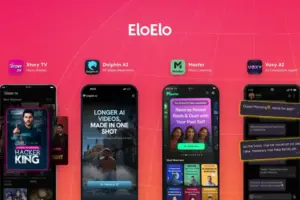
To solve the "supply-side" problem of needing constant, high-quality content, EloElo has developed an internal platform called Dolphin AI. While initially designed as a tool to streamline the company’s internal production workflows, EloElo plans to open this platform to external creators.
The Dolphin AI Ecosystem
Dolphin AI serves as an end-to-end creative suite, incorporating:
- Automated Editing: Templates that allow for rapid assembly of episodic content.
- Generative Assets: Models for high-fidelity audio, image, and video synthesis.
- Marketing Integration: Tools specifically designed to help creators generate ad campaigns for their own shows, driving discovery within the app.
This move aligns EloElo with other industry players like Kuku, which has leaned heavily into AI to optimize its production pipeline. However, by providing this toolset to creators, EloElo aims to build a creator economy around the microdrama format, similar to how CapCut transformed the TikTok creator landscape.
Future Outlook: Beyond the Drama
EloElo’s ambitions extend well beyond the microdrama niche. The company has diversified its portfolio with:
- Master: A vertical video learning app that competes with ed-tech players like Seekho.
- Voxy AI: An AI-powered companion application.
With a current headcount of 240 employees, the company is aggressively expanding its AI and machine learning research teams. The fresh capital from the Series C round will be deployed toward three key areas: doubling down on original content production, scaling the Dolphin AI platform, and expanding its reach to capture the remaining non-paying audience segments through localized, hyper-relevant storytelling.
As the industry approaches 2030, the battle for the "mobile attention span" will be won by companies that can balance high-velocity production with high-quality emotional resonance. With institutional backing from the likes of MIT Investment Co., Play Ventures, and Kalaari Capital, EloElo appears well-positioned to lead the charge, turning the ephemeral nature of mobile viewing into a long-term, multi-billion dollar empire.
Disclaimer: This article is for informational purposes. When you purchase through links in our reports, we may earn a small commission, which helps support our editorial independence and ongoing industry analysis.