Executive Overview
In a decisive move targeting the financial architecture supporting the Russian state, the United Kingdom has levied sweeping economic sanctions against Cryptomus, a notorious cryptocurrency payment processor. Long flagged by blockchain intelligence firms and investigative journalists, Cryptomus serves as a critical financial conduit for ransomware syndicates, darknet narcotics vendors, cybercrime service-providers, and illicit networks actively helping Moscow bypass international financial restrictions.
Announced on October 8, the U.K. Treasury’s sanctions freeze any assets held by Cryptomus within British financial institutions and strictly prohibit U.K. companies and citizens from conducting business with the platform, whether in fiat or virtual currencies. Alongside Cryptomus—which has operated under aliases including Certa Payments, Xeltox Enterprises, and more recently, Heleket—the U.K. government targeted several parallel virtual payment platforms, including VexPay, TokenSpot, and the Tsunami Payments service.
This regulatory hammer blow represents a critical escalation in the Western coalition’s efforts to sever the financial lifelines fueling Russia’s wartime economy. Unlike previous administrative actions—such as a record-shattering $176 million fine issued by Canada that ultimately went uncollected—U.K. sanctions carry the force of legal criminalization. According to blockchain experts, this distinction marks the difference between a slap on the wrist and an operational death blow.
Furthermore, the U.K. sanctions carry unprecedented geopolitical weight. Investigators note this is the first documented instance of a "Five Eyes" nation (comprising Australia, Canada, New Zealand, the United Kingdom, and the United States) officially sanctioning a cryptocurrency entity incorporated within another Five Eyes jurisdiction. This case exposes deep vulnerabilities in corporate registration systems, the shadowy rise of phony regulatory bodies tied to disputed territories, and the remarkable adaptability of cybercriminal payment infrastructure.
Detailed Chronology of an Illicit Empire
The Genesis and Early Expansion (2022)
Cryptomus emerged onto the digital underground landscape in 2022, rapidly establishing itself as a preferred checkout gateway for illicit operators. Operating under the corporate umbrellas of Certa Payments and Xeltox Enterprises, the platform presented itself as a legitimate payment gateway for e-commerce websites. Behind this digital storefront, however, Cryptomus built a robust backend tailored to Russian cryptocurrency exchanges and underground cybercrime forums.
According to forensic findings by blockchain analytics firm TRM Labs, Cryptomus processed an astounding $7 billion in cumulative transactions between its inception and mid-2026. The platform’s early volume was fueled by seamless, no-questions-asked transaction processing that attracted not only financial cybercriminals, but also vendors of child sexual abuse material (CSAM), terrorist financing cells, and human trafficking operations.
Regulatory Pressures and the "Chameleonic" Pivot (2024–2025)
As scrutiny from blockchain intelligence firms intensified, Cryptomus was forced to alter its operational posture. Investigations revealed that the platform shared a nominal corporate address in Vancouver, Canada, with dozens of other foreign currency dealers and money-transfer operations—none of which maintained an actual physical presence at the location.
In late 2024, independent investigations shed light on how Cryptomus bridged the gap between untraceable digital assets and clean fiat currency within Russian banks. Faced with mounting evidence of systemic anti-money laundering (AML) violations, Canadian authorities cracked down on the platform, culminating in October 2025 with a landmark CAD $176 million fine—the largest of its kind in Canadian history.
Rather than folding, Cryptomus leveraged its chameleonic nature. The platform appealed the Canadian fine while simultaneously launching a parallel, no-KYC (Know Your Customer) service called Heleket. While transaction volumes initially dipped when Cryptomus briefly experimented with rudimentary compliance checks, Heleket ensured that illicit capital flows continued uninterrupted. Telegram support channels for Heleket brazenly—and falsely—denied any operational affiliation with Cryptomus, even as investigators mapped identical wallet infrastructures and administrative backends.

The U.K. Intervention (October 2026)
By late 2025, the monthly volume of illicit counterparties interacting with Cryptomus and its derivatives had surged past 900 entities in a single month, rivaling or exceeding the volume processed by traditional crypto mixers. Recognizing that monetary fines were entirely ineffective against decentralized, offshore-backed shell corporations, the international community shifted toward targeted sanctions.
On October 8, the U.K. government officially designated Cryptomus, Heleket, VexPay, TokenSpot, and Tsunami Payments. Within hours of the announcement, user-facing Telegram support bots for Cryptomus and Heleket went dark, responding to customer inquiries with automated messages stating that the platform was suddenly and indefinitely unable to process transactions.
Supporting Context & Metrics: Scale and Scope of Abuse
The sheer volume of illicit capital moving through Cryptomus and its sister platforms underscores the systemic threat they pose to global financial integrity. Leading blockchain forensics organizations have published comprehensive telemetry detailing the depth of the platform’s criminal integration.
Chainalysis Findings
In an October 8 advisory, blockchain intelligence firm Chainalysis contextualized the U.K. sanctions as a direct blow to Russia’s wartime procurement networks. Chainalysis reported that Cryptomus and Heleket had evolved into premier payment hubs for high-risk and illicit transactions.
- Surpassing Mixers: Combined, these services received a greater volume of illicit funds across tracked categories than traditional cryptocurrency mixing services monitored in the firm’s dataset.
- Counterparty Surge: The number of unique illicit counterparties transacting with the platform spiked dramatically, surging to more than 900 entities in a single month during late 2025.
TRM Labs Telemetry
Data compiled by TRM Labs in April 2026 further mapped the dark ecosystem serviced by Cryptomus:
- $7+ Billion Processed: Cumulative transaction volume since 2022 exceeded $7 billion.
- Diverse Criminal Sectors: Funds traced through the platform tied directly to state-sponsored Russian ransomware groups, sanctioned financial institutions, online child exploitation networks, and international narcotics syndicates.
- The KYC Evasion Loophole: TRM noted that whenever public pressure forced Cryptomus to implement minor KYC or identity-verification hurdles—which caused temporary dips in transaction volume—the operators simply spun up new, unverified brands like Heleket to recapture fleeing criminal clientele.
Official Statements and Industry Analysis
The international response to the U.K. sanctions has highlighted a fundamental truth in modern financial crime enforcement: monetary fines are insufficient tools for policing borderless, pseudonymous cryptocurrency networks.
The Enforcement Shift: Fines vs. Sanctions
Richard Sanders, a prominent blockchain analyst and investigator who spent months mapping Cryptomus’s intricate payment infrastructure, emphasized the strategic importance of the U.K.’s actions. Commenting on the limitations of Canada’s previous $176 million penalty, Sanders noted that uncollected and uncollectible administrative fines fail to disrupt ongoing criminal operations.
"A fine doesn’t stop a cryptocurrency payment processor from processing payments," Sanders wrote in a public analysis. "Sanctions kill the operation. The distinction matters."
Sanders also highlighted the historic nature of the cross-jurisdictional enforcement. Because Cryptomus was ostensibly tied to a Five Eyes member state (Canada), the decision by another Five Eyes member (the U.K.) to sanction the platform represents a novel regulatory alignment. It demonstrates a growing intolerance for shell corporations operating within allied borders while serving geopolitical adversaries like Russia.

The Illusion of Legitimacy: Phony Regulators and Western Sahara
One of the most bizarre and illuminating aspects of the Cryptomus investigation is how an enterprise facilitating billions of dollars in darknet transactions and Russian sanctions evasion maintained a veneer of legal authority.
The Corporate Web
According to corporate filings uncovered during deep-dive investigations into Cryptomus’s parent company, Certa Payments, the sole shareholder was recorded as a 25-year-old Ukrainian woman. This individual simultaneously held leadership positions across a portfolio of dubious shell companies, including the WS Management and Advisory Corporation.
The Western Sahara Nexus
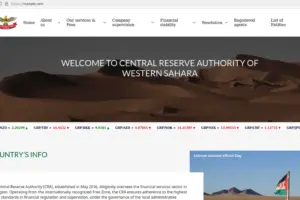
WS Management and Advisory Corporation marketed itself as an official, exclusive regulatory body responsible for licensing cryptocurrency platforms, foreign exchange brokers, and online gaming operators. However, its jurisdiction of authority was claimed to be the Western Sahara—a disputed territory in northwest Africa that lacks widespread international recognition as a sovereign state.
Investigators traced the administrative plumbing behind this scheme:
- The Regulatory Portal: The entity operated a website (
crasadr.com), purporting to represent the Central Reserve Authority of the Western Sahara, which issued official-looking licenses to high-risk financial platforms. - Shared Infrastructure: Historical domain records revealed that one of Certa Payments’ former web properties (
certa.website) shared a server hosting environment with 12 distinct domains, includingrasd-state.ws, the digital home of the pseudo-governmental central reserve authority.
This elaborate corporate fiction allowed Cryptomus to present itself to banking partners, API service providers, and payment aggregators as a "regulated" entity, exploiting gaps in international corporate registries and oversight standards.
Future Outlook
The U.K. economic sanctions against Cryptomus, Heleket, TokenSpot, and their associated entities mark a turning point in the regulation of cross-border digital assets. By moving beyond civil monetary penalties and toward full-scale asset freezes and business bans, Western governments are systematically closing the loopholes that allowed Russian state actors and global cybercriminals to launder billions.
However, the saga of Cryptomus illustrates the resilient and hydra-like nature of illicit crypto infrastructure. As long as demand persists for sanctions evasion, ransomware cash-outs, and darknet liquidity, bad actors will continue to cycle through new brand names, exploit lax corporate registration laws in foreign jurisdictions, and invent fictitious regulatory bodies.
Moving forward, intelligence agencies and blockchain analytics firms stress that effective disruption will require real-time, multi-lateral coordination. Future enforcement actions must target not only the front-end payment gateways, but also the underlying ledger networks, liquidity providers, and offshore shell companies that give these chameleonic platforms their lifeblood.