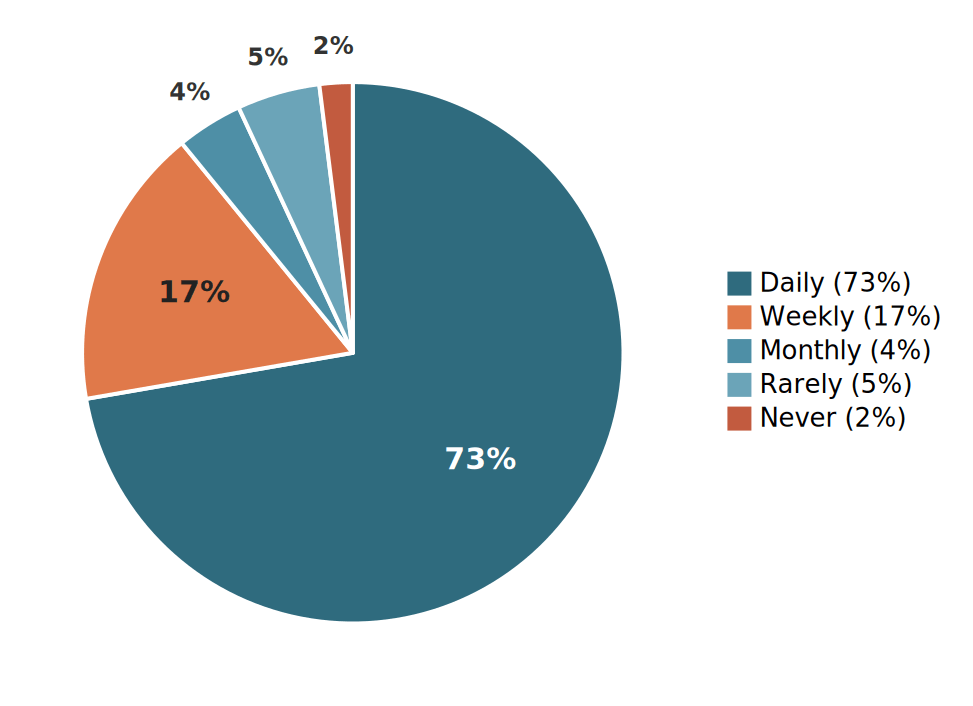
The integration of Artificial Intelligence into small business operations has crossed a critical threshold, transitioning from speculative experimentation to foundational infrastructure. According to findings from Social Media Examiner’s 2026 AI Marketing Industry Report, daily AI usage among marketing professionals has nearly doubled over the past two years, moving from a modest 37% in 2024 to an overwhelming 73% today.
Based on a comprehensive survey of industry practitioners—60% of whom represent micro-enterprises and small organizations with ten or fewer employees—the study captures a grounded, empirical snapshot of how lean teams leverage synthetic intelligence to maintain market competitiveness.
Rather than being driven by enterprise-level capital or mandated corporate training programs, this technology wave is overwhelmingly bottom-up. Frontline professionals are self-funding their software stacks, self-educating through hands-on trial, and embedding AI directly into daily operations.
However, this rapid adoption has created operational paradoxes: while an overwhelming majority report significant time savings, only a fraction can quantitatively prove their return on investment (ROI). Furthermore, while text generation has reached near-total market saturation, high-value frontiers like AI-generated video and autonomous agentic workflows remain largely untapped, presenting a strategic window of opportunity for agile firms.
AI ADOPTION AT A GLANCE (2024 vs. 2026)
-----------------------------------------------------------------
Daily AI Usage (Marketers):       37%  ════════> 73%
Weekly+ AI Usage:                [Not Tracked] -> 90%
Rare/No AI Usage:                 23%  ========>  7%
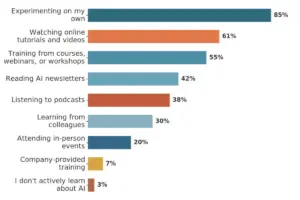
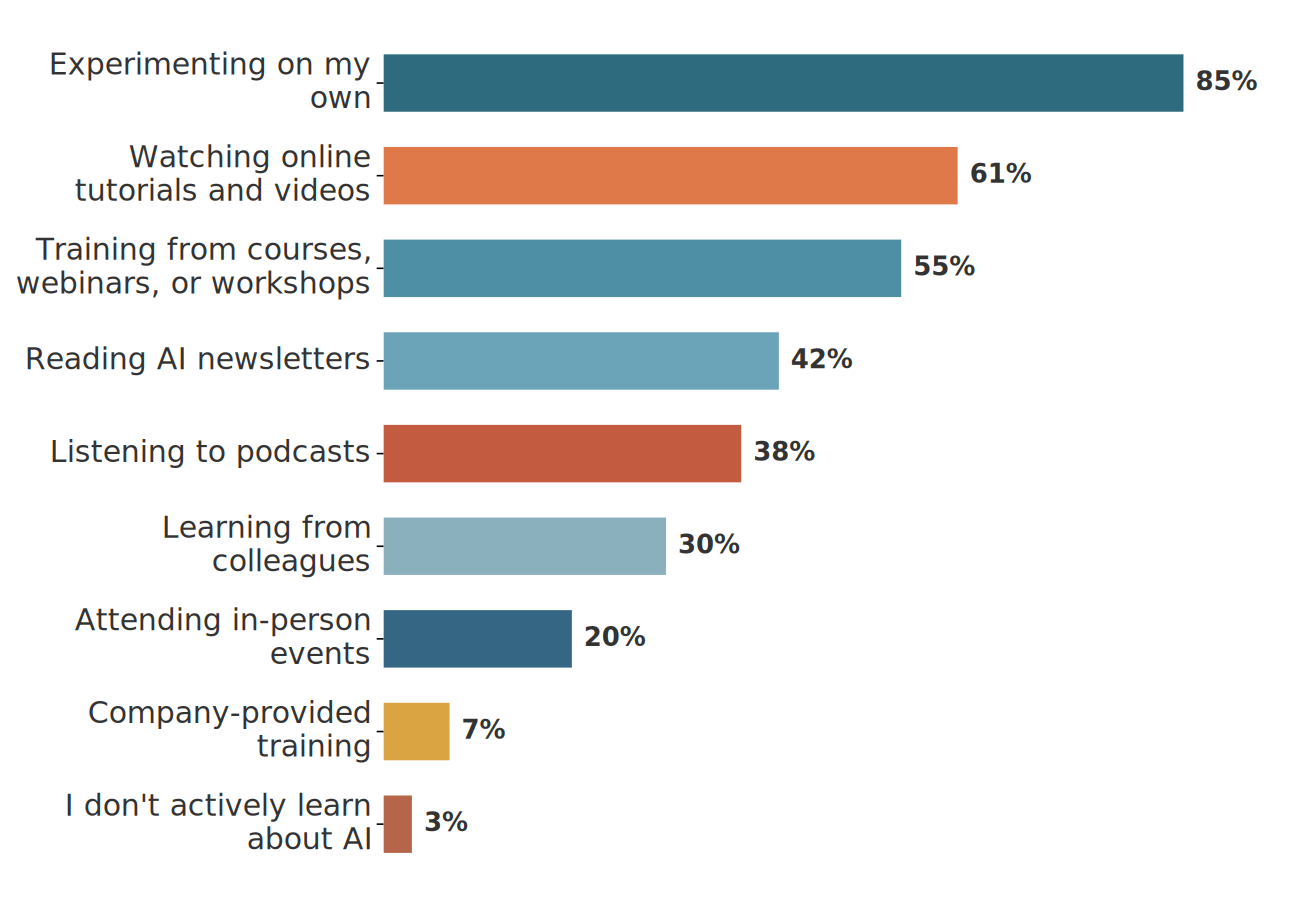
Self-Taught via Experimentation:                 85%
Receiving Corporate AI Training:                  7%
Reporting Time/Productivity Gains:                86%
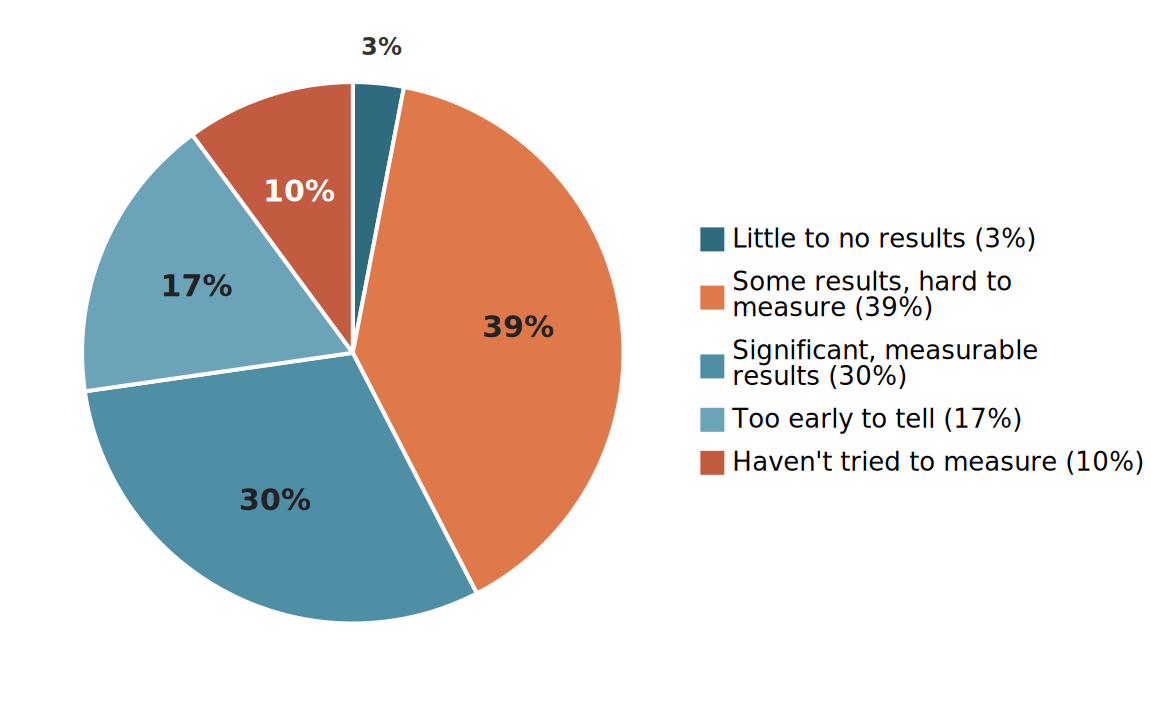
Able to Quantify AI ROI:                          30%
-----------------------------------------------------------------
Source: Social Media Examiner 2026 AI Marketing Industry Report
Detailed Chronology: The 2024–2026 AI Transformation
To understand the current state of artificial intelligence in small business marketing, one must trace the rapid progression of user behavior and infrastructure development between 2024 and 2026.
2024: THE NOVELTY PHASE
  └─ 37% Daily Usage
  └─ Enterprise-Dominated Experiments
  └─ Free Tier Dominance (ChatGPT-centric)
  └─ High Skepticism (23% Non-Users)

2025: THE HYBRID SHIFT
  └─ Expansion of Multimodal Capabilities
  └─ Rise of Specialized Competitors (Claude, Midjourney)
  └─ Grassroots Employee-Led Tool Acquisition

2026: THE OPERATIONAL ERA
  └─ 73% Daily Usage / 90% Weekly Usage
  └─ Paid Tier Standard (85% Paid Usage)
  └─ Shift Toward Autonomous Agents & AI Video
  └─ The Measurement & Attribution Gap Emerges
The 2024 Baseline: Novelty and Hesitation
In early 2024, corporate engagement with generative AI was characterized by cautious exploration. Large language models (LLMs) were primarily viewed as novel writing assistants or ideation engines.
Daily usage sat at just 37%.
Nearly a quarter of marketers (23%) reported rarely or never utilizing AI in their workflows.
Free tiers of platforms like OpenAI’s ChatGPT dominated the landscape, and organizational governance frameworks were largely absent.
The 2025 Transition: Workflow Integration
Throughout 2025, the release of multimodal models capable of processing text, image, audio, and code simultaneously expanded the operational scope of AI. The market began shifting away from single-platform reliance toward specialized ecosystems. As software providers monetized advanced features behind paywalls, individual end-users increasingly transitioned from free tiers to paid professional subscriptions, driving adoption directly within small business teams.
The 2026 Standard: Essential Operations
By 2026, the paradigm shift reached completion. Non-users collapsed to a marginal 7%, while regular weekly usage climbed to 90%. AI moved from an auxiliary tool to an invisible baseline layer for business communication, data analysis, and visual content production. The narrative has transformed from “Should we use AI?” to “How efficiently can we deploy autonomous AI systems?”
Supporting Context & Core Metrics: Analyzing the 5 Key Findings
                      SURVEY HIGHLIGHTS AT A GLANCE

       73%                        85%                        86%
┌─────────────────┐        ┌─────────────────┐        ┌─────────────────┐
│  Daily AI Use   │        │ Self-Taught via │        │ Productivity &  │
│  (Up from 37%)  │        │ Experimentation │        │ Time Savings    │
└─────────────────┘        └─────────────────┘        └─────────────────┘
       37%                        79%                        30%
┌─────────────────┐        ┌─────────────────┐        ┌─────────────────┐
│ Current AI Video│        │ Active/Planning │        │ Can Quantify    │
│  Adoption Rate  │        │  Agent Adoption │        │    AI Results   │
└─────────────────┘        └─────────────────┘        └─────────────────┘
The survey data uncovers five core operational realities shaping how lean teams navigate the modern marketplace.
1. Ubiquity and the Normalized Workflow
AI is no longer an optional advantage; it is a baseline operational requirement.
73% of surveyed marketers access AI systems on a daily basis.
90% engage with AI tools at least weekly.
84% report that their organizational reliance on AI expanded over the past 12 months.
78% project their usage will continue upward over the next year.
This data underscores an accelerating adoption curve. The window for early-adopter advantage in basic generative AI has closed; baseline proficiency is now assumed across the market.
Marketer AI Usage Frequency (2024 vs. 2026)
-------------------------------------------------------------------
Daily Use      (2024):  [███████████████                      ] 37%
Daily Use      (2026):  [█████████████████████████████████████] 73%

Weekly+ Use    (2026):  [█████████████████████████████████████████] 90%
Rare / Never   (2024):  [███████████                          ] 23%
Rare / Never   (2026):  [███                                  ] 7%
-------------------------------------------------------------------
2. The Self-Taught, Self-Funded Enterprise
Small businesses are adapting without formal corporate infrastructure or enterprise software budgets.
85% of respondents acquired their AI capabilities through self-directed experimentation.
Only 7% received formal, company-provided training.
53% of practitioners pay for AI software out of their own pockets, with 85% employing some form of paid tier.
55% explicitly state that they personally own AI adoption within their organization.
How Marketers Learn and Fund AI Tools
-------------------------------------------------------------------
Learning Method:
  Self-Directed Experimentation: [██████████████████████████████████] 85%
  Company-Provided Training:    [███                               ]  7%

Funding Model:
  Paying via Personal Funds:    [███████████████████               ] 53%
  Using Any Paid Tier:          [███████████████████████████████   ] 85%
-------------------------------------------------------------------
This self-reliance demonstrates that lack of corporate funding or formal training programs is no longer a barrier to technology integration. Agility and personal initiative have proven more impactful than formal IT rollouts.
3. The ROI Attribution Gap
While efficiency gains are widely reported, formal financial verification remains elusive.
86% of marketers report substantial time savings.
86% confirm an overall increase in operational productivity.
However, only 30% can substantiate these gains with hard, metric-driven data.
39% recognize positive returns but admit an inability to quantify them.
10% make no effort to track or measure AI performance metrics.
The ROI Measurement Paradox
-------------------------------------------------------------------
Perceived Benefits:
  Saves Time / Boosts Productivity: [███████████████████████████████] 86%

Ability to Measure Impact:
  Can Quantify Measurable Results:  [███████████                    ] 30%
  Sees Results, Cannot Quantify:   [████████████████               ] 39%
  No Attempt to Measure ROI:       [████                           ] 10%
-------------------------------------------------------------------
This analytics void reveals an opportunity: businesses that establish simple attribution models—such as tracking hours saved per task, output velocity, or cost-per-asset reduction—can optimize their tech stack far more effectively than competitors operating on intuition alone.
4. Content Divergence: Text Saturation vs. The Video Deficit
The type of media being generated reveals a stark divide in software adoption.
95% of marketers actively use AI for text-based asset generation.
Image generation has surged to 67%, up from 39% in 2024.
Conversely, only 37% utilize AI for video production.
Despite low adoption, 74% cite AI video as the #1 skill they wish to master.
Content Type Adoption vs. Learning Demand
-------------------------------------------------------------------
Text Generation:    [█████████████████████████████████████████] 95%
Image Generation:   [███████████████████████                  ] 67%
Video Generation:   [█████████████                            ] 37%
                                                                ▲
           37-Point Skill Deficit (High Demand: 74%) ───────────┘
-------------------------------------------------------------------
This 37-point variance between demand and execution highlights the technical barriers of early video tools. As next-generation video synthesis models stabilize, early adopters stand to gain a distinct advantage in engagement metrics.
5. The Frontier of Autonomous AI Agents
The survey highlights a major strategic turn toward agentic AI—systems engineered to execute multi-step processes autonomously without requiring continuous human prompting.
11% of firms currently deploy autonomous agents in daily workflows.
24% are actively running pilot implementations.
44% plan to integrate agents into their stack in the near term.
Collectively, 79% of the industry is moving toward autonomous operations.
Learning to deploy AI agents ranks as the top educational priority (74%).
Current Status of AI Agent Adoption
-------------------------------------------------------------------
Active Regular Use:     [████                                 ] 11%
Pilot Experimentation:  [█████████                            ] 24%
Planning to Adopt:      [██████████████████                   ] 44%
No Plan / No Interest:  [███████                              ] 21%
-------------------------------------------------------------------
For lean small-business teams, autonomous agents offer virtual leverage—handling complex tasks such as multi-channel email campaigns, real-time analytics monitoring, and customer service triage without human overhead.
Official Statements & Industry Perspectives
Reflecting on the study’s findings, industry leaders emphasize that the democratized nature of modern artificial intelligence has fundamentally altered the competitive landscape between small businesses and large enterprises.
"This isn’t enterprise research. This is your world," noted Michael Stelzner, founder of Social Media Examiner and author of the report. "Two years ago, about a third of marketers used AI every day. Today, nearly three out of four do. That’s not a trend. That’s a transformation."
Stelzner highlighted that the lack of formal corporate support within smaller firms has counterintuitively become an operational advantage:
"The marketers who are furthest ahead didn’t get there through corporate training programs or massive budgets. They got there by rolling up their sleeves and figuring it out. When we asked who owns AI adoption at their company, 55% said ‘me.’ In the AI era, it turns out everyone else is catching up to the way small business already works."
Addressing the measurement gap that currently affects nearly 70% of the industry, market analysts point out that formalizing tracking standards will separate top performers from average users.
"Everyone feels the value, but almost nobody can prove it," Stelzner observed. "If you start tracking how AI impacts your output—even something as simple as hours saved per week or pieces of content produced—you’ll be ahead of 70% of marketers who can’t do that yet. You’ll make much smarter decisions about where to invest your limited time and money."
Future Outlook & Strategic Imperatives
As small businesses navigate the second half of the decade, the data points to clear strategic priorities for leaders aiming to maximize their technological leverage.
                      STRATEGIC ROADMAP FOR SMBs

┌─────────────────────────────────────────────────────────────────┐
│ 1. Formalize ROI Measurement                                    │
│    Track baseline metrics: hours saved, asset cost, velocity    │
├─────────────────────────────────────────────────────────────────┤
│ 2. Bridge the Visual & Motion Gap                               │
│    Expand beyond text generation; pilot AI video tools          │
├─────────────────────────────────────────────────────────────────┤
│ 3. Prepare for Agentic Workflows                                │
│    Shift from simple text prompts to multi-step autonomous workflows│
├─────────────────────────────────────────────────────────────────┤
│ 4. Consolidate Software Stacks                                  │
│    Transition from fragmented free tools to specialized engines │
└─────────────────────────────────────────────────────────────────┘
Strategic Action Items for Small Business Leadership
Establish ROI Metrics immediately
Small businesses should move beyond anecdotal evidence of productivity gains. By instituting simple baseline tracking—such as tracking campaign turnaround times, cost-per-content-asset, or lead-nurturing velocity—firms can quantify their investments and double down on high-performing systems.
Capitalize on the AI Video Shortfall
With 95% of competitors leveraging AI for text generation, written content is increasingly commoditized. With video adoption sitting at just 37%, early implementation of video synthesis presents a clear pathway to capture audience attention across digital channels.
Transition from Manual Prompting to Agentic Systems
The trajectory of software integration is moving from passive co-pilots to active, autonomous agents. Small business owners should begin mapping routine, multi-step administrative and marketing processes—such as lead qualification, inventory updates, and reporting—to prepare for autonomous agent integration.
Rationalize and Upgrade Software Expenditures
With 85% of market participants utilizing paid tiers, rely less on entry-level free software. Strategically reallocate resources toward specialized, high-yield tools (such as advanced reasoning models like Claude, specialized visual generation tools, and automation orchestrators) to build a defensible operational advantage.