Executive Overview
The artificial intelligence sector is experiencing a fundamental structural pivot. For the past three years, enterprise adoption of AI has been dominated by conversational LLM interfaces such as OpenAI’s ChatGPT, Anthropic’s Claude, and Google’s Gemini. While these platforms excel at generating text, brainstorming, and summarizing information, they rely heavily on human intervention. Workers are forced to act as data copy-paste conduits across software suites, maintaining high oversight and continuously feeding prompts to nudge the models toward completion.
This operational paradigm is being challenged by the arrival of agentic AI—systems designed not merely to answer queries, but to execute complex, multi-step workflows across external tools with minimal human supervision. At the forefront of this transition is Manus, an emerging agentic platform capable of browsing the web, logging into applications, interacting with local desktop files, and provisioning persistent cloud environments to execute end-to-end operational tasks.
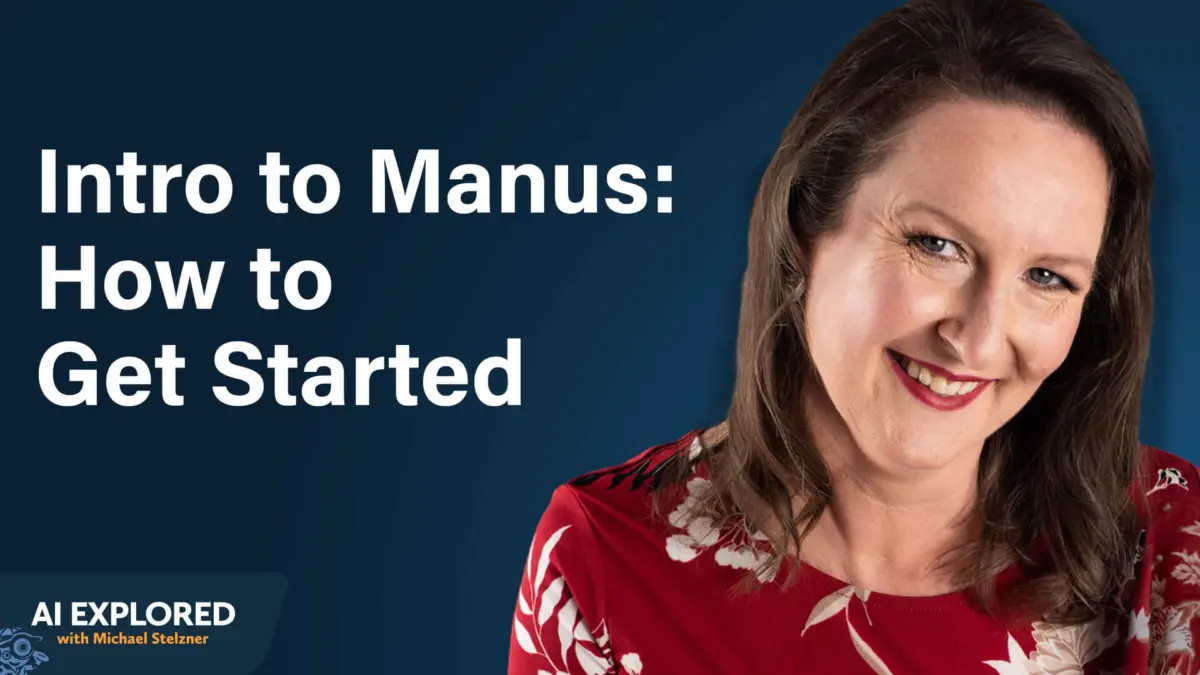
In a recent technical deep dive hosted by Michael Stelzner on the AI Explored podcast, marketing strategist and AI consultant Kate vanderVoort outlined the mechanics of Manus. Her analysis reveals that the primary distinction between legacy AI chatbots and agentic tools lies in execution philosophy: standard chatbots ask "How can I help you?" and delegate the work back to the user, whereas Manus asks "What can I do for you?" and independently completes the task across third-party environments.
This report provides an exhaustive investigation into Manus’s underlying architecture, operational modes, financial credit mechanics, real-world enterprise deployment cases, and best practices for building reusable autonomous skills.
Strategic Architecture: The Operational Chronology of an Agentic Workflow
Deploying an agentic workflow within Manus requires moving away from the trial-and-error prompting typical of traditional AI chat interfaces. Because Manus operates autonomously—spending computational units (credits) at every step of a task—flawed initial prompts can lead to unnecessary resource consumption. High-performing workflows follow a structured, multi-stage methodology.
[Phase 1: Pre-Execution Architecture]
  ├── Voice-to-Text Brain Dump (Wispr Flow)
  └── LLM Meta-Prompt Drafting (Perplexity/Claude with strict structural constraints)
        │
        ▼
[Phase 2: Environment Provisioning]
  ├── Select Deployment Mode (Browser / Desktop / Telegram / Cloud Computer)
  └── Isolated Credential Handling & Context Injection
        │
        ▼
[Phase 3: Autonomous Multi-Step Execution]
  ├── Dynamic Web/App Navigation & Synthesis
  └── Real-time Monitoring via Webhooks/Mobile
        │
        ▼
[Phase 4: Modular Standardization]
  ├── Capture Output & Step Logic
  └── Package as Version-Controlled Reusable "Skill" (ZIP Manifest)
Phase 1: Pre-Execution Architecture and Meta-Prompting
To avoid spending credits on open-ended brainstorming inside the agent runtime, planning is handled off-platform.
- Unstructured Narration: The workflow architect uses a voice-to-text tool (such as Wispr Flow) to record a raw, unedited narrative of the desired workflow, explaining the inputs, required outputs, business logic, and operational constraints.
- Meta-Prompt Synthesis: The narrative is passed into a standard LLM (e.g., Perplexity or Claude) alongside a strict system constraint:
"Please write a highly optimized, structured prompt for a Manus AI agent. Do not perform the task. Ask me clarifying questions if key information is missing before generating the final prompt."
- Brief Generation: The LLM outputs an optimized execution blueprint, ready to be submitted to Manus as a single instruction payload.
Phase 2: Environment & Access Mode Provisioning
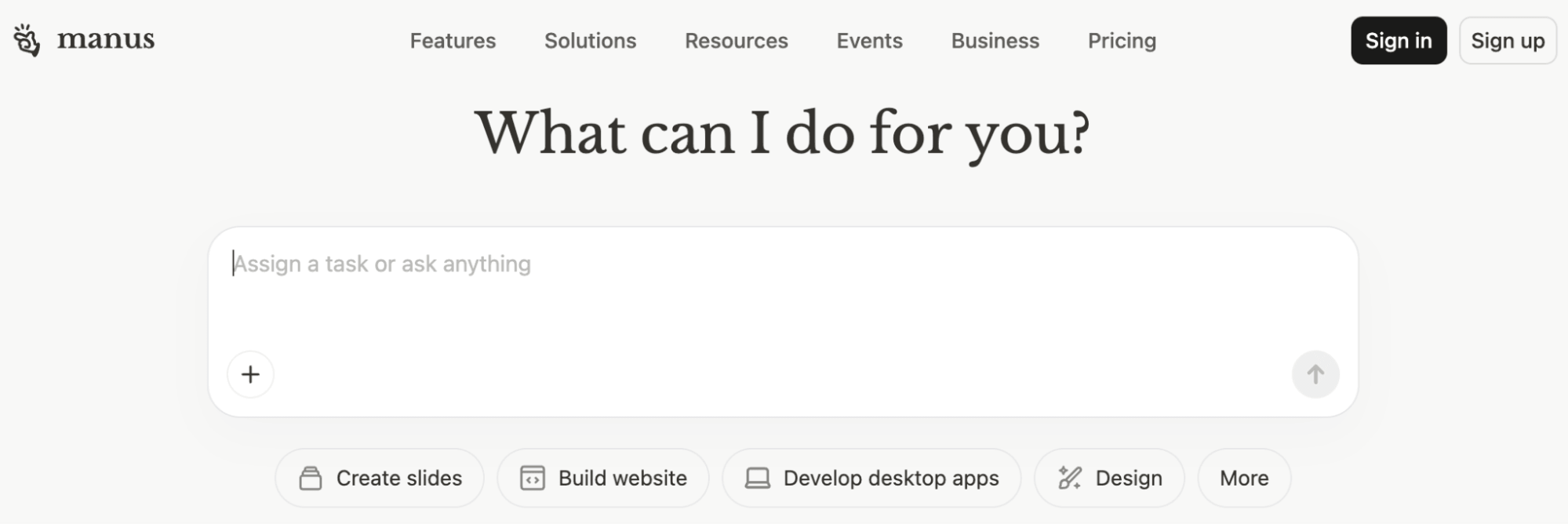
Depending on the task’s scope and security requirements, the operator routes the generated prompt through one of four access channels:
| Access Mode | Infrastructure Environment | Primary Use Case | Key Operational Characteristics |
|---|---|---|---|
| Browser-Based Access | Hosted Web Instance | Web research, platform interaction, web scraping | Operates behind user session cookies; logs into platforms (e.g., LinkedIn, CRMs) without exposing raw credentials to the model. |
| My Computer (Desktop) | Native Local Application | Local file processing, data analysis, directory ops | Requires active machine state; reads and alters files stored locally (similar to Claude Cowork or Perplexity Computer). |
| Telegram Agent | Asynchronous Webhook Link | Mobile monitoring, dynamic human-in-the-loop input | Sends progress updates and prompts the user for decisions while long-running desktop processes execute in the background. |
| Cloud Computer | Persistent Virtual Machine | 24/7 background monitoring, persistent database maintenance | Maintains dedicated state, automatically provisions Command-Line Interfaces (CLI), writes its own code, and operates indefinitely. |
Phase 3: Autonomous Multi-Step Execution
Once triggered, Manus compiles an internal action plan, spawning an isolated sandbox container. The agent sequentially interacts with websites, processes documents, extracts DOM elements, writes necessary script utilities, and handles errors without human intervention unless explicitly programmed to pause for approval.
Phase 4: Modular Standardization (Skill Packaging)
Upon successfully completing a task, Manus prompts the user to convert the recorded execution log into a reusable Skill. Manus automatically extracts the step-by-step logic, contextual parameters, and formatting guidelines into a compressed ZIP manifest. Future runs can be triggered using natural language or by invoking a direct forward-slash command (e.g., /proposal_generator).
Supporting Context & Metrics
Evaluating the business value of agentic platforms like Manus requires analyzing direct system costs alongside tangible productivity metrics.
Financial and Credit Mechanics
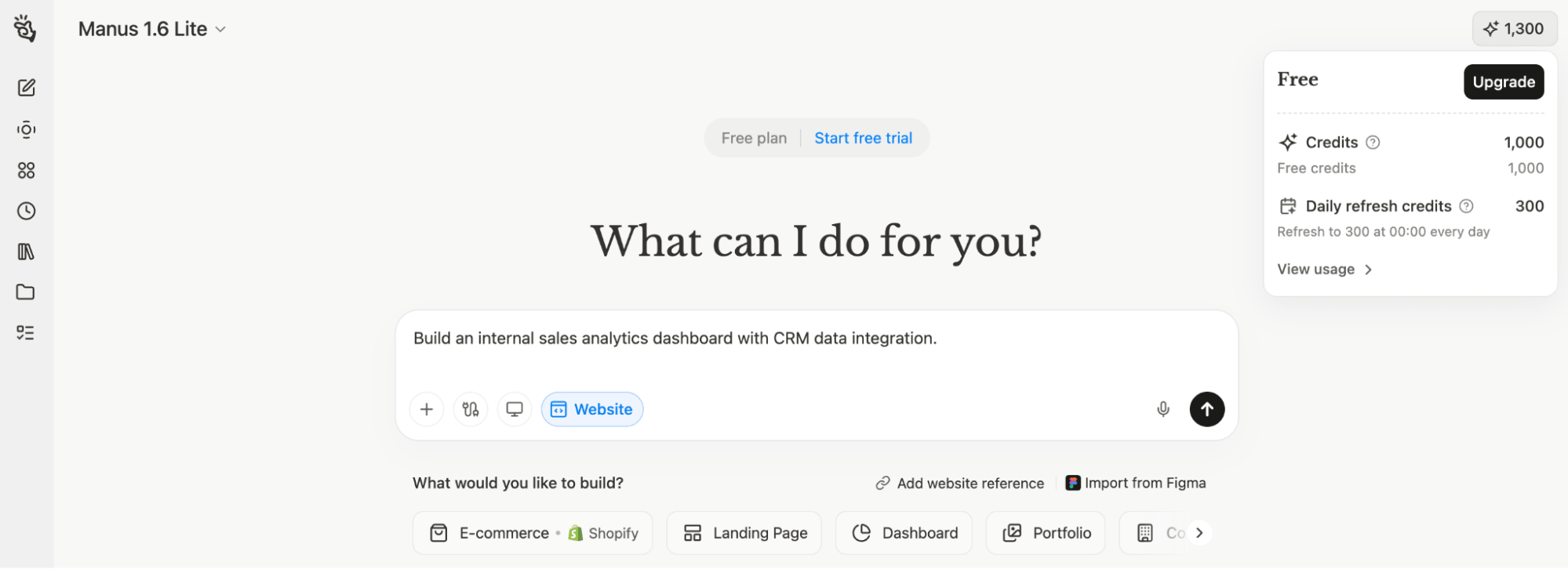
Manus uses a credit-based consumption model layered over a monthly subscription fee. Unlike simple token-in/token-out pricing, credit burn scales directly with task complexity, tool usage, and execution duration.
-
Subscription Tiers:
- Free Tier: Includes 300 daily refresh credits (resetting every 24 hours; non-cumulative).
- Entry Tier ($20/month): Allocates 4,000 monthly credits + daily refresh credits.
- Mid Tier ($40/month): Allocates 8,000 monthly credits + daily refresh credits.
- Enterprise Tier ($200/month): Allocates 40,000 monthly credits + daily refresh credits.
- Note: Unused monthly credits expire at the end of each billing cycle and do not roll over.
-
Consumption Variability:
- Low-Complexity Tasks (e.g., simple data extraction or quick single-site lookup): 5–10 credits.
- High-Complexity Workflows (e.g., deep multi-site research, synthetic data transformation, multi-page document compilation): 900+ credits per run.
Task Complexity vs. Credit Consumption

[Simple Query / Lookup]
  █ 5-10 Credits

[Multi-Site Synthesis & Report Generation]
  ████████████████████████████████████████ 900+ Credits
Quantitative Case Study 1: B2B Proposal Generation
In a standard consulting workflow, preparing a comprehensive client proposal requires gathering background data, performing prospect research, analyzing competitive positioning, drafting discovery briefing docs, and building personalized proposals.
- Legacy Toolchain Pipeline: Perplexity (Research Prompting) → Gemini Deep Research (30–40 page company background) → Gemini Canvas (Interactive Dashboard Creation) → Discovery Call → Claude (Transcript Synthesis & Proposal Drafting).
- Human Labor Time: 3.0 to 4.0 hours per prospect.
- Operational Risk: High fragmentation, manual copy-pasting errors, context loss across tool boundaries.
- Manus Integrated Workflow: Single prompt execution running autonomously across browser environments, synthesizing research, generating context dashboards, and producing final proposals post-call.
- Initial Workflow Build Cost: ~$15.00 in credits.
- Execution Cost per Client: ~2,000 to 3,000 credits (~$5.00 equivalent).
- Human Labor Time: Restricted solely to uploading the call transcript into the active thread (< 5 minutes total human intervention).
Quantitative Case Study 2: Enterprise L&D Training Architecture
During an enterprise operational test within a global food and beverage manufacturing organization, Manus was tasked with building an end-to-end Learning & Development (L&D) training framework.
- Project Scope: Analyze internal operational documentation, structure a multi-module training program, build practical exercises, compile an extensive reference manual, and generate an interactive grading framework.
- Agent Performance Output:
- Execution Steps: 42 autonomous steps.
- Execution Time: 49 minutes continuous processing.
- Structural Adaptation: Autonomously adjusted the requested 6-module syllabus to a 7-module structure after identifying critical domain coverage gaps during web and document analysis.
- Deliverables Generated: A comprehensive 7-module curriculum, practical experiential exercises, a 150-page training manual, and an interactive knowledge-assessment quiz.
- Corporate Baseline Comparison: The enterprise’s internal L&D team had spent two years on the initiative, reaching step 4 of their internal roadmap, and had recently received a $150,000 commercial quote from an external agency to complete the project.
Official Statements & Expert Perspectives
In analyzing the practical implementation of agentic architectures, experts emphasize that working with tools like Manus requires a fundamental shift in how teams approach operations and organizational knowledge.
Kate vanderVoort highlights that the primary hurdle in adopting agentic AI is unlearning habits formed while using standard chat interfaces:
"The biggest mistake users make when transitioning to Manus is bringing a chatbot mindset to an agent platform. If you hired a $500-per-hour business consultant, you wouldn’t waste billable hours brainstorming basic ideas out loud. You would show up with a complete operational brief. Manus functions under the exact same logic. Every minute spent ‘thinking out loud’ inside the runtime actively consumes credits. Strategy belongs outside the agent; execution belongs inside it."
Addressing the role of Standard Operating Procedures (SOPs) as the core instructions for autonomous systems, vanderVoort adds:

"When we convert SOPs into Manus Skills, we aren’t just documenting what steps to take—we are capturing the why. A well-built Skill records the business logic behind a decision, the target audience considerations, and the rationale behind specific formatting choices. Once an agent understands the underlying logic, its outputs stop reading like generic AI text and start matching how your business actually operates."
On platform safety, governance, and skill distribution, Michael Stelzner noted the necessity of strict supply-chain security when loading third-party automation components:
"Because a Manus Skill contains detailed operational instructions and can execute code, security and source verification become paramount. Installing untrusted skills downloaded from open forums or unverified repositories exposes your workflows to execution risks. Organizations must treat AI skill files with the same security oversight as executable software."
Future Outlook & Industry Implications
The progression from conversational language models to autonomous execution platforms like Manus marks a significant shift in enterprise automation. Several industry developments are emerging from this transition:

[Conversational Era]         [Task Automation Era]         [Autonomous Agent Era]
  Stateless LLMs        ──►    Linear Zapier Hooks   ──►   Persistent Cloud Computers
 (Text Generation)             (API-to-API Transfers)        (Dynamic 24/7 Execution)
1. The Rise of "Always-On" Cloud Compute Staff
The launch of persistent environments like the Manus Cloud Computer signals a shift away from ephemeral, single-session executions. Cloud-hosted agents can run continuously, acting as virtual employees that perform ongoing competitor analysis, monitor regulatory shifts, curate real-time news summaries, and manage client engagement channels (e.g., WhatsApp, Telegram) without requiring a local machine to remain powered on.
2. Standard Operating Procedures (SOPs) as Executable Code
Historically, enterprise SOPs remained static in internal document repositories, often growing outdated as workflows evolved. In an agent-driven ecosystem, SOPs become functional software assets. Organizations that convert their procedural knowledge into structured skill files (across operational tiers such as brand voice, legal compliance, research methodologies, and content production) can instantly run complex operational workflows on demand.
3. Democratization of Technical Environment Provisioning
A key barrier to software automation has traditionally been the technical knowledge required to set up execution environments, manage Command Line Interfaces (CLIs), and maintain database structures. Modern agentic systems bridge this gap by converting natural language instructions into fully configured virtual environments. Non-technical business leaders can now deploy complex software pipelines without relying on custom engineering support.
As platforms like Manus continue to evolve, organizational advantage will depend less on writing individual prompts and more on effectively mapping, structuring, and scaling autonomous business workflows.