Executive Overview
The landscape of artificial intelligence engineering has fundamentally shifted. Developing proof-of-concept applications powered by a single large language model (LLM) or a solitary, isolated autonomous agent is now relatively straightforward. However, the architectural challenge facing modern software engineers has evolved from mere orchestration to massive, concurrent scaling.
Keeping a fleet of autonomous AI agents operating simultaneously—coordinating complex, multi-step workflows without deadlocking the event loop, inducing memory leaks, or triggering cascading rate-limit failures—requires rigorous design patterns.
Python’s built-in asyncio library provides the foundational primitives necessary to manage concurrent I/O-bound operations. Yet, simply deploying coroutines without a battle-tested coordination strategy introduces subtle failure modes. These issues are notoriously difficult to reproduce in local development environments and can cripple production systems under heavy load.
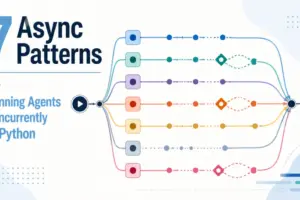
To bridge the gap between fragile prototypes and resilient, enterprise-grade systems, engineers must understand how to deploy and secure specific async architectural patterns. This report examines seven essential asynchronous patterns for running AI agents concurrently in Python, detailing their ideal use cases, operational benefits, and critical production-level pitfalls.
Detailed Chronology & Architectural Evolution of Agent Concurrency
As development teams moved from synchronous, blocking API requests to asynchronous paradigms, the methods for managing concurrent workloads underwent significant evolution. Early Python applications relied on threading models that struggled with the sheer volume of network I/O inherent in modern LLM applications. The introduction of native async/await syntax and the asyncio library standardized asynchronous programming, but it left the burden of architectural design entirely on developers.
[Synchronous Execution] ──> [Basic Threading] ──> [Native Asyncio (async/await)] ──> [Enterprise Task Groups (Py 3.11+)]1. Fire and Forget (Detached Background Execution)
In a "Fire and Forget" workflow, an orchestrator launches an agent task and immediately moves forward without awaiting its completion. The coroutine executes in the background while the primary execution path continues uninterrupted.
- Ideal Use Case: Non-blocking operations whose outcomes do not impact downstream logic. This includes writing telemetry data, flushing contextual memory to vector databases, or triggering asynchronous background cleanup routines.
- Production Pitfall: Exceptions raised inside detached tasks are silently swallowed by the event loop. If a background logging or cleanup agent fails due to an API timeout or schema violation, no exception propagates to the main thread. Developers must explicitly attach robust error callbacks and localized try-except blocks before treating any background task as safe to ignore.
2. Strict Scatter-Gather
The Scatter-Gather pattern fans out a single orchestrator workflow into multiple worker agents simultaneously. It pools their execution and blocks the primary flow until every single worker has returned a result.
- Ideal Use Case: Parallelized data ingestion or multi-source retrieval. For instance, five distinct agents querying separate enterprise databases or external APIs concurrently, with their payloads aggregated only after the slowest agent completes.
- Production Pitfall: By default, native utilities like
asyncio.gather()operate with a "fail-fast" mentality, where a single exception immediately cancels all sibling tasks. Even when configured to return exceptions rather than raise them, the pattern remains vulnerable to straggler latency. The entire operation is bottlenecked by the slowest responding agent, turning an otherwise performant batch job into a latency trap.
3. Supervised Task Groups
Introduced in Python 3.11, structured concurrency via asyncio.TaskGroup offers a modern, highly predictable alternative to loose task collections. Task groups utilize context managers to establish a clear lexical scope for concurrent operations. When the block exits, all enclosed tasks are guaranteed to be either fully completed or cleanly cancelled, and exceptions surface immediately.
- Ideal Use Case: Greenfield projects running Python 3.11 or newer that require deterministic lifecycle management for a batch of parallel worker agents.
- Production Pitfall: Task groups are aggressively protective. If a single worker agent fails or encounters an unhandled exception, the task group immediately cancels all remaining sibling tasks. If one agent breaches an API rate limit, every other active agent in the group is instantly terminated. Developers must build localized retry and backoff logic directly inside individual agent coroutines to prevent transient errors from destabilizing the entire task group.
4. Producer-Consumer with Queues
Real-world agent systems rarely start all tasks at the exact same moment. Frequently, a producer agent generates dynamic workloads that must be processed by a pool of consumer agents. A thread-safe or async-safe queue acts as a decoupled buffer between them.
- Ideal Use Case: Stream processing, dynamic task allocation, and complex multi-agent pipelines where generation rates fluctuate unpredictably and consumer scaling is required.
- Production Pitfall: Unbounded queues create silent memory leaks. If a high-volume producer agent generates tasks faster than the consumer pool can process them, the internal buffer expands indefinitely until the host process exhausts its RAM and encounters an Out-Of-Memory (OOM) crash. Production systems must always set a maximum queue size (
maxsize) to enforce backpressure on upstream producers.
5. Backpressure via Semaphores
When scaling agents, hardware and API limits dictate the maximum allowable concurrency. Semaphores establish a hard ceiling on how many agents can access a constrained resource simultaneously, forcing excess agents to queue up politely.
- Ideal Use Case: Protecting external LLM provider APIs, internal database connection pools, and downstream microservices from being overwhelmed by traffic spikes.
- Production Pitfall: Semaphores limit connection concurrency, not token consumption. A developer might safely cap concurrent requests at 10 using a semaphore, yet still rapidly exhaust an LLM provider’s Tokens-Per-Minute (TPM) quota if all 10 agents happen to generate massive multi-thousand-token outputs concurrently. True production resilience requires pairing semaphores with token-aware throttling mechanisms.
6. Speculative Execution (First Completed Wins)
Speculative execution sacrifices compute efficiency to achieve maximum speed. The orchestrator races multiple agent variations against the exact same objective and instantly cancels the losing tasks the moment the first valid result is returned.
- Ideal Use Case: Latency-critical applications. For example, racing a smaller, highly optimized model against a larger, deeply reasoning model, accepting whichever response satisfies the latency threshold first.
- Production Pitfall: While cancelling a task terminates the local socket connection, it frequently does not halt generation on the remote provider’s servers. The upstream model continues computing and consuming tokens against your account even after your application has discarded the request. Consequently, organizations pay for every losing agent execution in full, which can drastically inflate API costs.
7. Asynchronous Pipeline Chaining
Pipeline chaining organizes agents sequentially, where the output of one agent serves as the input for the next. For instance, Agent A extracts raw unstructured text, Agent B sanitizes and normalizes it, Agent C performs semantic analysis, and Agent D formats the final structured payload.
- Ideal Use Case: Complex multi-stage retrieval-augmented generation (RAG) pipelines, automated reasoning loops, and modular workflows with distinct security or role boundaries.
- Production Pitfall: End-to-end tracing is notoriously difficult without rigorous instrumentation. By the time Agent D crashes due to a malformed schema or invalid argument, the root cause may have originated entirely in Agent A. Production pipelines must inject cryptographically secure tracing identifiers into every payload passed between stages to maintain observability.
Supporting Context & Operational Metrics
Deploying concurrent AI agents at scale requires continuous profiling of system metrics. Engineering teams must monitor several key performance indicators (KPIs) to ensure their async architectures remain healthy:
- Event Loop Latency: Measures the delay between when a callback is scheduled and when it actually executes. High event loop latency indicates a blocked loop, which severely impacts downstream request timeouts.
- Task Queue Depth: In producer-consumer setups, tracking queue length provides real-time visibility into backpressure and consumer saturation.
- Token Velocity (TPM/RPM): Monitoring tokens-per-minute and requests-per-minute against provider rate limits prevents unexpected HTTP 429 errors.
- Memory Footprint per Coroutine: Tracking resource consumption ensures that scaling agent pools does not trigger premature OOM events.
The following matrix contrasts the seven async patterns across critical operational dimensions:
| Async Pattern | Primary Advantage | Primary Risk Factor | Recommended Python Primitives |
|---|---|---|---|
| 1. Fire and Forget | Non-blocking execution | Swallowed exceptions | asyncio.create_task() |
| 2. Strict Scatter-Gather | High parallelism | Straggler bottlenecks | asyncio.gather() |
| 3. Supervised Task Groups | Structured lifecycle | Sibling cancellation storms | asyncio.TaskGroup (Py 3.11+) |
| 4. Producer-Consumer | Decoupled scalability | Unbounded memory growth | asyncio.Queue |
| 5. Backpressure Semaphores | Resource protection | Token-limit exhaustion | asyncio.Semaphore |
| 6. Speculative Execution | Minimal latency | Uncontrolled API billing | asyncio.as_completed() / manual cancel |
| 7. Pipeline Chaining | Modular responsibility | Obscured error tracing | Custom async generators / queues |
Official Statements & Industry Perspectives
As artificial intelligence systems transition from experimental scripts to mission-critical infrastructure, software architects emphasize the critical need for robust concurrency controls.
Principal infrastructure engineers across the AI ecosystem note that asynchronous I/O is merely the starting point for modern agentic workflows. According to enterprise platform architects, “The primary failure mode of modern multi-agent systems is not network latency or model hallucinations; it is structural fragility in how concurrent state and rate limits are managed. When fifty agents execute simultaneously without proper backpressure, they create synthetic denial-of-service attacks against internal databases and external API providers alike.”
Furthermore, systems reliability engineers stress the hidden dangers of mixing synchronous, CPU-bound operations—such as heavy JSON parsing, cryptography, or tokenization—directly inside an asynchronous event loop.
Industry standards increasingly advocate for hybrid architectures where I/O-bound agent coordination is managed via asyncio, while heavy computational tasks are safely offloaded to process pools using concurrent.futures.ProcessPoolExecutor.
Future Outlook & Emerging Standards
Looking ahead, the evolution of concurrent AI agent architecture will be defined by stricter native type safety, automated backpressure negotiation, and decentralized agentic mesh networks.
As Python continues to optimize its concurrency models in versions 3.12 and beyond, developers can anticipate more granular diagnostic tooling built directly into the standard library. Future frameworks will likely automate speculative execution cost-tracking, allowing systems to dynamically calculate whether the latency savings of racing multiple models outweigh the associated token expenditure.
Moreover, as organizations transition from single-application agent teams to enterprise-wide multi-agent ecosystems, distributed asynchronous queues (such as Redis-backed task brokers) will replace in-memory asyncio.Queue primitives.
By mastering the seven foundational async patterns detailed in this report—and proactively mitigating their respective production pitfalls—engineers can build resilient, high-performance AI systems capable of scaling gracefully under demanding real-world workloads.