Executive Overview
In a strategic pivot that signals a profound evolution in personal computing, Microsoft has announced a major redesign of the Windows 11 Search Menu, effectively turning a long-criticized operating system feature into an interactive, conversational chatbot. Slated for a rollout this fall, the revamped interface will allow users to execute thousands of distinct system actions, query local files, adjust system parameters, and interface directly with Copilot—all through a single, streamlined command line embedded directly into the Windows Taskbar.
This announcement, delivered by Pavan Davuluri, Microsoft’s Executive Vice President of Windows and Devices, during the company’s high-profile fall Surface event in San Francisco, comes less than a year after Microsoft walked back its aggressive, mandatory Copilot integrations. Recognizing user feedback that forced AI features felt clunky or intrusive, the tech giant is now pursuing a more integrated, contextual, and user-controlled approach. Rather than forcing users to open a separate application window, the new Windows Search leverages ambient artificial intelligence to understand natural language prompts, instantly surfacing settings sliders, launching deep system routines, and integrating deeply with the newly updated Copilot app.
Simultaneously, Microsoft unveiled Hybrid Intelligence, a groundbreaking suite of software orchestration tools designed to blend on-device, local AI processing with cloud-based inference. By allowing PCs to execute advanced AI models locally, Microsoft is tackling lingering industry concerns regarding user privacy, data security, and operational latency. Combined with security features like Microsoft Execution Containers (MXC) and enhanced personal agent capabilities within Autopilot, this fall’s update marks a definitive turning point in how humans interact with their operating systems—shifting the paradigm from manual point-and-click navigation to intent-driven, conversational computing.
Detailed Chronology & Event Breakdown
The transformation of Windows Search did not happen overnight; it is the culmination of a multi-year effort by Microsoft to embed artificial intelligence deeply into its flagship operating system.
The Journey from Bloat to Balance
In late 2023 and early 2024, Microsoft introduced Copilot to Windows 11 with immense fanfare, positioning it as the ultimate digital assistant. However, early implementations drew sharp criticism from power users, enterprise administrators, and privacy advocates alike. Copilot was frequently shoehorned into applications as a standalone web wrapper, consuming unnecessary system resources and cluttering the desktop interface. By mid-2024, facing mounting consumer pushback, Microsoft rolled out updates that allowed users to remove Copilot from select Windows apps, decouple it from the taskbar, and regain granular control over their user environments.
The lessons learned during this period laid the groundwork for the philosophy behind the upcoming fall redesign. Instead of treating AI as an external application slapped onto the operating system, Microsoft realized that artificial intelligence needed to act as the invisible connective tissue of the OS itself.
The Fall Surface Event Unveiling
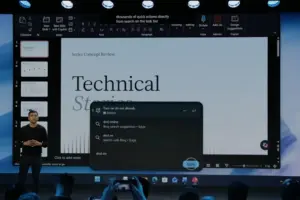
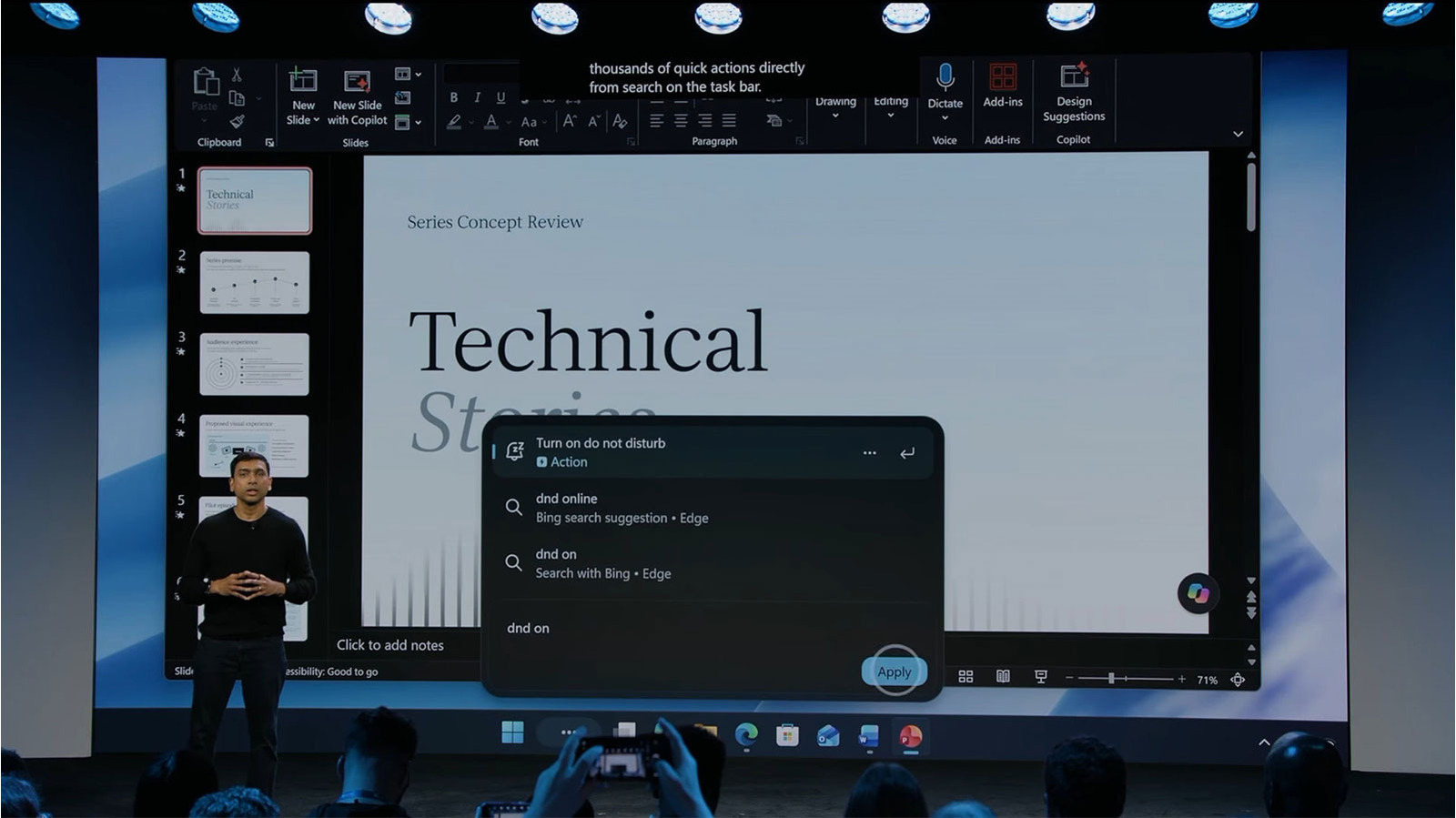
During the keynote address in San Francisco, Pavan Davuluri took the stage to demonstrate what the future of Windows interaction looks like. The centerpiece of the presentation was the new Search Menu.
Rather than merely indexing local hard drives or serving up web search results via Bing—a frequent pain point for users who just wanted to launch local apps or find specific files—the new search interface acts as an active agent. Davuluri demonstrated typing intuitive phrases like "turn on dark mode," "enable do not disturb," or "increase mic volume." Instead of navigating through multiple layers of the Settings app, the interface immediately responded: toggles shifted instantly, and a dedicated volume slider materialized directly above the prompt bar.
Furthermore, Davuluri showcased how users can converse directly with the updated Copilot app through the search interface without ever launching the standalone application. For power users with a smartphone paired to their Windows PC, the upgraded taskbar now supports sending text messages and managing notifications natively through quick text prompts, bridging the gap between mobile and desktop ecosystems.
The Introduction of Hybrid Intelligence
Following the search demonstrations, Microsoft expanded on the architectural foundation making these features possible: Hybrid Intelligence.
The company detailed how modern Windows PCs—particularly Copilot+ PCs equipped with dedicated Neural Processing Units (NPUs)—can dynamically route computing tasks. Simple, privacy-sensitive, or latency-critical tasks are processed locally on the machine’s hardware using lightweight, highly efficient small language models (SLMs). Meanwhile, computationally intensive requests that require massive reasoning engines are securely routed to the cloud.
This orchestration layer forms the backbone of the updated Autopilot and developer tools, ensuring that local AI agents operate swiftly, securely, and without unnecessary cloud round-trips.
Supporting Context & Metrics: Under the Hood
To truly understand the significance of transforming Windows Search into a chatbot, one must examine the technical hurdles Microsoft had to clear, alongside the underlying architecture powering Hybrid Intelligence and local AI execution.
Resolving Historical Pain Points of Windows Search
For over a decade, Windows Search has been a persistent target of user dissatisfaction. Historically plagued by sluggish indexing, erratic web result integration (which often pushed sponsored Bing links over local file paths), and excessive CPU utilization, many users routinely disabled the Windows Search service entirely, opting for third-party utilities like Everything or Alfred-style launchers.
The new search architecture addresses these historical bottlenecks through several key mechanisms:
- Contextual Inference Engine: The new system utilizes localized intent recognition to bypass heavy web-scraping queries when a user is clearly trying to perform a local system action.
- Streamlined UI Rendering: Built on modern WinUI frameworks, the search flyout loads faster and consumes fewer graphical resources.
- Deep API Hooks: By granting the search interface direct API access to Windows Core OS components, commands like changing audio devices or altering display scaling happen instantaneously, bypassing the graphical settings tree entirely.
The Architecture of Hybrid Intelligence
Hybrid Intelligence is more than just a marketing buzzword; it represents a fundamental shift in Windows software orchestration. By unifying cloud and local processing, Microsoft is addressing three critical pillars of modern computing: Privacy, Cost, and Performance.
+-----------------------------------------------------------------+
|                    Hybrid Intelligence Engine                   |
+-----------------------------------------------------------------+
       |                                                   |
       v                                                   v
+-----------------------------+     +-----------------------------+
|    Local NPU Processing     |     |     Cloud Infrastructure    |
+-----------------------------+     +-----------------------------+
| • High Privacy (No data     |     | • Complex Reasoning         |
|   leaves device)            |     | • Massive Model Scale       |
| • Zero Latency              |     | • Heavy Creative Tasks      |
| • Offline Functionality     |     | • Advanced Code Generation  |
+-----------------------------+     +-----------------------------+
                                                          /
                                                         /
         v                                               v
+-----------------------------------------------------------------+
|                        Windows 11 Copilot                       |
+-----------------------------------------------------------------+- Privacy-First Processing: In scenarios handling sensitive information—such as financial documents, corporate records, or personal journals—Hybrid Intelligence automatically routes prompts to local models. As demonstrated by Microsoft’s tax-document organization scenario, the AI can read, rename, compress, and draft emails regarding local files without a single byte of personal data traversing the internet.
- Reduced Cloud Infrastructure Costs: Running massive LLMs in the cloud for every trivial user query is economically and environmentally unsustainable. By offloading thousands of routine task executions (like toggling settings or summarizing local text) to local NPUs, Microsoft significantly reduces cloud compute overhead.
- Offline Capability: Because the core command-and-control features are backed by local models, users retain advanced chatbot and system-automation capabilities even when disconnected from the internet.
Developer Empowerment via Microsoft Execution Containers (MXC)
For developers, the integration of Hybrid Intelligence brings robust support for Microsoft Execution Containers (MXC). Writing native Windows applications using Copilot has historically carried some security risks, primarily concerning rogue AI agents executing unintended system modifications.
MXC creates a secure, sandboxed environment for local AI agents. Developers can build, test, and deploy automated routines and custom extensions knowing that the AI operates within strict security boundaries, preventing unauthorized file system access or malicious prompt injection attacks.
Official Statements & Industry Perspective
Microsoft’s leadership is framing this release not merely as a feature update, but as a philosophical milestone in human-computer interaction.
"To make AI a part of everyday life, we need to bring it to places people use the most — into the flow of human ambition," said Pavan Davuluri, Executive Vice President of Windows and Devices, during his keynote address in San Francisco. "We’re moving into a future where everyone can simply express what they want, and their Windows PC, with their permission, can take action on their behalf."
Industry analysts have responded with cautious optimism. While consumers have historically grown fatigued by relentless pushes toward cloud-centric AI services, Microsoft’s pivot toward local execution and utilitarian task management appears to hit the right notes.
Tech analysts note that by focusing on practical, mundane friction points—such as adjusting system configurations, managing notifications, and sorting local files—Microsoft is solving real user annoyances rather than forcing abstract generative art tools onto unwilling professionals. Furthermore, the emphasis on local privacy via Hybrid Intelligence directly counters the growing regulatory scrutiny facing tech giants over enterprise data harvesting and cloud telemetry.
Future Outlook: What This Means for the PC Ecosystem
The launch of the chatbot-powered Windows Search and Hybrid Intelligence this fall is poised to reshape the personal computing landscape in several profound ways.
1. The Death of Traditional Menu Navigation?
As conversational interfaces become more robust, the traditional multi-tiered graphical user interface (GUI) may slowly take a back seat. While control panels and settings menus will not disappear overnight, the primary mode of interaction for power users and mainstream consumers alike is shifting toward natural language commands. Typing or speaking an intention is inherently faster than hunting through nested submenus, suggesting that Windows 11 could be the last operating system version where manual navigation is the primary design paradigm.
2. A Hardware Arms Race for NPUs
Microsoft’s heavy reliance on local model execution places immense strategic value on hardware specifications. Standard CPUs and traditional GPUs are ill-equipped to run local language models efficiently without draining laptop batteries. Consequently, this update accelerates the transition toward NPU-equipped Copilot+ PCs. Manufacturers like Intel, AMD, and Qualcomm will find their silicon evaluated not just by raw clock speeds, but by their TOPS (Tera Operations Per Second) metrics and their ability to smoothly run Microsoft’s Hybrid Intelligence workloads.
3. Enterprise Adoption and Data Governance
For enterprise IT administrators, the prospect of local AI processing is a welcome development. Historically, corporate security policies strictly prohibited employees from pasting proprietary data into cloud-based AI tools due to compliance and data leakage concerns. By leveraging local models that keep sensitive files strictly within the corporate perimeter, Hybrid Intelligence opens the floodgates for widespread AI adoption in finance, healthcare, legal, and government sectors.
Conclusion
Microsoft’s decision to turn the Windows Search menu into an interactive, chatbot-driven command center is a masterclass in listening to user feedback. By abandoning the intrusive, app-bloated approach of the past and replacing it with contextual, lightning-fast local intelligence, Microsoft has solved the long-standing frustrations of Windows Search. As these features roll out to hundreds of millions of PCs this fall, they will not only redefine how we interact with our computers—they will set a new baseline for what consumers and enterprises alike expect from a modern operating system.