Executive Overview
In an era where a single search result can define a professional reputation or a personal brand, the ability to curate one’s digital footprint has transitioned from a luxury to a necessity. Recent data analysis conducted by Erase.com provides an unprecedented look into the mechanics of online reputation management (ORM). By examining over 22,000 removal requests processed between January and September 2026, we have gained critical insights into what content can be removed, which platforms are most cooperative, and how the rise of AI-generated search summaries is complicating the landscape.
The findings are stark: not all negative content is created equal. While automated systems like Google’s review policy have streamlined the removal of specific infractions, legacy platforms and independent news outlets remain formidable hurdles. As artificial intelligence begins to synthesize negative reviews and search results into “AI Overviews,” the urgency to address harmful content has reached a boiling point. This report serves as a comprehensive guide for individuals and businesses navigating the complex bureaucracy of the internet.
Detailed Chronology: The Lifecycle of a Removal Request
Understanding the lifecycle of a removal request is the first step in managing digital crises. Erase.com’s internal data highlights that the median time for a successful removal—whether through deletion, de-indexing, or redaction—is approximately 18 days. However, this figure masks the massive variance between different types of content.
The Sprint: Court Records and Mugshots
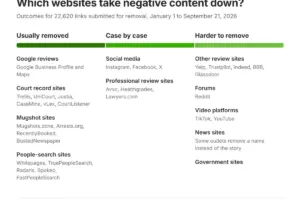
For those dealing with legal records, time is of the essence. Fortunately, the data suggests that republished court records and mugshot databases are among the fastest to process. With a median removal time of just 9 to 11 days, these platforms often have established protocols for opt-outs. Because these sites frequently scrape government databases, they are often legally or ethically compelled to provide mechanisms for removal when a case is expunged or a user requests privacy.
The Marathon: News and Corporate Reviews
Conversely, the "hard-to-remove" category includes news articles and reviews on sites like Yelp, Trustpilot, and Glassdoor. These platforms prioritize editorial independence and consumer feedback, meaning they rarely remove content unless it blatantly violates their specific terms of service. For news outlets, the process often extends beyond 28 days, as any request must bypass editorial boards that weigh the public interest against the individual’s right to be forgotten.
Supporting Context & Metrics: The Data Breakdown
The study analyzed 22,620 links, offering a statistical snapshot of the digital landscape. To provide clarity, we have categorized the removal efficacy by content type:

| Content Type | Median Days to Removal | Success Within 30 Days |
|---|---|---|
| Court Records | 9 Days | 89% |
| People-Search Listings | 9 Days | 84% |
| Mugshots | 11 Days | 93% |
| Social Media | 14 Days | 79% |
| Google Reviews | 19 Days | 67% |
| News Articles | 28 Days | 51% |
The "De-indexing" Pivot
It is crucial to distinguish between "full removal" and "de-indexing." When a direct removal is impossible, savvy reputation managers often pivot to de-indexing. This process requests that search engines like Google stop displaying the link in their results. While the page remains live on the host site, its impact on a user’s digital reputation is effectively neutralized because it becomes invisible to the average person conducting a search.
The AI Factor: Why Accuracy Matters Now More Than Ever
The most significant shift in the 2026 digital landscape is the integration of AI Overviews in search engines. As highlighted in our May analysis for Search Engine Journal, AI models often pull from the "long tail" of the internet to provide summaries.
This creates a high-stakes scenario: if a negative review or an old, inaccurate news story exists, AI may synthesize that information into a concise summary that sits at the very top of a search results page—even if the user did not specifically ask for it. This makes the "hygiene" of your search results more important than ever. If your digital footprint is cluttered with outdated, negative, or false information, the AI will inevitably curate that information into a coherent narrative that can be devastating to a reputation.
Strategic Approaches: Navigating Platform Policies
To effectively manage negative search results, one must understand the specific rules of the ecosystem.
Google Reviews: The Policy-First Approach
Google’s review policy is robust. To succeed here, you must move beyond claiming a review is "unfair." You must prove it violates a policy:
- Conflict of Interest: Does the reviewer have a personal stake or a past relationship with the business?
- Harassment/Off-topic: Is the review personal, defamatory, or completely irrelevant to the services provided?
- Personal Information: Does the review contain private details that violate privacy laws?
The News and Media Hurdle
News outlets are the most difficult to influence. They are protected by principles of journalistic freedom. However, there are nuances. If a story contains outdated information, a significant error, or poses a legitimate security risk, requesting a "name edit" (redacting your name from the text) or requesting that the article be de-indexed is often more successful than asking for a full deletion.

The Social Media Ecosystem
Instagram, Facebook, and X (formerly Twitter) generally respond well to reports of impersonation or the sharing of private information. However, content that merely expresses a negative opinion is rarely removed. In these cases, the best strategy is often "suppression"—the practice of creating high-quality, positive, and authoritative content that pushes the negative post to the second or third page of search results, where it is rarely seen.
Future Outlook: The Right to Digital Privacy
As we look toward the future, the legal landscape regarding online reputation is shifting. The FTC’s Consumer Reviews and Testimonials Rule (effective October 2024) has already begun to curb the use of intimidation by businesses seeking to silence critics. Conversely, there is a growing movement advocating for a "Right to be Forgotten" in jurisdictions outside the EU, which could eventually simplify the removal of irrelevant or outdated information.
However, the burden remains on the individual or business to be proactive. The 2026 data confirms that waiting for time to "heal" a digital reputation is an ineffective strategy. Algorithms prioritize engagement, and negative content often generates the engagement that keeps it at the top of the pile.
Final Recommendations for Vetting Services
If you choose to outsource your reputation management, the data suggests you should vet your potential partner with the following four questions:
- What is your success rate for this specific platform? (Avoid providers who promise 100% removal for all sites.)
- Do you utilize de-indexing as a primary strategy? (This indicates a more realistic, technical approach.)
- How do you handle AI-generated summaries? (A sophisticated firm will have a plan to address how AI consumes your content.)
- What is your communication cycle for status updates? (Given the 18-day median, you should expect regular, transparent reporting.)
The digital age has turned our public records into a permanent, searchable archive. By understanding the data, respecting the policies of the platforms involved, and acting with precision, individuals can reclaim their digital narrative. The data from 2026 is clear: while the internet is vast and persistent, it is not immutable.
Disclaimer: This article was sponsored by Erase.com. The views, analysis, and data presented herein are those of the sponsor. Readers are encouraged to consult with legal counsel regarding specific privacy rights and defamation concerns.