Executive Overview
The deployment of Large Language Models (LLMs) at enterprise scale faces a silent, structural crisis. While foundation models have achieved astonishing capabilities in reasoning, synthesis, and code generation, their deployment is hamstrung by a fundamental operational bottleneck: autoregressive text generation. Every single time a chatbot responds, a line of code is completed, or a customer service query is resolved, the underlying model must produce its output one token at a time.
This single constraint has turned inference latency into one of the most critical engineering hurdles of the modern AI era. For real-time applications—such as voice agents, live coding assistants, and interactive diagnostic tools—even a fraction of a second of delay can degrade the user experience. Simply throwing more compute power at the problem through brute force has proven insufficient.
Enter speculative decoding.
Speculative decoding is a paradigm-shifting inference optimization technique that bypasses the traditional token-by-token constraint. By pairing a small, nimble "draft" model with a massive "target" model, speculative decoding achieves a 2x to 3x speedup in inference throughput. Crucially, it accomplishes this feat without modifying model weights, without retraining on new datasets, and—most importantly—without sacrificing an iota of output quality. Backed by rigorous statistical guarantees, the final output distribution remains mathematically identical to what the target model would have produced on its own.
As production frameworks like vLLM, Hugging Face Text Generation Inference (TGI), and llama.cpp integrate this technique natively, speculative decoding is rapidly transforming from an academic curiosity into an indispensable pillar of modern AI infrastructure.
Detailed Chronology: The Evolution of Inference Optimization
To understand the significance of speculative decoding, one must trace the historical evolution of how the artificial intelligence community has attempted to accelerate generative inference.
1. The Era of Naive Autoregression
In the early days of transformer deployment, inference was treated as a straightforward step-by-step process. The model processed the prompt, computed attention scores across its billions of parameters, and emitted a single token. It then appended that token to the context window and repeated the process. Compute hardware was utilized inefficiently, but because models were smaller and user bases were sparse, the latency was tolerable.
2. The Memory-Bandwidth Wall
As parameter counts exploded from millions to hundreds of billions, hardware constraints shifted. Engineers realized that modern AI accelerators—such as the NVIDIA H100 GPU—possessed more than enough raw floating-point compute capacity (FLOPs) to handle transformer math.
The real constraint became the memory bus. Because the model’s vast weights must be fetched from High Bandwidth Memory (HBM) into the processor cache for every single token generated, the GPU spends most of its lifecycle idling. It sits starved of data, waiting for weights to travel across the memory bus. The industry dubbed this the "memory-bandwidth bound" era. Standard computational scaling could no longer buy speed; engineers needed architectural cleverness.
3. The Birth of Speculative Sampling (Early 2023)
The breakthrough arrived when researchers independently formalized speculative decoding (often referred to in early literature as speculative sampling). By recognizing that verifying a batch of tokens is computationally cheap compared to generating them sequentially, researchers realized they could delegate the "guessing" work to a lightweight proxy model.
4. Modern Adaptations: Beyond Dual-Model Architectures
As the technique matured past its initial two-model formulation, researchers began removing the dependency on an external draft model altogether. Innovations such as Medusa (introducing multiple prediction heads directly onto the target model) and Eagle (leveraging internal hidden states for superior draft prediction) pushed acceptance rates higher. Concurrently, prompt-lookup methods bypassed secondary models entirely by mining the local context window, cementing speculative decoding as a dynamic, highly adaptable family of algorithms rather than a rigid trick.
Supporting Context & Metrics: Under the Hood of the Speculative Loop
To fully grasp why speculative decoding yields such dramatic speedups, one must examine the mechanics of the speculative loop and the quantitative metrics that dictate its efficiency.
The Memory-Bandwidth Bottleneck Explained
During standard text generation, the arithmetic intensity (FLOPs per byte of memory accessed) is exceptionally low. For every token emitted, the entire weight matrix of the target model must be loaded from memory. If a model has 70 billion parameters stored in 16-bit precision (roughly 140 gigabytes of data), generating a single token requires moving all 140 GB across the memory interface, even though the actual mathematical operations required for that single token take mere microseconds.
The Mechanics of the Speculative Loop
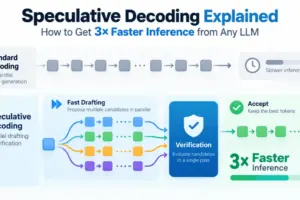
Speculative decoding breaks this cycle by structuring inference into distinct phases:
- The Draft Phase: A lightweight draft model (e.g., a 1-billion or 3-billion parameter model) autoregressively generates a short sequence of candidate tokens—typically 4 to 8 tokens deep. Because of its compact size, its memory footprint is small, allowing it to produce these guesses at blazing-fast speeds.
- The Verification Phase: The massive target model takes this entire candidate sequence and evaluates it in a single forward pass. Thanks to the parallel processing architecture of modern GPUs, processing a batch of tokens takes almost the same amount of time as processing a single token.
- The Acceptance/Rejection Test: Using a rigorous probabilistic rejection-sampling algorithm, the target model compares the draft model’s confidence against its own.
- If the target model’s probability distribution matches or exceeds the draft model’s confidence, the token is accepted.
- If the draft model was overconfident, the token is probabilistically rejected, and a corrected token is sampled from an adjusted residual distribution.
- The Mathematical Guarantee: This specific statistical adjustment ensures that the output tokens maintain the exact same probability distribution as native target-model generation. There is no degradation in output quality or perplexity.
[Prompt] ──> [Draft Model] (Generates 5 guesses rapidly)
                   │
                   ▼
             [Target Model] (Evaluates all 5 guesses in 1 parallel pass)
                   │
         ┌─────────┴─────────┐
         ▼                   ▼
   (4 Tokens Accepted)  (1 Token Rejected & Corrected)
         │                   │
         └─────────┬─────────┘
                   ▼
         [Final Output: 5 Tokens for the cost of ~1 Target Pass]
Key Performance Metrics
The efficacy of speculative decoding is governed by two primary metrics:
- Acceptance Rate ($A_r$): The percentage of draft tokens successfully validated by the target model. In well-matched model pairs (e.g., Llama-3-8B drafting for Llama-3-70B), acceptance rates routinely hover between 70% and 80%.
- Speedup Factor ($S$): Functionally, speedup scales sub-linearly with the length of the draft sequence and directly with the acceptance rate. With an 80% acceptance rate and a draft length of 5, systems regularly achieve real-world latency reductions of 2.5x to 3x.
Official Statements & Industry Perspectives
AI infrastructure leaders and systems architects have increasingly championed speculative decoding as a standard deployment pattern.
Dr. Joelle Pineau, VP of AI Research at Meta, has frequently emphasized that inference efficiency is just as critical as architectural scaling in modern machine learning research. "As models approach human-level reasoning capabilities, the cost and latency of serving them scale exponentially," industry researchers note in foundational systems papers. "Techniques like speculative decoding represent a vital paradigm shift—maximizing hardware utilization without compromising the integrity of the model’s learned distribution."
Engineering teams at major cloud providers and model-serving startups echo these sentiments. In release notes for vLLM and Hugging Face TGI, maintainers highlight that speculative decoding is no longer experimental.
"Enabling speculative decoding shifts the economics of LLM serving," notes a leading infrastructure engineer at a major AI deployment platform. "When you can squeeze three times the token throughput out of the exact same cluster of H100 GPUs simply by running a smaller companion model alongside your primary weights, it fundamentally alters capacity planning and cloud compute expenditures."
Furthermore, open-source contributors emphasize its accessibility. Because the technique requires no retraining or fine-tuning of the primary model weights, organizations can adopt it overnight through simple configuration flags in existing serving engines.
Future Outlook: The Next Frontier of Inference Acceleration
As we look toward the future of large language model deployment, speculative decoding is evolving beyond its initial implementations to tackle new computational paradigms.
1. Hardware-Aware Co-Designing
Future AI accelerators (such as next-generation TPUs, custom silicon ASICs, and specialized GPU architectures) are beginning to incorporate hardware-level primitives specifically designed to accelerate speculative verification loops. By optimizing cache persistence for the target model while maintaining ultra-low latency execution paths for draft generation, hardware manufacturers are bridging the gap between theoretical speedups and peak physical throughput.
2. Autonomous and Self-Drafting Models
While external draft models remain popular, the industry trend is moving toward integrated self-drafting mechanisms. Architectures derived from Medusa and Eagle point toward a future where models inherently possess multiple output heads or specialized internal gating layers that predict their own trajectories. This eliminates the operational overhead of managing and memory-mapping two distinct model binaries in production clusters.
3. The Multi-Tenant Serving Trade-Off
A crucial area of ongoing research involves optimizing speculative decoding for high-throughput, multi-tenant batch serving. While speculative decoding excels in low-concurrency environments (such as serving a single user streaming a coding assistant response), heavily batched enterprise environments face complex memory trade-offs. Future serving schedulers will dynamically toggle speculative decoding on or off based on real-time cluster load, traffic patterns, and GPU memory saturation.
Conclusion
Speculative decoding has permanently redefined how the AI industry approaches the latency wall. By treating the autoregressive bottleneck not as an immutable law of physics, but as an engineering constraint ripe for algorithmic innovation, it bridges the gap between massive model intelligence and real-time user expectations. As deployment frameworks mature and hardware architectures adapt, speculative decoding is cementing its status as an indispensable cornerstone of high-performance artificial intelligence infrastructure.