Executive Overview
The digital marketing ecosystem is undergoing a seismic, structural transformation, yet a significant portion of the industry is pouring resources into the wrong targets. For the past two years, the gold rush of Search Engine Optimization (SEO) has increasingly pivoted toward Generative Engine Optimization (GEO)—the pursuit of securing citations, brand mentions, and visibility inside Large Language Models (LLMs) like ChatGPT, Claude, and Perplexity.
However, newly analyzed data reveals a stark, counterintuitive reality: optimizing exclusively for LLM visibility misses where the actual return on investment (ROI) resides.
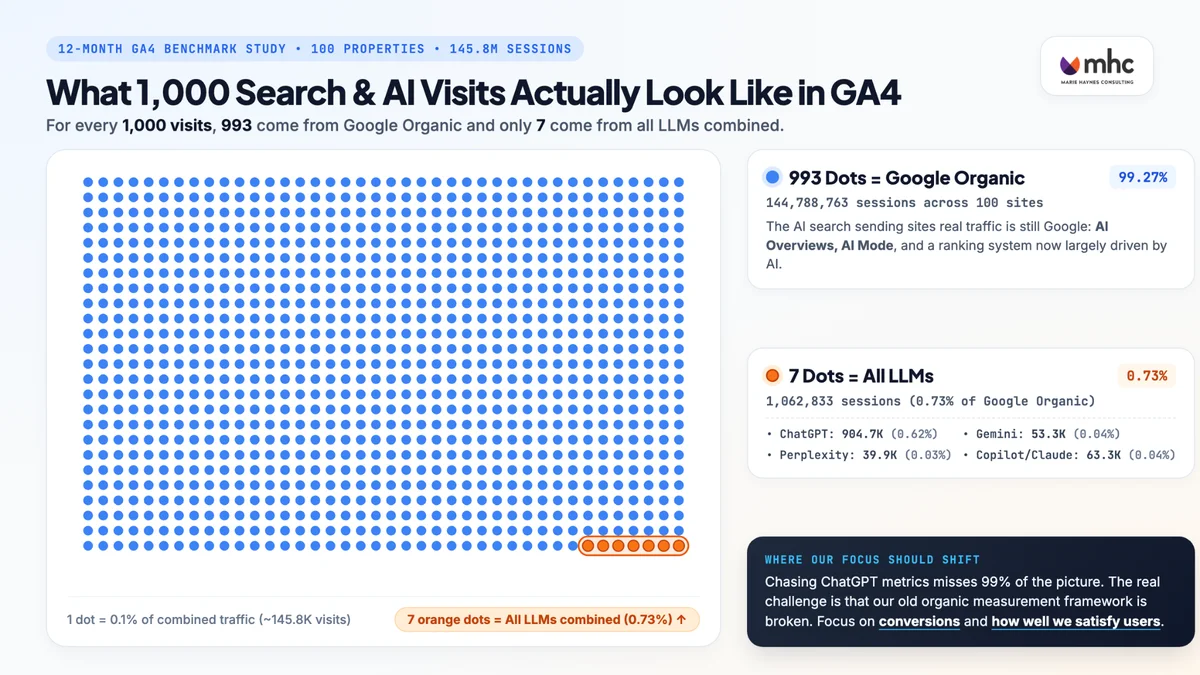
A comprehensive 12-month GA4 data study encompassing 100 diverse websites and over 145 million sessions demonstrates that referral traffic from ChatGPT and other direct LLM tools accounts for a minuscule fraction of web volume—averaging roughly 0.62% to 0.73% compared to traditional Google Organic traffic. Furthermore, the exponential growth curves once projected for direct LLM referral traffic plateaued following the release of models like GPT-5, revealing a contracting, rather than expanding, referral pathway.
Yet, this data does not imply that Artificial Intelligence is failing to reshape the web. Rather, it highlights a profound misdirection in strategic focus. AI has fundamentally altered search, but the dominant battleground remains Google. Through AI Overviews, AI Mode, deep-learning ranking paradigms, and the dawn of the "agentic web," Google commands the vast majority of intent-driven digital discovery. As search engines transition from passive blue-link indexes into active task coordinators and "agent managers," digital strategists must shift their focus away from chasing isolated AI chat citations and pivot toward the infrastructure of the agentic economy: Universal Carts, the Universal Commerce Protocol (UCP), WebMCP integrations, and ambient computing via intelligent eyewear.
Detailed Chronology: The Rise, Plateau, and Realities of AI Referral Traffic
When conversational AI tools first captured mainstream adoption, search marketers observed a rapid, compounding surge in referral clicks originating from platforms like ChatGPT. Early adopters and analysts extrapolated these initial exponential trajectories, predicting a near-future where direct conversational interfaces would eclipse traditional search engines as the primary gateway to the internet.
The industry braced for a paradigm shift, assuming that getting an LLM to cite a brand’s URL would become the ultimate currency of online visibility. But reality has proven far more nuanced.

The 145-Million-Session Dataset
To understand the true scale of AI-driven referral traffic, a rigorous analysis of 12-month Google Analytics 4 (GA4) data was conducted across 100 independent websites of varying sizes and niches, totaling more than 145 million sessions. The findings upend conventional industry anxiety:
- ChatGPT Referral Volume: Sessions originating directly from ChatGPT accounted for a mere 0.62% of the volume driven by Google Organic search.
- Total LLM Volume: When incorporating all other conversational LLM tools into the dataset, the collective aggregate rose only slightly to 0.73%.
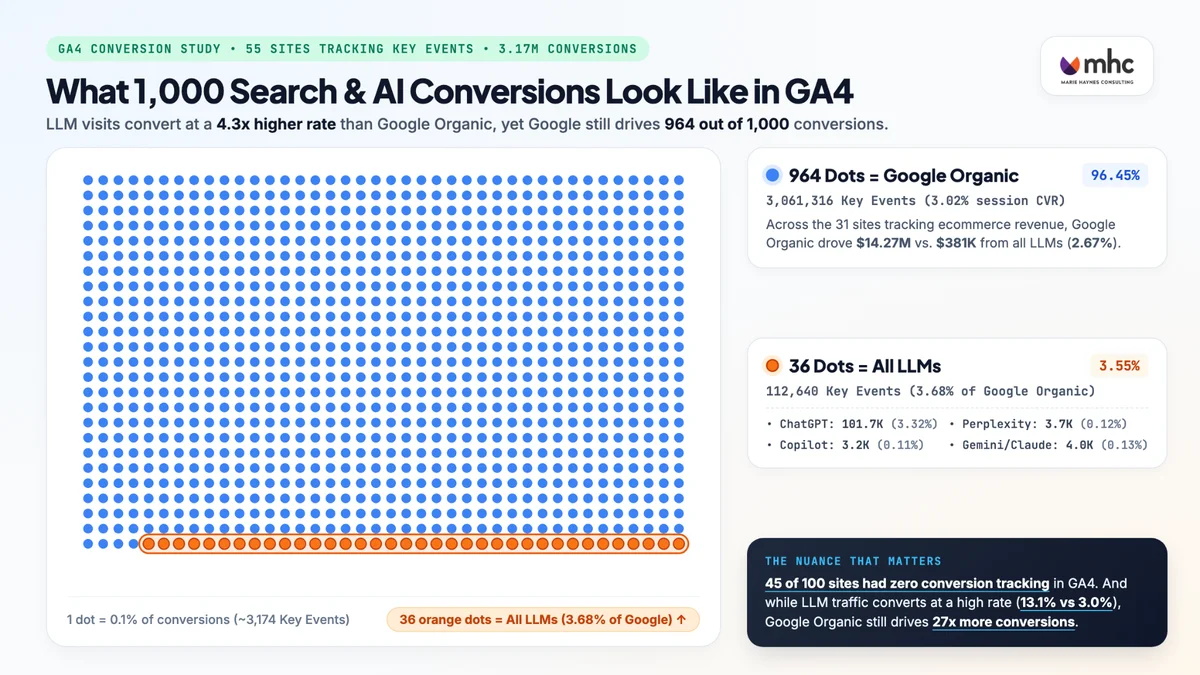
- The Conversion Discrepancy: Among the 55 sites in the dataset actively tracking key conversion events, ChatGPT visitors did exhibit a notably higher conversion rate—surpassing Google organic visitors by more than 4.5x.
- The Net Impact: Despite this higher conversion efficiency, the sheer volume disparity meant that Google Organic still accounted for 96.5% of total conversions across all analyzed channels. In absolute terms, Google organic traffic drove roughly 27 times more conversions than all LLMs combined.
The End of Exponential LLM Traffic Growth
Perhaps the most critical revelation in the data timeline centers on traffic momentum. When analyzing properties collectively, the exponential growth curve of ChatGPT referral visits reached an inflection point. Coinciding with updates like the rollout of GPT-5, the exponential climb in referral sessions flatlined. Rather than continuing on a steep upward trajectory toward dominance, direct referral traffic from ChatGPT plateaued and, in many sectors, began a gradual contraction.
Users are increasingly content to find their answers, summarize documents, and resolve queries directly inside the chat interface without clicking out to publisher websites. Consequently, treating direct LLM referrals as a primary growth channel is an exercise in diminishing returns.
Supporting Context & Metrics: Why Google Remains the Undisputed King of Intent
While digital marketers obsess over GEO and LLM chat optimization, search engines—specifically Google—have quietly integrated AI into the very fabric of their core ranking systems and user interfaces.
The Shift Inside the Search Engine Results Page (SERP)
The AI search behavior that actually drives customers to businesses today does not happen in isolated chat apps; it happens on Google surfaces. Through features like AI Overviews and AI Mode, alongside deeply integrated deep-learning ranking algorithms, millions of consumers execute complex, AI-powered queries every single day without ever leaving the Google ecosystem.
This shift has undeniably disrupted traditional informational publishing. Field studies indicate that AI Overviews can reduce organic click-through rates for informational content by upwards of 38%. Publishers lament the evaporation of top-of-funnel informational traffic, but this misses the macro-trend: consumer intent has evolved.
When users are actively looking to engage with a commercial entity, book a service, or purchase a product, Google Search remains by far the most reliable discovery engine. The challenge for modern brands is no longer just ranking for keywords, but measuring key performance indicators (KPIs) within an increasingly opaque landscape.
The Measurement Crisis
Data integrity remains a glaring vulnerability for modern digital strategies. In random audits of web properties, a staggering percentage of businesses fail to track basic key events or conversions in GA4. Traditional rank tracking provides nominal insight, and Google Search Console offers aggregated data that is rarely immediately actionable.
To thrive in an AI-dominated search environment, organizations must prioritize:
- Rigorous Conversion Tracking: Defining clear micro and macro-conversions (e.g., e-commerce transactions, appointment bookings, qualified phone calls, or form submissions).
- Deep-Learning Alignment: Shifting away from superficial keyword stuffing and mechanical optimization toward genuine user satisfaction. Google’s core ranking architectures rely heavily on deep-learning models designed to predict and reward content that genuinely helps the user.
Official Statements and Industry Insights on the "Agentic Web"
The transition from a link-based web to an agent-driven web is supported by leadership from the world’s most influential technology architects. Google’s CEO, Sundar Pichai, famously noted that "Search will become an agent manager."
This transition redefines the internet. Search is no longer a passive repository of blue links; it is becoming an active task coordinator capable of executing complex multi-step workflows on behalf of the user.
Reflecting on this transformation, tech luminaries have emphasized the unpredictability and scale of the change:

- At Google I/O, when questioned about the state of the web a decade into the future, Google co-founder Sergey Brin remarked: "I don’t think we really know what the world looks like in 10 years."
- Demis Hassabis, CEO of Google DeepMind, added crucial technical context regarding agent-first architectures: "The web is going to change quite a lot if you think about an agent-first web, like it doesn’t necessarily need to see renders and things like we do as humans using the web. So I think things will be pretty different in a few years."
This foundational shift demands that digital strategists look beyond traditional SEO and prepare for the infrastructure of autonomous commerce.
Future Outlook: Navigating the Agentic Web and Commerce Protocols
As the web transitions into an agent-managed ecosystem, four major technological pillars are emerging that will define digital success over the coming years. Forward-thinking brands must prepare their technical architecture to accommodate these developments.
1. Google’s Universal Cart
The Universal Cart aggregates product inventories from multiple retailers into a unified checkout flow housed within Google Wallet. It monitors real-time price fluctuations, promotional discounts, and inventory restocks autonomously. Searchers can curate carts containing items from entirely different vendors and execute a single, frictionless checkout without visiting the individual merchant websites.
- The Opportunity: Deeply mastering Google Merchant Center and its built-in AI assistants. Ensuring product feed data, stock accuracy, and promotional markup are pristine allows automated shopping systems to bundle and recommend products directly at the moment of consumer intent.
2. Universal Commerce Protocol (UCP)
Governed collaboratively by industry leaders including Google, Shopify, and Stripe, the Universal Commerce Protocol provides an open discovery layer that enables autonomous AI agents to compare disparate inventories and execute native purchases while keeping the brand as the merchant of record.
- The Opportunity: Technical SEO must expand to encompass agentic discovery endpoints. Specialists must understand server configurations like
/.well-known/ucpand how products and variations are surfaced via Merchant Center feeds. Competitor research will grow more complex as personalized, generative search results ensure that no two consumer queries yield identical outputs.
3. WebMCP (Model Context Protocol)
WebMCP allows websites to expose their interactive tools—such as dynamic pricing calculators, custom booking schedulers, and multi-step intake forms—directly to AI agents through declarative markup and imperative APIs.
- The Opportunity: While broad enterprise adoption is still maturing, progressive brands should begin experimenting with WebMCP capabilities. Brainstorming custom utility tools that autonomous agents can invoke on a user’s behalf will establish a vital competitive moat.
4. Intelligent Eyewear
Moving beyond screens, Google’s hardware initiatives in "Intelligent Eyewear" (running Android XR and powered by Gemini audio frames and micro-LED displays) promise to weave ambient search directly into the physical world.
- The Opportunity: Intelligent eyewear will expand search from a sedentary desktop or mobile experience into an ambient, contextual layer of daily life. Use cases range from interactive cooking assistance with expert recipe creators to augmented reality service diagnostics for home maintenance and instant visual commerce ("Hey Gemini, find that jacket and buy it in my size").
Conclusion
The obsession with Generative Engine Optimization and chasing conversational AI citations is largely a distraction. While artificial intelligence is undeniably rewriting the mechanics of the internet, the actual return on investment remains anchored in Google’s dominant search and AI surfaces, and will soon extend into the agentic infrastructure of Universal Carts, UCP, and ambient computing.
Marketers must stop chasing the illusion of chat-referral volume and instead focus on what truly matters: engineering exceptional user experiences, ensuring pristine technical data feeds for AI-driven commerce systems, and building robust attribution models that measure actual business growth in an evolving digital era.