Executive Overview
The deployment of Large Language Model (LLM) applications has shifted from speculative prototyping to robust enterprise engineering. Yet, a perilous vulnerability remains at the heart of many development pipelines: informal testing. Most engineering teams test LLM applications by reading a handful of sample outputs, deciding they look acceptable, and shipping them to production.
Inevitably, a minor prompt edit, a model weight swap, or a slight change to a retrieval database breaks an edge case that was never explicitly checked. By the time users report the degradation, isolating the specific change responsible becomes nearly impossible.
Systematic LLM evaluation is the engineering discipline designed to eliminate this blind spot. By treating LLM assessment with the same rigor as traditional regression testing—building deterministic datasets, grading outputs against explicit rubrics, and tracking performance trajectories across release cycles—developers can catch regressions before users ever notice them. This guide explores how to evaluate LLM applications systematically, spanning scorer selection, the design of reliable LLM judges, the assessment of Retrieval-Augmented Generation (RAG) systems, agent diagnostics, and operational deployment strategies.
Detailed Chronology: The Evolution of LLM Quality Assurance
To understand modern LLM evaluation, it helps to trace how quality assurance for text-based AI has matured over the past several years:
- The Era of Spot-Checking and Heuristics (Pre-2023): Early natural language processing models relied heavily on manual inspection and rudimentary string-matching scripts. Developers used lexical overlap metrics like BLEU and ROUGE, which were inherited from statistical machine translation. These metrics calculated n-gram overlaps against a reference text, completely failing to capture semantic equivalence, nuance, or contextual correctness.
- The Rise of Embedding-Based Metrics (2023): As transformer models proliferated, metrics like BERTScore and cosine similarity emerged. These tools leveraged contextualized vector representations to measure semantic proximity, mitigating the strict penalty of lexical mismatch. However, they remained severely limited by their inability to evaluate complex criteria like tone, factual groundedness, or adherence to multi-step instructions.
- The Paradigm Shift of "LLM-as-a-Judge" (2023–2024): Recognizing that powerful generative models could comprehend rubrics and criteria just as well as humans, researchers pioneered the "LLM-as-a-Judge" framework. Instead of relying on static mathematical formulas, engineering teams began prompting frontier models to evaluate candidate outputs. This opened the door to sophisticated techniques like G-Eval and Question-Answer Generation (QAG).
- The Modern Enterprise Release Cycle (Present Day): Today, evaluation is no longer an afterthought. Mature organizations treat LLM evaluation as a continuous, automated feedback loop spanning offline development (golden datasets, pull-request regression gates) and online production monitoring (live traffic sampling, reference-free telemetry).
Supporting Context & Metrics: Why Spot-Checking Breaks Down
LLM outputs are inherently stochastic and context-dependent. In classical software engineering, a unit test asserts binary equality: the expected value must match the actual output precisely.
In natural language generation, however, strict string comparison fails. Consider a customer service policy stating: "You can return shoes within 30 days" versus "Returns are accepted for a month after delivery." Both statements are semantically identical and legally compliant, yet a naive programmatic unit test comparing string equality would flag them as a mismatch.
To bridge this gap, organizations must adopt a structured evaluation framework consisting of three core pillars:
- A Dataset of Inputs: A curated, version-controlled collection of representative prompts, edge cases, adversarial inputs, and out-of-domain queries.
- Scorers: Automated or programmatic grading mechanisms that evaluate outputs against clear criteria.
- A Tracking System: A persistent record of score histories over time to monitor performance trends across model and prompt iterations.
Choosing the Right Scorers
A scorer accepts a test case (input, output, and optional context or reference data) and returns a quantitative score or a categorical verdict. Scorers generally fall into three distinct categories:
| Scorer Type | Grading Mechanism | Best Suited For | Typical Example |
|---|---|---|---|
| Code-Based | Deterministic logic & regex | Format validation, length constraints, required strings | Validating JSON syntax, enforcing output under 120 words |
| Reference-Based | Comparing output to a known ground-truth answer | Fact retrieval, exact-match tasks, arithmetic | Exact match, token F1 score, embedding similarity |
| LLM Judge | A frontier model applying a written rubric | Tone, safety, groundedness, reasoning quality | "Is every factual claim supported by the provided context?" |
Engineering best practices dictate starting with code scorers wherever a strict rule can be enforced. Code scorers cost nothing in compute overhead and yield 100% deterministic results. LLM judges should be reserved strictly for evaluating nuanced semantic criteria that cannot be captured by static rules.
Deep Dive: The Mechanics of "LLM-as-a-Judge"
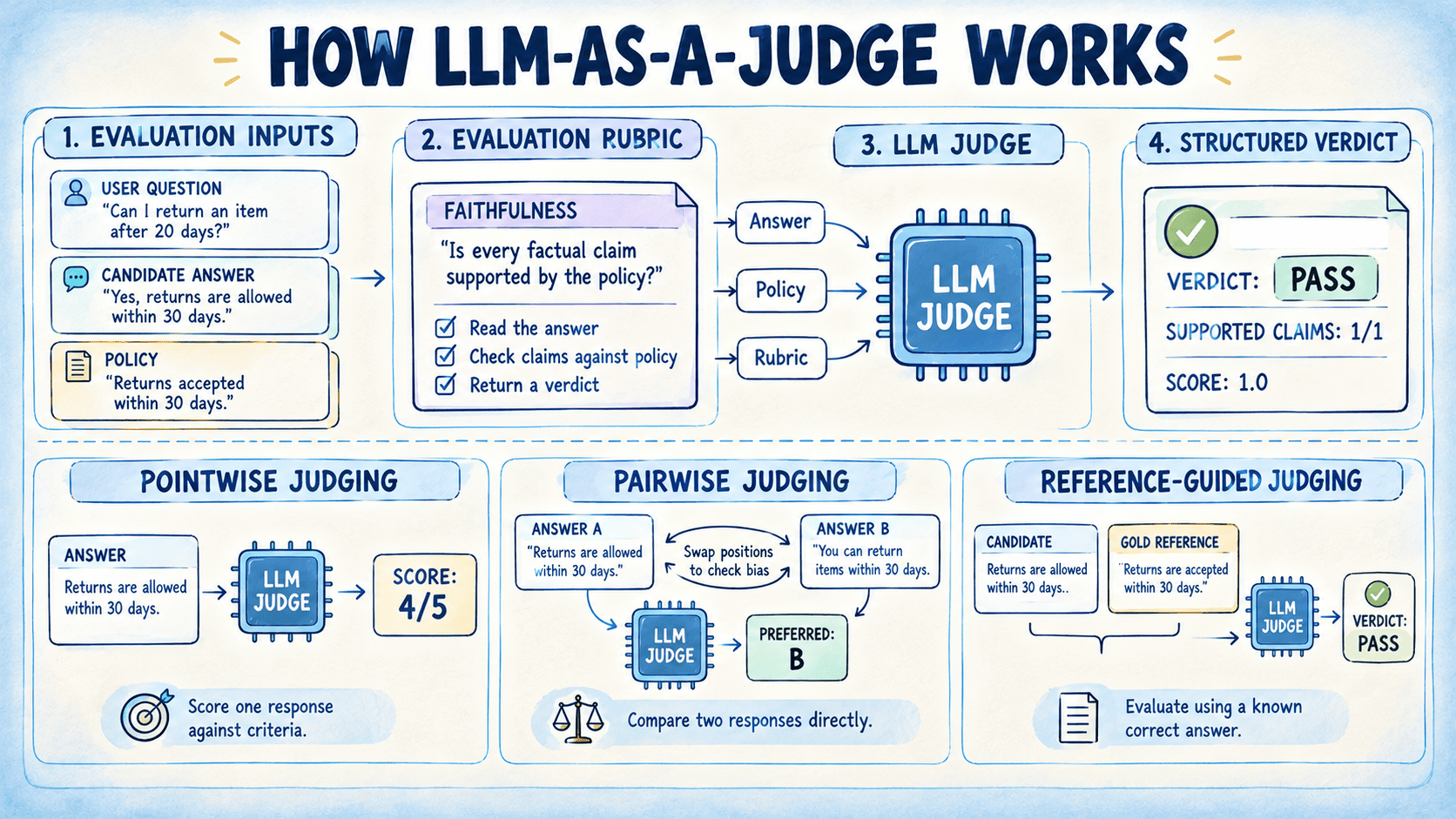
An LLM judge is a dedicated model instance prompted to evaluate the output of another model. Its task is narrower and more structured than general text generation: it reads a target rubric alongside a candidate response and emits a structured verdict.
Writing Robust Rubric Prompts
Vague evaluation prompts—such as "Rate how good this answer is from 1 to 10"—produce unstable, uncalibrated scores because the underlying model lacks a stable internal scale. A professional judge prompt must include four discrete components:
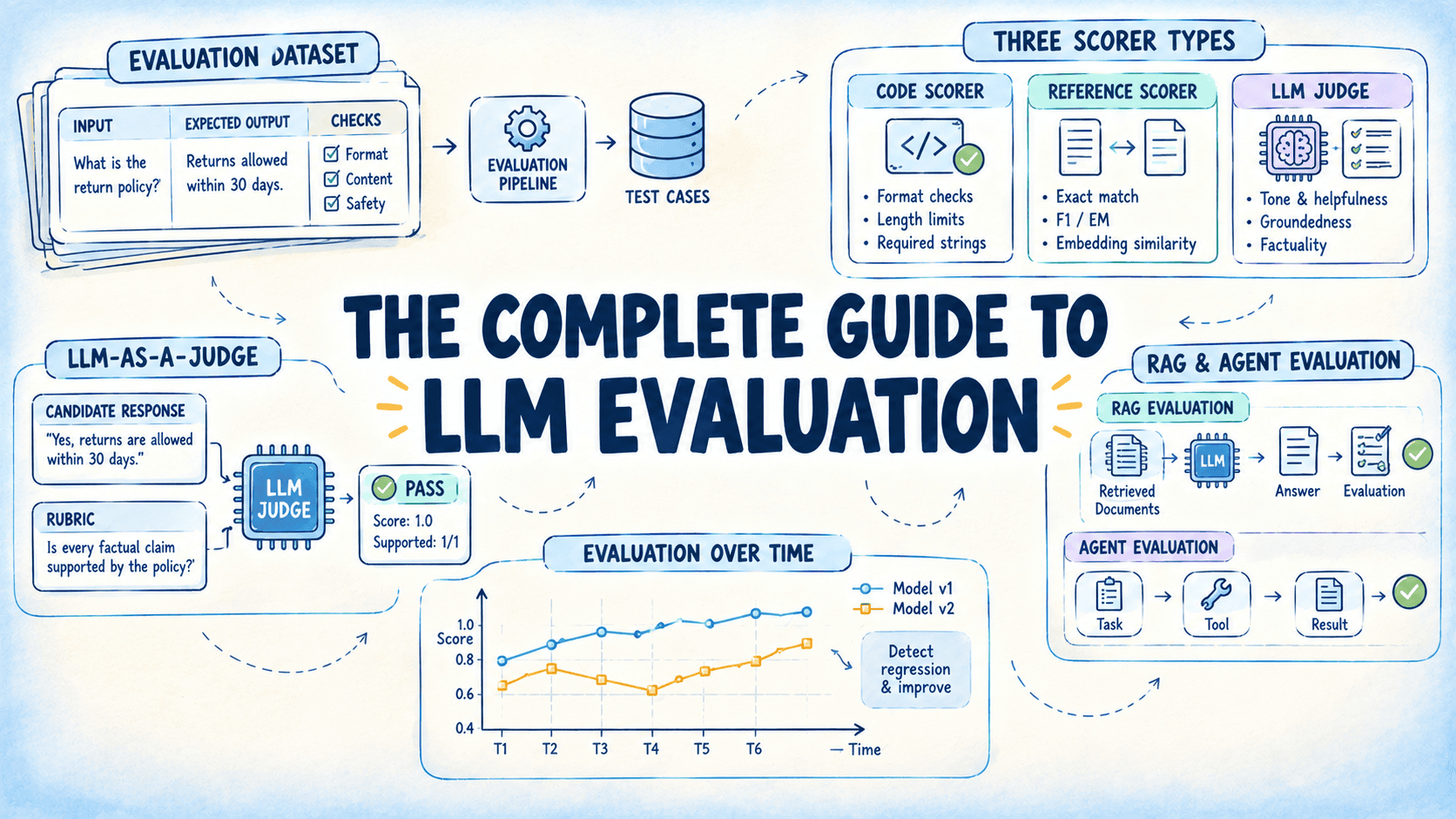
- A precise definition of the evaluation criterion.
- The explicit inputs the judge is permitted to reference.
- A step-by-step reasoning procedure (Chain-of-Thought).
- A strict, parsable output format (typically structured JSON).
Consider the following implementation of a faithfulness judge for a policy-answering enterprise bot:
import json

RUBRIC = """You are grading a customer-support answer for faithfulness.
Policy: context
Question: input
Answer: answer

Steps:
1. List each factual claim in the Answer.
2. For each claim, decide whether the Policy supports it.
3. Verdict: PASS if every claim is supported, otherwise FAIL.

Respond with JSON only:
"claims": ["text": "...", "supported": true], "verdict": "PASS""""

def judge(case, answer):
    response = call_llm(RUBRIC.format(answer=answer, **case), temperature=0)
    return json.loads(response)
Several intentional design choices underpin this implementation. First, the model generates its step-by-step reasoning (the claims list) before rendering the final verdict, forcing the model to condition its judgment on explicit evidence. Second, the output is formatted as strict JSON, allowing automated logging of the reasoning process when anomalies arise. Third, the temperature is set to 0 to minimize sampling noise.
To mitigate residual floating-point nondeterminism and provider-side batching artifacts on borderline cases, mission-critical evaluations should execute the judge an odd number of times and compute a majority vote.
Advanced Scoring Methodologies: QAG and G-Eval
When numerical scoring is required, standard rating prompts often fail. Advanced methodologies resolve this limitation:
- Question-Answer Generation (QAG): Instead of asking an LLM to assign an arbitrary score from 1 to 10, QAG breaks the evaluation down into closed, binary yes/no verification questions. Using the claims list from our previous example, each individual claim is converted into a binary proposition ("Does the policy support claim X?"). The final score is calculated deterministically via code:
$$textScore = fracsum textsupported claimstexttotal claims$$
This reduces the LLM’s role to simple classification—a task frontier models perform with maximum reliability. - G-Eval: Designed for subjective dimensions like coherence, fluency, or helpfulness where discrete claims cannot easily be isolated, G-Eval uses an Auto-CoT prompt to decompose criteria into execution steps, followed by a form-filling generation prompt. Crucially, G-Eval computes the final score using a probability-weighted summation (expected value) over the log-probabilities of token outputs (e.g., tokens
1through5). If a model assigns a 60% probability to a score of 4 and 40% to a score of 5, the resulting score is 4.4. This eliminates score collapse and yields high-resolution granularity.
Managing Pairwise Comparisons and Model Biases
When evaluating two competing models or prompt iterations, pairwise comparisons ("Is Output A or Output B better?") avoid the pitfalls of absolute scales. However, pairwise judges are notoriously susceptible to cognitive biases:
- Position Bias: Judges systematically favor the model presented first (Option A).
- Verbosity Bias: Judges disproportionately reward longer, more verbose answers regardless of conciseness or accuracy.
- Self-Model Bias: A judge model often exhibits an inherent preference for outputs generated by its own model family.
Mitigation strategies include swapping response positions for every evaluation run (retaining only judgments that agree across both permutations), explicitly instructing the judge not to reward unnecessary length, and utilizing a judge model from an entirely different model family than the system under test.
Most importantly, engineering teams must calibrate their judges against human ground-truth labels. By manually labeling a sample of 30 to 50 outputs, teams can compute Cohen’s kappa ($kappa$) to measure inter-rater reliability between human evaluators and the LLM judge:
from sklearn.metrics import cohen_kappa_score
kappa = cohen_kappa_score(human_labels, judge_labels)
logger.info(f"Judge calibration Cohen's kappa: kappa:.2f")
A Cohen’s kappa value exceeding $0.6$ indicates substantial agreement. If kappa is low, teams must inspect disagreements, refine the rubric instructions, and treat the labeled dataset as a permanent regression suite for the evaluation pipeline itself.
Evaluating RAG Systems and AI Agents
Complex architectures introduce multi-layered failure modes that require specialized evaluation strategies.
Deconstructing RAG (Retrieval-Augmented Generation)
A RAG system decouples retrieval from generation, meaning components fail independently. Evaluating a RAG architecture requires isolating these layers:
- Context Precision: Did the retriever rank the most relevant documents at the top of the context window?
- Context Recall: Did the retriever fetch all necessary background documents required to answer the prompt?
- Faithfulness (Groundedness): Is every statement in the generated answer directly supported by the retrieved context (preventing hallucinations)?
- Answer Relevance: Does the final response directly address the user’s initial query without wandering off-topic?
When faithfulness is high but context recall is low, the generation model is behaving correctly, but the retriever is starving it of vital information. Conversely, high precision paired with low faithfulness indicates that while pristine documents were retrieved, the generator hallucinated claims outside of the provided text, pointing directly to a prompt or model failure.
Assessing AI Agents and Conversational Threads
Modern AI agents introduce autonomous tool-calling, multi-step planning loops, and iterative execution paths. Evaluating an agent begins with binary task completion: Did the user’s ultimate goal get successfully accomplished? A conversational agent that provides exceptionally polite, fluent replies while failing to resolve customer support tickets is fundamentally broken.
When task completion rates decline, diagnostic sub-scores isolate the breakdown:
- Tool Selection Correctness: Did the agent invoke the correct API or database tool for the sub-task?
- Argument Correctness: Did the agent pass correctly formatted parameters into the tool call?
- Trajectory Efficiency: Did the agent reach the goal in an optimal number of steps, or did it get trapped in unproductive iteration loops?
For multi-turn conversational threads, evaluation must operate at the macro thread level. Individual turns may appear perfectly coherent in isolation, while the broader dialogue loses context or contradicts earlier commitments over time.
Official Statements & Industry Standards
As enterprise adoption of generative AI accelerates, industry standards bodies and AI research leaders have emphasized the non-negotiable nature of systematic evaluation:
"Evaluating generative AI is fundamentally different from traditional software testing because software outputs are deterministic, whereas LLM outputs are probabilistic. Organizations that rely solely on manual inspection are flying blind. Establishing programmatic evaluation loops, rigorous rubric calibration, and continuous offline/online validation is no longer optional—it is the bedrock of production-grade AI engineering."
— Leading Enterprise AI Architecture Guidelines
Research from major AI safety and evaluation consortia further highlights that automated evaluation must be treated as a first-class software artifact. Test datasets must be version-controlled alongside source code, and evaluation suites must be integrated directly into CI/CD continuous integration pipelines.
Future Outlook: The Next Frontier of LLM Quality Assurance
Looking ahead, the landscape of LLM evaluation is evolving rapidly across several critical dimensions:
- Automated Red-Teaming and Synthetic Data Generation: Future evaluation pipelines will leverage advanced adversarial agents to autonomously probe deployed models for security vulnerabilities, prompt injections, and safety jailbreaks, dynamically expanding golden test datasets without manual human annotation.
- Real-Time Observability and Automated Remediation: The boundary between offline evaluation and online monitoring will continue to blur. Production observability platforms will integrate closed-loop feedback mechanisms that automatically flag low-confidence outputs, trigger fallback routines, and convert production failures directly into regression test cases.
- Standardized Benchmarking Frameworks: As open-source and proprietary evaluation libraries mature, industry-wide consensus on standardized metrics for reasoning, agentic planning, and domain-specific safety will streamline enterprise procurement and compliance audits.
Summary & Actionable Recommendations
Implementing a production-grade LLM evaluation pipeline requires executing a disciplined sequence of stages across the software development lifecycle:
| Stage | Actionable Implementation | Key Metrics & Techniques |
|---|---|---|
| Scorer Selection | Employ deterministic code rules for syntax/format; use reference-based metrics for exact answers; reserve LLM judges for subjective semantics. | Regex checks, exact match, F1, LLM judge |
| Judge Rubric Design | Define clear criteria, permitted inputs, step-by-step reasoning, and strict JSON output formats. | Temperature 0, majority voting over odd trial counts |
| Judge Scoring | Decompose complex criteria into checkable propositions or probability-weighted distributions. | QAG (claims analysis), G-Eval (expected token value), pairwise swaps |
| Judge Calibration | Benchmark judge verdicts against a manually labeled golden dataset. | Cohen’s kappa ($kappa$), position swaps, cross-family judges |
| RAG Assessment | Evaluate retriever performance independently from generator groundedness. | Context precision, context recall, faithfulness, relevance |
| Agent Diagnostics | Measure end-to-end task completion before inspecting intermediate operational steps. | Tool correctness, argument validation, trajectory analysis |
| Offline Evals | Execute versioned golden test suites (25–50 cases) on every pull request against pre-defined release gates. | Holdout validation sets, maximum allowable regression limits |
| Online Evals | Continuously sample production traffic for reference-free quality drift, cost, and latency anomalies. | Live faithfulness tracking, token latency, operational cost |
By institutionalizing these testing loops, engineering teams can transform LLM development from an unpredictable art form into a predictable, highly reliable engineering discipline.