Executive Overview
Federal law enforcement agencies in the United States and Europe are aggressively untangling a sprawling cybercrime web following a high-profile series of breaches orchestrated by the notorious ShinyHunters hacking group. Investigators have shifted their focus beyond traditional cybercriminals to target an unexpected layer of the digital underworld: executives within the ransomware negotiation and incident response industry.
According to sources close to the unfolding federal investigation, U.S. and European authorities have identified executives at two separate ransomware negotiation firms who allegedly maintained unusually close, illicit relationships with the extortion syndicate. Most alarmingly, investigators believe that at least one U.S.-based executive actively assisted ShinyHunters in operating a victim-shaming and pressure portal known as shinywire[.]com.
The crackdown follows an unprecedented security breach in late September, when hackers associated with ShinyHunters compromised the FBI’s recruitment portal, fbijobs.gov. The breach exposed highly sensitive personnel records—including Social Security numbers, home addresses, and psychological evaluations—and prompted an immediate, aggressive response from federal authorities. The resulting sweep has led to the detention of key syndicate leaders, the arrest of prominent cybersecurity executives, and the exposure of deep-seated conflicts of interest that threaten to upend the multi-billion-dollar cyber extortion remediation market.
Detailed Chronology: From Dutch Raids to the FBI Recruitment Hack
The Fall of Pepijn van der Stap
The unraveling of the modern ShinyHunters command structure began in the Netherlands on the evening of September 15, 2026. Dutch police, utilizing flash-bang grenades to stun their target, arrested convicted hacker and prominent ShinyHunters suspect Pepijn van der Stap. At the time of the raid, Van der Stap was actively logged into various online accounts, most crucially his Signal instant messaging application.
Access to Van der Stap’s active Signal sessions provided law enforcement with a goldmine of unencrypted intelligence. Investigators were able to review real-time communications between the Dutch hacker and frequent contacts, including ransomware negotiators based in the United States and Canada. Furthermore, sources close to the investigation revealed that Van der Stap’s Signal logs contained details concerning an alleged murder-for-hire plot targeting individuals abroad. While Dutch news outlet RTL reported that Van der Stap likely gave the order for these attacks, there is no indication that the hits were ever carried out.

The Rise of "Rey" and the FBI Breach
Van der Stap’s sudden arrest created a power vacuum within ShinyHunters, which had already seen its original French leadership imprisoned or sidelined over the years. Control of the brand swiftly passed to "Rey," a teenage hacker from Amman, Jordan, who was publicly identified by cybersecurity researchers late last year.
Operating under Rey’s leadership, the syndicate escalated its activities, culminating in the late September breach of fbijobs.gov. By threatening to publish deeply personal files belonging to federal personnel, the hackers provoked an extraordinary reaction. The FBI moved with uncommon speed to track down anyone who had communicated with Rey or his associates. On October 3, Reuters reported that Rey had been detained by Jordanian authorities and was actively cooperating with federal investigators.
The Arrest of Edward Dubrovsky
The decrypted communications from Van der Stap’s device also pointed directly toward the executive suites of the Western cybersecurity and incident response sector. On October 9, KrebsOnSecurity broke the news that the FBI had arrested Edward Dubrovsky, a 54-year-old Canadian cybersecurity executive and co-founder of CyberSteward Inc., who had recently published a book on handling cyber extortion.
According to federal court records in the United States, Dubrovsky was charged with threatening to disclose hacked data and interfering with interstate commerce through extortion. Federal prosecutors quickly requested that Dubrovsky remain in custody pending trial, keeping case records under seal.
Investigative findings shared with KrebsOnSecurity indicated that Van der Stap’s chats showed Dubrovsky was routinely tipped off about new ShinyHunters victims—often before the target organizations even realized they had been breached. Most damningly, investigators discovered that Dubrovsky knew ShinyHunters had exfiltrated sensitive data from FBI servers yet failed to notify the bureau before the hackers publicly taunted the agency on social media.

Supporting Context & Metrics: The "Shinywire" Operation and Industry Corruption
The Mechanics of "Shinywire"
Federal investigators believe that at least one executive at a prominent U.S.-based consulting firm played a direct operational role in running shinywire[.]com, a public-facing extortion website utilized by ShinyHunters. Active from May 3, 2026, until mid-October, the site listed nearly 100 organizations compromised by the syndicate.
The website served as a coercive pressure valve. Each victim entry displayed samples of stolen files and warned that the complete cache would be leaked on the dark web via the Tor network unless the organization engaged with the hackers and paid a ransom within seven days. Major enterprises, such as American medical technology firm Intuitive Surgical—which suffered a credential compromise via targeted phishing in March 2026—found themselves listed alongside hundreds of school districts and healthcare providers.
The Corporate Feud and the "Ghostbyte" Connection
Dubrovsky’s legal troubles unfolded against the backdrop of a bitter corporate divorce. Earlier in the year, Dubrovsky filed a lawsuit in Ontario against Daniel Tobok, the former chief executive of Cypfer, a major Toronto-based cybersecurity firm with international reach. Dubrovsky claimed he was forced out of the company by Tobok’s erratic business decisions. Tobok denied the allegations, filing a counter-suit accusing Dubrovsky of misappropriating confidential information and competing unfairly through CyberSteward.
Compounding this corporate drama, former colleagues of Daniel Tobok revealed to investigators that he had long been associated with a specific pseudonym in ransomware circles: Ghostbyte.
In 2018, when a Canadian company was hit by the Russian-language Dharma ransomware affiliate program, the victim requested payment guarantees. In an email reply, a Dharma representative explicitly advised the victim to contact an IT professional using the email address [email protected], noting that the individual frequently solved such extortion problems in Canada. Threat intelligence platform Constella Intelligence subsequently linked an email address frequently used by Tobok ([email protected]) to online accounts bearing the username "ghostbyte," including a Snapchat profile. Furthermore, Constella tied the Dharma representative’s wallet to transactions exceeding $3.5 million in historical value.

Conflicting Interests in Ransomware Remediation
The indictment of cybersecurity executives highlights a foundational conflict of interest within the incident response and ransomware negotiation ecosystem. Many negotiation firms operate on a contingency or percentage-based fee structure, meaning their compensation scales directly with the size of the ransom payout. This financial model creates a perverse incentive for negotiators to capitulate quickly to cybercriminals, discourage pushback, and advocate for payment rather than remediation.
The Department of Justice has increasingly targeted these corrupt intermediaries. On October 7, the DOJ charged MonsterCloud CEO Zohar Pinhasi with wire fraud and conspiracy for allegedly charging clients $19 million for ransomware remediation while secretly paying hackers only $8 million and pocketing the difference. Similarly, in July, Florida ransomware negotiator Angelo Martino was sentenced to 70 months in prison for leaking his clients’ negotiation strategies to the BlackCat/ALPHV ransomware syndicate to maximize payouts.
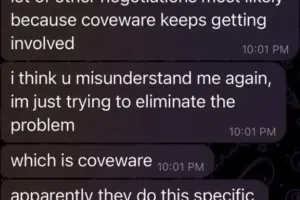
Meanwhile, reputable incident response firms like Coveware and Unit 221B have consistently warned victims that paying ShinyHunters is futile, noting that "destroyed" data is frequently resold or used to secondary-extort clients. These warnings have drawn the ire of ShinyHunters leadership. Private Telegram chats intercepted by investigators reveal the syndicate’s deep frustration with Coveware. In May 2026 messages, the lead ShinyHunters administrator complained that Coveware was tanking their revenue, writing:
"Go on my website, majority of those companies would’ve paid if it weren’t for Coveware giving them misinformation… Someone (100% Coveware) is going out of their way to make sure i am not paid."
Official Statements and Industry Response
As the fallout from the ShinyHunters investigation widens, corporate entities and industry groups have scrambled to distance themselves from the accused executives and clarify their internal standards.

- Cypfer’s Stance: In an official statement released in mid-October, Cypfer emphasized that its core business practices do not involve facilitating or making ransomware payments. The company stated that it learned of Edward Dubrovsky’s arrest exclusively through media reports.
"We had no prior knowledge of Mr. Dubrovsky’s arrest," a Cypfer spokesperson noted. "CYPFER has not received any outreach from law enforcement and, to our knowledge, is not the target of any law enforcement investigation."
The company also reiterated its independence from CyberSteward and highlighted its recent acquisition by the Apros Group, led by former FBI special agent Jason Hogg. - CyberAcuView Perspective: Addressing the broader structural flaws in the extortion market, Mark Camillo, CEO of cyber insurance consortium CyberAcuView, pointed out the inherent moral hazards of percentage-based negotiator fees.
"It has come to the industry’s attention that many of the ransomware payers charge a percentage of the final payment which may or may not be disclosed," Camillo stated. "This makes no sense if they are also the negotiator. There needs to be more transparency in the process as no one in the ecosystem should be profiting purely on the size of the ransomware transaction."
Future Outlook: A Turning Point for Incident Response
The federal investigation into ShinyHunters and the complicity of high-ranking negotiation executives marks a watershed moment in the global fight against cyber extortion. For years, the boundary between cyber defenders and cyber criminals has been blurred by an unregulated gray market of ransom negotiators, fixers, and breach brokers.
The arrest of figures like Edward Dubrovsky and the dismantling of infrastructure like shinywire[.]com demonstrate that law enforcement is no longer solely focused on anonymous hackers hiding behind Tor nodes and cryptocurrency mixers. Prosecutors are increasingly setting their sights on domestic professionals who weaponize inside knowledge, betray client trust, and fuel the multi-million-dollar extortion economy from corporate boardrooms in North America and Europe.
Moving forward, regulatory bodies, cyber insurance providers, and law enforcement agencies are expected to enforce stringent oversight over incident response firms. Mandating total financial transparency, banning contingency fees tied to ransom volumes, and criminalizing the willful withholding of breach intelligence from federal authorities will be critical steps in restoring integrity to an industry that has, for too long, operated in the shadows.