Executive Overview
For decades, the mechanics of search engine optimization (SEO) were defined by binary choices. Webmasters and technical SEOs either welcomed web crawlers with open arms or locked them out with a few well-placed lines in a robots.txt file. This uncomplicated era of "all-in or all-out" access was imperfect, but it was universally understood, easily managed, and sufficient for the search landscape of the late 1990s through the early 2020s.
Today, that foundational paradigm has completely broken down. The explosive rise of generative AI, large language models (LLMs), retrieval-augmented generation (RAG), and autonomous personal agents has transformed the digital ecosystem into a chaotic frontier. Websites are no longer simply visited by traditional indexers looking to catalog pages for a blue-link search engine results page (SERP). Instead, they are continuously probed, scraped, queried, and navigated by an evolving zoo of specialized bots: massive multi-terabyte model training scrapers, real-time retrieval bots feeding live AI answers, user-initiated fetches, and autonomous consumer agents acting on behalf of individual shoppers.
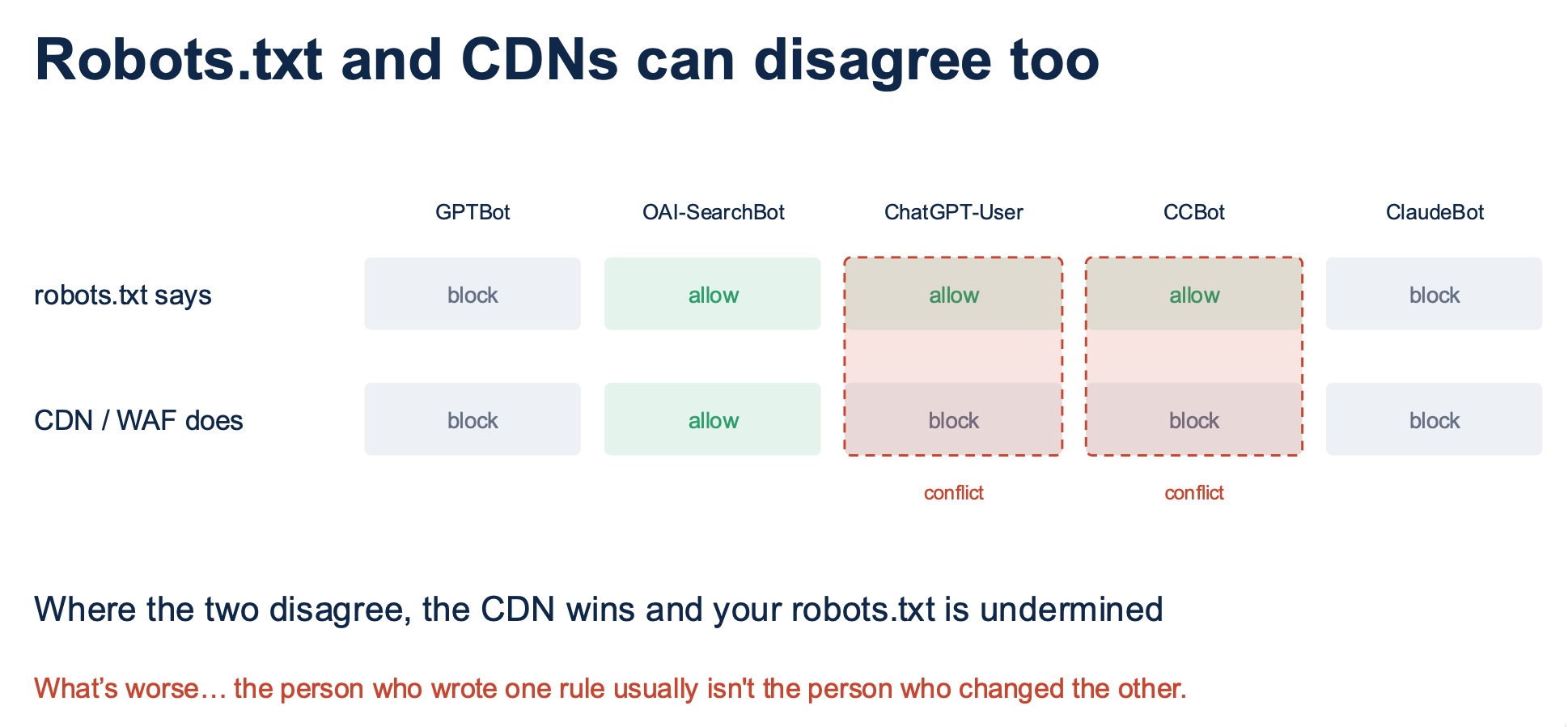
Compounding this operational complexity is a dangerous disconnect within modern organizations. While SEO teams meticulously draft and update robots.txt directives to fine-tune their visibility in AI-driven search, the actual enforcement of web traffic is increasingly controlled upstream. Content Delivery Networks (CDNs), Web Application Firewalls (WAFs), and third-party bot mitigation services frequently override, ignore, or contradict these SEO strategies—often without the digital marketing department even knowing.
This article explores why traditional block lists are no longer fit for purpose, the dangerous blind spots hiding within modern IT infrastructure, and why organizations must transition from reactive blocking to cross-functional, deliberate bot management policies.
The New Bot Taxonomy: Moving Beyond the "AI Bot" Catch-All
To understand the current crisis in technical SEO, one must first dismantle the lazy terminology currently dominating boardrooms and tech blogs. Lumping every automated script under the monolithic banner of "AI bots" is a critical strategic error.
In the contemporary web ecosystem, automated visitors operate across vastly different functional vectors, each carrying distinct commercial implications for a publisher, e-commerce platform, or enterprise brand:
1. Traditional Search Crawlers
These are the legacy indexers operated by Google, Bing, Yahoo, and regional search engines. Their primary objective is to discover, parse, and rank content to drive referral traffic back to the source website via traditional organic search results. For most websites, blocking these crawlers results in an immediate, catastrophic loss of organic visibility and revenue.
2. AI Model Training Crawlers
These bots ingest vast swaths of the internet to train foundation models (such as OpenAI’s GPT series, Anthropic’s Claude, or Meta’s Llama). They download data at scale, storing the semantic and syntactic patterns of your content permanently within model weights. Crucially, these crawlers rarely offer direct referral traffic in return. Allowing them means contributing your proprietary intellectual property to commercial models for free; blocking them preserves your data leverage.
3. Retrieval and Answer Engine Bots
Distinct from training crawlers, retrieval bots operate in real-time. When a user asks an AI-powered search engine or answer engine a question, these bots fetch live content from the web to synthesize an immediate, cited response. Blocking a retrieval bot does not just stop your data from entering a training set; it actively removes your brand from being cited as a source in real-time conversational answers, effectively erasing you from the new generation of search discovery.

4. Autonomous Personal Agents and Consumer Bots
Perhaps the most disruptive entities on the horizon are autonomous agents. These sophisticated scripts act on behalf of individual users—browsing e-commerce storefronts, comparing prices, reading reviews, filling out forms, and executing transactions autonomously. They navigate websites just like human users, triggering analytics events, loading dynamic JavaScript, and seamlessly blending into your traffic logs.
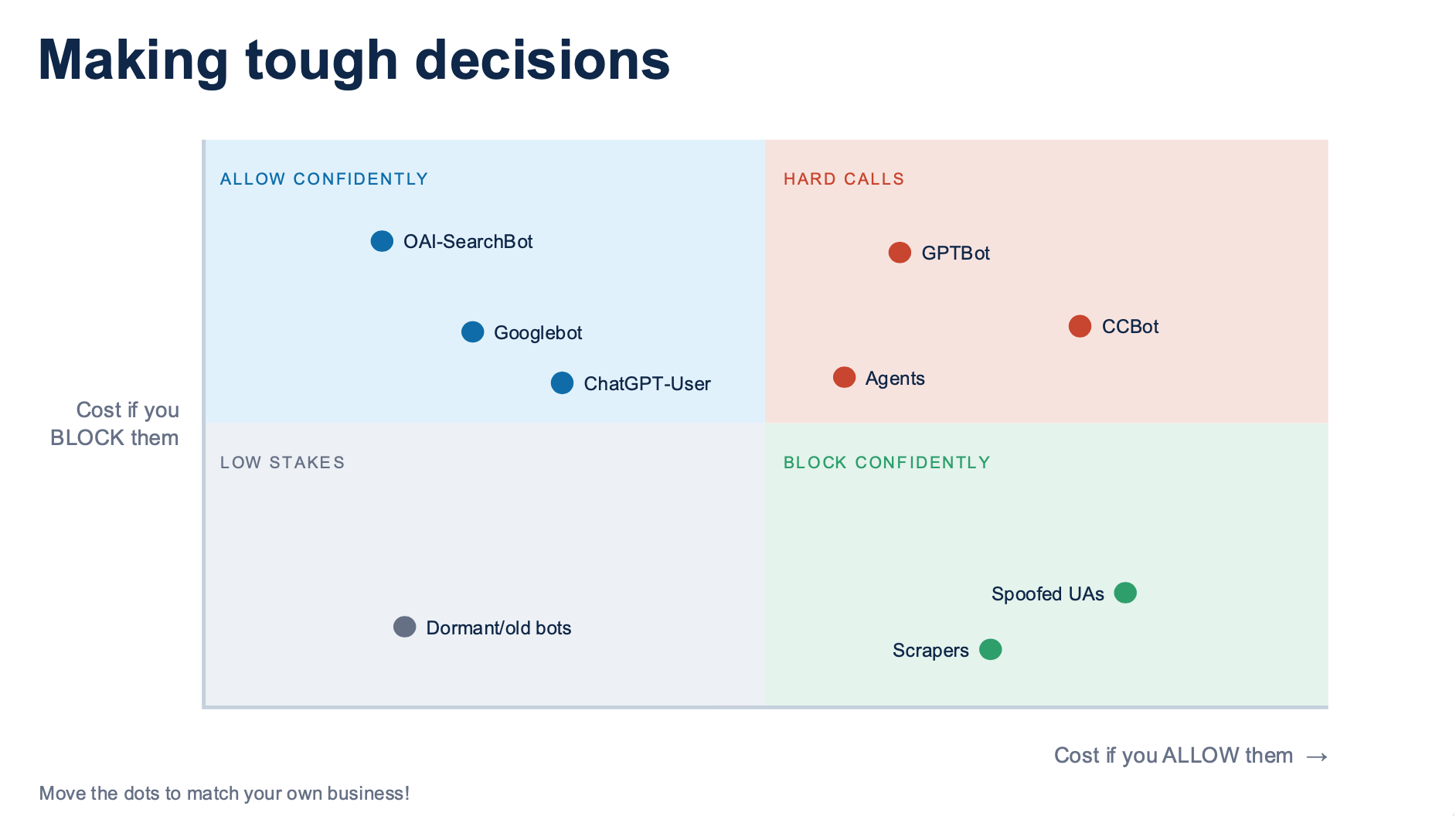
Treating these four categories with a single administrative rule is a recipe for digital disaster. Accidentally blocking a retrieval bot while trying to stop a training crawler can cause your brand to vanish from AI-generated answers. Conversely, failing to stop aggressive, unauthorized scraping can expose proprietary data and crash your web servers under sudden traffic spikes.
The Infrastructure Blind Spot: When CDNs Contradict SEO Strategy
One of the most alarming revelations in modern enterprise web management is the profound disconnect between the marketing department and the IT security infrastructure.
For many organizations, robots.txt is treated as the holy grail of bot control. SEOs spend hours analyzing user-agent strings, testing directives, and verifying compliance. However, robots.txt has always possessed a glaring vulnerability: it is entirely voluntary. It relies on the ethical compliance of the bot operator to honor the standard. Malicious scrapers, rogue AI startups, and aggressive data brokers routinely ignore robots.txt directives altogether.
Because of this voluntary nature, real, hard enforcement of website access has shifted away from the application root and up into the network infrastructure—specifically into Content Delivery Networks (such as Cloudflare, Akamai, or Fastly), WAFs, and enterprise bot mitigation services.
This creates a perilous invisible friction:
- The SEO Team carefully writes instructions to allow specific retrieval bots while blocking heavy scrapers.
- The Security/IT Team, operating under strict directives to prevent DDoS attacks, credential stuffing, scraping, and bandwidth exhaustion, deploys aggressive bot-blocking rules at the CDN edge.
- The CDN, utilizing heuristic machine learning models to identify non-human traffic signatures, ends up blocking legitimate AI search indexers, aggregators, and retrieval bots.
The marketing department remains entirely oblivious. They wonder why their brand visibility in emerging AI platforms is plummeting, assuming the AI engines simply "don’t like" their content, while their own CDN is aggressively turning away the very bots required to secure visibility. Bridging this communication gap between SEO, engineering, and cybersecurity is no longer optional; it is an urgent operational necessity.
Autonomous Agents and the Threat of Digital Invisibility
As artificial intelligence shifts from passive conversational interfaces to proactive, autonomous execution, the rules of user engagement are being rewritten. Personal AI agents are rapidly evolving into primary gatekeepers of digital commerce.
Consider how a consumer might interact with the web in the near future. Instead of opening five different browser tabs to compare smartphone specifications, check shipping times, and read user reviews, a consumer will instruct their personal AI agent: "Find me the best mid-range smartphone under $500 with a 48-hour battery life and order it."
The autonomous agent then visits retail and review websites behind the scenes, parsing product data, evaluating inventory, and executing the purchase.
If your website’s bot management policy is overly aggressive—relying on crude, blunt block lists that reject any non-standard user-agent or suspicious traffic signature—your brand will fail the agent’s screening process. The agent will be blocked by your WAF, or your server will return a 403 Forbidden error, or your dynamic JavaScript layout will fail to render correctly for a headless browser script.
The consequences of this failure go far beyond losing a traditional click. If an autonomous agent cannot read, parse, and transact on your site smoothly, your business effectively ceases to exist for that consumer. You are invisible not just on a search engine results page, but within the automated transaction pipeline where modern commerce is increasingly settling.
Balancing security—protecting your infrastructure from malicious credential-stuffing bots and bandwidth-hogging scrapers—with openness—ensuring frictionless access for legitimate autonomous buyer agents—requires surgical precision rather than a blunt axe.
The Solution: Transitioning from Block Lists to Deliberate Bot Policies
To survive and thrive in this multi-agent era, organizations must fundamentally change how they govern web traffic. Relying on static, reactive block lists is the digital equivalent of locking your front door while leaving the windows wide open to the backyard.
Industry experts and technical leaders advocate for the establishment of comprehensive, cross-functional, and deliberate bot policies. Moving to this advanced framework requires four core pillars:
1. Unified Cross-Departmental Governance
Bot management can no longer be siloed within the SEO department or dumped entirely onto the IT security team. Creating an effective bot policy requires a multidisciplinary roundtable consisting of:
- SEO & Marketing: To evaluate the traffic, visibility, and commercial value of various crawlers and search agents.
- Engineering & IT: To manage server load, API limits, rate-throttling, and CDN configuration rules.
- Security & Compliance: To protect against malicious data harvesting, DDoS threats, and unauthorized intellectual property theft.
- Legal: To establish clear terms of service regarding data usage, content syndication, and intellectual property rights in the age of generative AI.
2. Granular Classification and Intent Analysis
Instead of treating all automated traffic as a monolithic threat, organizations must implement deep-packet inspection and advanced behavioral telemetry to identify who is visiting, why they are visiting, and what they intend to do with the content. Organizations should utilize customized rate-limiting and access tiers rather than binary allow/block commands. For example:
- Allow retrieval bots full, frictionless access to product description pages to maintain AI search visibility.
- Throttle training crawlers or require API-based licensing agreements for massive data downloads.
- Challenge suspicious, high-frequency scrapers with advanced JavaScript challenges or CAPTCHAs while letting verified human-like agents pass smoothly.
3. Comprehensive Visibility and Auditing
You cannot manage what you do not measure. SEO teams must demand full transparency into CDN and WAF bot-mitigation logs. Regularly auditing these logs ensures that security rules are not inadvertently sabotaging organic search and AI-discovery performance. If a high-value retrieval bot is being blocked at the CDN edge, marketing needs to know immediately.
4. Continuous Review Cycles
The bot landscape evolves on a weekly basis. New AI agents, retrieval networks, and scraping syndicates emerge constantly. A bot policy written six months ago is already obsolete. Enterprises must establish routine quarterly reviews to recalibrate bot management rules in alignment with shifting business goals, emerging search technologies, and evolving cybersecurity threats.
Future Outlook: The Strategic Imperative for Modern Brands
The evolution of bot management serves as a microcosm of the broader transformation sweeping the digital marketing industry. The era of easy answers, simple checklists, and isolated channel management is dead.
As the web transitions from a human-browsed library of static pages into a dynamic machine-readable network of connected APIs, retrieval engines, and autonomous buyer agents, technical SEO has become inextricably linked with enterprise architecture and data governance.
Brands that cling to outdated, reactive block lists will find themselves slowly bleeding organic visibility, disappearing from AI-generated answer engines, and locked out of the lucrative ecosystem of autonomous digital commerce. Conversely, organizations that proactively design sophisticated, collaborative bot policies will successfully protect their intellectual property, secure their infrastructure, and position themselves as trusted, accessible authorities in the new age of AI-driven search.
The question facing digital leaders today is no longer “How do we block the bots?”
It is far more nuanced: “How do we curate our digital presence so that the right machines can find us, trust us, and transact with us?” The brands that answer this question first will define the future of the web.