By Global Aerospace & Defense Desk
Published: November 2026
Executive Overview
Blue Origin’s long-awaited orbital ambitions have hit a significant roadblock. Jeff Bezos’s premier aerospace enterprise has officially confirmed that the maiden operational flight of its heavy-lift New Glenn rocket will not take place until January 2027. This latest postponement represents a substantial shift from earlier corporate projections, which optimistically anticipated a return to the launchpad before the close of 2026.
The delay stems from the fallout of a dramatic launchpad explosion that occurred in May 2026 during a routine hot-fire test at Cape Canaveral, Florida. While the incident did not result in casualties, it inflicted severe structural damage on critical ground infrastructure, forcing a complete overhaul of the launch site.
Despite an aggressive recovery effort spearheaded by Chief Executive Officer Dave Limp—who initially promised an expedited turnaround—engineering teams have faced persistent headwinds, ranging from extensive structural rebuilding requirements to adverse weather conditions along the Florida coast.
The postponement is more than just a scheduling setback for the commercial space titan; it carries profound implications for major institutional stakeholders. Blue Origin’s upcoming manifest is deeply intertwined with critical national security payloads, NASA’s ambitious interplanetary exploration initiatives, and Amazon’s multi-billion-dollar Project Kuiper low-Earth orbit (LEO) satellite internet constellation.
As competitors in the commercial heavy-lift sector continue to capture market share, the pressure on Blue Origin to deliver a flawless, high-cadence launch vehicle has never been higher. This report examines the chronology of the accident, the engineering hurdles of the recovery, the broader strategic implications for NASA and Amazon, and what the path to 2027 means for the future of commercial spaceflight.
Detailed Chronology: From the May Explosion to the 2027 Slip
The Incident: May 2026
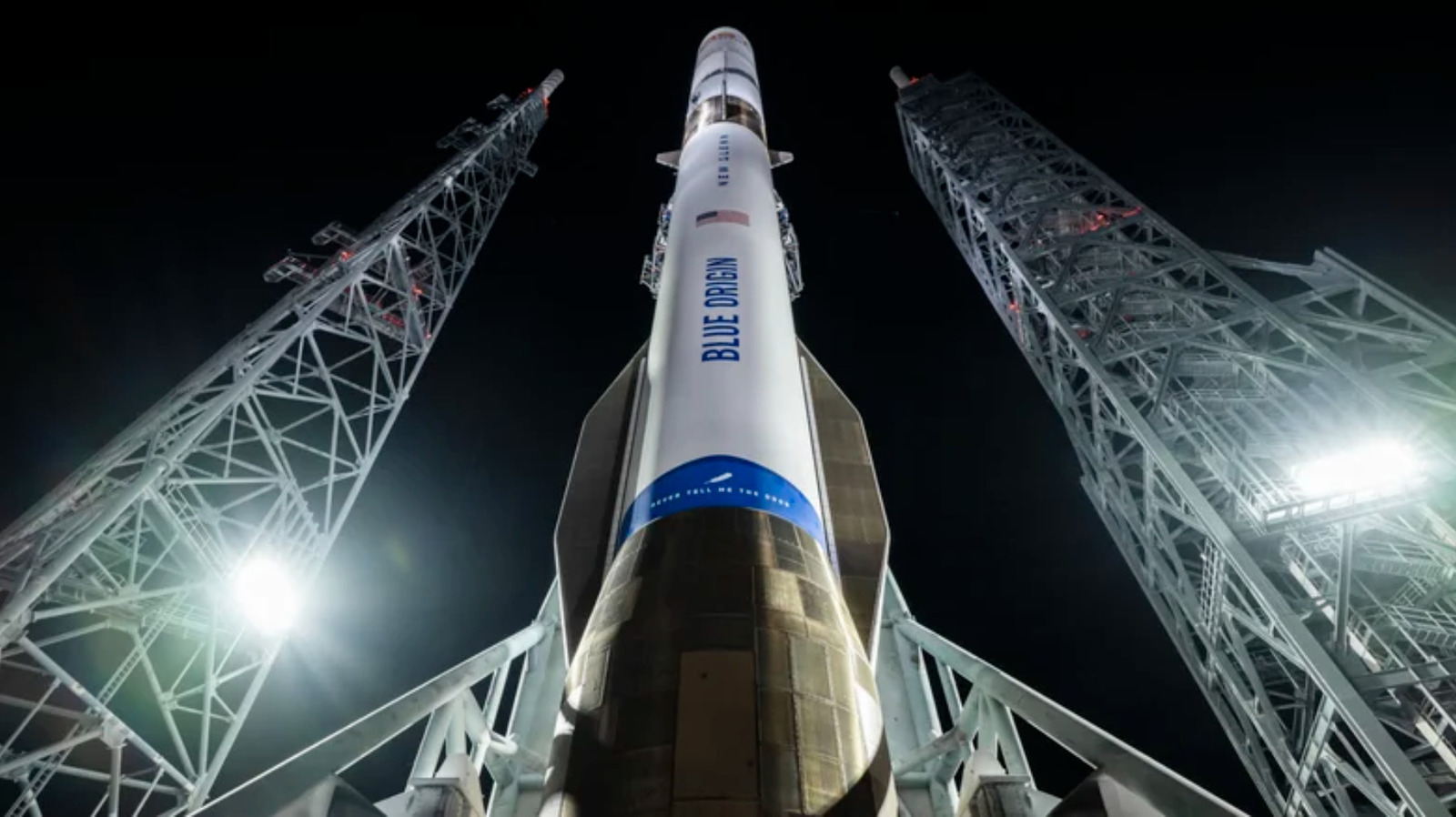
The crisis began on a spring afternoon at Space Launch Complex 36 (SLC-36) at Cape Canaveral Space Force Station in Florida. Blue Origin was conducting a static-fire test—a standard pre-flight procedure where a rocket’s first-stage engines are ignited while the vehicle is firmly anchored to the pad—on a fully integrated New Glenn flight vehicle.
Catastrophic failure occurred seconds into the test sequence. An anomaly, reportedly originating within the propulsion architecture of the massive booster stage, triggered an explosion that engulfed the base of the rocket and severely impacted the surrounding launch support infrastructure.
Emergency response teams contained the fire swiftly, and confirmation was quickly established that all personnel were accounted for and safe. However, the physical toll on the launch facility was immediately evident. Television feeds and aerial reconnaissance revealed significant structural warping of the launch mount, damage to propellant lines, and critical impacts on the umbilical systems designed to feed cryogenic fuels into the vehicle.
Initial Optimism and Executive Messaging
In the immediate aftermath of the disaster, Blue Origin leadership sought to project absolute confidence. CEO Dave Limp took to public platforms and internal channels to reassure employees, investors, and clients. Limp asserted that the company’s modular design philosophy and agile engineering culture would allow for rapid repairs. Initial forecasts floated by company executives suggested that SLC-36 could be remediated within weeks, setting the stage for a dramatic return-to-flight attempt before the end of calendar year 2026.
However, as structural engineers stripped away the soot and began non-destructive testing of the surrounding concrete and steel frameworks, the true depth of the damage became apparent. The blast had compromised structural joints within the primary service tower, requiring meticulous metallurgical inspections and complex architectural rebuilding that could not be rushed without risking safety.
The Internal Memo and the 2027 Pivot
The reality of the situation finally necessitated a public and internal recalibration. According to an internal memorandum distributed to Blue Origin personnel—and first brought to light by investigative reporting from the Financial Times—CEO Dave Limp officially communicated that the launch window had slipped into January 2027.
In the memo, Limp sought to balance the disappointment of the delay with high praise for the engineering corps. He noted that the launchpad’s Vehicle Access Tower had successfully been repaired and restacked, and the primary launch bridge had been fully restored to operational specifications.
Limp explicitly credited persistent weather anomalies along the Space Coast for slowing down the final phases of remediation, noting that tropical systems and high-wind days severely restricted crane operations and high-altitude structural welding.
"Your collective work on our return to flight has been nothing short of remarkable," Limp wrote in the communication. "In just six months, Team Blue has accomplished what many thought would take years."
Despite the praise, the reality remains: New Glenn’s path to orbit has lost another critical quarter of execution time.
Supporting Context & Metrics: The Scale of New Glenn
To understand why the May 2026 explosion and subsequent delay have sent shockwaves through the aerospace industry, one must examine the sheer scale and strategic importance of the New Glenn program.
Named after legendary NASA astronaut John Glenn, the rocket represents Blue Origin’s definitive leap from suborbital tourism (powered by the smaller New Shepard vehicle) to heavy-lift orbital supremacy.
Key Technical and Programmatic Metrics:
- Height: Approximately 98 meters (322 feet), making it one of the tallest operational rockets in the world, roughly comparable to NASA’s Space Launch System (SLS) and SpaceX’s Starship.
- Payload Capacity: Designed to haul up to 45,000 kilograms (99,000 lbs) to Low Earth Orbit (LEO) and 13,000 kilograms (28,600 lbs) to Geostationary Transfer Orbit (GTO).
- First-Stage Reusability: Engineered for a minimum of 25 flights, featuring a reusable booster that descends back to Earth to land on an offshore ocean platform, mirroring the successful recovery paradigm pioneered by SpaceX.
- Propulsion: Powered by seven BE-4 engines on the first stage, utilizing liquefied natural gas (LNG) and liquid oxygen (LOX), which also serve as the engine architecture powering United Launch Alliance’s (ULA) Vulcan Centaur rocket.
- Fairing Volume: Boasts a massive 7-meter payload fairing diameter, offering nearly double the volumetric capacity of traditional commercial rockets, tailored for bulky mega-constellation satellites and deep-space hardware.
The capital investment poured into New Glenn over the past decade totals billions of dollars, funded primarily by Jeff Bezos’s personal fortune alongside growing revenues from commercial contracts. Consequently, every month of delay translates into significant holding costs and postponed revenue realization.
Official Statements and Industry Reactions
The aerospace sector has reacted to the 2027 delay with a mixture of professional empathy and commercial opportunism. Building heavy-lift orbital rockets is widely recognized as one of the most intellectually and physically demanding endeavors in human engineering; thus, structural setbacks are viewed by veteran aerospace analysts as an occupational hazard rather than a fatal flaw.
However, commercial partners who have built their deployment strategies around New Glenn’s availability are facing difficult timeline adjustments.
The NASA and Amazon Factor
Chief among these partners is Amazon. The tech giant’s Project Kuiper—a massive satellite broadband constellation designed to rival SpaceX’s Starlink—is under strict regulatory deadlines imposed by the Federal Communications Commission (FCC) to launch half of its planned 3,232 satellites by mid-2026. While Amazon has secured launch capacity across multiple providers (including ULA, Arianespace, and SpaceX), New Glenn was slated to carry a massive share of the bulk deployment. The 2027 delay places additional pressure on Amazon to lean heavily on alternate vehicles to meet its regulatory milestones.
Beyond corporate broadband, Blue Origin’s space exploration division continues to secure vital institutional backing. In September 2026, just months after the launchpad accident, NASA awarded Blue Origin a prestigious contract to design, build, and deploy an advanced telecommunications network for Mars.
This contract highlights NASA’s enduring faith in Blue Origin’s long-term technical competence, even as near-term launch schedules experience turbulence. Agency officials have privately expressed confidence that the rigorous post-accident investigations conducted by Blue Origin will ultimately yield a safer, more reliable launch vehicle when it finally clears the tower.
Future Outlook: The Road to January 2027 and Beyond
As Blue Origin enters the final stretch of its remediation efforts at SLC-36, the focus shifts entirely to the meticulous recertification of the launchpad systems and the integrated flight vehicle.
Critical Path Milestones Prior to January 2027:
- Integrated Wet Dress Rehearsal (WDR): Before any launch attempt can be scheduled, Blue Origin must load cryogenic propellants into the newly restacked New Glenn rocket to test all repaired ground-to-vehicle interfaces, valves, and chill-down procedures under flight-like conditions.
- Static Fire Recertification: The company must successfully execute a repeat of the aborted May 2026 hot-fire test, running the seven BE-4 engines at full thrust while bolted to the pad, proving that the propulsion anomalies have been fully resolved.
- Regulatory Sign-Off: The Federal Aviation Administration (FAA), which oversees commercial space transportation licensing, must review the mishap investigation findings, approve the corrective actions taken at SLC-36, and modify or reissue Blue Origin’s launch license.
- Final Payload Integration: Securing the customer payload into the 7-meter fairing and executing final electrical and mechanical checkouts.
If these milestones are met without further meteorological or technical interruptions, January 2027 will mark a watershed moment for Blue Origin. A successful flight will validate Jeff Bezos’s long-term vision, cement the company’s status as a true heavyweight in national and international space logistics, and open the floodgates for a high-cadence launch manifest stretching well into the next decade.
For now, however, Team Blue remains heads-down in Florida, racing against the calendar to ensure that when New Glenn finally thunders off the pad, it stays aloft for good.