Executive Overview
In the crowded and fiercely competitive landscape of consumer wireless audio, manufacturers have historically prioritized software-driven conveniences over raw acoustic performance. For years, the prevailing design philosophy among dominant market players has leaned heavily toward aggressive Active Noise Cancellation (ANC) algorithms, heavily scooped EQ profiles, and mass-market tuning designed to appeal to the lowest common denominator. While these features make daily commutes more bearable, they frequently come at the expense of genuine musicality, instrumental separation, and neutral audio fidelity.
Challenging this paradigm is Status Audio, a brand that has carved out a distinct reputation among audiophiles and creative professionals alike for building hardware that places sound quality at the very top of the priority list. When the company launched the Status Audio Pro X, it successfully bucked the industry trend by offering sophisticated driver architectures and engaging tuning that respected the source material.
Now, Status Audio is doubling down on its commitment to purist sound reproduction through a high-profile collaboration. The brand has partnered with renowned audio engineer and independent reviewer Cameron Oatley—widely known across the industry by his moniker, "GoldenSound"—to release the Status Audio Pro X GoldenSound Edition.
This specialized release takes the robust hardware foundation of the standard Pro X and introduces a bespoke, meticulously calibrated tuning profile. Designed using advanced testing rigs, the GoldenSound Edition aims to bridge the gap between consumer-friendly wireless convenience and reference-grade acoustic accuracy. This comprehensive report explores the engineering philosophy behind the new earbuds, the chronological development of the Pro X series, the technical specifications that separate them from mainstream competitors, and what this collaboration signifies for the future of portable high-fidelity audio.
Detailed Chronology: From the Genesis of the Pro X to the GoldenSound Partnership
To fully understand the significance of the GoldenSound Edition, it is vital to trace the developmental path that brought Status Audio to this juncture. The journey of the Pro X line reflects a deliberate, iterative approach to solving common audio engineering dilemmas in true wireless stereo (TWS) form factors.
The Problem with TWS: Prioritizing Software Over Drivers
For the past decade, the evolution of wireless earbuds has been dictated by advancements in Bluetooth codecs, chipsets, and digital signal processing (DSP) rather than acoustic engineering. As processing power increased, brands focused their engineering budgets on ANC performance, transparency modes, and spatial audio simulations. While these features are undoubtedly convenient, they often mask the physical limitations of tiny, single-driver enclosures.
Status Audio recognized a growing fatigue among discerning listeners who wanted the untethered freedom of wireless earbuds without sacrificing the clarity, staging, and dynamics typically reserved for wired IEMs (In-Ear Monitors) or open-back over-ear headphones.
The Birth of the Standard Pro X
When Status Audio engineered the standard Pro X, the primary directive was to reject the single-driver compromise. Instead of relying entirely on software tricks to manufacture bass or artificially boost treble, the company invested in a sophisticated hybrid triple-driver architecture.
- The Low-End Foundation: A dedicated 12mm dynamic driver was implemented to handle sub-bass frequencies with physical weight and authority.
- The Highs and Mids: Dual Knowles balanced armature drivers were integrated to manage the midrange and high frequencies, ensuring crisp transient response and vocal clarity.
Out of the box, the standard Pro X shipped with Status Audio’s signature tuning profile. This configuration delivered an engaging, dynamic V-shaped sound signature defined by excellent instrument separation, a punchy low end, and energetic highs. Furthermore, recognizing that sound preference is inherently subjective, Status Audio built an open EQ architecture into their companion application, allowing users to craft and save bespoke sound profiles.
Enter Cameron "GoldenSound" Oatley
Despite the success of the standard Pro X and its customizable EQ, Cameron Oatley—an audio engineer and digital creator whose platform, GoldenSound, is synonymous with uncompromising technical scrutiny—saw an opportunity to push the hardware even further.
Oatley is well-known within the audiophile community for his rigorous measurements, objective testing methodologies, and skepticism toward marketing hype in the audio industry. A partnership between a consumer audio manufacturer and an independent, highly critical reviewer might seem unusual at first glance, but it represents a growing trend: brands collaborating directly with trusted community figures to co-develop products that address specific acoustic grievances.
The collaboration led to the conceptualization of the GoldenSound Edition. Rather than leaving the tuning entirely up to end-users via an app slider, Oatley sought to engineer a fixed, precision-calibrated profile designed to optimize the physical capabilities of the Pro X’s triple-driver array. Released as a distinct, specialized variant, the GoldenSound Edition marries Status Audio’s hardware craftsmanship with Oatley’s rigorous target curves.
Supporting Context & Technical Metrics: Under the Hood of the Pro X Architecture
Achieving high-fidelity audio in a compact, wireless form factor requires careful management of physical space, acoustic damping, and crossover design. The engineering specifications of the Status Audio Pro X lineup reveal why these earbuds stand apart from standard market offerings.
The Hybrid Triple-Driver Array
The defining characteristic of the Pro X series is its acoustic layout. Traditional wireless earbuds typically rely on a single full-range dynamic driver. While cost-effective, a single driver must stretch across the entire audible frequency spectrum (20 Hz to 20 kHz), which often leads to congestion in the complex midrange when dense instrumentation and vocals compete.
The Pro X solves this by dividing labor across three distinct drivers per earbud:
- 12mm Dynamic Driver: Responsible for moving large volumes of air to reproduce low-frequency sub-bass and mid-bass notes. By isolating the dynamic driver to the lower registers, the earbuds eliminate distortion in the midrange, resulting in clean, punchy bass that does not bleed into vocal clarity.
- Dual Knowles Balanced Armatures: Balanced armature drivers use an electrical signal to vibrate a tiny armature pivoted inside a small magnetic field. Known for their exceptional efficiency and lightning-fast transient response, Knowles armatures excel at reproducing delicate highs and complex mid-range details. In the Pro X, these two armatures work in tandem to deliver airy treble and articulate, natural vocals.
Standard Tuning vs. The GoldenSound Profile
While the hardware remains fundamentally identical between the standard Pro X and the GoldenSound Edition, the acoustic presentation differs significantly due to tuning and software implementation.
-
Standard Pro X Tuning:
- Features an engaging V-shaped signature.
- Delivers a weighty sub-bass presence paired with energetic, shimmering highs.
- Offers rich midrange body, making it ideal for modern genres like pop, hip-hop, electronic music, and rock.
- Fully customizable via the companion application’s open EQ.
-
GoldenSound Edition Tuning:
- Features a locked, specialized sound profile developed using advanced testing methodologies.
- Tuned utilizing the state-of-the-art Brüel & Kjær 5128 head and torso simulator (HATS)—an industry-standard acoustic testing fixture that simulates the human head, ear canal, and torso acoustics far more accurately than older, legacy couplers.
- Targets a natural, balanced timbre with smoother treble transitions and improved mid-range cohesion.
- Results in a more acoustic-friendly, realistic presentation that excels with classical, jazz, acoustic, and complex orchestral recordings.
- Flexibility: Crucially, users of the GoldenSound Edition are not locked into Oatley’s profile permanently; the companion app allows listeners to toggle back to the standard Pro X tuning whenever they desire.
Aesthetic and Build Specifications
Beyond their acoustic engineering, the GoldenSound Edition introduces a distinct visual identity that sets them apart from the standard model.
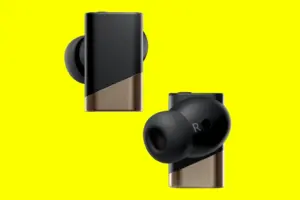
- Colorway: The earbuds feature a sophisticated matte black chassis accented by a refined matte gold finish.
- Charging Case: The accompanying charging case maintains a stealthy matte black aesthetic, topped with a matte gold lid.
- Branding: The lid is subtly stamped with both the Status Audio and GoldenSound logos, marking the cooperative nature of the hardware release.
- Ergonomics & Isolation: The physical housing is sculpted to achieve a secure, deep-insertion seal, which provides strong passive noise isolation—reducing the reliance on heavy-handed digital ANC algorithms that can sometimes degrade audio transparency.
Official Statements and Industry Perspectives
The convergence of independent audio engineering and mainstream consumer hardware manufacturing has sparked significant discussion across the tech and audiophile sectors. While brands have historically kept third-party critics at arm’s length, the willingness of companies like Status Audio to hand over tuning control to figures like Cameron Oatley signals a shift in product validation.
Industry analysts note that consumers are becoming increasingly sophisticated. Armed with measurement tools, frequency response graphs, and online community forums, buyers are looking past marketing buzzwords like "Hi-Res Audio" and demanding verifiable acoustic performance.
By utilizing the Brüel & Kjær 5128 simulator—a testing apparatus typically found in high-end acoustic laboratories rather than consumer electronics design labs—the GoldenSound collaboration demonstrates an adherence to objective acoustic science. The 5128 simulator accounts for the physical transfer function of the human outer ear (the pinna) and ear canal resonance, allowing engineers to tune headphones and earphones in a way that sounds natural to human biology rather than flat on an artificial measurement rig.
Status Audio’s willingness to offer both the locked GoldenSound profile and the ability to revert to the standard Pro X tuning reflects a consumer-first philosophy. It acknowledges that while objective acoustic accuracy is the gold standard for engineers, individual preference still plays a vital role in everyday listening enjoyment.
Future Outlook: What the GoldenSound Edition Means for Wireless Audio
The release of the Status Audio Pro X GoldenSound Edition serves as a case study for where the portable audio market may be heading. As wireless technology matures and Bluetooth transmission bitrates continue to improve—pushed forward by advanced codecs like aptX Lossless and LDAC—the bottleneck of wireless audio is no longer transmission bandwidth; it is acoustic tuning and transducer capability.
Several key trends emerge from this release:
- The Rise of Specialized Hardware Variants: We may see more manufacturers collaborating with respected acoustic engineers, content creators, and musicians to release curated editions of existing hardware, catering directly to niche audiences who value specific tuning philosophies.
- Advanced Testing Standards in Consumer TWS: The adoption of high-fidelity head and torso simulators like the Brüel & Kjær 5128 in developing consumer-grade TWS earphones points to a narrowing gap between professional monitoring gear and lifestyle audio products.
- Balancing Customization with Reference Tuning: The dual-profile approach seen in the GoldenSound Edition—providing a locked, scientifically backed reference tuning alongside user-customizable EQ apps—strikes a balance between artistic intent and consumer autonomy.
For consumers, the takeaway is clear: the era of accepting compromised sound quality in exchange for wireless convenience is drawing to a close. Products like the Status Audio Pro X GoldenSound Edition prove that multi-driver hybrid architectures and careful, science-backed acoustic tuning can successfully coexist within a portable, untethered package. As competition intensifies, brands that prioritize authentic audio fidelity alongside modern creature comforts will undoubtedly lead the next evolution of personal sound.