Executive Overview
For decades, the global footprint of Japanese cinema has been defined by a paradox. While anime boasts a near-hegemonic cultural influence across the globe, and historical auteurs like Akira Kurosawa and Yasujiro Ozu remain cornerstones of cinematic history, live-action Japanese filmmaking has struggled to consistently capture contemporary international markets. The primary culprit? A deeply entrenched domestic infrastructure: the traditional Japanese production committee system.
Designed to insulate local studios from financial risk, this closed-loop ecosystem has historically prioritized the domestic market, restricted foreign equity, suppressed international distribution, and left creators with meager returns.
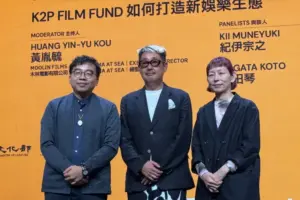
Enter K2 Pictures and its visionary founder, Kii Muneyuki. Speaking at the prestigious Taiwan Creative Content Fest (TCCF) in Taipei alongside director Nagata Koto, Kii outlined a radical blueprint to overhaul how Japanese live-action cinema is funded, produced, and distributed globally. Backed by a soaring $100 million war chest—comprising a $33 million equity round anchored by giants like MUFG Bank and bolstered by institutional loans—K2 Pictures is spearheading an aggressive counter-narrative.
By leveraging a decentralized greenlight process, a transparent 70/30 profit-split model favoring creators, direct international distribution outposts, and a unique "Japan plus one" targeted marketing strategy, K2 is proving that Japanese live-action cinema can bypass outdated gatekeepers. As the company sets its sights on producing 50 films over seven years—bolstered by gems like the Venice-competing Look Back and bold upcoming projects like Nagata’s Fukushima-noir The Nuke Crab—Kii is not merely building a production fund; he is rewriting the economic and creative rules of engagement for Asian cinema.
Detailed Chronology and Industry Genesis
Breaking Free from the Production Committee Shackles
Kii Muneyuki’s journey to disrupting Japanese cinema did not begin in a high-rise corporate office. He started his career at the ground level of the industry, tearing movie theater tickets and selling popcorn before rising through the ranks to become a producer at Toei, one of Japan’s major studios. This grassroots exposure afforded him a front-row seat to the systemic inefficiencies plaguing the local film business.
For decades, Japanese live-action films have been financed almost exclusively through the seisaku iinkai (production committee) system. In this arrangement, TV broadcasters, advertising agencies, toy companies, and publishers pool capital to mitigate individual risk. While the model successfully greenlights dozens of domestic titles annually, it suffers from fatal structural flaws:
- Risk Aversion: Because committees are driven by corporate consensus, daring, boundary-pushing, or socially taboo subjects are routinely vetoed.
- Capital Isolation: The closed nature of these committees historically locked out foreign and outside private equity.
- Creator Disconnect: Profits rarely trickle down to the actual artists, writers, and producers whose creativity birthed the asset in the first place.
Recognizing that this system was choking the growth of Japanese live-action storytelling on the world stage, Kii founded K2 Pictures. His mission was simple yet revolutionary: to establish an independent alternative that treats films not as corporate collateral, but as dynamic intellectual property capable of competing on the global stage.
The Stephen Chow Encounter: Embracing Authentic Cultural Assets
A pivotal philosophical cornerstone of K2’s mission was highlighted during Kii’s panel at TCCF, where he recounted conversations with legendary Hong Kong star-director Stephen Chow during their evenings out in Tokyo.
According to Kii, Chow offered a blunt, invaluable critique of Asian action filmmaking. The Hong Kong auteur urged Japanese filmmakers to abandon the temptation to imitate the sleek, stylized kung fu traditions of Hong Kong and mainland China.
"He said, ‘You have karate, judo, jujitsu and kendo. That is Japanese culture. Only you can turn it into action films, so you should be the ones doing it. Stop aping kung fu,’" Kii recalled.
Kii immediately recognized the wisdom in Chow’s words, pointing to Netflix’s critically acclaimed sumo drama Sanctuary as a prime example of a project that succeeds precisely because it taps into uniquely Japanese cultural phenomena. This philosophy—authenticity over imitation—now permeates K2 Pictures’ content strategy. Rather than tailoring narratives to chase homogenized Hollywood formulas, K2 champions stories deeply rooted in the complexities of contemporary and historical Japanese society.
Supporting Context & Financial Metrics
Anatomy of a $100 Million War Chest
The ambition of K2 Pictures is backed by formidable financial engineering. In February, the company closed its initial equity round at an impressive $33 million. Led by MUFG Bank—Japan’s largest lender—the investor roster has swelled to approximately 30 corporate titans.
The cap table reads like a cross-section of Japanese corporate power, featuring:
- Bandai and Dentsu (entertainment and advertising powerhouses)
- Development Bank of Japan (a government-backed financial institution)
- Tokyu Land and Mori Trust (major real estate developers)
However, equity is only part of the equation. Kii revealed that K2 is pairing this equity with structured loans added iteratively, scaling the fund’s total capitalization to $67 million and ultimately targeting a monumental $100 million war chest. The fund’s overarching mandate is ambitious: finance and deliver a slate of 50 films over a seven-year period, translating to a target output of roughly six to seven releases annually.
Disrupting the Profit Model: 70/30 Creator-First Split
Perhaps K2’s most disruptive innovation lies in its profit-distribution model. Eschewing traditional studio accounting—which often buries profits under opaque overhead charges—K2 calculates returns strictly on a title-by-title basis.
Under K2’s framework, 70% of profits go directly to investors, while 30% goes to the creative side. Kii defends this allocation with pragmatic reverence for artists:
"Producers and the people involved in making the film aren’t putting up money, but the film exists because of their creativity."
To protect debut filmmakers and mid-tier directors from the career-ending fallout of a box-office flop, K2 employs a strict budget-to-revenue balancing act. Kii emphasizes fiscal discipline: if a niche arthouse project is projected to gross ¥50 million ($330,000) globally, its budget is ruthlessly capped at ¥20 million ($130,000). By lining up pre-sales, streaming rights, and sponsorships ahead of production, K2 ensures that even first-time directors are insulated from catastrophic financial losses, preserving their viability for future projects.
Official Statements and Case Studies
The Nuke Crab: Tackling Japanese Taboos
The true test of K2 Pictures’ editorial freedom is its upcoming slate, most notably The Nuke Crab, a Fukushima-set noir directed by Nagata Koto. Unveiled at the Cannes Film Market in May, the project dives headfirst into social territory that mainstream Japanese networks and major studios aggressively avoid.
The film follows the cynical opportunists who profited from the massive influx of public and private capital funneled into the radiation cleanup of the Tohoku region following the 2011 disasters. Nagata, whose previous feature Baka’s Identity competed at the Busan International Film Festival, noted that the subject remains heavily stigmatized in Japan.
"When I took it to Kii-san, he immediately said, ‘That sounds interesting, let’s do it,’ and got it started," Nagata recounted during the TCCF panel.
Rather than viewing the film through an exclusively local lens, K2 and Nagata are employing their strategic "Japan plus one" international targeting framework. Kii believes the film will strike a profound emotional chord in Eastern Europe—specifically in countries like Poland and Ukraine—where audiences who lived through the shadow of the Chernobyl disaster share an intimate understanding of nuclear fallout’s societal aftershocks.
Nagata emphasized that beneath the geopolitical and historical specifics of the narrative lie universal emotional truths:
"I think jealousy and love are the same anywhere in the world, as long as we are human."
The "Japan Plus One" Distribution Strategy
K2’s commitment to international markets goes far beyond traditional foreign sales agents. Historically, 99.9% of Japan’s overseas film business has been conducted via passive licensing deals—a practice Kii lambasts as detrimental to the long-term value of Japanese IP.
To combat this, K2 has established direct distribution outposts in key regional hubs like Taiwan and South Korea.
"Japanese people taking Japanese films to that place and promoting them hard there — I think that’s what raises their value," Kii argued.
This philosophy anchors the "Japan plus one" strategy. Kii notes that international appetites for Japanese culture are fundamentally heterogeneous: what resonates with French cinephiles differs vastly from what appeals to American multiplex audiences, Taiwanese art-house patrons, or South Korean youth culture. By pairing Japan with a secondary target market during a film’s conceptualization and marketing phase, K2 ensures tailored, high-impact global distribution.
Future Outlook: Legislative Reform and Industry Legacy
Building a Legal Framework for Content Securitization
Kii’s ambitions extend far beyond individual film slates; he aims to fundamentally reform Japanese financial legislation regarding intellectual property.
During his discussions with international legal and financial experts—including a British entertainment lawyer and an American completion bond executive—Kii learned that the global film business operates much like real estate: creators generate foundational assets and subsequently monetize them. While Japan successfully passed investment trust laws around the year 2000 to enable the securitization of real estate assets, no equivalent legal framework exists for creative content.
Kii has begun consulting with legal experts to lobby for legislative changes that would allow entertainment content to be officially securitized in Japan. If successful, this reform could unlock institutional capital on a scale hitherto unseen in the Japanese entertainment sector, transforming intangible creative assets into liquid, investment-grade financial instruments.
A Sustainable Pipeline for New Talent
As K2 Pictures approaches the close of its foundational years—having completed six notable projects this year, including Kore-eda Hirokazu’s live-action manga adaptation Look Back (which competed at Venice) and Son Myung-ah’s debut feature Trophy—the pace remains grueling. Yet, Kii remains steadfast in his long-term vision.
By combining decentralized creative freedom (where producers retain greenlight power without executive interference) with rigorous financial hedging and direct overseas distribution, K2 is constructing an industrial template for modern Japanese cinema.
As the TCCF session—moderated by Moolin Films founder and Cinema at Sea festival director Huang Yin-yu Kou—drew to a close, Kii encapsulated his ultimate ambition for the next generation of filmmakers passing through his studio doors:
"I want to keep launching new directors from K2 Pictures. And I want them to be grateful for the rest of their lives. Don’t forget us when you make it big."
Through unyielding financial discipline, cultural authenticity, and a fearless willingness to challenge domestic taboos, K2 Pictures is successfully steering Japanese live-action cinema out of its insular past and into a bold, highly profitable global future.