
Executive Overview
For years, paid search practitioners have found themselves locked in a silent tug-of-war with Google over Responsive Search Ads (RSAs). At the heart of this friction lies a deceptively simple metric: Ad Strength.
Google has repeatedly insisted that Ad Strength is merely a diagnostic tool designed to guide copywriters during the creation stage. According to official documentation and public statements from Google representatives, the rating does not directly influence ad serving eligibility, nor is it factored into Ad Rank, Quality Score, or auction dynamics.
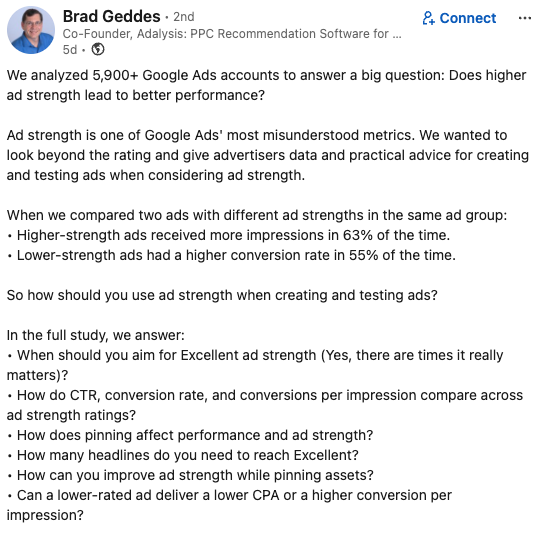
However, a comprehensive new industry study conducted by Adalysis co-founder Brad Geddes—analyzing data from more than 5,900 Google Ads accounts—tells a strikingly different story. The data reveals that Google’s delivery systems are increasingly steering impressions toward ads carrying higher Ad Strength ratings, regardless of whether those ads actually drive better bottom-line results.
In head-to-head matchups within the same ad groups, higher-rated RSAs captured more impressions 63% of the time. Yet, when evaluated on efficiency, those same top-tier ads only boasted a higher conversion rate in 45% of test cases.
This deep-dive investigation examines how Ad Strength functions in practice, the four-year drift in Google’s delivery algorithms, the critical variable of "pinning," and what digital marketers must change in their accounts to protect their margins before peak traffic seasons arrive.
Detailed Chronology: The Evolution of Ad Strength and Algorithmic Drift
To understand where paid search is today, we must trace how Google’s relationship with RSAs and automated ad optimization has evolved over the past half-decade.
The Shift to RSAs as the Default Format
When Google first rolled out Responsive Search Ads, it marked the beginning of the end for Expanded Text Ads (ETAs). Advertisers were forced to transition from static, manually controlled ad copy to dynamic frameworks where they provided multiple headlines and descriptions, leaving the assembly up to Google’s machine-learning algorithms.
To help marketers navigate this loss of control, Google introduced the Ad Strength meter—ranging from "Poor" to "Excellent." The promise was simple: follow our best practices, feed the machine more assets, and earn a better score.
The 2022 Adalysis Baseline
In 2022, Adalysis published its first major study on Ad Strength, establishing a baseline for how Google’s algorithm distributed impressions across ads with varying ratings. At that time, data showed that the higher-rated ad in a mixed-strength ad group secured more impressions in 56.8% of cases, while achieving a higher Click-Through Rate (CTR) 48.5% of the time and a higher conversion rate in 45.8% of tests.
The 2026 Reality Check
Fast-forward four years, and Adalysis’s updated 2026 study across nearly 6,000 accounts reveals a distinct algorithmic drift. Google’s reliance on Ad Strength to determine which ad wins impressions has intensified significantly:
- Impression Share Wins: The higher-rated ad now captures the lion’s share of impressions in 63% of ad groups (up from 56.8% in 2022).
- Click-Through Rates: Higher-rated ads secure a better CTR in 52.5% of matchups (up from 48.5%).
- Conversion Rates: Conversely, conversion performance has actually worsened slightly for top-rated ads, dropping to 45.1% (down marginally from 45.8%).
This chronological progression demonstrates a clear trend: Google’s systems are leaning harder on Ad Strength to make serving decisions, even though that metric correlates more closely with clicks than with actual conversions.
Supporting Context & Metrics: When 2 Ads Go Head-to-Head
To strip away account-level noise and isolate the true impact of Ad Strength, the Adalysis study focused heavily on ad groups running exactly two active RSAs with differing Ad Strength ratings. Because both ads shared identical keywords, bids, and budgets, the performance comparisons yield undeniable clarity.

The Impression Disparity
When pitting ads of varying ratings against one another, the performance gap in impression distribution is stark:
- "Excellent" vs. "Poor": In matchups between the highest and lowest possible ratings, the Excellent ad captured more impressions in an overwhelming 78% of ad groups.
- Two Ratings Apart: Matchups featuring a two-tier gap (e.g., Excellent vs. Average, or Good vs. Poor) saw the higher-rated ad win impressions 66% of the time.
- Adjacent Ratings: Even in close matchups like Good versus Average, the higher-rated ad claimed the impression majority 59% of the time.
The Performance and Cost Breakdown
While high Ad Strength reliably commands more real estate on the search engine results page (SERP), it fails to deliver proportional business value.
- CTR: The higher-rated ad achieved a better CTR in just 52.5% of ad groups—performing only marginally better than a coin flip.
- Conversion Rate: The higher-rated ad secured a superior conversion rate in only 45% of tests. This means that lower-rated ads converted better 55% of the time.
- Cost Per Acquisition (CPA): Across the dataset, higher-rated ads ran an average 11.8% higher CPA than their lower-rated counterparts. To put this in perspective, if a lower-rated ad yields a profitable CPA of $100, its higher-rated rival in the same ad group averages a cost of $111.80 per acquisition.
For enterprise accounts spending millions annually, an 11.8% inflation in CPA driven entirely by algorithmic favorability toward a diagnostic label is far from a rounding error—it is a direct hit to profitability.
Official Statements vs. Observed Reality
The tension between Google’s official guidance and real-world observations is one of the most hotly debated topics in modern PPC management.
What Google Says
Google has consistently maintained that Ad Strength is an in-interface helper rather than an auction-time signal.
- Google Help Center: Documentation explicitly states that Ad Strength "doesn’t directly influence your ad’s serving eligibility" and is not factored into Ad Rank, Quality Score, or auction wins.
- Ginny Marvin (Google Ads Product Liaison): Echoing this stance on social media, Marvin clarified that Ad Strength "isn’t used directly in the auction & shouldn’t limit your testing."
Reconciling the Claims
Experienced practitioners note that both Google and researchers like Brad Geddes can technically be correct at the same time.
It is entirely plausible that the Ad Strength score itself is not a direct input in the real-time ad auction. However, the underlying qualities that generate a high Ad Strength score—such as maximum asset variety, broad keyword coverage, and unconstrained machine-learning combinations—give Google’s automated systems more raw materials to work with. When the algorithm constructs an ad variant on the fly, it naturally favors assets that align with broader structural preferences, resulting in the observed impression bias.
Ultimately, whether the algorithm uses the score directly or uses the components that create the score, the practical outcome inside the ad account remains identical: the higher-rated ad gets the traffic.
Why Lower-Rated Ads Frequently Win: The Power of Pinning
Before writing off Ad Strength as a misleading metric, marketers must examine why lower-rated ads often outperform their "Excellent" counterparts. The secret lies in a single setting: Pinning.
The Conflict Between Pre-qualification and Machine Freedom
In many mixed-strength ad groups, the lower-rated ad has headlines or descriptions pinned to specific positions, while the higher-rated ad is left entirely unpinned.
Experienced advertisers often pin headlines for strategic reasons:
- Enforcing the display of a specific price point.
- Adding legally required disclaimers or qualifiers.
- Pre-qualifying users to filter out unqualified clicks before they happen.
Google’s Ad Strength algorithm penalizes pinning because it restricts the machine’s flexibility. However, that exact restriction is often what makes the ad effective at driving conversions. A pinned ad designed to pre-qualify buyers filters out junk traffic, leading to a higher conversion rate and a lower CPA, even if it triggers a "Poor" or "Average" Ad Strength rating.
Unpinned vs. Pinned Realities
When examining unpinned ads exclusively, the data tells a much more traditional story:
- CTR rises steadily with every step up in Ad Strength.
- Conversion rates improve at each tier (with a minor plateau between Poor and Average).
- For unpinned accounts, striving for a higher Ad Strength rating genuinely pays off.
Therefore, the definitive takeaway is nuanced: Ad Strength is an effective predictor of performance when you let Google’s machine run unchecked, but it becomes an inverted indicator when you deliberately override the system to protect your conversion quality.
Asset Volume Realities: What It Actually Takes to Reach "Excellent"
Many marketers fall into the trap of "asset stuffing"—cramming low-quality headlines into an ad just to turn the Ad Strength meter green. The Adalysis data proves this strategy is fundamentally flawed.
- The Threshold for Excellence: Without pinning, an ad can achieve a "Good" rating with as few as seven assets, but reaching "Excellent" typically requires at least 11 distinct headlines.
- The Diminishing Returns of Volume: Simply adding more text does not guarantee a top score. Only 44% of ads with 15 or more headlines managed to reach "Excellent." In extreme cases, accounts featured ads with up to 38 assets that were still rated "Poor" due to redundancy or lack of thematic variety.
- The Penalty of Pinning: Pinning assets raises the barrier to entry. Pinning two positions caps most ads at "Good" or lower. If an advertiser insists on pinning all three headline positions, Adalysis recommends building a robust library of at least 13 distinct assets to claw back a respectable rating.
Strategic Recommendations: What to Change in Your Account This Week
Rather than treating Ad Strength as a vanity score that must be won at all costs, paid search managers should treat it as a traffic-allocation variable that must be actively managed. Consider implementing the following four-step action plan immediately:
1. Audit and Tag RSAs by Pinning Status
Before evaluating an ad’s rating, segment your RSAs in Google Ads Editor or via data exports into three distinct categories: unpinned, partly pinned, and fully pinned. Because Ad Strength means entirely different things in each category, judge each bucket on its own merits rather than applying a blanket rule.
2. Optimize Unpinned Ads via Variety, Not Volume
If an unpinned ad is stuck at "Average" or "Good," do not respond by adding duplicate headlines. Instead, aim for a minimum of 11 unique assets that thoughtfully mix core keywords, product benefits, features, distinct calls-to-action (CTAs), and brand authority statements.
3. Rebuild Pinned Ads Strategically
Do not abandon pinning if it protects your brand voice or profit margins. Instead, adopt a structured workflow:
- Remove pins temporarily to build the foundational ad up to an "Excellent" rating.
- Re-apply necessary pins and continuously add fresh assets until the rating stabilizes at "Good" or "Average."
- If you must pin all three headline positions, expand your asset count to at least 13 variations to give the machine enough alternative combinations.
4. Judge Tests on CPI and CPA, Not Ratings
It is entirely acceptable to run ads with differing Ad Strength ratings within the same ad group. However, recognize that your Excellent ads will starve your lower-rated ads of impressions, significantly lengthening the time required to reach statistical significance. If a lower-rated, pinned ad consistently wins on Cost Per Acquisition (CPA) and Conversions Per Impression (CPI), keep it running. Never pause a conversion winner just to fix a diagnostic label.
Future Outlook: The Human Touch vs. The Machine
As Brad Geddes famously noted at the conclusion of his study: “Often, the human ability to create compelling ads will outperform the machine’s ability to serve the ads properly.”
While artificial intelligence and machine learning continue to dominate the mechanics of the Google Ads auction, the ultimate responsibility for business profitability rests with human strategists. Google’s algorithms are brilliantly optimized to generate clicks and maximize platform spend; human marketers are tasked with generating profitable revenue.
Ad Strength is not a useless metric, but it is deeply misunderstood. By recognizing that high Ad Strength drives traffic rather than guaranteed conversions—and by refusing to let algorithmic grading override sound commercial strategy—PPC managers can successfully harness machine learning without sacrificing their bottom lines.
The machine may dictate who sees your best ad, but the human strategist must decide whether that visibility is actually worth paying for.