Executive Overview
The barriers to internet publishing have effectively dissolved. In the span of a single afternoon, modern generative artificial intelligence allows an enterprise to synthesize, format, and deploy thousands of pages into the digital ether. Eager to capture organic search traffic and monetize digital real estate, many companies adopted this approach, casually labeling it "programmatic SEO" (pSEO). For a brief window, it yielded results. Organic traffic surged, short-term revenue scaled, and management teams—seduced by compressed time-to-market and negligible production costs—celebrated the strategy.
Today, those exact metrics of success have become liabilities. Aggressive, unvetted programmatic initiatives are collapsing under the weight of algorithmic updates, manual penalties, and a broader industry reckoning. The root cause is a fundamental failure of perspective: creators stopped asking whether these pages actually deserved to exist.
Search engines have systematically clamped down on this phenomenon. Google’s scaled content abuse policies target high-volume publishing operations regardless of whether the text is generated by automated scripts, human ghostwriters, or hybrid pipelines. Concurrently, the rise of zero-click searches and generative AI overviews has fundamentally altered the search engine results page (SERP). With fewer users clicking through to traditional links, pages built solely to capture keyword rankings are rapidly losing their commercial viability.
This article examines the critical divergence between mass AI publishing and legitimate programmatic SEO. By evaluating historical frameworks, expert insights, algorithmic shifts, and rigorous publishing checklists, digital strategists can learn how to build sustainable, data-driven systems that survive the era of AI search.
Detailed Chronology: The Evolution of Scaled Publishing
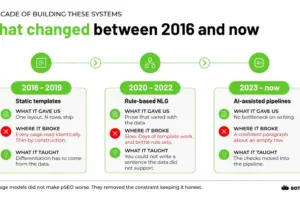
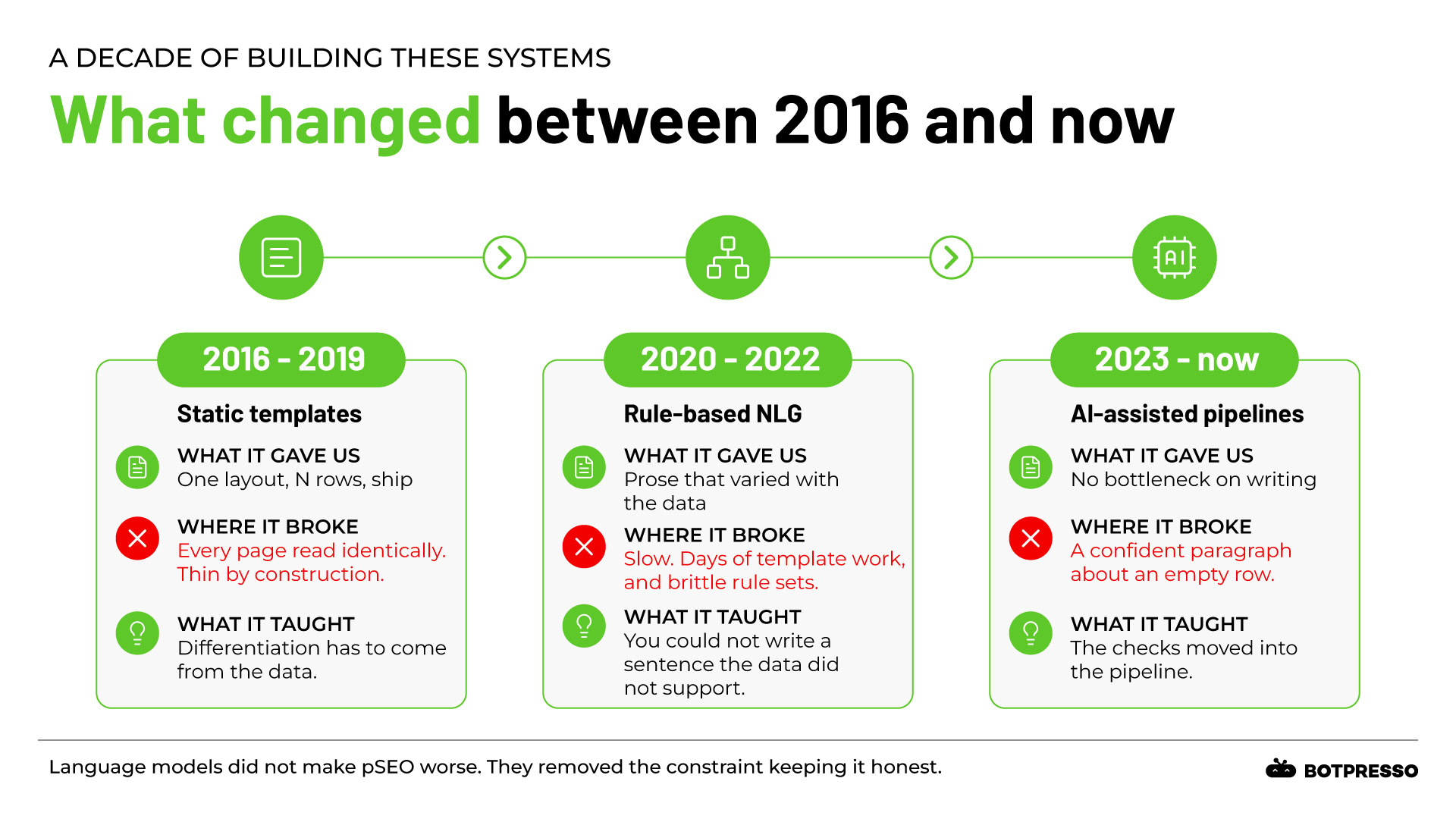
To understand where programmatic SEO stands today, it is necessary to trace its evolution from rigid, rule-based coding exercises to modern, LLM-driven pipelines.
[2016: Static Templates & Rule-Based Engines]
       │
       ▼
[Middle Era: Rosae NLG & Natural Language Generation]
       │
       ▼
[Current Era: AI-Assisted Pipelines & Scaled Abuse]
1. The Early Era (2016): Static Templates and Rule-Based Engines
Building programmatic SEO systems a decade ago required heavy technical lifting. Practitioners relied on static HTML templates combined with structured relational databases. Tools were rudimentary, forcing developers to map out every variable manually.
Systems were slow to construct, and that very slowness served as a natural quality control mechanism. Because engineering resources were scarce, publishers only targeted high-value keyword patterns backed by robust datasets—such as real estate registries, flight schedules, or currency exchange rates.

2. The Middle Era: Natural Language Generation (NLG)
As the discipline matured, rule-based engines like Rosae NLG emerged. These systems translated structured data rows into readable sentences using predefined grammar rules. While more efficient than purely manual coding, these engines maintained strict guardrails: a page could only state what the underlying data and template constraints permitted. The technology acted as a governor on output volume, ensuring that every published page maintained a direct correspondence to verified data points.
3. The Modern Era: Large Language Models and Mass Publishing
The advent of advanced Large Language Models (LLMs) shattered these natural limitations. Where early engines required explicit data mappings, modern language models can generate fluent, highly persuasive prose based on minimal prompts and sparse datasets.
Swap a city name in a prompt, and an AI can instantly output thousands of distinct destination guides. Unfortunately, this fluency often masks a total lack of substance. Models will write authoritatively about variables that do not exist, producing pages that look comprehensive to the casual human eye but offer zero genuine utility to the user.
Supporting Context & Metrics: The Shift in Search Economics
The consequences of mass AI publishing are amplified by massive structural shifts in how users interact with search engines.
The Rise of Zero-Click Searches
Data analyzed by SparkToro from Similarweb indicates that in the first four months of 2026, 68% of U.S. Google searches ended without a single click. This represents a dramatic increase from roughly 60% in 2024 and just 45% in 2016.
This erosion of traffic is largely driven by AI Overviews, which now appear on over 20% of searches. According to estimates by Ahrefs, these features reduce outbound clicks to the top-ranking traditional search result by up to 58%.
Google’s Algorithmic Enforcement
Google has steadily tightened its enforcement mechanisms to combat low-quality output. On March 5, 2024, the search engine significantly strengthened its scaled content abuse policy. This policy explicitly penalizes pages generated in bulk to manipulate search rankings, regardless of whether automation or human labor was used. Subsequent Google quality reports indicated a 45% reduction in low-quality, unoriginal content appearing across search results.
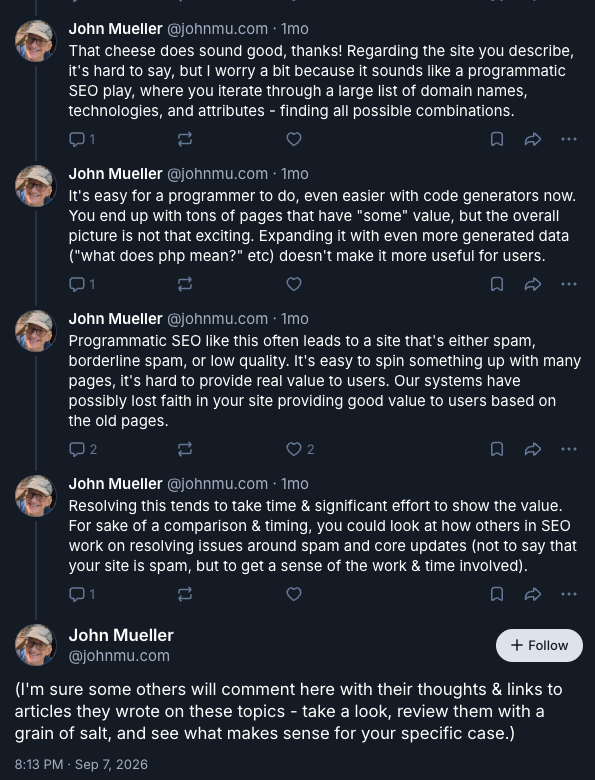
Industry authorities continue to reinforce these warnings. In late 2026, Google’s John Mueller responded to a site generating programmatic variations of domain names and attributes, noting that such approaches frequently result in spam, borderline spam, or low-quality indexes. Crucially, Mueller highlighted that hosting low-quality programmatic pages can negatively influence how search engines evaluate an entire domain.
Official Statements and Industry Perspectives
To separate legitimate architectural scaling from exploitative content generation, leading voices in the SEO community have established clear conceptual boundaries.
Lucia Lecesne (Marketing Lead, Wise)
Wise operates one of the most enduring examples of legitimate programmatic SEO in the financial sector: global currency conversion and transfer guides. Lecesne emphasizes that utility must always precede scale:
"At Wise, we focus on genuine customer utility: solving a problem that users face on their journey to become customers. Programmatic SEO can then make that solution relevant and accessible across the many search queries and modifiers that share the same problem, in other words, tailoring it to each customer’s specific search context. It should never be a shortcut to publishing large volumes of low-quality pages."
Eli Schwartz (SEO Strategist and Author)
Schwartz draws a sharp line between strategic architecture and automated manipulation:
"Spinning up pages just because you can isn’t SEO; it’s programmatic spam. If you create pages because they benefit many users, that is good SEO, whether you create them programmatically or manually."
Kevin Indig (Growth Advisor)
Reflecting on the primary failure modes of corporate SEO strategies, Indig highlights the danger of treating web architecture like a manufacturing assembly line:
"Programmatic SEO usually goes wrong when it is ‘spray and pray’: publishing a lot of pages at once with no experimentation, no refreshing, and no look at engagement. The fix is the one worth underlining: treat pSEO like its own product, not like a content batch."
Dominik Schwarz (Digital Marketing Executive)
Schwarz underscores the temptation faced by corporate leadership teams:
"pSEO doesn’t fail because it’s programmatic; it fails when scale replaces substance. The hard part isn’t the tech; it’s the discipline to never trade quality for volume, because pSEO makes that trade tempting for every decision maker."
Defining the Core Difference: pSEO vs. Mass AI Publishing
┌───────────────────────────────────────────────┐
│           PROGRAMMATIC SEO (pSEO)             │
├───────────────────────────────────────────────┤
│ • Built on a verified, structured dataset     │
│ • Template scales unique value per row        │
│ • Every page answers a distinct user need     │
│ • Regularly audited and updated with live data│
└───────────────────────────────────────────────┘
                        vs.
┌───────────────────────────────────────────────┤
│            MASS AI PUBLISHING                 │
├───────────────────────────────────────────────┤
│ • Driven by generic prompts and guesswork     │
│ • Identical text blocks with swapped keywords │
│ • Created solely to manipulate rankings       │
│ • Lacks verifiable sources or timestamps      │
└───────────────────────────────────────────────┘
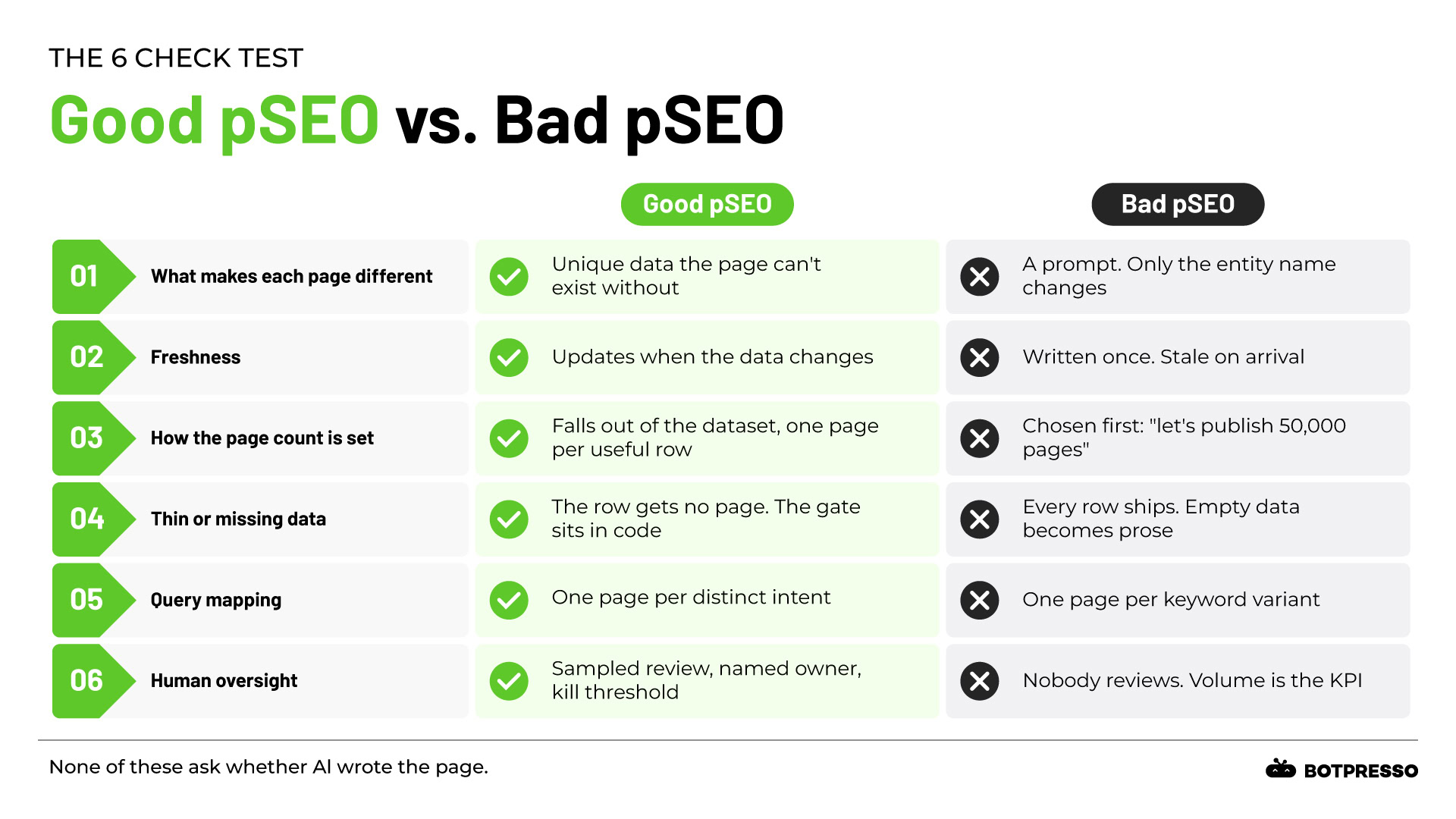
Programmatic SEO is fundamentally a publishing methodology, not a content type. A legitimate pSEO program relies on three immutable pillars:
- A Repeatable Search Pattern: A consistent user query structure (e.g., "Convert [Currency A] to [Currency B]").
- A Structured Dataset: A maintained, verified database that supplies unique data points to every single generated page.
- A Scalable Template: A framework that translates raw data into a helpful, context-aware user interface.
The Lisbon Cost-of-Living Test
Consider two distinct web pages targeting the search query "Cost of living in Lisbon." Both utilize the exact same template structure.
-
Page A (True pSEO): Pulls live rent ranges, local public transit pricing, and current grocery costs from a continuously updated economic dataset. If grocery inflation rises by 4% in Lisbon, the data updates dynamically, and the page reflects that
change.
- Page B (Mass AI Publishing): Displays convincing rent figures, generalized monthly budgets, and confident summaries. However, the numbers are generated via LLM guesswork. They carry no source citations, no timestamps, and identical sentences appear across hundreds of other city guides with only the geographic noun swapped.
To determine which framework a site employs, ask a simple diagnostic question: Where did each data point come from, and when was it last verified? Page A answers instantly. Page B cannot.
The pSEO Pre-Flight Checklist
Before deploying automated pages at scale, digital architects must run every proposed URL template through a rigorous evaluation framework.
Phase 1: Before the First Page
- [ ] Dataset Verification: Does every variable on the page link back to a structured, maintained, and verifiable database?
- [ ] Intent Audit: Would a user arriving directly at your domain via direct navigation or an external bookmark genuinely benefit from landing on this specific page?
- [ ] Uniqueness Threshold: Does the underlying data ensure that Page X offers materially different utility and information than Page Y?
Phase 2: At Launch
- [ ] Source Attribution: Are data sources, pricing indexes, and calculation methodologies clearly cited for users and search engine crawlers?
- [ ] Expert Review: Have subject matter experts reviewed sample outputs to ensure factual accuracy and strict alignment with brand guidelines?
- [ ] Crawl Budget Management: Are internal linking architectures configured to prevent low-value or transitional index bloat?
Phase 3: Ongoing Maintenance
- [ ] Automated Refresh Cycles: Are datasets programmed to update dynamically based on real-world fluctuations?
- [ ] Engagement Monitoring: Are you tracking post-click user behavior (such as dwell time, conversion events, and bounce rates) rather than relying solely on raw impression metrics?
- [ ] Pruning Protocols: Is there a defined, automated process for deprecating, redirecting, or deleting underperforming pages before they harm overall domain reputation?
Future Outlook: Surviving and Thriving in AI Search
As artificial intelligence continues to reshape search engines, the traditional metrics of SEO success are evolving. When more than two-thirds of searches conclude without a traditional outbound click, treating traffic acquisition as the sole KPI for a programmatic program is a recipe for obsolescence.
In the zero-click ecosystem, programmatic pages must achieve a dual purpose:
- Direct Utility: Delivering immediate, actionable value to the fraction of users who do click through.
- Entity Influence: Providing structured, authoritative data that large language models and search engines cite when synthesizing AI-driven answers.
When a brand builds a programmatic initiative anchored in proprietary data and rigorous editorial standards, even an AI-generated summary must reference the source. Conversely, if a page’s only justification for existence was keyword manipulation, the rise of zero-click search guarantees its irrelevance.
The path forward requires strict discipline. Scale should amplify authority, never substitute for it. Before deploying your next programmatic pipeline, strip away the templates, look at the individual data rows, and ask: Does this page deserve to exist?