Executive Overview
If video killed the radio star, generative artificial intelligence has systematically assassinated our collective faith in the visual medium. In an era where a few text prompts can conjure hyper-realistic, indistinguishable portraits of world leaders, historical events that never happened, and malicious deepfakes, the foundational maxim that "seeing is believing" has effectively collapsed. Enter Josh Cowell, founder and CEO of CAIM1 (Counter Artificial Intelligence Machine 1), who is leading a high-stakes hardware crusade to resurrect objective reality.
CAIM1 is developing a revolutionary, ruggedized camera prototype designed to embed cryptographic proof of authenticity directly into an image at the exact moment of capture. By marrying cutting-edge open-source silicon, decentralized blockchain verification, and heavy-duty industrial engineering, the startup aims to establish an unalterable chain of custody for digital media. As Cowell starkly puts it: "The traditional photograph is dead, and designing a secure camera to replace it is an exercise in healthy paranoia."
As the digital landscape buckles under an unprecedented deluge of synthetic media—with Europol projecting that a staggering 90 percent of online content will be AI-generated by the end of 2025—CAIM1’s approach represents a paradigm shift. Rather than relying on retroactive software detection tools that are constantly outpaced by generative models, CAIM1 is baking trust directly into the hardware. With a planned commercial release in the first quarter of 2027, the startup is not merely building a niche security gadget, but laying the foundation for a comprehensive infrastructure designed to salvage digital truth before it slips away completely.
Detailed Chronology: The Genesis and Engineering of CAIM1
The journey toward creating a tamper-proof camera began with a grim realization: software-based watermarking and post-capture verification are fundamentally broken. Because bad actors can easily strip metadata or train models to bypass superficial digital signatures, CAIM1 realized that the fortification of images had to happen at the very point of creation—inside the physical sensor and silicon architecture of the camera itself.
The Hardware Blueprint: The Tropic01 Chip and the "Digital Vault"
The cornerstone of CAIM1’s technology is its integration with the Tropic01 chip, developed by silicon provider Tropic Square. Hailed as the "world’s first auditable secure element," this component acts as a physical digital vault.
When a user presses the shutter button on a CAIM1 prototype, incoming light photons pass through this heavily guarded internal pipeline on their way to the sensor. At that microsecond, the internal chip generates a hardware-level verification fingerprint. Because microscopic, random irregularities occur during every silicon manufacturing process, no two chips produce the exact same digital fingerprint. This physical uniqueness ensures that the cryptographic signature tied to the image is utterly impossible to duplicate, spoof, or forge.
Once the photo is captured, the verification data is mapped to a unique, anonymous blockchain signature, establishing an immutable, auditable decentralized record. To safeguard users against state-sponsored tampering, sophisticated cyberattacks, or key-theft vulnerabilities, CAIM1 deploys advanced physical noise systems and internal encryption protocols that act as digital tripwires.
Solving the Thermal Crisis: The Noctua Partnership
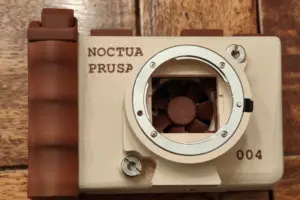
Building an ultra-secure, high-performance camera capable of processing massive cryptographic pipelines alongside high-resolution video presented a severe engineering hurdle: extreme heat. High processor temperatures degrade image quality and threaten hardware stability. Traditional cooling solutions fell short—standard passive heatsinks could not dissipate the intense thermal load of the camera’s advanced processors, while standard internal fans introduced mechanical micro-vibrations that caused catastrophic motion blur.
To overcome this, CAIM1 entered into an unexpected partnership with renowned PC cooling manufacturer Noctua. The collaboration yielded the NF-A4x10 active-cooling airflow system. This unified single-airstream design skillfully channels cool air across the camera’s two primary heat sources—the CPU and the image sensor—while actively expelling thermal buildup. Crucially, the system is secured by two custom anti-vibration mounts, neutralizing internal motor vibrations and preserving pristine image sharpness even under punishing operational conditions.
Field Testing at the Nürburgring
Rather than confining its prototype to sterile laboratory environments, CAIM1 took its creation straight to the asphalt. The startup recently tested its camera setup at Germany’s infamous Nürburgring racetrack, marrying its secure processing core with premium glass lenses from Japanese optics company Kowa Optronics (specifically the JC10M series).
Operating under a "Bring-Your-Own-Lens" philosophy that accommodates both vintage and modern glass, the camera proved that it was designed for more than laboratory theory. Capable of handling high-octane action sports and crisp 4K video recording, the field tests demonstrated that CAIM1 is built to withstand high-stress environments without compromising durability, security, or cinematic fidelity.
Supporting Context & Metrics: The Deepfake Epidemic
To truly grasp the urgency behind CAIM1’s hardware initiative, one must examine the staggering scale of the global disinformation and deepfake crisis currently overwhelming the digital ecosystem. The proliferation of synthetic media is no longer an emerging threat—it is an ongoing systemic failure across global platforms.
The Numbers Behind the Synthetic Deluge
- Exponential Growth: According to a comprehensive report published by the European Parliament, social media deepfakes have doubled every six months since 2023, surging to an estimated 8 million instances in 2025 alone.
- The 90 Percent Threshold: Current trajectories analyzed by Europol indicate that up to 90 percent of all online content could be synthetically generated or heavily manipulated by AI before the close of 2025.
- The Pornographic Pandemic: Perhaps most alarming is the deeply harmful vector of nonconsensual synthetic media. Europol data reveals that an astonishing 98 percent of all deepfakes circulating online are explicitly pornographic in nature.
- Corporate Accountability under Fire: Major tech conglomerates—including xAI, Google, Meta, and Apple—have faced mounting legal challenges for failing to implement robust guardrails. Lax platform safeguards have repeatedly allowed the systematic generation and viral distribution of nonconsensual sexual deepfakes, as highlighted by recent investigations into platforms like Hugging Face.
The Analogue "Physical Receipt" Innovation
In addition to blockchain verification and cryptographic silicon fingerprints, CAIM1 has tackled the accessibility of truth by introducing a tangible solution: the physical receipt. For every image captured on the system, the camera can generate a physical or digital receipt containing:
- A permanent, scannable QR code linked directly to the immutable blockchain record.
- Critical, tamper-proof metadata including the exact date, time, and geographic coordinates of the shot.
- A unique access key granting secondary verification rights to journalists, legal researchers, and everyday consumers.
Official Statements & Industry Perspectives
The race to secure visual media has sparked an ideological divide between closed corporate ecosystems and open-source infrastructure developers.
In a joint publication on the Tropic Square blog, CAIM1 founder Josh Cowell articulated the philosophy driving his startup:
"The traditional photograph is dead, and designing a secure camera to replace it is an exercise in healthy paranoia… CAIM1 is ultimately just the foundation of a comprehensive, verifiable infrastructure we are developing designed to aid digital truth."
Cowell has been vocal about how CAIM1 differentiates itself from legacy tech giants entering the space. While major manufacturers have begun exploring hardware attestation—such as Apple’s Reference Image system for the iPhone 18 Pro and 18 Pro Max, alongside a 2024 joint initiative by Sony, Canon, and Nikon to embed digital signatures into camera-borne media—Cowell argues that these solutions fall short of true transparency.
According to Cowell, competitor systems force users to "place blind faith in a single corporate entity’s closed ecosystem." In contrast, CAIM1 utilizes Tropic Square’s open-security hardware architecture, allowing independent researchers, cryptographers, and the general public to audit the camera’s internal pipeline from the silicon up, ensuring absolute trust without corporate intermediaries.
Future Outlook: The Road to 2027 and Beyond
As CAIM1 navigates the final stages of prototyping and refinement leading up to its commercial debut in the first quarter of 2027, the stakes could not be higher. The company’s roadmap extends far beyond catering to niche action sports videographers or professional photojournalists; the ultimate goal is to instantiate a new global standard for objective reality.
The battle lines for the future of information have been drawn. As generative video and image models grow increasingly sophisticated—capable of rendering photorealistic physics, lighting, and human emotion within seconds—the human eye can no longer serve as a reliable detector of truth.
By decentralizing verification, opening hardware architecture to public audits, and fusing rugged industrial design with military-grade cryptographic safeguards, CAIM1 is betting that humanity’s desire for unvarnished truth will outpace the convenience of synthetic illusion. Whether the market adopts this "healthy paranoia" en masse remains to be seen, but one thing is certain: without innovations like CAIM1, the history we record tomorrow may be entirely fiction.