Executive Overview
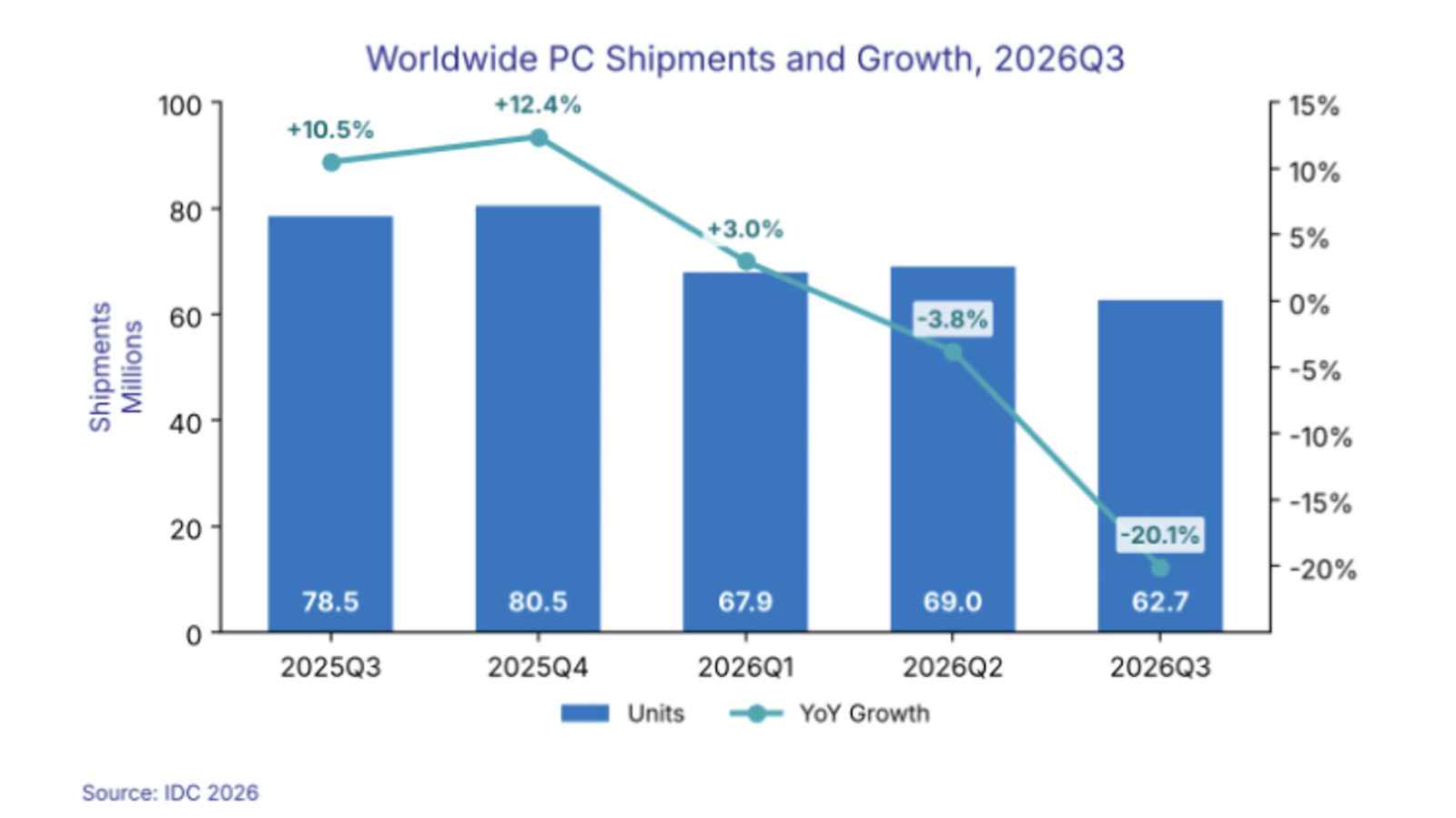
The global personal computer industry is navigating one of the most turbulent economic landscapes in its history. According to a landmark market intelligence report released by the International Data Corporation (IDC), worldwide PC shipments plummeted to 62.7 million units in the third quarter of 2026. This performance represents a severe 9.1 percent contraction compared to the previous quarter (Q2 2026) and a devastating 20.1 percent year-over-year drop relative to the third quarter of 2025.
Industry analysts have codified this ongoing hardware crisis under the grim moniker "RAMaggedon"—a portmanteau capturing the severe supply chain strangulation, component scarcity, and runaway inflation of memory architecture (RAM) and core processing units. What began as early indicators of manufacturing friction in late 2025 has metastasized into a structural market correction. Elevated consumer prices, tightening macroeconomic headwinds, and inflated retail inventories are actively suffocating consumer demand.
For enterprise buyers, system builders, and everyday consumers, the market dynamic has completely reversed from the post-pandemic supply gluts. Instead of ubiquitous discounts and accessible hardware availability, buyers are now forced to navigate an inflated marketplace where relief is fleeting and recovery horizons stretch well into late 2027 or beyond. This comprehensive investigative report analyzes the architectural causes of the Q3 2026 downturn, traces the chronology of the hardware crisis, unpacks the economic implications for channels and consumers, and projects the trajectory of the global PC ecosystem.
Detailed Chronology: The Escalation of the 2026 Hardware Crisis
To understand the severity of the Q3 2026 metrics, one must trace the compounding failures that transformed regional supply chain bottlenecks into a global semiconductor and memory crisis. The warning signs materialized long before IDC published its bleak third-quarter numbers, forming a distinct timeline of market degradation.
Late 2025: The First Tremors in the Silicon Supply Chain
As the PC market attempted to stabilize following years of post-pandemic correction, underlying shifts in semiconductor fabrication priorities began to destabilize component pricing. Major dynamic random-access memory (DRAM) and NAND flash manufacturers aggressively reallocated production lines toward high-bandwidth memory (HBM) modules designed to feed the relentless, high-margin demands of the enterprise artificial intelligence infrastructure boom.
This pivot created an immediate capacity squeeze for consumer-grade memory components. Standard DDR5 and advanced memory controllers experienced immediate production shortfalls. By late 2025, component wholesalers began warning system integrators of impending cost adjustments, setting the stage for hardware price hikes that would inevitably reach the retail end-user.
Spring 2026: Forecast Cuts and the Redefinition of Market Expectations
By the middle of the first quarter of 2026, the cumulative effect of memory scarcity forced market researchers to adjust their lenses. In early spring 2026, IDC took the rare and decisive step of slashing its full-year PC market forecast. Analysts realized that the traditional seasonal rebound—typically driven by back-to-school purchasing and enterprise refresh cycles—would be severely muted by soaring hardware costs.
Manufacturers attempted to pass rising component expenses down the supply chain. However, retail channels quickly discovered that consumer elasticity had a hard limit. Laptops, pre-built desktops, and DIY upgrade kits saw sudden, steep retail price jumps of 15% to 30%, completely shifting the purchasing calculus for budget-conscious buyers.
July 2026: The Definite Turning Point
The structural cracks in the market officially broke into public view in July 2026. IDC reported that global PC shipments had contracted for the first time in two full years. This milestone shattered the illusion that the industry could indefinitely insulate itself from upstream component deficits. The July report served as the official acknowledgement that "RAMaggedon" was not a localized pricing anomaly, but a systemic supply shock crippling volume across every major tier of consumer and enterprise computing.
Q3 2026: The 20% Year-Over-Year Freefall
Culminating in the recent data release, the third quarter of 2026 recorded the steepest single-quarter drops and year-over-year contractions of the decade. With global shipments sinking to 62.7 million units—a 20.1 percent plummet compared to Q3 2025—OEMs (Original Equipment Manufacturers) found themselves saddled with unsold inventory, while supply channels grew increasingly reluctant to take on new stock at inflated wholesale valuations.
Supporting Context and Metrics: Analyzing the Numbers
The raw metrics provided by IDC illuminate the sheer scale of the downturn. To contextualize the 62.7 million units shipped in Q3 2026, industry analysts look at historical baselines, inventory ripple effects, and macroeconomic pressures.
Volume and Contraction Metrics
- Q3 2026 Total Shipments: 62.7 million units worldwide.
- Quarter-over-Quarter (QoQ) Decline: Down 9.1 percent compared to Q2 2026.
- Year-over-Year (YoY) Decline: Down 20.1 percent compared to Q3 2025.
- Consecutive Market Correction: Marks the second consecutive major quarterly contraction following the historical inflection point identified in July 2026.
The Inventory Dilemma and Channel Anxiety
A critical element of the Q3 2026 report centers on channel inventory management. During periods of robust demand, distribution channels (distributors, value-added resellers, and major retailers) actively maintain deep inventories to ensure rapid fulfillment. However, in the current economic environment, channel partners are facing a dangerous paradox: high wholesale prices coupled with suppressed consumer demand.
Carrying excess inventory in a deflationary demand market is a recipe for financial ruin. Consequently, distributors have drastically reduced their purchase orders from OEMs. This creates a feedback loop: lower orders force OEMs to reduce factory utilization rates, which in turn diminishes economies of scale, keeping component and system prices artificially elevated.
Macroeconomic Headwinds and Consumer Hesitation
Beyond hardware-specific memory shortages, broader macroeconomic conditions have exacerbated the crisis. Global inflationary pressures, rising cost-of-living expenditures, and tighter enterprise IT budgets mean that purchasing a new PC is no longer treated as a routine consumer upgrade cycle. Instead, consumers are stretching the lifespan of existing hardware—extending upgrade cycles from an average of 3 to 4 years out to 6 or 7 years.
Furthermore, enterprise buyers are practicing fiscal conservatism. Rather than deploying sweeping hardware refreshes across corporate fleets, businesses are opting for piecemeal repairs, software optimizations, or cloud-based virtualization solutions that bypass the need for expensive local client hardware upgrades.
Official Statements and Industry Insights
The human and strategic elements behind these figures are best understood through the commentary of industry leaders who are monitoring the crisis daily.
Jitesh Ubrani, IDC’s research director for consumer devices, provided critical context regarding the psychological and strategic shifts occurring within retail and distribution channels during today’s market announcement:
"Channels are now worried about carrying too much inventory into a market where high prices are suppressing demand," Ubrani stated. "That could translate into promotions and some short-term relief for consumers, but we don’t expect pricing anywhere near what it was a year ago. Prices will remain elevated. With macro conditions worsening, the risk is that the outlook for the next few quarters gets worse before it gets better."
Ubrani’s assessment highlights a grim reality for hardware shoppers. While desperate OEMs and retailers may introduce targeted holiday promotions or clearance sales to clear out specific aging inventory tiers, these will not represent a broad-based structural price correction. The underlying cost of RAM, storage controllers, and advanced silicon wafers remains structurally high due to the persistent diversion of foundry capacity toward AI data center architecture.
Independent supply chain analysts echo these sentiments, noting that semiconductor foundries—such as TSMC, Samsung, and SK Hynix—face enormous profit incentives to prioritize high-margin enterprise AI accelerators over low-margin consumer DRAM and NAND modules. Until new fabrication plants (fabs) currently under construction come online—projected for late 2027 and 2028—the structural supply bottleneck for consumer memory will persist.
Future Outlook: Navigating "RAMaggedon" and Strategic Recommendations
As the personal computer market enters the final stretch of 2026 and looks ahead to 2027, stakeholders across the ecosystem must adapt to the new normal of elevated component costs and volatile supply chains.
What This Means for Consumers
For individual consumers shopping for new computers, custom-built rigs, or component upgrades, the advice from market researchers is unequivocal: exercise extreme strategic patience.
- Exploit Short-Term Promotions: As noted by IDC, desperate retailers may introduce tactical price cuts or bundled deals to unload aging stock. If an immediate purchase is mandatory, consumers should ruthlessly hunt for these localized sales.
- Delay Non-Essential Upgrades: For those whose current hardware is still functional, the IDC recommends holding off on purchases for at least another year. Waiting out the storm until late 2027 or early 2028 will increase the likelihood of catching the market as it finally begins to regain a sense of pricing normalcy.
- Optimize Existing Hardware: Investing minor sums in localized upgrades—such as swapping a mechanical hard drive for an affordable SSD or performing deep system cleanups—can extend the working lifespan of legacy machines, buffering users against the current hardware tax.
What This Means for Enterprises and System Integrators
Enterprise IT directors and system builders face a more complex strategic calculus. Fleet management cannot be indefinitely frozen without introducing severe cybersecurity vulnerabilities and operational inefficiencies associated with aging hardware.
Organizations are advised to:
- Negotiate Flexible Procurement Contracts: Lock in long-term enterprise pricing agreements with primary OEMs to hedge against further spot-market spikes in RAM and storage.
- Evaluate Virtual Desktop Infrastructure (VDI): Shift computational loads to cloud-based virtual environments to minimize the necessity of deploying high-spec local client machines.
- Prioritize Component Longevity: When purchasing new enterprise hardware, invest in higher-tier specifications upfront to ensure systems remain viable across an extended 5-to-6-year depreciation schedule.
Conclusion
"RAMaggedon" has fundamentally reshaped the global PC landscape. The 20.1 percent year-over-year shipment drop in Q3 2026 is not an isolated statistical blip; it is the measurable consequence of a profound realignment in global semiconductor manufacturing priorities and consumer economic pressure. While the road ahead remains fraught with inventory anxieties, high prices, and macroeconomic headwinds, understanding the underlying market dynamics empowers buyers to navigate this turbulent hardware era with clarity and caution.