Executive Overview
The humble robots.txt file has long served as the digital gatekeeper of the internet. Positioned quietly in the root directory of a website, it instructs search engine crawlers on which paths they are permitted to access and which they must ignore. However, as the digital landscape undergoes a radical transformation driven by generative artificial intelligence (AI), Large Language Models (LLMs), and autonomous software agents, the stakes of managing a robots.txt file have never been higher.
Today, traditional search engine crawlers share web infrastructure with a surging population of AI scrapers, data-harvesting bots, and real-time retrieval agents. Misconfiguring this foundational file can have catastrophic consequences for a digital property. Blocking the wrong bot can inadvertently scrub your brand from foundational LLMs, AI-driven search results, and traditional Search Engine Result Pages (SERPs). Conversely, leaving unnecessary or infinite-space URLs—such as complex faceted navigation, internal searches, and session parameters—open to the public can drain your server resources and obliterate your crawl budget.
This exhaustive guide explores the mechanics of robots.txt directives, order of precedence, critical technical implementation strategies for enterprise and SMB websites, and the nuanced policies surrounding modern AI crawlers. By understanding how to balance content accessibility with rigid crawl management, webmasters can protect server resources while maximizing visibility across both traditional and emerging discovery channels.
Detailed Chronology & Mechanics: Understanding Robots.txt Architecture
To master robots.txt optimization, one must first understand its syntax, structural hierarchy, and evaluation logic. The protocol functions as a text-based standard where compliant crawlers look for instructions before indexing a domain.
Core Directives Reference
| Directive | Description |
|---|---|
| User-agent | Specifies the exact crawler or family of crawlers the subsequent rules apply to. Using an asterisk (*) acts as a fallback for any crawler without a specific group matching its name. |
| Disallow | Asks compliant crawlers to refrain from crawling specified URL paths. |
| Allow | Overrides parent restrictions by explicitly allowing specific URLs or subdirectories to be crawled, even if a parent directory is disallowed. |
| Sitemap | Directs search engines to the absolute location of XML sitemaps to accelerate content discovery. |
Wildcards and Case Sensitivity
The robots.txt standard does not support full regular expressions. Instead, it relies on two primary wildcards:
- *`` (Asterisk):** Matches any sequence of characters.
$(Dollar sign): Denotes the end of a URL string.
Furthermore, URL path matching is strictly case-sensitive (e.g., filter= is fundamentally distinct from Filter=). However, directive names and user-agent matching are case-insensitive.

Order of Precedence and Conflict Resolution
When search engine crawlers process a robots.txt file containing conflicting or overlapping rules, they adhere to strict deterministic logic to decide which rule wins:
- Specific User-Agent Groups Override Global Groups: If you write a dedicated set of rules for a specific crawler (such as
User-agent: Googlebot), it will follow those rules exclusively, ignoring the globalUser-agent: *block. - The Most Specific Rule Wins: When multiple rules target the same URL, the crawler applies the rule that matches the highest number of characters in the URL string. For instance, if a rule disallows
/downloads/but another allows/downloads/free/, the more granular subdirectory rule wins. - The Least Restrictive Rule Wins: If competing rules possess the exact same level of specificity (e.g., both matching the same character count), crawlers will choose the least restrictive instruction, defaulting to access.
Supporting Context & Metrics: Why Robots.txt Matters for Technical SEO
In enterprise environments hosting millions of dynamic URLs, the mismanagement of crawling behavior can cause immense technical debt.
Crawl Budget and Server Sustainability
Large e-commerce platforms, classified portals, and user-generated content sites often generate infinite combinatorial loops through filtering parameters, sorting options, and session IDs. If left unchecked, bots waste computing resources crawling duplicate, low-value, or non-existent parameter combinations.
Optimizing robots.txt prevents crawlers from falling into these infinite traps. While Google notes that saving crawl budget on blocked pages only redistributes resources if a site is already hitting its capacity limit, efficient crawling directly reduces server load, lowering energy consumption and supporting broader corporate sustainability initiatives.
The Myth of De-Indexing via Robots.txt
A common misconception is that blocking a URL via robots.txt removes it from search engine results. This is false.
If external sites link to a blocked URL, search engines can still index the address based on anchor text alone, displaying it as a description-only result with a note that content is restricted. To completely eliminate a page from search indexes, webmasters must combine crawl allowances with an X-Robots-Tag: noindex HTTP header or a <meta name="robots" content="noindex"> tag, ensuring the crawler can still access the page to read the de-indexing instruction.
Practical Implementation: 9 Essential Use Cases
Depending on your site architecture and long-term indexing strategy, certain URL structures demand strict crawl governance. Below are concrete implementations for managing common scenarios.

1. Blocking Internal Search Pages
Internal search result pages rarely offer unique value to external searchers and can expand infinitely, draining server resources. To block standard parameter queries (such as WordPress ?s= parameters), deploy the following:
User-agent: *
Disallow: /*?s=
Disallow: /*?*&s=
2. Managing Faceted Navigation
Faceted navigation creates millions of filter combinations (color, price, size, sort order) that trigger duplicate content issues. While commercial landing pages optimized for SEO (e.g., "grey t-shirts") should remain open, unwanted filter parameters should be restricted:
User-agent: *
Disallow: /*?sortby=
Disallow: /*?*&sortby=
Disallow: /*?color=
Disallow: /*?*&color=
3. Restricting PDF and Document Archives
To prevent resource-heavy document downloads from cluttering the index while allowing specific strategic assets, combine global disallows with targeted allowances:
User-agent: *
Disallow: /wp-content/uploads/*.pdf$
Allow: /wp-content/uploads/2026/03/strategic-whitepaper.pdf$
4. Securing User Account and Portal Directories
E-commerce and membership platforms must shield transactional or personal data pages (such as sign-in portals and shopping carts) while preserving the top-level directory for discovery:
User-agent: *
Disallow: /myaccount/
Allow: /myaccount/$
5. Isolating Non-Render JavaScript and Tracking Scripts
Prevent crawlers from wasting time processing tracking pixels or scripts that do not contribute to visual rendering:
User-agent: *
Disallow: /assets/js/tracking-pixels.js
6. Managing AI Bots and Scrapers
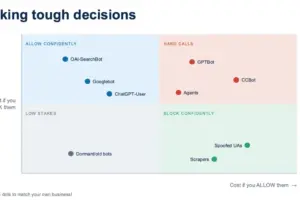
The proliferation of generative AI has forced publishers to draw clear lines between model-training scrapers and user-requested retrieval agents. Recent studies indicate that a vast majority of major publishers now restrict training bots while evaluating real-time search utility.

# Block model-training crawlers
User-agent: GPTBot
User-agent: ClaudeBot
Disallow: /

# Allow search and user-requested verification bots
User-agent: OAI-SearchBot
User-agent: ChatGPT-User
User-agent: Claude-SearchBot
User-agent: PerplexityBot
Disallow: /private/
Note: While automated training bots like GPTBot and ClaudeBot rigorously honor robots.txt, user-triggered fetchers (such as ChatGPT-User or Perplexity-User) often bypass standard exclusions because they act dynamically on direct human requests.
7. Restricting Proprietary AI Training (Google and Apple)
Publishers wishing to prevent their content from feeding foundational models without forfeiting search visibility can explicitly target specialized platform tokens:
User-agent: Google-Extended
User-agent: Applebot-Extended
Disallow: /
Blocking these tokens prevents Gemini and Apple foundation model training while leaving standard Google Search indexing and Applebot web discovery untouched.
8. Declaring XML Sitemaps
Help search engines discover structured content hierarchies quickly by appending absolute URLs at the base of your file:
Sitemap: https://www.example.com/sitemaps/articles.xml
Sitemap: https://www.example.com/sitemaps/products.xml
9. Implementing Crawl-Delay for Compliant Bots
For resource-intensive secondary bots that respect non-standard extensions, you can throttle request frequencies to protect your infrastructure:
User-agent: ClaudeBot
Crawl-delay: 60
Official Statements and Industry Insights
Major search engines and industry architects continue to emphasize precision over blanket bans. Gary Illyes of Google has repeatedly urged site administrators to proactively block high-velocity "action URLs" (such as infinite filtering strings and add-to-cart parameters) to preserve server health.

Concurrently, legal and technical frameworks surrounding AI data harvesting are evolving. Platforms like OpenAI, Anthropic, and Perplexity have established distinct token identifiers to separate their corpus-scraping data miners from active, real-time user lookup agents. Webmasters are increasingly advised to consult platform developer portals regularly to ensure their bot exclusion lists reflect the latest industry standards.
Future Outlook: Centralized Management and Autonomous Agents
As enterprise architectures scale into complex arrays of regional subdomains and content delivery networks (CDNs), maintaining fragmented robots.txt files across dozens of properties becomes increasingly inefficient. Modern technical SEO strategies lean heavily toward centralized robots.txt management, utilizing intelligent edge routing and cross-domain redirects to unify governance from a single root domain.
Looking ahead, the line between traditional search crawlers and autonomous AI agents will continue to blur. As AI agents evolve from passive data consumers into transactional participants capable of executing multi-step workflows on behalf of users, webmasters must adopt a granular, policy-driven approach to bot management.
Best Practices for Ongoing Maintenance
- Regularly Audit Server Logs: Check your access logs to verify that intended bots are honoring instructions and that critical assets aren’t being inadvertently starved of traffic.
- Utilize Validation Tools: Always test syntax modifications using the Google Search Console Robots.txt Report or open-source parsing libraries before deploying updates to production servers.
- Align Stakeholders: Ensure that technical SEO teams, legal counsel, and business stakeholders collaborate on AI scraping policies to balance brand visibility with intellectual property protection.
By treating robots.txt not as a static afterthought, but as an active, strategic firewall, organizations can successfully navigate the complexities of the modern web ecosystem.