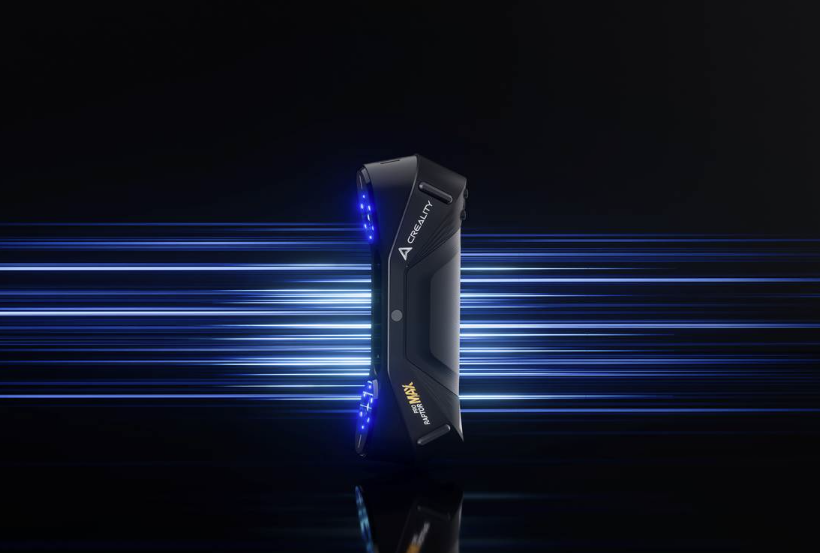
The landscape of custom manufacturing, reverse engineering, and automotive modification has taken another monumental leap forward. Creality—a globally recognized titan in desktop 3D printing and an increasingly dominant force in spatial capture technology—has officially expanded its hardware lineup with the launch of the Raptor Pro Max.
Building directly upon the solid foundation of its predecessor, the Raptor Pro handheld scanner, this new iteration has been meticulously engineered to tackle the grueling time constraints and geometric complexities inherent in automotive customization. By nearly doubling the count of cross blue laser lines, expanding the single-capture field of view by 40%, and vastly increasing overall measurement density, the Raptor Pro Max seeks to slash workflow bottlenecks.
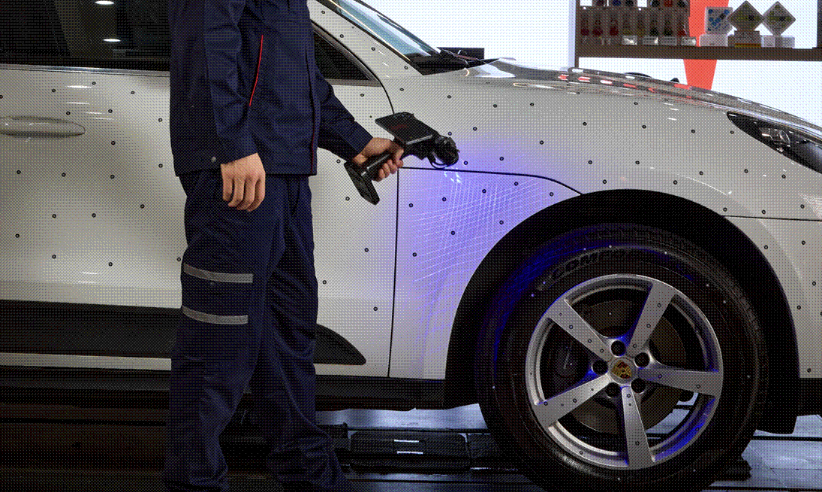
For fabricators, designers, and custom car builders, the promise is alluring: scan entire vehicle body panels, bumpers, and doors faster, with fewer tracking markers, and transition seamlessly from digital capture to rapid prototyping or trial-fitting. Priced at a competitive standard retail value of $1,799—with initial promotional discounts bringing it down to $1,619—the Raptor Pro Max positions itself as an accessible industrial-grade tool for professionals who demand uncompromising precision without entering the five-figure price brackets traditionally associated with metrology-grade equipment.
Detailed Chronology & Technological Evolution
To understand the magnitude of the Raptor Pro Max, one must examine the rapid trajectory of Creality’s optical scanning division. For years, the market for handheld 3D scanners was sharply divided: entry-level structured-light units struggled with reflective metallic surfaces and fine details, while high-end industrial metrology lasers were financially prohibitive for independent workshops, custom automotive shops, and boutique design studios.
Bridging the Gap: The Evolution to Hybrid Scanning
Creality initially disrupted this paradigm by introducing versatile hybrid systems, such as the Sermoon P1S, which offered cost-effective multi-mode scanning capabilities. However, professionals working on large, complex automotive surfaces consistently faced two major challenges:
The Tracking Bottleneck: Capturing smooth, featureless, or highly reflective car body panels often required endless alignment passes and the painstaking application of hundreds of tracking markers.
Time Consumption: The sheer volume of passes required to capture a complete quarter-panel or bumper translated directly to bloated project timelines.
Recognizing these industry pain points, Creality developed the Raptor series, combining blue laser technology (ideal for capturing difficult black and metallic surfaces without messy scanning sprays) with infrared structured light. The original Raptor Pro proved to be a reliable handheld solution, but industry feedback from the automotive sector demanded greater coverage per pass to accelerate the scanning of large vehicular architecture.
The Raptor Pro Max Breakthrough
The introduction of the Raptor Pro Max marks a direct response to these demands. By rethinking the optical architecture, Creality engineers achieved significant hardware upgrades:
The Laser Array Upgrade: The device transitions from the Raptor Pro’s 22 cross blue laser lines to a staggering 42 cross blue laser lines.
Measurement Velocity: This expanded array unlocks up to 1.26 million measurements per second, elevating the maximum scanning rate by approximately 91%.
Expanded Single Capture Range: The capture window has been widened to 480 × 330 mm at a standard working distance of 550 mm, representing a 40% enlargement in single-frame coverage.
This chronological refinement moves the tool away from iterative scanning toward rapid, large-format spatial acquisition, fundamentally altering how technicians capture asymmetrical aftermarket components.
Supporting Context & Technical Metrics
A deep dive into the technical specifications of the Creality Raptor Pro Max reveals a machine built for high-performance metrology and rapid fabrication workflows.
Precision Meets Coverage
The cornerstone of the Raptor Pro Max’s efficiency lies in its geometry-handling capabilities. Because the device captures a significantly wider area per pass—such as an entire section of a vehicle’s bumper or door—successive frames share vastly more common geometry. This ensures robust, stable tracking even when moving quickly across sweeping, continuous curves.
Consequently, Creality notes that operators can reduce their reliance on retroreflective tracking markers by up to 25%. This reduction is not merely a matter of convenience; placing fewer markers saves preparation time, reduces consumable costs, and keeps delicate paint or wrap finishes free of temporary adhesive residue.
Dual Laser Modes for Comprehensive Versatility
The scanner utilizes two distinct blue laser operation modes to handle objects ranging drastically in scale:
Cross Blue Laser Mode (42 Lines): Designed for rapid, large-area scanning of automotive body panels, chassis components, and medium-to-large mechanical assemblies. It operates at up to 60 frames per second (fps).
Parallel Blue Laser Mode (7 Lines): Activated for intricate, high-detail work. By switching to seven parallel lines, operators can effortlessly capture sharp edges, narrow threads, tight radii, and chamfered features.
Together, these modes accommodate objects ranging from 5 mm to 4,000 mm in size, offering a volumetric accuracy rated at an impressive 0.02 mm + 0.08 mm/m². Furthermore, the blue laser technology natively handles challenging dark, glossy, or metallic surfaces, completely bypassing the traditional requirement for anti-glare scanning sprays that can foul sensitive automotive finishes.
Real-Time Monitoring and Stabilization
During active handheld scanning, operators utilize the proprietary Creality Scan software suite for real-time visual previews. This software ensures that coverage gaps are identified immediately as the operator maneuvers around the workpiece.
In addition to the Blue Laser Line Mode running at 60 fps, the scanner also features a near-infrared (NIR) structured-light mode operating at up to 30 fps, utilizing either geometric tracking or texture tracking. To combat human error and slight hand tremors during extended scanning sessions, Creality has integrated advanced anti-shake functionality into the hardware pipeline, ensuring clean, artifact-free point clouds even when operating without a mechanical gantry or tripod.
Official Statements & Industry Impact
The release of the Raptor Pro Max has sent ripples through the digital manufacturing and automotive aftermarket communities. Industry analysts point out that the democratization of high-speed metrology is changing the competitive landscape for small-batch custom shops.
In official statements accompanying the launch, Creality emphasized its commitment to streamlining professional workflows:
"By optimizing our optical systems to deliver nearly double the laser lines and a significantly larger single-capture footprint, we are directly addressing the time-sensitive nature of automotive design. The Raptor Pro Max allows professionals to bypass tedious preparation steps, minimize repositioning errors, and complete complex scans of automotive workpieces in up to 40% less time."
Transforming the Custom Automotive Workflow
In practical terms, a 40% reduction in scanning time translates directly to commercial viability for custom fabricators. When designing a wide-body kit, a bespoke roll cage, or custom aerodynamic splitters, the traditional pipeline required hours of manual digitizing, point-cloud cleanup, and iterative mesh stitching.
By capturing cleaner, larger datasets on the first pass, custom shops can move digital assets into CAD design environments and trial-fitting simulations exponentially faster. This acceleration allows boutique manufacturers to compete with OEM development cycles, bringing unique parts from concept to CNC milling or large-format 3D printing in record time.
Future Outlook: The Next Frontier in Spatial Capture
As desktop and handheld 3D scanning technology continues to converge with industrial-grade accuracy, the boundaries between consumer-accessible tools and high-end metrology equipment will continue to blur. The Creality Raptor Pro Max is a testament to this evolution.
Looking ahead, the integration of advanced artificial intelligence and machine learning into scanning software suites like Creality Scan points toward a future of fully automated alignment, error correction, and instant mesh generation. While hardware enhancements like 42-line laser arrays solve the physical bottleneck of data capture, software intelligence will likely solve the post-processing bottleneck next.
For now, automotive customizers, prop makers, industrial designers, and reverse-engineering specialists have a powerful new ally in their toolkit. By stripping away the historical friction points of spatial capture—such as marker placement, spray usage, and slow frame rates—devices like the Raptor Pro Max ensure that digital fabrication is faster, cleaner, and more accessible than ever before.
Price and Availability
The Creality Raptor Pro Max carries a suggested retail price of $1,799. However, to celebrate its rollout, Creality has introduced a limited-time promotional discount reducing the unit price to $1,619. Additionally, a specialized bundle incorporating a dedicated Scan Bridge is available at the standard launch price of $1,799.
Interested professionals and studios can explore purchase options and regional specifications directly through the official Creality US Store or the Creality UK Store.