Executive Overview
In the rapidly shifting landscape of artificial intelligence, Google has once again pivoted its strategy, rebranding the AI agent formerly known as "Spark" into the more utilitarian "Gemini Task." This move signals a significant evolution in Google’s product philosophy: moving away from static, conversational chatbots and toward autonomous, agentic workflows. Integrated directly into the Gemini interface, Gemini Task is designed to bridge the gap between simple LLM queries and actionable, real-world productivity.
For the power user, Gemini Task represents a "controlled" AI agent capable of operating within the background of the Google ecosystem. It is not merely a tool for drafting emails or summarizing documents; it is an automation engine that interfaces with Gmail, Google Drive, and Google Photos to perform complex, multi-step tasks. While the feature is currently available globally for free, it arrives with a tiered reality: a robust experience for those deeply entrenched in Google’s suite of services, and a more restrictive, often hampered experience when attempting to interact with the wider, increasingly "anti-AI" open web.

Detailed Chronology: From Spark to Task
The journey of Gemini Task began under the internal moniker "Spark." Originally conceived as an experimental, standalone tab within the broader Gemini interface, it functioned as a siloed sandbox for users to test automation. On November 24, 2026, Google officially sunsetted the Spark branding, absorbing the technology into the core Gemini experience.
The Integration Phase
The transition was seamless for existing users. By migrating the agentic capabilities into the primary Gemini chat interface, Google has effectively lowered the barrier to entry for millions of users. The interface now features a dedicated "Task" tab that sits alongside the standard "Chat" tab, allowing users to toggle between passive information retrieval and active, automated task execution.

The Mechanics of Operation
To activate the full potential of Gemini Task, users must have "Personal Intelligence" enabled—a privacy-conscious permission layer that allows the AI to parse private data from linked accounts. Once the permissions are granted, the agent gains the ability to "read" and "act" on behalf of the user. By utilizing tags such as "@Gmail" or "@Drive," the user directs the agent to specific data silos. The core functionality relies on a logic-based automation layer; for instance, a prompt like "scan my inbox for all receipts from November and create a summary spreadsheet" triggers a series of API calls that would have previously required manual intervention or complex Zapier-like third-party integrations.
Supporting Context & Metrics: Where Task Shines (and Stumbles)
The utility of Gemini Task is highly correlated with the user’s dependence on the Google-verse. In our testing, the tool performed exceptionally well in internal ecosystem management, yet struggled significantly when venturing into the "hostile" environment of the open web.

The Inbox Command Center
Email management is perhaps the most compelling use case for the new agent. By automating the identification and unsubscribing process for marketing emails, Gemini Task effectively acts as a digital janitor. However, the system is designed with a "human-in-the-loop" safety protocol. It cannot execute mass deletions or unsubscriptions without explicit user verification. While this limits the "set it and forget it" appeal, it provides a crucial layer of security against the accidental destruction of important communication, such as financial statements or legal correspondence.
The Subscription Manager
One of the most impressive capabilities is the agent’s ability to consolidate data into actionable formats. By requesting a "subscription audit," the AI can parse through thousands of emails to identify recurring payments, convert varying currencies (such as USD to INR), and export the final analysis into a structured Google Sheet. This functionality directly challenges the business models of third-party subscription tracking applications, effectively internalizing a service that was previously fragmented across the app ecosystem.

The Open Web Wall
The contrast between the agent’s internal efficacy and its external limitations is stark. As publishers and retailers increasingly deploy "anti-scraping" measures to prevent AI training and data harvesting, the open web has become a digital minefield. During our testing, the agent was tasked with monitoring the price of consumer electronics on major retail platforms. While it was able to access some regional retailers, it was blocked by others almost instantly. The "remote browser" feature, which allows the AI to navigate the web, is currently too slow and resource-intensive to be considered a viable alternative to manual browsing for time-sensitive tasks.
Official Statements and Constraints
Google has been transparent about the limitations of the free tier of Gemini Task. While it provides a powerful entry point, it is strictly gated:

- Execution Limits: Free users are restricted to one task per day, with a hard cap of 10 concurrent active tasks.
- Regional Disparities: A significant portion of the "agentic" power—such as the ability to make phone calls to businesses on the user’s behalf or the automated email-to-task forwarding—remains locked behind U.S.-only regulations and feature rollouts.
- Compute Costs: AI Pro users benefit from a higher threshold, with the ability to manage up to 50 concurrent tasks, reflecting the higher compute cost associated with maintaining persistent agentic sessions.
Future Outlook: The "Google-verse" Strategy
The trajectory of Gemini Task suggests that Google is not aiming to create a "General Purpose" AI agent that controls your entire digital life, but rather a "Google-native" agent that dominates your workspace.
The Ecosystem Moat
The success of Gemini Task is likely to deepen the "moat" around the Google ecosystem. If an AI agent can manage your calendar, organize your finances, clean your inbox, and reconcile your data—all within the Google environment—the cost of switching to a competitor becomes exponentially higher. Users are no longer just choosing a search engine or a mail provider; they are choosing an operating system for their digital existence.

The Path Toward Proactive Agency
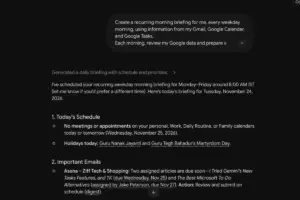
While the current iteration of Gemini Task is reactive (it waits for your prompt), the roadmap points toward a more proactive future. We anticipate that by mid-2027, the agent will move from a "command-and-control" model to an "anticipatory" model. Imagine a system that doesn’t wait for you to ask for a morning briefing but instead pre-emptively compiles your schedule, highlights your most urgent emails, and identifies potential calendar conflicts before you even open your laptop.
Final Verdict
Gemini Task is a powerful, if somewhat guarded, step forward. For users already living within the Google ecosystem, it is a transformative tool that can save hours of administrative labor. For those hoping for a universal agent that can effortlessly navigate the complexities of the open web, the reality is still catching up to the ambition. As the technology matures, the success of Gemini Task will ultimately depend on Google’s ability to balance the raw power of its AI with the increasing need for user privacy and the growing resistance of the open web to automated agents. The age of the AI assistant is over; the era of the AI agent has begun.