By Jeff Somers
Published: August 7, 2026
Executive Overview
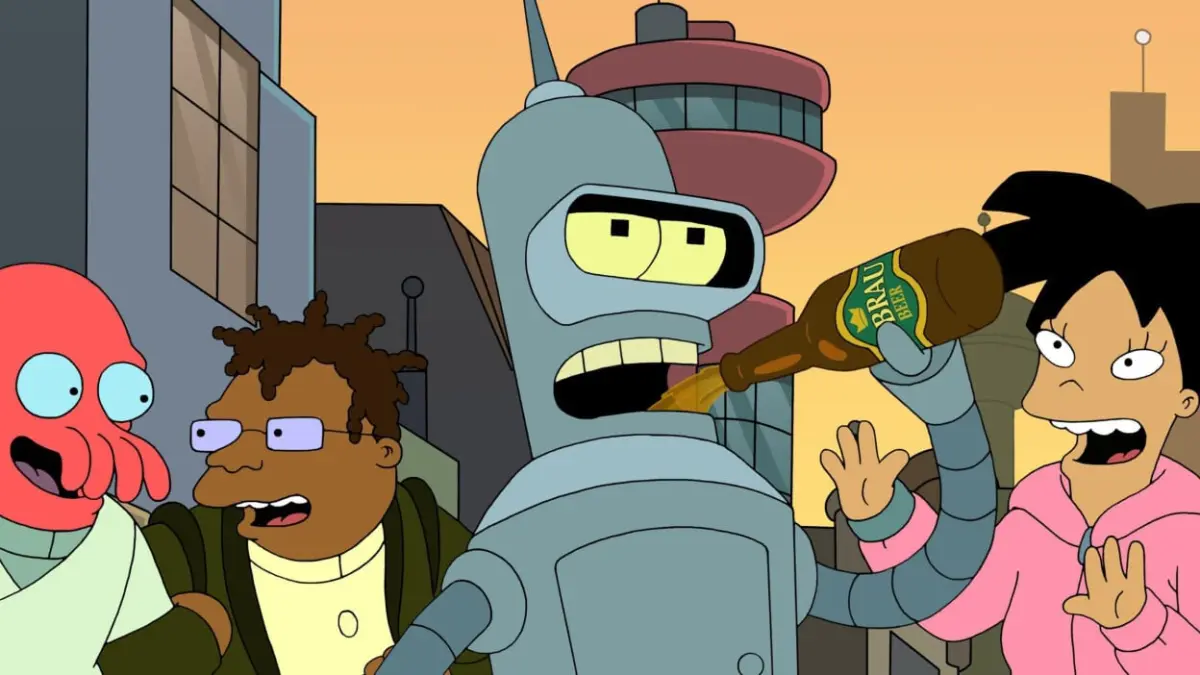
Few properties in television history have achieved the unique cultural longevity and intellectual elasticity of Matt Groening and David X. Cohen’s Futurama. Having weathered multiple cancellations, network shifts, and revivals across more than two decades, the series remains an industry-defining masterclass in animated sci-fi satire. Its enduring appeal lies in a rare creative alchemy: an uncanny blend of low-brow slapstick, heartfelt emotional resonance, and high-concept scientific and mathematical humor so dense that parts of it are reportedly penned by actual PhD holders in the writers’ room.
However, even the most dedicated fans who have thoroughly mined every dimension of the Planet Express crew’s adventures eventually find themselves staring at a void in their streaming queues. When the binge is finally over, what narrative universe captures that distinct blend of dystopian absurdity, consumerist critique, and endearing incompetence?
This comprehensive guide serves as an authoritative curation for Futurama enthusiasts. Moving beyond standard streaming suggestions, we examine the foundational texts and spiritual successors—ranging from cult-classic cinematic satires to foundational sci-fi parodies—that match Futurama‘s specific comedic wavelength, structural pacing, and satirical bite.
Detailed Chronology and Evolution of the Futurama Phenomenon
To understand what to watch next, it helps to contextualize the historical trajectory that made Futurama a singular entity in television history. Launched in 1999 on Fox at the height of The Simpsons’ cultural dominance, the series initially struggled to find a standardized broadcast slot, leading to erratic scheduling that frustrated its core demographic. Despite these structural hurdles, the show established a meticulous internal logic centered around Philip J. Fry, a 20th-century slacker cryogenically frozen until the year 3000.
- The Fox Era (1999–2003): Marked by world-building, high-concept continuity, and foundational episodes like "Space Pilot 3000" and "The Luck of the Fryish," this period established the series’ narrative boundaries—a future that was simultaneously high-tech and deeply mundane.
- The Direct-to-Video Interregnum (2007–2009): Following cancellation, strong DVD sales and robust adult swim syndication ratings prompted Comedy Central to fund four feature-length movies: Bender’s Big Score, The Beast with a Billion Backs, Bender’s Game, and Into the Wild Green Yonder. These films later served as the structural template for Season 6 when chopped into traditional episode formats.
- The Comedy Central Revival (2010–2013): This era modernized the show’s technological and social satires, tackling topics ranging from social media algorithms to climate change, culminating in the poignant, loop-resetting finale "Meanwhile."
- The Hulu Era (2023–Present): Continuing into the mid-2020s, the streaming revival proved that the show’s satirical engine remains responsive to modern anxieties, continuously proving why viewers seek out media that replicates its distinct brand of sci-fi chaos.
Supporting Context & Curated Film Pairings for Futurama Fans
When seeking out cinematic companions for a series as multifaceted as Futurama, viewers must look for specific thematic markers: temporal displacement, systemic corporate satire, well-meaning ordinary protagonists thrust into extraordinary cosmic stakes, and a relentless commitment to visual gags.

1. The Ultimate Spiritual Successor: Idiocracy (2006)
If you are forced to pick only one film to watch immediately after completing a Futurama marathon, Mike Judge’s Idiocracy is the undisputed top choice.
- The Premise: Like Futurama, the film hinges on a man of thoroughly average intelligence undergoing accidental cryogenic hibernation, only to wake up centuries later in a vastly altered world. However, while Philip J. Fry finds himself in a gleaming, high-tech metropolis where he fits right in, Average Joe Bauers (Luke Wilson) wakes up 500 years in the future to find that human evolution has taken a severe downward trajectory. Through centuries of dysgenics, humanity has grown so profoundly stupid that Joe is instantaneously crowned the smartest man alive.
- The Futurama Connection: The satiricalDNA of Idiocracy mirrors Futurama Season 3, episode 7, "The Day the Earth Stood Stupid," wherein floating alien brains broadcast a wave of anti-intelligence across Earth, leaving Fry—due to a genetic anomaly stemming from being his own grandfather—unaffected and momentarily the intellectual savior of the planet.
- Key Themes: The movie is a masterclass in consumerist satire. It features a hyper-commercialized dystopia where the Supreme Court is rebranded the "Extreme Court," capital punishment is handled via monster truck demolition derbies, and an electrolyte-rich sports drink called Brawndo has replaced water for everything from drinking to crop irrigation. Anchored by Terry Crews’ unforgettable performance as the violently dimwitted President Dwayne Elizondo Mountain Dew Herbert Camacho, Idiocracy delivers the exact flavor of exasperated, systemic critique that Futurama fans adore.
2. Time-Travel Slacker Comedy: Bill & Ted’s Excellent Adventure (1989)
For fans whose favorite Futurama episodes are the ones involving catastrophic temporal paradoxes, predestination loops, and historical absurdism, this 1989 classic is an essential entry.
- The Premise: Set in San Dimas, California, the film follows high-school slackers Bill S. Preston, Esq. (Alex Winter) and Theodore "Ted" Logan (Keanu Reeves), whose impending failure in history class threatens to derail a utopian, music-driven future society. Rufus (George Carlin) is dispatched via a time-traveling telephone booth to help them pass their presentation by kidnapping historical figures.
- The Connection: The parallel lies in the character dynamics. Bill and Ted share the lovable, well-meaning dimwittiness of Philip J. Fry and Bender’s casual disregard for temporal laws. The film balances high-concept science fiction mechanics with absolute idiocy, creating a warm, comedic safety net that mirrors the emotional core of Planet Express.
3. The Definitive Sci-Fi Send-Up: Spaceballs (1987)
Futurama’s writing room has never hidden its love for cinematic parody, regularly skewering properties from Willy Wonka and Armageddon to One Flew Over the Cuckoo’s Nest.
- The Premise: Mel Brooks’ iconic 1987 spoof takes direct aim at the original Star Wars trilogy and broader space-opera tropes. It introduces audiences to Dark Helmet (Rick Moranis), Lone Starr (Bill Pullman), and a universe where air is canned and "Schwartz" is the ultimate mystical power.
- The Connection: Beyond its relentless gag-a-minute structure, Spaceballs shares Futurama’s willingness to break the fourth wall for the sake of a joke. With a long-awaited sequel on the horizon, revisiting this demented takedown of foundational sci-fi world-building provides the precise comedic palette cleanser a sci-fi animation fan needs.
4. Cosmic Chaos and Bureaucracy: The Hitchhiker’s Guide to the Galaxy (2005)
If Futurama is an animated universe built on institutional absurdity, space-faring bureaucracy, and existential dread wrapped in bright colors, Douglas Adams’ masterwork is its literary and cinematic ancestor.
- The Premise: Arthur Dent (Martin Freeman) wakes up on the morning his house is scheduled to be bulldozed, only to discover Earth is about to be vaporized to make way for a hyperspatial express route. Whisked into space by his friend Ford Prefect, an undercover alien researcher, Arthur embarks on a dizzying tour of the cosmos equipped only with a digital towel and an electronic guidebook.
- The Connection: The film is populated by concepts that feel as though they were ripped straight from the Futurama writers’ room: poetry utilized as an explicit form of physical torture, an Infinite Improbability Drive that alters physical reality at random, and depressed androids (voiced by Alan Rickman) who make Bender look like an optimist.
5. Heartfelt Dystopia: WALL-E (2008)
While Futurama is frequently celebrated for its intellectual wit and biting satire, its enduring success relies on its emotional sincerity. Philip J. Fry, despite his flaws, is driven by profound affection, loyalty, and a desire to belong.
- The Premise: Pixar’s 2008 masterwork presents a dual vision of the future: an abandoned, garbage-choked Earth managed by a lonely, sentient compaction robot, and the Axiom, a massive starliner housing generations of human descendants who have grown morbidly obese, hyper-sedentary, and completely reliant on automated screens.
- The Connection: WALL-E manages the delicate trick of offering a devastating critique of modern consumer culture and ecological negligence while maintaining an unabashedly sweet, romantic core—a balancing act that Futurama perfected across its emotional masterworks like "Jurassic Bark" and "The Luck of the Fryish."
6. Absurdist Superheroes: Megamind (2010)
For viewers drawn to Futurama’s obsession with wildly impractical, dangerous technology and hyper-stylized comic book tropes, DreamWorks’ Megamind is a brilliant subversion of the superhero genre.

- The Premise: Two alien infants are launched toward Earth from exploding planets, Superman-style. One grows up to be the beloved superhero Metro Man (Brad Pitt); the other, due to a mishap in the arrival nursery, ends up in a prison yard and grows up to be the super-villain Megamind (Will Ferrell). When Megamind accidentally succeeds in actually killing his rival, he experiences an existential crisis because a villain requires a hero to have purpose.
- The Connection: The film relies on visual gags, rapid-fire pop-culture references, and gadgets that defy the laws of physics—such as dehydration guns that shrink foes into pocket-sized cubes and advanced holographic watches. It operates on the same chaotic, high-energy wavelength as the adventures of the Planet Express delivery crew.
Official Statements and Industry Perspective
Industry analysts note that the longevity of adult animated sci-fi remains one of the most reliable investments in modern entertainment streaming. In a recent retrospective panel discussion regarding the expansion of mature animated universes, executive producers noted that the genre’s durability stems from its infinite canvas.
"When you work in live-action science fiction, your budget dictates your imagination," noted one industry veteran during a recent media briefing on streaming trends. "In animation—and particularly in satirical formats like Futurama—the only boundary is whether the audience can process the joke before you move on to the next three. That density of humor is why properties like this maintain cultural relevance across decades."
Streaming metrics consistently validate this perspective. Library content of this nature experiences sustained, non-cyclical viewership, driven heavily by background consumption and deep-dive fandoms that analyze background sight gags and mathematical proofs embedded within single animation frames.
Future Outlook
As the streaming landscape continues to fragment across competing platforms—with Futurama currently anchored on Hulu in the United States and its cinematic offshoots distributed across various digital storefronts like Prime Video—the curation of niche "watch-alikes" has become increasingly essential for viewers navigating algorithmic fatigue.
The appetite for intelligent, cynical, yet ultimately life-affirming science fiction shows no signs of contraction. Whether through upcoming legacy sequels, cinematic parodies, or new animated properties designed to push the boundaries of television satire, the cultural lineage established by Futurama in 1999 will continue to shape how we laugh at the distant, ridiculous futures we are actively building for ourselves today.
For readers looking to begin their streaming journey through this curated list, Idiocracy is currently available to rent on Prime Video, while foundational titles like WALL-E and Bill & Ted’s Excellent Adventure can be accessed via Disney+ and Tubi, respectively.