Executive Overview
The digital marketing landscape is currently obsessed with Generative Engine Optimization (GEO). Across boardrooms and agency slack channels, an immense amount of capital is being funneled into tracking brand mentions, citations, and visibility metrics inside standalone Large Language Models (LLMs) like ChatGPT, Claude, and Perplexity. Marketers are scrambling to adapt their content strategies to satisfy the algorithms of conversational bots, fearing that if they are not cited in an AI-generated chat response, they will cease to exist.
However, a sweeping new empirical study conducted across 100 enterprise and small-to-medium business websites reveals an uncomfortable truth: this obsession is chasing the wrong target.
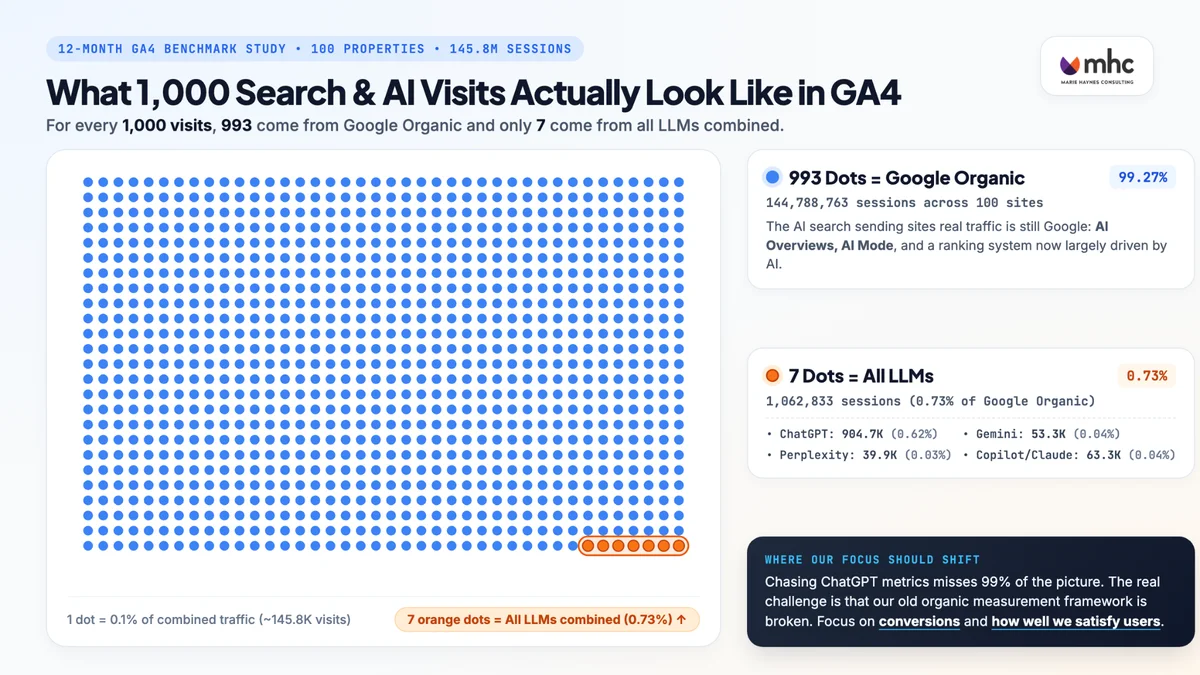
An analysis of 145 million sessions over a 12-month period demonstrates that referral traffic originating from ChatGPT accounts for a minuscule 0.62% of the volume driven by traditional Google Organic search. Even when factoring in all other major standalone LLMs, the aggregate AI referral figure rises only slightly to 0.73%.
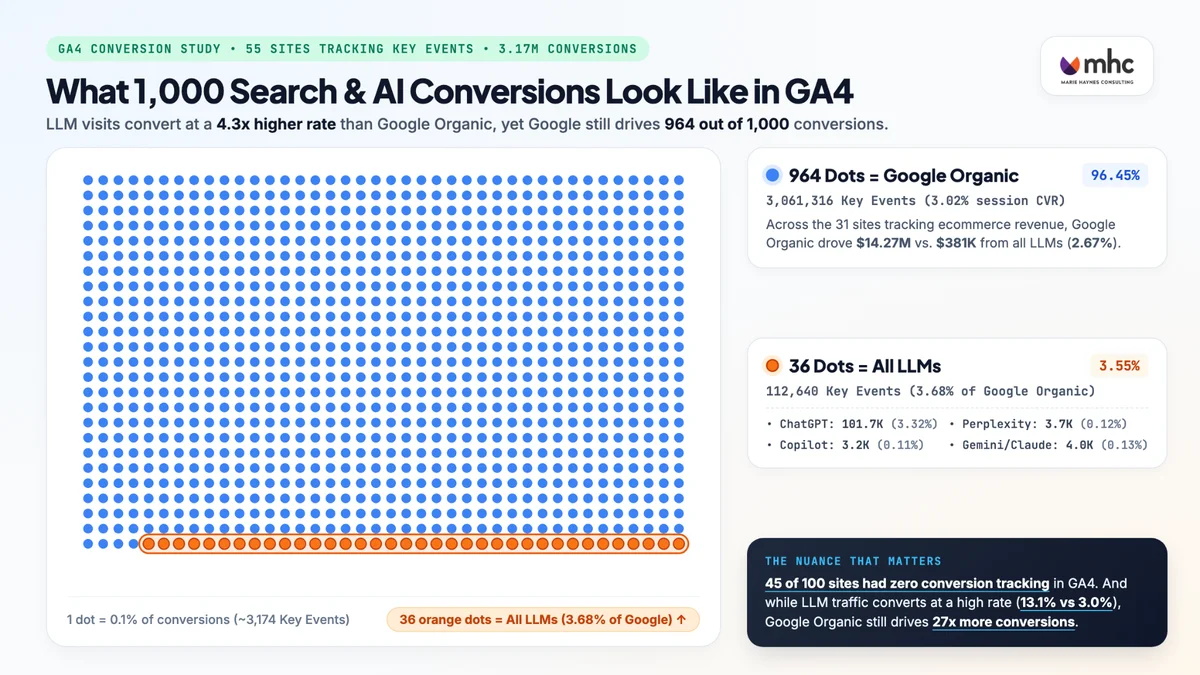
While it is true that visitors originating from LLMs tend to exhibit higher conversion intent—in some cases converting at rates up to 4.5 times higher than standard organic traffic—the sheer disparity in top-of-funnel volume renders standalone LLM referral optimization a marginal play for most businesses. Google organic search—heavily augmented and transformed by deep learning architectures, AI Overviews, and AI Mode—remains the undisputed titan of digital discovery, driving over 96.5% of tracked conversions.
Yet, the search ecosystem is undergoing a fundamental metamorphosis. As major platforms pivot from serving as passive directories of blue links to acting as active "agent managers," the true competitive frontier is shifting. The web is evolving into an agentic, multimodal environment powered by infrastructure like Google’s Universal Cart, the Universal Commerce Protocol (UCP), Model Context Protocol (WebMCP) integrations, and Android XR-powered intelligent eyewear. For digital strategists, the mandate is clear: abandon the distraction of chasing isolated LLM citations, shore up foundational user metrics, and prepare for an automated, agent-driven commerce future.

Detailed Chronology: The Rise, Plateau, and Realities of AI Traffic
To understand how the SEO industry fell into the trap of over-indexing on standalone LLM visibility, one must trace the timeline of consumer AI adoption and web traffic dynamics over the past several years.
The Exponential Illusion (Late 2022 – Mid-2025)
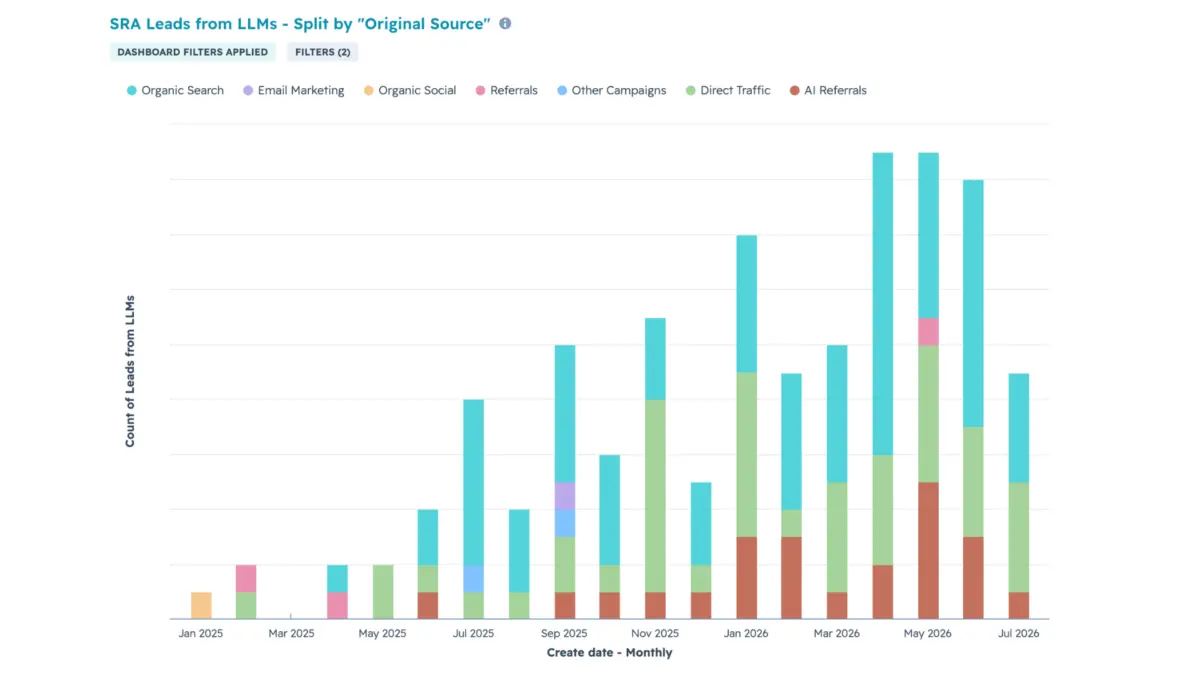
When consumer-facing conversational AI first burst onto the scene in late 2022, digital marketers watched the early referral graphs with unbridled fascination. Month-over-month clicks from tools like ChatGPT showed a steep, seemingly unstoppable upward trajectory.
During this foundational window, many industry analysts and SEO practitioners extrapolated these early growth curves. The prevailing hypothesis was simple and terrifying for legacy publishers: if exponential adoption continued at its initial rate, standalone LLM tools would eventually bypass traditional search engines as the primary referral pipeline for the internet. Millions of dollars were raised by startups specializing exclusively in LLM brand-monitoring, tracking whether a bot recommended Brand A over Brand B when queried about software tools, apparel, or professional services.
The Inflection Point: August 2025
The narrative began to shift dramatically in August 2025, coinciding with major architectural updates across frontier AI models, including the rollout of GPT-5. According to longitudinal data extracted from 100 distinct web properties, the exponential growth curve of ChatGPT referral sessions abruptly flattened.
Rather than continuing its upward surge, referral traffic from ChatGPT entered a structural plateau and, in many sectors, began a slow, steady decline. Why? Because modern LLMs are increasingly engineered to provide comprehensive, synthesized answers directly within the interface. Users no longer need to click through to a publisher’s website to read an article, check a basic fact, or compare specs. The AI answers the prompt internally, eliminating the traditional traffic loop.
The Shift to Ambient and Embedded AI Search (2026 and Beyond)
As standalone referral volumes leveled off, the locus of AI search migrated inward—directly into the infrastructure of legacy search giants and operating systems. Today, the dominant AI search engine is not a chat window; it is Google.
Through the ubiquitous deployment of AI Overviews, dedicated AI Modes, and deep-learning-driven core ranking algorithms, hundreds of millions of users perform AI-powered searches every day without ever leaving Google’s ecosystem. The user experience has transformed from a multi-step journey of clicking links to an all-in-one synthesis engine. Consequently, publishers lamenting the drying up of informational traffic are witnessing a structural evolution, not a temporary glitch.
Supporting Context & Metrics: What the Data Actually Says
To ground these observations in hard data, consider the granular metrics uncovered in the 12-month GA4 dataset spanning 100 websites and 145 million sessions:
- The Traffic Disparity: Sessions driven by ChatGPT accounted for a mere 0.62% of the volume delivered by Google Organic. When expanded to encompass all prominent LLM tools, the aggregate figure limped to 0.73%. To put this in perspective, Google Organic retained a staggering 99.27% share of the comparative search traffic landscape.
- The Conversion Reality: Out of the 100 properties evaluated, 55 actively tracked conversions through GA4. While it was observed that ChatGPT visitors converted at a rate more than 4.5 times higher than standard Google organic visitors, the sheer volume discrepancy meant that Google organic still commanded 96.5% of total conversions across all analyzed channels. In real terms, Google organic drove roughly 27 times more total conversions than all LLM referral channels combined.
- The Measurement Blind Spot: Perhaps most alarmingly, the study revealed foundational tracking deficiencies among modern web properties. Of the 100 randomly sampled websites, 45 were not tracking key events or conversions at all in GA4. Furthermore, traditional rank tracking has lost its predictive power, and Google Search Console data, while informative, offers sparse actionable insight into how a brand is perceived or synthesized by internal AI algorithms.
Official Statements and Industry Insights
Industry leaders and tech pioneers have increasingly signaled that the future of the web bears little resemblance to the link-based directories of the past.
During recent keynote appearances and earnings calls, Alphabet CEO Sundar Pichai explicitly noted that "Search will become an agent manager." This conceptual pivot repositions search engines from passive informational indexes to active coordinators of human tasks and transactions.

Reflecting on this paradigm shift at technology symposiums, tech visionaries have been candid about the unpredictability of the next decade:
- Sergey Brin (Co-Founder of Google): “I don’t think we really know what the world looks like in 10 years.”
- Demis Hassabis (CEO of Google DeepMind): “The web is going to change quite a lot if you think about an agent-first web, like it doesn’t necessarily need to see renders and things like we do as humans using the web. So I think things will be pretty different in a few years.”
These statements underscore a fundamental truth: optimizing for human visual consumption of web pages is becoming secondary to optimizing for machine-readable, agent-executable endpoints.
The Future Outlook: Preparing for the Agentic Web
As we move past the distraction of Generative Engine Optimization (GEO) and standalone LLM citation tracking, businesses must pivot toward the four foundational pillars of the emerging agentic web.
┌────────────────────────────────────────────────────────┐
│               THE AGENTIC WEB ECOSYSTEM                │
├──────────────────────────┬─────────────────────────────┤
│ 1. Universal Cart        │ Centralized multi-vendor    │
│                          │ checkout via Google Wallet  │
├──────────────────────────┼─────────────────────────────┤
│ 2. Universal Commerce    │ Open discovery layer for    │
│    Protocol (UCP)        │ AI-to-AI transactions       │
├──────────────────────────┼─────────────────────────────┤
│ 3. WebMCP                │ Declarative APIs enabling   │
│                          │ agents to run on-site tools │
├──────────────────────────┼─────────────────────────────┤
│ 4. Intelligent Eyewear   │ Multimodal, ambient,        │
│                          │ "See it, Buy it" discovery  │
└──────────────────────────┴─────────────────────────────┘
1. Google’s Universal Cart
Google’s Universal Cart aggregates product inventories from multiple distinct retailers into a unified, streamlined checkout experience hosted directly within Google Wallet. The system continuously monitors real-time price adjustments, promotional discounts, and inventory restocks. Users can seamlessly bundle products from competing vendors and complete transactions without ever visiting the underlying merchant’s website.
- The Opportunity: Deep mastery of Google Merchant Center and its integrated AI assistant is paramount. Ensuring your product feed data is pristine guarantees that your inventory is eligible for bundling within automated Universal Cart recommendations.
2. Universal Commerce Protocol (UCP)
Governed collaboratively by industry titans including Google, Shopify, and Stripe, the Universal Commerce Protocol provides an open discovery layer that allows autonomous AI agents to compare cross-merchant inventories and execute native purchases while preserving the brand as the merchant of record.
- The Opportunity: Technical SEO must expand to encompass agentic discovery endpoints. Familiarity with
/.well-known/ucpprofiles and programmatic product data formatting will define the next generation of e-commerce optimization. Success will ultimately rely on having superior products, transparent pricing, and exceptional customer service, as traditional keyword-based reporting dissolves into hyper-personalized, dynamic search results.
3. WebMCP (Model Context Protocol)
WebMCP allows websites to expose their interactive functions—such as dynamic pricing calculators, custom booking schedulers, and multi-step diagnostic forms—directly to AI agents through declarative markup and imperative APIs.
- The Opportunity: While broad enterprise adoption is still maturing, progressive brands should begin experimenting with WebMCP architectures. Brainstorming custom utilities that an autonomous "Google-Agent" can execute on a user’s behalf will establish early dominance in transactional self-service.
4. Intelligent Eyewear and Ambient Computing
Moving beyond screens, Google’s Android XR-powered intelligent eyewear (featuring audio frames and micro-LED display integrations) introduces true multimodal, ambient search. When consumers can interact with their environment by simply asking an assistant what they see, hear, or experience, search becomes physical.
- The Opportunity: Brands must prepare for ambient use cases. Whether it is an embedded troubleshooting guide accessed by a tradesperson via smart glasses or a real-time fashion lookup ("Find me that jacket in my size and buy it"), intelligent eyewear opens entirely new avenues for contextual commerce and customer acquisition.
Conclusion
The era of chasing easy vanity metrics—such as whether a chatbot mentioned your brand name in a conversational response—is drawing to a close. The data is definitive: standalone LLM traffic is a statistical drop in the ocean compared to the commanding market share of Google Organic and its deeply integrated AI search surfaces.
To thrive in the years ahead, digital strategists must stop optimizing exclusively for machines and instead focus on deep user satisfaction, robust conversion tracking, and foundational data hygiene. By embracing the infrastructure of the agentic web—preparing for Universal Commerce, WebMCP protocols, and ambient multimodal computing—businesses can future-proof their operations against the most profound transformation the internet has ever seen.