In the modern digital economy, the boundary between creative writing and commercial revenue has evaporated. For elite marketers and agency founders, copywriting is not merely an artistic endeavor—it is the foundational infrastructure of customer acquisition. Having generated over seven figures online primarily through written marketing channels such as strategic blog posts, targeted social media, and high-converting email newsletters, industry veterans understand that the most potent copy rarely sounds like "literature." Instead, it functions as a precise, clinical mechanism designed to capture attention, build institutional trust, systematically deconstruct consumer objections, and drive measurable return on investment (ROI).
This comprehensive report synthesizes ten foundational pillars of modern copywriting. Designed for business owners, agency operators, and ambitious digital marketers alike, this playbook transitions the focus away from superficial metrics—such as likes, shares, and arbitrary stylistic eloquence—and redirects it toward commercial outcomes. By leveraging deep customer research, competitor analysis, structured writing workflows, and judicious applications of artificial intelligence, writers can transform content from a cost center into a compounding growth asset.
Detailed Chronology: The Evolution of Modern Copywriting
The landscape of digital copywriting has undergone a radical transformation over the past decade. Understanding this evolution is critical for anyone seeking to master the craft in an era saturated with automated noise.
Phase One: The Shift from Art to Science
Historically, copywriting was viewed through a Madison Avenue lens—an exercise in clever puns, emotional brand storytelling, and elevated prose. However, the rise of direct-response digital marketing in the 2010s shattered this paradigm. Marketers realized that web-weary consumers do not read copy for entertainment; they read it to solve acute, real-world problems. The discipline pivoted from how a sentence sounds to what action that sentence drives.
Phase Two: The Data-Driven Revolution
As analytics platforms matured, elite copywriters stopped relying on gut instinct. They began cross-referencing sales call transcripts, mining community-driven forums like Reddit, and analyzing paid advertising libraries to isolate exact consumer pain points. Copywriting evolved from a solitary brainstorming session into a systematic engineering process anchored in qualitative and quantitative data.
Phase Three: The AI Integration Era
Today, the industry stands at the intersection of human psychology and artificial intelligence. While early adopters feared that generative AI would commoditize the craft, top-tier practitioners have instead weaponized tools like ChatGPT as research assistants and sounding boards. The modern copywriter maintains exclusive ownership of the strategic narrative while delegating arduous tasks—such as baseline pain-point brainstorming, phrasing alternatives, and expert quote sourcing—to machine learning models.
Supporting Context & Metrics: The 10 Pillars of High-ROI Copywriting
Achieving mastery in copywriting requires adherence to a disciplined operational framework. Below are the ten essential principles required to construct copy that consistently converts.
1. Conduct Exhaustive Customer and Market Research
The primary mandate of a copywriter is to mirror a potential customer’s exact psychological and emotional reality. When readers look at a sales page or an advertisement, they need to feel instantly understood.
Consider Ramit Sethi’s landing page for his flagship course, Earnable. Rather than relying on generic platitudes like "learn how to make more money," Sethi meticulously details the monotonous cadence of his target demographic’s daily existence: the grueling 9-to-5 commute, unwinding with mindless television, weekend errands to home improvement stores, and endless social media scrolling. By validating these specific friction points, the copy proves that the product was custom-built for them.
Tactical Research Methods:
Sales Team Interviews: If direct customer access is restricted, interview sales representatives who speak to prospects daily regarding objections and pain points.
Call Transcript Analysis: Download historical sales call recordings, ingest the transcripts into an AI tool, and prompt the software to isolate recurring friction points and objections.
Community Mining: Dive into niche Reddit threads and Facebook groups where target demographics congregate to discuss their frustrations using their exact vernacular and tone of voice.
2. Reverse-Engineer Competitor Success via Ad Libraries
Industry leaders have already expended substantial capital testing structural copy frameworks. Rather than inventing campaigns in a vacuum, astute copywriters utilize competitor intelligence to shorten the testing curve.
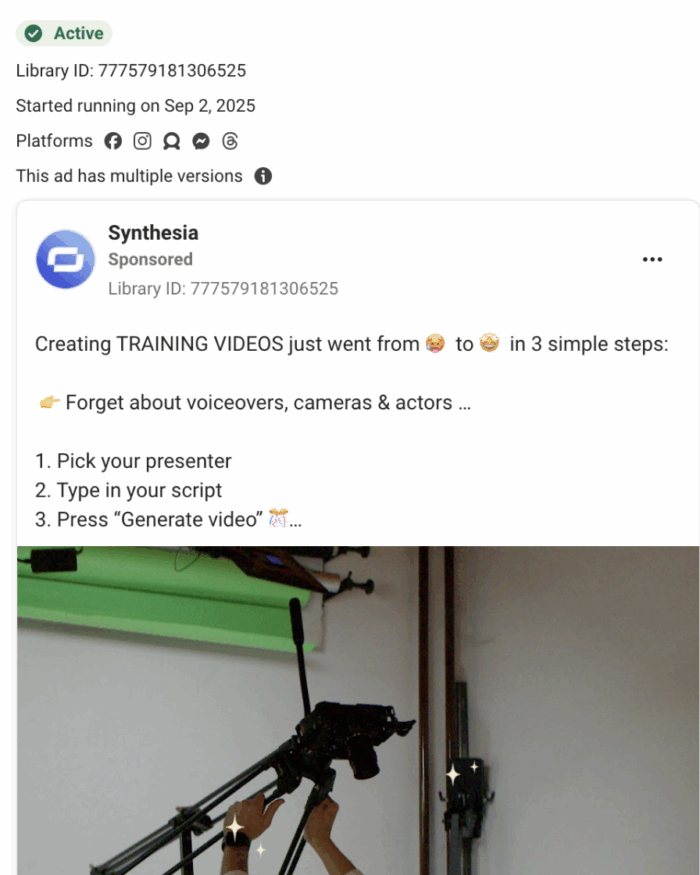
Platforms like the Meta Ad Library and LinkedIn Ad Library provide transparent visibility into active paid campaigns. Campaigns that have run uninterrupted for weeks or months signal validated market demand and proven psychological angles. Analyze these enduring ads to identify which underlying pain points—such as messy CRM data leading to lost enterprise deals—are driving the highest engagement in your vertical.
3. Build and Maintain a Curated Swipe File
Elite copywriters rarely write from a blank slate; they maintain extensive swipe files containing exceptional headlines, high-converting landing page layouts, and disruptive ad hooks. In addition to collecting personal finds, practitioners should routinely reference curated repositories like SwipeFile.com (maintained by copywriter Neville Medhora). Studying work validated by veteran marketers accelerates pattern recognition and refines one’s commercial intuition.
4. Establish a Repeatable Writing Workflow
Staring at a blank page is the primary symptom of an unstructured writing process. Effective copywriting is simply the methodical assembly of strategically placed pain points, logical transitions, objection handlers, and calls to action (CTAs).
For long-form blog content, a reliable workflow includes:
Outline Construction: Structuring subheadings around high-intent search queries and user pain points.
Drafting: Fleshing out each section using real-world examples and data points.
Refinement: Tightening sentence phrasing and verifying that the final output guides the reader seamlessly toward a commercial conversion.
5. Practice Intentionally Through Owned Assets
The only pathway to copywriting fluency is relentless volume coupled with critical feedback. However, practicing solely for hypothetical clients yields slow growth. Instead, writers should build and market their own digital assets—such as launching a niche affiliate marketing site, ghostwriting on LinkedIn, building a micro-SaaS tool, or running an e-commerce storefront.
When you are forced to fund your own customer acquisition using your own words, you quickly learn the difference between driving empty vanity traffic and capturing true purchase intent.
6. Embrace AI as a Strategic Collaborator
Artificial intelligence should never be deployed to generate blind, unedited copy. Instead, leverage AI for specific analytical and structural use cases:
Pain Point Extraction: Prompt models to analyze qualitative data sets and summarize customer frustrations.
Sentence Clarity Optimization: Feed dense or awkward passages into an LLM with the prompt: "Can you rewrite this passage with more clarity?"
Expert Sourcing: Use AI to locate authoritative quotes, case studies, and discussions from industry practitioners on platforms like LinkedIn to substantiate your claims.
7. Master a Singular Distribution Platform
Different channels demand vastly different writing mechanics. Thought leadership and personal branding frameworks thrive on LinkedIn and X, whereas comprehensive, how-to search intent content dominates organic blog traffic. By mastering the native nuances and algorithmic mechanics of one platform, you can generate a demonstrably higher ROI for your clients, justifying premium pricing structures.
8. Rigorously Measure the ROI of Your Content
Subjective peer feedback is secondary to hard commercial data. To command elite rates, copywriters must tie their words directly to revenue:
LinkedIn/Twitter: Track the seniority and industry of commenting profiles to ensure you are capturing decision-makers, not casual observers. Implement custom attribution fields on conversion forms asking, "How did you hear about us?"
Blog Content: Partner with clients to establish robust conversion tracking in Google Analytics 4 (GA4) to isolate which specific articles drive inbound pipeline generation.
Sales Funnels: Regularly review historical conversion rate optimization (CRO) metrics with clients to quantify revenue lift post-copy overhaul.
9. Participate in High-Level Masterminds and Communities
Isolated writing leads to stagnant skill development. Surrounding oneself with multi-figure entrepreneurs and seasoned copywriters provides immediate accountability, critical peer review, and high-value professional referrals. Programs like Copyblogger Academy were engineered specifically to fill this gap, offering direct feedback loops from proven seven-figure marketers on SEO, email marketing, personal branding, and sales conversions.
10. Maintain Tactical Impatience and Strategic Patience
Echoing the philosophy of investor Naval Ravikant, elite copywriters must be "impatient with action and patient with results." The operational velocity behind testing hooks, drafting copy, and shipping campaigns must remain exceptionally high on a daily basis. Simultaneously, creators must accept that compound growth in digital marketing requires months of unyielding consistency before yielding exponential returns.
Official Statements & Industry Perspectives
The philosophy underpinning modern, revenue-focused copywriting is championed by top-tier operators across the digital marketing ecosystem.
"Great copywriters are clear, concise, and ultimately convert readers into customers. Instead of focusing on improving the craft of writing more eloquently, focus on how to generate more revenue from your words."
— Industry Consensus from Copyblogger Leadership
Industry leaders consistently emphasize that writing proficiency is merely the entry ticket. The true differentiator is commercial accountability—the ability to look a client in the eye and prove that every dollar invested in content returned a measurable multiple in customer lifetime value (LTV).
Future Outlook: The Next Decade in Content Commerce
As algorithmic distribution channels grow increasingly saturated, the future of copywriting will belong to those who master hyper-specific audience resonance and rigorous data attribution. Generic, AI-bloated content will be filtered out by search engines and consumer skepticism alike.
Conversely, copywriters who ground their work in authentic customer interviews, rigorous competitor research, and measurable economic outcomes will continue to command premium compensation. For professionals willing to embrace structured workflows, continuous practice, and high-level community collaboration, the digital landscape offers an unprecedented runway for sustained, compounding revenue growth.