
Executive Overview
The modern digital economy has fundamentally transformed how businesses acquire customers, scale operations, and build enduring brands. At the epicenter of this shift is content marketing. Once considered a secondary tactic dominated by basic search engine optimization (SEO) and static blog posts, content marketing has evolved into a sophisticated, multi-channel discipline. Today, practitioners must navigate personal branding, social media distribution algorithms, automated email funnels, and the seismic disruptions introduced by generative artificial intelligence (AI).
Consequently, the market for content marketing education has exploded. Hundreds of programs, academies, and certifications promise to turn novices into high-earning digital marketers. However, a superficial examination reveals a troubling homogenization across the industry. Most courses rely on pre-recorded video modules, standardized action items, and recycled theoretical best practices that fail to translate into tangible commercial success.
This investigative review examines the actual mechanics of what makes a content marketing program effective. By establishing a rigorous evaluation matrix—measuring instructor credibility, content format diversity, advice recency, feedback mechanisms, community engagement, and pricing models—this report analyzes eight of the most prominent content marketing courses and communities available today. The goal is to provide business owners, marketing professionals, and aspiring creators with an authoritative guide to selecting a curriculum that delivers genuine return on investment (ROI).

Detailed Chronology & Evolution of Content Marketing Education
To understand the current landscape of content marketing courses, one must examine how the medium itself has matured over the past two decades.
Era 1: The Tactical Blogging Boom (Early 2010s)
In the early days of content marketing, education was largely decentralized. Blogs, forums, and basic PDF guides dominated. Courses from this era focused almost exclusively on keyword stuffing, basic backlink acquisition, and high-frequency blog publishing. The prevailing philosophy was simple: volume equals traffic, and traffic equals revenue. Platforms like HubSpot and early independent creators pioneered free, structured learning paths to help brands navigate this nascent search-engine-driven landscape.
Era 2: The Data-Driven and Agency Playbook Era (Mid-to-Late 2010s)
As search algorithms grew increasingly sophisticated, simple volume proved insufficient. Education shifted toward data-driven SEO, topical authority, and conversion rate optimization. Programs emerged that treated content not just as an awareness tool, but as a systematic pipeline for B2B lead generation. Industry leaders began packaging proprietary agency frameworks into scalable online courses, emphasizing case studies and rigorous measurement over mere guesswork.
Era 3: The Creator Economy and Algorithmic Diversification (2020–Present)
Today, content marketing is inextricably linked to personal branding and platform diversification. Traditional long-form blogging shares the stage with short-form video, professional networks like LinkedIn, micro-blogging on X (formerly Twitter), and automated email newsletters. Furthermore, the advent of generative AI has commoditized average content production, forcing educators to pivot rapidly. Modern courses can no longer simply teach how to write; they must teach how to build defensible ecosystems, command algorithmic attention, and convert transient eyeballs into long-term commercial value.
Content Marketing Course Evaluation Criteria
Not all educational programs are created equal. To objectively assess the offerings reviewed in this report, we measure each against six core pillars:
| Evaluation Factor | Why It Matters |
|---|---|
| Instructor Credibility | Has the instructor successfully used these exact content marketing frameworks to build multi-figure businesses, or are they merely teaching theory? |
| Content Formats Covered | Modern strategies require multi-channel execution. Does the curriculum extend beyond basic blogging to include social media, personal branding, email marketing, and conversion tactics? |
| Advice Recency | The rapid rise of AI and shifting search landscapes demand up-to-date methodologies. Is the curriculum actively maintained to reflect today’s market realities? |
| Feedback and Individual Support | Self-paced video libraries often leave students stranded when execution fails. Is there direct access to instructors or structured critique loops? |
| Community | Peer-to-peer networking, accountability groups, and shared insights provide exponential value compared to isolated learning. |
| Pricing Model | Does the financial investment match the depth of instruction, ongoing updates, and community access provided? |
Comprehensive Evaluation of Top Content Marketing Courses
1. Copyblogger Academy
- Overview: A hybrid course and community platform operated by seasoned entrepreneurs Tim Stoddart and Charles Miller. It is explicitly designed to teach business owners, creators, and freelancers how to transform content into a predictable revenue engine.
- Instructor Credibility: Tim Stoddart has built multiple multi-million-dollar companies, including digital marketing agency operations and the acquisition of Copyblogger itself. Charles Miller has cultivated massive audiences on X (220,000+ followers) and LinkedIn (100,000+ followers), using personal branding to generate millions for entrepreneurs. Critically, both instructors remain actively engaged in operating their respective businesses.
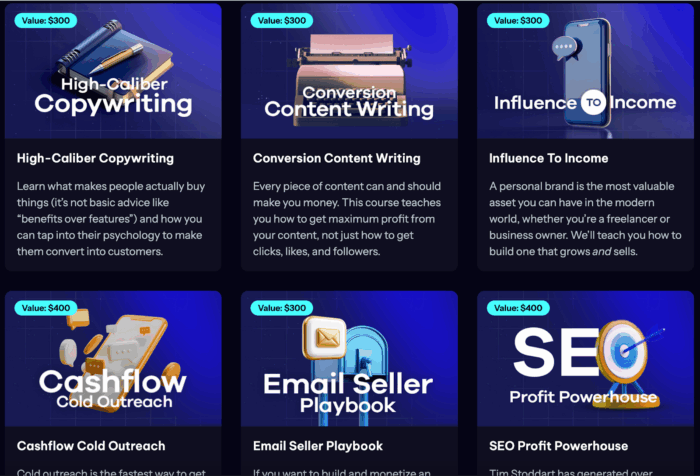
- Course Content: Rather than offering a single monolithic course, the academy provides six hyper-specific modules covering copywriting, SEO content architecture, email copywriting, personal branding, and client closing frameworks.
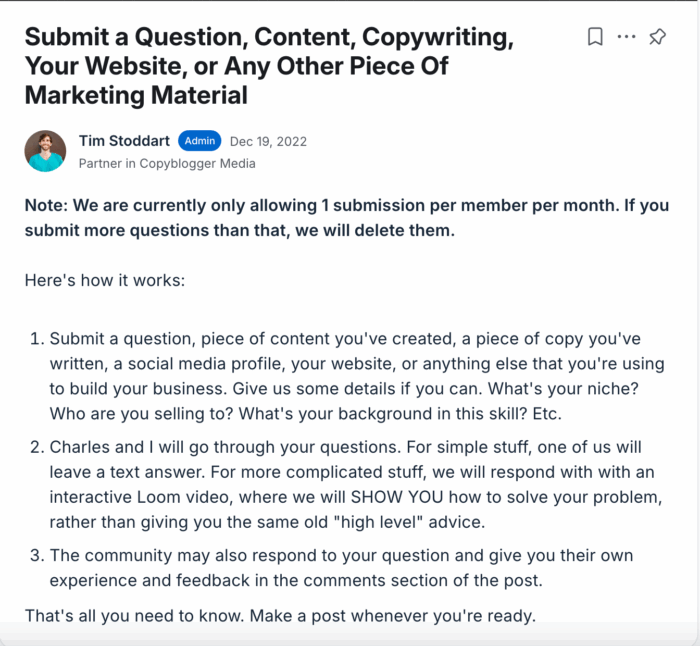
- Community and Support: Features an active private community where members can submit their work for direct, personalized critiques from Tim, Charles, and fellow advanced peers. Exclusive monthly mini-courses keep the curriculum fresh.
- Pricing: Features a low-barrier trial entry (often structured around a $1 introductory period) leading into an ongoing monthly membership.
2. HubSpot Content Marketing Certification Course
- Overview: A free, comprehensive 8.5-hour program spanning 14 lessons, 54 videos, and 11 quizzes, culminating in a shareable digital certification.
- Instructor Credibility: Primarily taught by Justin Champion, HubSpot’s Global Head of Surround Sound Growth, alongside industry luminaries such as Andy Crestodina (Orbit Media).
- Course Content: Focuses heavily on traditional inbound marketing fundamentals, blogging strategies, guest blogging, and video marketing. However, it noticeably omits crucial modern modules like personal branding, email monetization, and AI adaptation strategies.
- Community and Support: Completely self-paced with zero one-on-one interaction, instructor feedback, or networking community.
- Pricing: 100% free.
3. Grow and Convert’s "Customers from Content"
- Overview: An intensive, results-oriented program created by agency founders Benji Hyam and Devesh Khanal, built around the exact systems they have utilized to drive traffic and measurable conversions for over 40 B2B and B2C brands (including Patreon and Leadfeeder).
- Instructor Credibility: Deeply authoritative; the curriculum is derived from real-world agency execution focused strictly on bottom-funnel sales rather than vanity traffic metrics.
- Course Content: Broken into five meticulous modules covering customer research, keyword selection, conversion-focused writing, distribution, and attribution tracking. The material evolves dynamically as the founders refine their agency processes.
- Community and Support: Hosted within a private discussion forum where founders actively answer questions, supplemented by regular live Zoom coaching calls.
- Pricing: Available via a one-time lifetime access fee of $699 or structured six-month payment plans ($135/month).
4. Superpath
- Overview: Founded by content veteran Jimmy Daly (formerly of Animalz), Superpath functions less as a traditional linear course and more as an elite, collaborative community for career advancement and advanced B2B content strategy.
- Instructor Credibility: Bolstered by a membership pool composed of content leaders from top-tier tech companies such as Shopify, HubSpot, Intercom, and Clearscope.
- Course Content: Offers graduate-level mini-courses, teardowns, templates, and workshops. The focus remains heavily tailored toward enterprise blogging, SaaS content operations, and editorial leadership.
- Community and Support: Widely regarded as one of the premier professional networks in the content industry, offering robust peer feedback loops, AMAs, and networking channels.
- Pricing: Tiered model featuring a free community tier, Pro access starting at $50/month ($500/year), and an Advanced tier at $1,000/year.
5. Ahrefs’ "Blogging for Beginners" (Blogging for Business)
- Overview: A free, 5-hour video course taught by Ahrefs CMO Tim Soulo, detailing how the software giant scaled its blog to millions of organic monthly visitors.
- Instructor Credibility: Tim Soulo is globally recognized as an authority in organic search and SaaS growth marketing.
- Course Content: Highly tactical framework for keyword research, on-page SEO, and link-building strategies. However, the core material was recorded in 2020, meaning it lacks vital updates concerning generative AI search overviews and modern algorithm updates. It also restricts its scope strictly to blogging.
- Community and Support: Non-existent beyond public YouTube comment sections.
- Pricing: Free.
6. Semrush Academy Content Marketing Courses
- Overview: A series of specialized self-paced modules, most notably featuring content led by globally renowned SEO expert Brian Dean.
- Instructor Credibility: Brian Dean built and successfully exited Backlinko and Exploding Topics to Semrush, cementing his status as a premier digital educator.
- Course Content: Covers advanced blogging frameworks, content campaigns, and traffic generation through structured worksheets and video lectures. The primary drawback is that key modules were recorded around 2022, leaving a gap in post-AI adoption strategies.
- Community and Support: None; purely self-study modules.
- Pricing: Free.
7. CXL Content Marketing Research Course
- Overview: A focused, one-hour masterclass comprising six lessons centered on strategic content planning and distribution, taught by Derek Gleason.
- Instructor Credibility: Derek Gleason serves as the SEO and Content Lead at Shopify, bringing enterprise-level experience managing massive content libraries and high-stakes corporate strategies (previously working with brands like Twitter and Land O’Lakes).
- Course Content: Provides a clean, high-level overview of enterprise content strategy and distribution channels, though it intentionally skips granular tactical writing instruction and AI optimization frameworks.
- Community and Support: Self-paced with no direct instructor feedback loop or peer network.
- Pricing: Available via CXL subscription tiers or as a standalone purchase for $299.
8. Content Marketing Masterclass: Create Content That Sells (Udemy)
- Overview: A broad, introductory course taught by media entrepreneur Brad Merrill, spanning nearly four hours across 95 individual lectures.
- Instructor Credibility: Brad Merrill brings general media publishing and digital storytelling experience as the CEO of Merrill Media.
- Course Content: Covers foundational marketing principles, buyer personas, storytelling frameworks (such as AIDA), and basic email marketing. Because of its broad scope, it lacks the deep, laser-focused execution steps found in niche programs.
- Community and Support: Limited strictly to the Udemy Q&A interface.
- Pricing: Available via Udemy subscription plans or a direct purchase fee of $109.99.
Supporting Metrics & Industry Benchmarks
To assist readers in synthesizing these options, the following matrix compares the core programs across critical performance indicators:
| Course Name | Primary Focus | Content Format | Feedback / Support | Price Range | Ideal Audience |
|---|---|---|---|---|---|
| Copyblogger Academy | Multi-channel revenue, personal branding, SEO | Writing, Social, Email, SEO | High (Direct founder critiques & community) | Low ($1 trial + monthly) | Solopreneurs, creators, agency owners |
| HubSpot Certification | Inbound marketing fundamentals | Blogging, Video | None (Self-paced) | Free | Marketing students, absolute beginners |
| Grow and Convert | Conversion-driven B2B content | SEO, Attribution, Writing | High (Founder-led community & calls) | Mid ($699 one-time) | B2B founders, serious content teams |
| Superpath | B2B SaaS content careers | Strategy guides, Teardowns | Exceptional (Peer network, AMAs) | Free to $1,000/yr | In-house content professionals, leaders |
| Ahrefs Blogging Course | Organic search & SEO growth | Blogging | None | Free | Beginning bloggers, SEO enthusiasts |
| Semrush Academy | Advanced search optimization | SEO, Backlinks, Content campaigns | None | Free | Intermediate SEO practitioners |
| CXL Content Marketing | Enterprise strategy & distribution | Strategic planning | None | $299 (or sub) | Mid-level corporate marketers |
| Udemy Masterclass | General digital marketing | General overview | Low (Platform Q&A) | $109.99 | Generalists seeking broad familiarity |
Future Outlook: The Next Horizon of Content Education
As the digital marketing landscape continues to accelerate, the criteria for evaluating educational resources will shift dramatically. Several emerging trends will dictate the future of content marketing training over the next three to five years:
- The AI Integration Mandate: Programs that treat artificial intelligence as a passing trend or ignore it entirely will become obsolete. Future-proof curricula must teach marketers how to leverage AI for scaling administrative workflows, ideation, and research while doubling down on authentic human storytelling, original data acquisition, and unique personal perspectives that algorithms cannot replicate.
- Shift from Traffic to Conversion Literacy: The era of chasing unmonitored organic traffic metrics (pageviews and impressions) is drawing to a close. Educational programs must increasingly focus on bottom-line attribution, customer acquisition cost (CAC), lifetime value (LTV), and building direct-to-audience ecosystems (such as owned email newsletters and tight-knit communities).
- Rise of Hybrid Mentorship Models: Passive video consumption is seeing declining completion and success rates. Modern practitioners demand dynamic, community-driven environments where feedback is rapid, peer networks act as accountability boards, and instructors remain active practitioners rather than retired theorists.
Conclusion
Selecting the right content marketing course ultimately depends on your immediate professional objectives, current skill level, and preferred learning environment.
For enterprise-level strategists seeking academic rigor, programs like CXL or Superpath offer immense networking and structural value. For those seeking foundational, zero-cost SEO training, HubSpot and Ahrefs provide solid introductory frameworks.
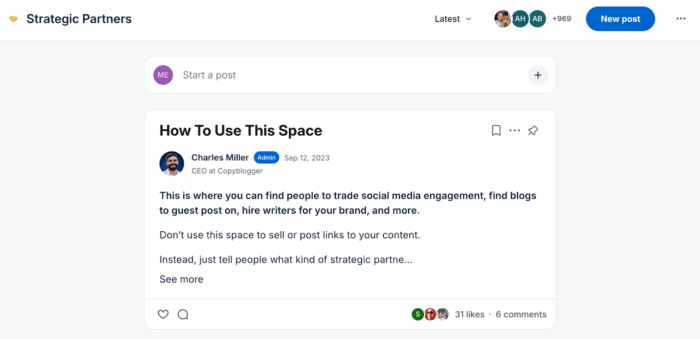
However, for entrepreneurs, freelance creators, and business owners striving to build holistic ecosystems that combine personal branding, multi-channel distribution, direct copywriting, and active mentorship, hybrid communities such as Copyblogger Academy and specialized playbooks like Grow and Convert offer the most direct, actionable path to sustainable commercial revenue.