Executive Overview
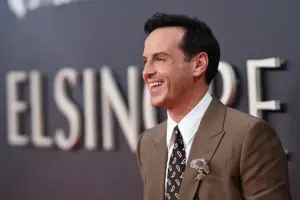
Following the high-profile European premiere of Elsinore—which served as the opening-night gala of the prestigious London Film Festival—acclaimed actor Andrew Scott delivered an impassioned critique of contemporary media trends, issuing a vital reminder about why cinema and television must continue to confront the darkest chapters of LGBTQ+ history. While expressing genuine enthusiasm for the burgeoning renaissance of joyful, life-affirming queer storytelling currently dominating pop culture, Scott underscored a growing, troubling cultural reluctance to revisit the harrowing realities of the HIV/AIDS epidemic.
Directed by visionary filmmaker Simon Stone from a sharply observed screenplay by Stephen Beresford, Elsinore chronicles the extraordinary final months of Scottish actor and Chariots of Fire star Ian Charleson. Set against the theatrical backdrop of late-1980s London, the biographical drama explores Charleson’s breathtaking, defiant final act: stepping into the title role of Hamlet at the National Theatre in 1989 after Daniel Day-Lewis abruptly walked off the stage mid-performance, all while quietly battling the terminal complications of AIDS.
Scott’s remarks, delivered during a deeply emotional post-screening appearance that united the film’s cast with the real-life historical figures who bore witness to Charleson’s final triumph, went straight to the heart of the artistic mandate for queer representation. Rather than retreating into sanitized, conflict-free narratives out of a misplaced sense of historical fatigue or internalized embarrassment, Scott argued that society must relentlessly confront the institutional failures and societal prejudices that defined the epidemic. Backed by Studiocanal and riding a wave of critical acclaim following its world premiere at the Telluride Film Festival, Elsinore arrives as a formidable contender for the upcoming awards season—not merely as a triumph of prestige filmmaking, but as an urgent cultural artifact demanding that the ghosts of the AIDS crisis never be quietly swept away.
Detailed Chronology: The Making of a Theatrical Legend and Cinematic Triumph
To understand the immense emotional weight of Elsinore, one must understand the staggering historical reality of Ian Charleson’s final months, a story that bridges the worlds of classical British theatre and the devastating height of the global health crisis.
In the spring of 1989, London’s National Theatre was rocked by an unprecedented disruption. Daniel Day-Lewis, then starring as the Prince of Denmark in director Richard Eyre’s production of Hamlet, suffered a reported nervous exhaustion and walked off the stage midway through a performance, vowing never to return to the run. Into this theatrical crisis stepped Ian Charleson. Already internationally renowned for his magnetic portrayal of Olympic runner Eric Liddell in the 1981 masterpiece Chariots of Fire, Charleson was privately grappling with a far more perilous battle. He had been diagnosed with HIV and was rapidly succumbing to AIDS-related complications.
Despite his declining physical health—enduring severe weight loss, fatigue, and the constant threat of opportunistic infections—Charleson accepted the grueling lead role. His performance did not merely rescue a troubled production; it entered the annals of theatrical legend. Critics lauded his Prince of Denmark as luminous, psychologically acute, and devastatingly profound. Yet, the triumph was laced with tragedy. Charleson performed the demanding Shakespearean marathon while managing his terminal condition in strict secrecy, sharing his diagnosis with only a trusted circle of confidants. Just weeks after the production closed, Charleson passed away on January 6, 1990, at the age of 40. He never lived to see the global cultural reckoning over HIV/AIDS that would slowly gather pace in the subsequent decade.
Decades later, screenwriter Stephen Beresford and director Simon Stone recognized the cinematic potential of this extraordinary true story. Securing backing from European powerhouse Studiocanal, the creative team crafted Elsinore, anchoring the narrative around Andrew Scott’s transformative performance as Charleson. The film meticulously recreates the tense, cigarette-hazed dressing rooms and high-stakes atmosphere of the late-1980s South Bank, capturing both the intoxicating magic of classical theatre and the creeping, pervasive shadow of a public health disaster.
Following a rapturous world premiere at the Telluride Film Festival that established the film as an instant critical darling, Elsinore crossed the Atlantic for its European debut at the London Film Festival. The opening-night screening was more than a red-carpet gala; it was a deeply cathartic homecoming for a story rooted deep in the institutional memory of British arts and culture.
Supporting Context & Metrics: The Evolution of Queer Media and the Danger of Historical Erasure
Andrew Scott’s post-screening reflections open a broader, critically vital conversation regarding the current landscape of LGBTQ+ representation across film and television. Over the past half-decade, media industries have experienced a seismic shift. Once dominated by narratives of trauma, tragic downers, and insurmountable queer suffering, the cultural marketplace has opened its arms wide to stories celebrating unadulterated joy, romance, and self-actualization.
Series and films such as Heartstopper, Red, White & Royal Blue, and the viral hockey romance phenomenon Heated Rivalry have captured the hearts of millions globally. These projects provide vital escapism and positive reinforcement for young, contemporary audiences who deserve to see queer love depicted with warmth, humor, and happy endings. Andrew Scott is the first to champion this evolution, noting:
"I welcome things like Heartstopper and Heated Rivalry and Red, White & Royal Blue and all those things that are joyful. I really, really, really do. And I think the fact that there’s lots of different types of gay drama, so to speak, in film and television is extraordinary."
However, Scott’s endorsement is paired with an incisive, necessary warning. As the pendulum swings toward sanitized, commercial-friendly queer joy, a dangerous cultural blind spot threatens to form. The historical memory of the AIDS crisis—and the immense political, social, and human devastation it wrought throughout the 1980s and 1990s—risks being sidelined, categorized by commissioning executives and modern audiences as "too depressing," "too dark," or "too niche."
Sociological and media metrics underline this underlying cultural anxiety. As generations pass who did not live through the height of the epidemic, youth literacy regarding the mechanics of government negligence, medical discrimination, and grassroots queer activism (such as the actions organized by ACT UP) is declining. When historical trauma is systematically avoided in favor of universally palatable romance, an entire generational legacy of resistance, grief, and solidarity is imperiled. Scott argues that this avoidance does not stem from artistic maturity, but rather from a lingering, societal discomfort with the raw, unfiltered truth of queer survival.
Official Statements: Andrew Scott’s Powerful Rebuke of Institutional Shame
Speaking candidly to festivalgoers and press following the premiere of Elsinore, Andrew Scott dismantled the emotional roots of this historical avoidance, shifting the burden of accountability away from the victims and placing it squarely where it belongs: on the shoulders of the state.
Addressing the cultural discomfort surrounding narratives of illness and oppression, Scott remarked:
"It troubles me a little bit because I think it speaks about people who perhaps don’t want to go back to a time when you’re talking about the AIDS crisis or you’re talking about when it was incredibly difficult for gay people. And I think that sometimes comes from a place of shame. I don’t want to see that anymore (…) because the shame does not lie with the gay people."
Expanding on this profound thesis, Scott drew a definitive line between personal tragedy and political failure, offering a perspective that resonated deeply with the audience:
"The shame lies with the governments who ignored the AIDS crisis and the stigma that was around people and the innate prejudice that was in society. So that’s someone else’s shame."
This powerful re-framing transforms Elsinore from a standard biographical drama into an act of historical reclamation. By refusing to let the suffering of Ian Charleson and millions of others be obscured by a blanket of comfortable historical amnesia, Scott insists that art must serve as both a mirror to past horrors and a shield against future injustices.
The emotional peak of the evening arrived when Scott brought the real-life individuals portrayed in the film onto the stage, honoring the living history connected to Charleson’s final days. Among them were Linda Tolhurst, the National Theatre’s stage doorkeeper for an astonishing 46 years (portrayed on screen by Monica Dolan); Ralph Mills, the theatre’s long-serving dresser (played by Paul Chahidi); and visionary director Sean Mathias, who was a close personal friend of Charleson (portrayed by Matthew Beard).
The emotional zenith of the night, however, was reserved for the introduction of Dr. Margaret Johnson, the pioneering HIV/AIDS consultant whose tireless medical and humanitarian work saved countless lives during the darkest years of the epidemic. Portrayed in the film by Academy Award winner Olivia Colman, Dr. Johnson’s appearance on stage drew a prolonged, thunderous standing ovation from the packed house.
Paying tribute to the medical pioneer, Scott stated with visible reverence:
"It’s difficult to underestimate the impact this person had on the development of treatment for people suffering with HIV and AIDS. To our mind, she is a true life hero."
Future Outlook: Awards Buzz and the Enduring Legacy of Elsinore
As Elsinore prepares for its broader commercial rollout courtesy of Studiocanal, its trajectory points directly toward a dominant presence in the upcoming awards season. The film has already proven its mettle with critics at Telluride and London, praised not merely for its technical execution, exquisite period recreation, and stellar ensemble cast, but for its moral clarity and emotional resonance.
In an awards landscape frequently saturated by biopics that sanitize their subjects for mass consumption, Elsinore refuses to flinch. It stands as a masterclass in dramatic storytelling that honors the sacrifice of a theatrical icon while interrogating the societal machinery that allowed a health crisis to become a human rights catastrophe.
Looking forward, the cultural impact of Elsinore and Andrew Scott’s outspoken advocacy will likely reverberate well beyond the cinematic red carpets. By forcefully reminding the entertainment industry that honoring our collective past is just as important as celebrating our present progress, Scott has thrown down a gauntlet for filmmakers worldwide. The ghosts of the AIDS crisis demand to be remembered—not with shame, but with fierce, unyielding pride, ensuring that the sacrifices of figures like Ian Charleson and the heroism of advocates like Dr. Margaret Johnson remain eternally illuminated on the world stage.