Executive Overview
With their breathtaking and deeply unsettling 2018 debut, The Wolf House, Chilean visionary duo Cristobal León and Joaquín Cociña announced themselves as masters of a distinctively handcrafted, psychological brand of horror. The stop-motion masterwork, which fused claymation, puppetry, and papier-mâché into a tactile yet deliriously surreal nightmare, captivated the global arthouse community. It transitioned seamlessly from a deceptive, juvenile storybook premise into the darkest, most traumatic recesses of human experience.
Six years later, their ambitious follow-up, The Hyperboreans (2024), challenged audiences with a dense, narratively abstruse pastiche of history, psychology, and radical political theory. While it captured fewer mainstream imaginations, it dazzled technicians by expanding their visual quiltwork to incorporate live-action cinematography.
Now, with their beguiling third feature, Donkey Princess, which celebrated its international premiere in competition at the Locarno Film Festival, León and Cociña have found a triumphant middle ground. The film brilliantly bridges the gap between their first two features. Continuing their singular exploration of hybrid live-action and animated cinema, Donkey Princess marks a fruitful return to the adult fairytale terrain that first made them international sensations.
While the film may lack the darkly enveloping atmosphere and gnawing, singular emotional impact of The Wolf House—an atmospheric apex few films ever touch—it more than compensates with aesthetic ambition. Blending accessible mythic structures with avant-garde execution, Donkey Princess solidifies the filmmakers’ auteur status, ensuring its journey extends far beyond the traditional festival circuit. As an artistic statement, it presents a mythic princess whose tortured, patriarchal daddy issues follow her across space, time, and dimensions, building toward a climax that is as emotionally touching as it is profoundly disquieting.
Detailed Chronology: From Perrault’s Dark Fable to Contemporary Chile
Rewriting the Unadaptable: The Inspiration of "Donkeyskin"
As hinted by its provocative title, the script—written by León and Cociña in close collaboration with novelist Alejandra Moffat—riffs directly on Charles Perrault’s 17th-century French fairy tale, Donkeyskin (Peau d’Âne). It is a classic piece of folklore famously avoided by Disney due to its deeply disquieting, incest-themed premise. While French New Wave icon Jacques Demy gave the source material a delightfully offbeat, candy-colored cinematic treatment in his 1970 musical, León and Cociña approach the material with a distinctly downbeat, melancholic whimsy.
At the center of this surreal universe is Princess Diana, played with haunting vulnerability by Hyperboreans star Antonia Giesen. Despite sharing a name with the famous British royal, this Diana bears no resemblance to her historical counterpart, save for one crushing burden: she is entirely suffocated by the demands of a hyper-patriarchal kingdom.
The Ramshackle Realm and the Tyranny of Grief
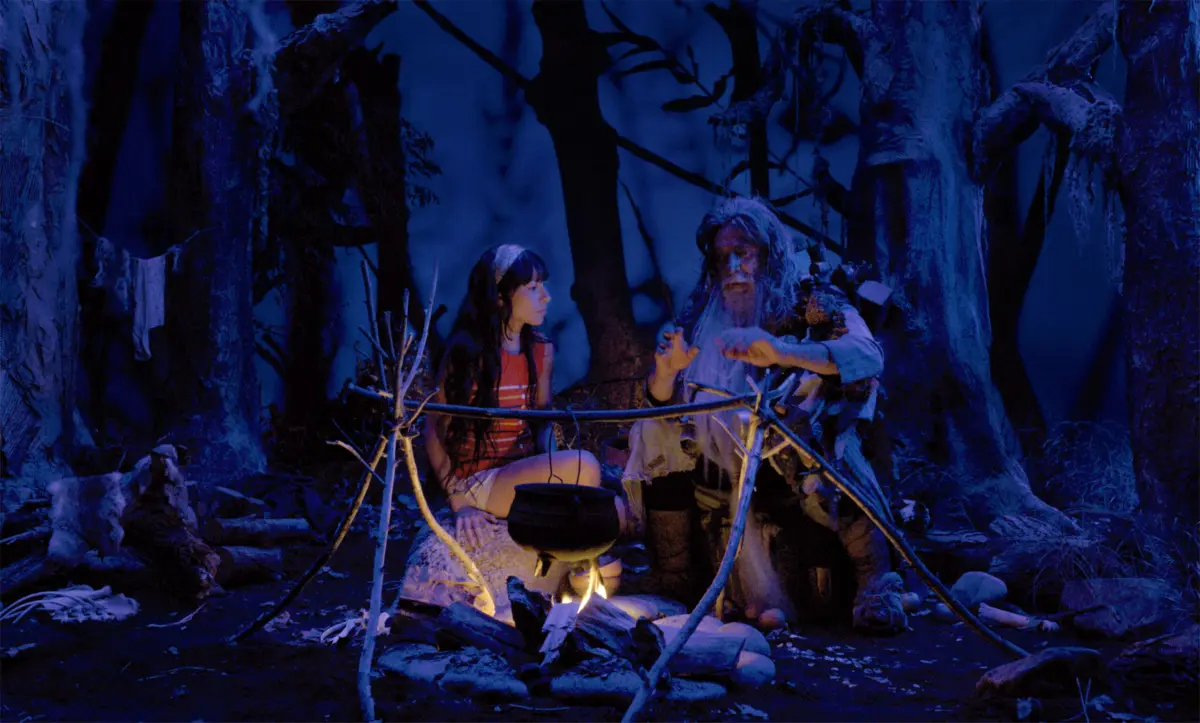
The sovereign realm of Donkey Princess is realized through a breathtakingly inventive mixture of animated imagery and aggressively tactile production design overseen by Natalia Geisse. Toadstool-shaped castle turrets look as though they have been sculpted from heavy, melting cake frosting; jagged mountain formations are fashioned from industrial fiberglass; and sprawling forests are forged from stray, dry branches, accessorized with sudden, fluttering flights of 2D cartoon butterflies and birds. Fans of the directors’ distinct stop-motion interlude in Ari Aster’s Beau Is Afraid will immediately recognize these signature landscape textures.
Washed in queasy, melancholic shades of turquoise and puce, this is a world rendered deliberately unstable—it does not look like a landscape built to last, and for Diana, it certainly isn’t. Guarded obsessively and pathologically by her grieving father (portrayed with brooding menace by Francisco Melo) ever since her mother’s untimely death, Diana yearns desperately for escape. Her salvation seemingly arrives when she crosses paths with Lalo, a charming commoner played by Andrew Bargsted. She falls swiftly in love, captivated both by the young man and by the intoxicating prospect of life outside the suffocating confines of the royal court.
Exile, Magic, and Interdimensional Displacement
For the King—who has taken exceptionally poorly to his status as a widower, reacting by brutally outlawing all forms of love throughout his domain—this romance is an unforgivable treason. Lalo is swiftly and violently banished to an orange-skied hellscape strewn with sharp thorns and circling vultures. This purgatorial wasteland serves as a masterclass in design, engineered through a witty fusion of silhouette animation and tangible, physical set construction.
Before his banishment, however, Lalo manages to gift Diana a magical bracelet rumored to grant wishes across the boundaries of space and time. Using its latent power, she is rapidly transported out of her fairytale prison and dropped directly into the gritty, urban bustle of contemporary Chile.
Here, the narrative takes a disorienting, sideways leap. Diana and Lalo attempt to live together as parallel, workaday versions of themselves, finding employment side-by-side in the decidedly unromantic pest control business. Yet, if viewers expect a straightforward, happily-ever-after conclusion, they underestimate the directors’ penchant for narrative disruption. The aging King, stripped of his monarchical authority but retaining his psychological tyranny, manages to teleport into this modern realm as an invalid—burdening Diana’s new life with the inescapable ghosts of her past.
Converging Realities and the Shock of Realism
As Donkey Princess progresses, Diana is continually shuffled through various lives, identities, and temporal personae, finding herself neither truly free nor genuinely happy in any of them. Viewers familiar with modern international cinema may draw thematic parallels to the naïve yet despairing time-travel mechanics of Bertrand Bonello’s recent metaphysical drama, The Beast. Like Bonello’s work, León and Cociña’s divergent temporal paths eventually converge into a single, highly charged, climactic tragedy, leaving behind an open-ended, fragile possibility of genuine emancipation.
The storytelling style of León and Cociña can occasionally prove opaque. The film’s opening salvo, in particular, feels hurried, scrambled, and aggressively dense. However, as the narrative unfurls, it gains remarkable grace and clarity, culminating in an astonishing final shift in register toward near-total cinematic realism. This aesthetic pivot represents the single biggest surprise from these famously feverish world-builders. Even if their most satisfying, tightly contained feature remains their most purely animated one, Donkey Princess stands as an intriguingly bold, transitional work in an oeuvre that refuses to be boxed in.
Supporting Context & Metrics: The Trajectory of León and Cociña
To fully understand the weight of Donkey Princess, one must contextualize the unique production ecosystem that fosters León and Cociña’s output. Working primarily out of Chile and Europe, the creative duo has systematically redefined what contemporary Latin American animation can achieve on an international scale.
| Metric / Milestone | The Wolf House (2018) | The Hyperboreans (2024) | Donkey Princess (2025/Locarno) |
|---|---|---|---|
| Primary Medium | Stop-motion, claymation, papier-mâché | Hybrid stop-motion, live-action, digital | Hybrid live-action, animation, tangible sets |
| Narrative Focus | Trajectory from fairy tale to psychological horror | History, politics, and theoretical abstraction | Mythic fairytale, patriarchal trauma, magical realism |
| Key Collaborators | Independent Chilean crew | Novelist/Writers, visual artists | Alejandra Moffat, Antonia Giesen, Natalia Geisse |
| Festival Debut | Berlinale (Panorama) | International festival circuit | Locarno Film Festival (In Competition) |
| Aesthetic Register | Claustrophobic, dark, enveloping | Abstruse, intellectual, quilt-like | Transitional, moving from whimsical fantasy to realism |
The evolution from the purely handcrafted, room-scale stop-motion of The Wolf House to the sprawling, interdimensional live-action integration of Donkey Princess demonstrates a deliberate artistic scaling. While The Hyperboreans proved somewhat impenetrable to general audiences due to its dense theoretical underpinnings, Donkey Princess successfully harnesses intellectual audacity without sacrificing emotional clarity.
Official Statements and Critical Reception
The international premiere of Donkey Princess at the Locarno Film Festival generated considerable buzz among critics, programmers, and industry insiders, establishing the film as a high-water mark for contemporary avant-garde storytelling.
Industry analysts have praised the film’s ability to balance accessibility with experimental daring. As early festival reviews have noted, the collaboration between León, Cociña, and screenwriter Alejandra Moffat yields a text that is as literarily rich as it is visually arresting.
"In Donkey Princess, León and Cociña manage to strike a rare equilibrium," notes one prominent festival dispatch. "They preserve the tactile, handmade terror that made them underground icons, while opening their cinematic universe up to the complexities of modern human geography and live-action performance."
While some critics have observed that the film’s narrative architecture occasionally outpaces its emotional resonance—noting that it does not quite match the relentless, dark gravitational pull of The Wolf House—the consensus remains overwhelmingly positive regarding its technical mastery.
Production designer Natalia Geisse’s contributions have been singled out for particular acclaim. By utilizing unconventional materials—such as fiberglass, dry foliage, and frosting-like textures—Geisse has helped construct a physical world that mirrors the fractured mental state of its protagonist.
Furthermore, lead actress Antonia Giesen has earned widespread praise for anchoring the film’s wild shifts in tone and dimension. Moving effortlessly from the stylized, mythic cadence of a fairy-tale princess to the deadpan exhaustion of a modern pest control worker, Giesen provides the emotional anchor necessary to ground the directors’ flights of surrealist fancy.
Future Outlook: Whither Chilean Animation?
As Donkey Princess prepares to expand its footprint beyond the rigorous confines of the international festival circuit, the film serves as a crucial milestone not only for its creators, but for the broader landscape of Latin American independent cinema.
By proving that avant-garde animation techniques can successfully merge with live-action cinematography and complex sociological themes—such as generational trauma, patriarchal oppression, and the weight of historical legacy—León and Cociña have effectively mapped out a new frontier for hybrid filmmaking.
The directors have continually demonstrated a refusal to repeat themselves. Where The Wolf House was a claustrophobic descent into historical trauma contained within a single architectural space, and The Hyperboreans was an intellectual labyrinth of political theory, Donkey Princess acts as an expansive, migratory bridge. It wanders across centuries, across animation and live-action, and across distinct aesthetic registers.
Ultimately, Donkey Princess may be viewed by future film historians as a transitional masterpiece—a work where two of contemporary cinema’s most ferocious imaginations tested the boundaries of their own vocabulary. Whether their next project plunges back into total darkness or ventures further into the realm of hyper-realism, one thing remains certain: Cristobal León and Joaquín Cociña operate in a category entirely their own, and the cinematic landscape is vastly richer for their uncompromising vision.