In an era dominated by automated textual generators and synthetic marketing slop, a stark macro-economic anomaly persists on professional networks: despite LinkedIn boasting over one billion members globally, a mere 1% of active users regularly create content. This severe supply-demand imbalance offers an extraordinary organic leverage point for business executives, consultants, and founders. However, as the platform becomes increasingly saturated with generic, AI-generated drivel, traditional vanity metrics are failing to translate into bottom-line pipeline growth.
To capture high-value prospective clients, organic growth strategists are turning away from automated generation tools and embracing rigorous structural frameworks rooted in human psychology. Developed through empirical testing by growth strategist Kasey Brown in collaboration with Social Media Examiner publisher Michael Stelzner, the Triple S Framework—comprising the distinct cognitive phases of Stop, Stay, and Share—provides a systematized methodology for capturing feed attention, engineering long dwell times, and driving earned viral distribution.
By grounding digital publishing in hyper-specific audience parameters and reader-centric value delivery, this architecture transforms LinkedIn from a passive networking hub into a predictable, revenue-generating engine—without relying on artificial intelligence.
Detailed Chronology: The Execution Architecture
The execution of high-performing organic LinkedIn content operates not on random inspiration, but through a sequence of deliberate tactical phases. Below is the systematic chronology required to execute the framework effectively.
+-----------------------------------------------------------------------------------+
|                        FOUNDATIONAL ARCHITECTURE SETUP                            |
|  - Define Precise ICP (VA-Searchable Parameters)                                  |
|  - Frame the 30-Day Follower Transformation                                       |
|  - Establish Reader-Centric Value Alignment                                       |
+-----------------------------------------------------------------------------------+
                                          │
                                          ▼
+-----------------------------------------------------------------------------------+
|                       PHASE 1: THE "STOP" MECHANISM                               |
|  - Deploy Visual Pattern Interrupts (Unpolished, 0.5x Zoom, Wide-Angle)           |
|  - Craft Hook Mechanics via the "Five Cs" Framework                               |
|  - Goal: Drive the "See More" Click (Accounts for 80% of Post Impressions)        |
+-----------------------------------------------------------------------------------+
                                          │
                                          ▼
+-----------------------------------------------------------------------------------+
|                       PHASE 2: THE "STAY" MECHANISM                               |
|  - Line 3 Re-Hook: Extend Narrative Tension (Do Not Resolve Immediately)          |
|  - Apply Cognitive Cadence (3-4 Single Sentences ➔ 2-3 Sentence Blocks)           |
|  - Enforce Readability (4th-7th Grade Level via Hemingway App)                    |
|  - Preview Mobile Formatting & Handle Character Overflow                          |
+-----------------------------------------------------------------------------------+
                                          │
                                          ▼
+-----------------------------------------------------------------------------------+
|                       PHASE 3: THE "SHARE" MECHANISM                              |
|  - Deliver the "Actionable Goodie Bag" (Step-by-Step Tactical Framework)           |
|  - Measure Shares-per-Impression Benchmark (Target > 0.5 Ratio)                   |
|  - Recirculate Top-Performing Assets (60–90 Day Systemic Recounting)              |
+-----------------------------------------------------------------------------------+
Strategic Foundations: Audience Precision and Transformation
Before deploying individual tactical posts, creators must establish three structural foundations. Without these operational baselines, high-performing copy fails to convert attention into commercially viable outcomes.
The Hyper-Specific Ideal Client Profile (ICP): Broad demographic targets, such as "professionals looking to scale their brand," fail to yield actionable content. A functional ICP must be defined with tactical granularity—specific enough that an administrative assistant could input the criteria into LinkedIn’s search engine and instantly isolate qualifying prospects. An operational ICP reads: "Public speakers, executive coaches, and B2B consultants generating at least $20,000 per month who lack organic content systems to scale their market reach."
The 30-Day Transformation Mandate: Every piece of content must serve a predetermined narrative destination. Creators must answer a core diagnostic question: What tangible operational, psychological, or tactical transformation will a prospective client undergo after following this feed for 30 days? This mandate dictates topic selection before a single word is typed.
The Reader-Centric Pivot: Standard corporate communications fail because they center on the creator: highlighting personal wins, demonstrating intelligence, or pitching services directly. Enterprise-grade content inverts this model, prioritizing what the ideal reader extracts from the narrative over what the writer desires to communicate.
Phase 1: The "Stop" Mechanism (Scroll Interrupts & Hook Dynamics)
The initial mandate of any feed item is physical: forcing a user to halt their thumb scroll. Approximately 80% of a post’s total algorithmic impression capacity is governed exclusively by two elements working in tandem: the visually attached media asset and the visible first two lines of text.
Visual Engineering: The Utility of Pattern Interrupts
The vast majority of professional network creators rely heavily on polished corporate headshots, high-resolution media collateral, or abstract stock imagery. Counter-intuitively, empirical testing reveals that hyper-polished assets often blend into feed background noise. High-converting content leverages distinct pattern interrupts.
In a controlled case study conducted by Kasey Brown, two distinct visual strategies were deployed to deliver an identical lead magnet (presentation slides offered in exchange for a post comment):
Control Asset (Polished): A high-resolution, professionally lit, studio-quality photograph of the speaker presenting on stage with a microphone. Result: 200 qualified leads.
Experimental Asset (Unpolished): A raw, wide-angle mobile phone photograph taken from the stage using a rear camera set to 0.5x zoom, displaying the full, candid audience environment in natural lighting. Result: 3,000 qualified leads.
This stark 1,400% performance delta illustrates that raw visual authenticity triggers innate human curiosity far more effectively than sanitized commercial media.
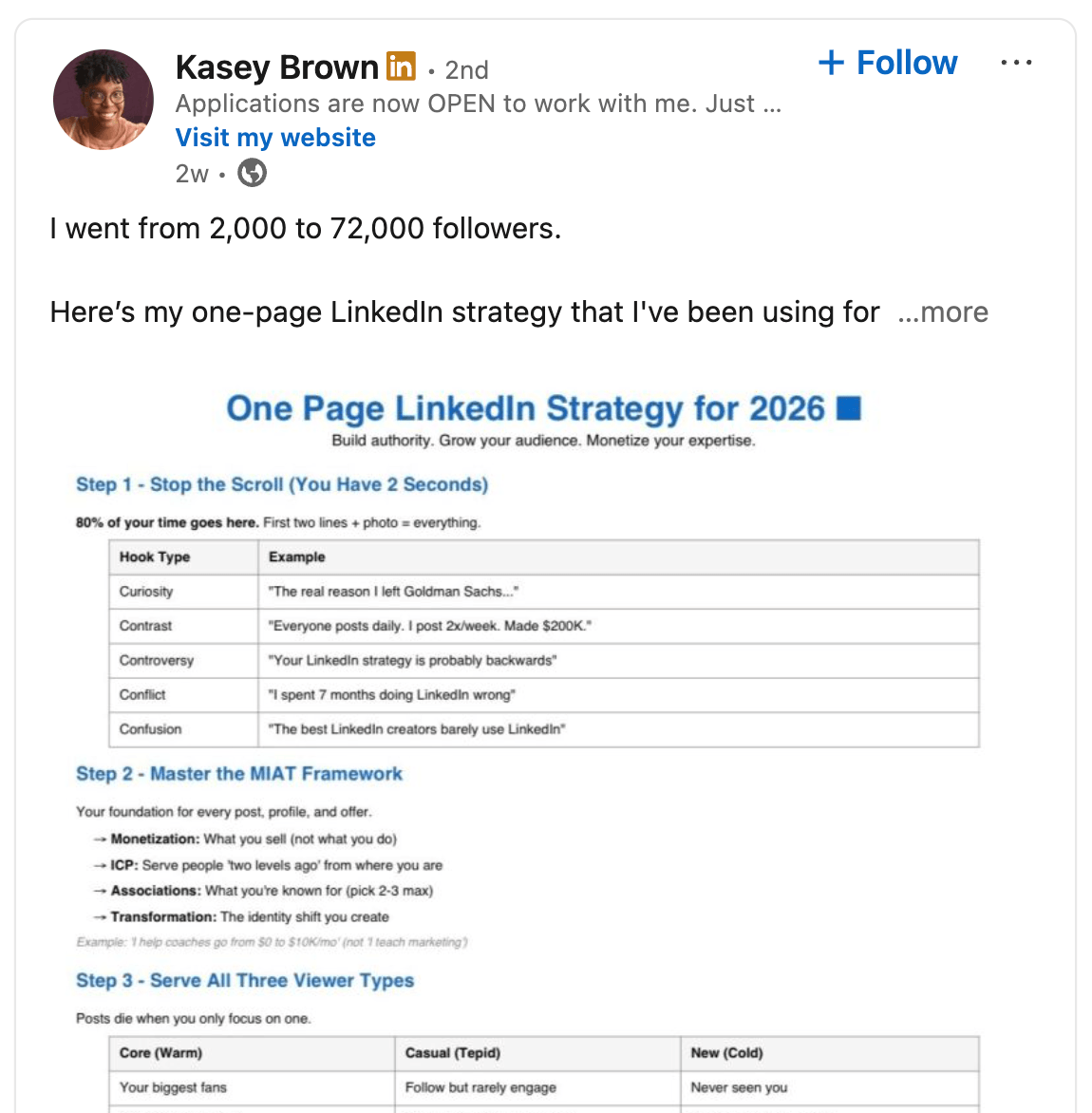
Tactical Execution for Infographics: Standard cover tiles stating titles like "A Framework for LinkedIn Growth" yield minimal engagement. Creators should present dense, fully articulated visual frameworks—formatted to resemble operational working documents—or capture photographs of content displays directly on office screens with the creator physically present in the frame.
Textual Hook Dynamics: The Five Cs Framework
The visible copy prior to the truncated "see more" line must generate intense psychological friction. Adapting principles from short-form video retention dynamics, high-converting hooks deploy at least two to three of the Five Cs:
           [Curiosity] ─── [Contrast] ─── [Contradiction]
                             │
                     THE FIVE Cs HOOK
                             │
           [Controversy] ─────────────── [Confusion]
To analyze this framework in action, consider a contrasting narrative audit:
Sub-Optimal Hook (Zero Friction):"On vacation in Bali, having a great summer with my family." (Fails to deploy any of the Five Cs; yields zero psychological tension).
High-Converting Hook (High Friction):
"I was working a job I absolutely hated in 2021. 2026: I just spent $30,000 to stand on this beach…"
This optimized hook simultaneously deploys Contrast (2021 corporate misery vs. 2026 luxury beach), Confusion ($30,000 expense detail), and Curiosity (how the systemic pivot occurred), forcing the reader to click "see more" to resolve the cognitive dissonance.
Phase 2: The "Stay" Mechanism (Cognitive Cadence & Dwell Retention)
Inducing the initial click is merely a entry ticket; sustaining reader retention through the body of the post dictates whether the algorithm registers long dwell time, which signals high content quality.
   [ See More Click ]
           │
           ▼
   [ Line 3 Re-Hook ] ──► (Builds secondary tension; delays narrative payoff)
           │
           ▼
   [ Rhythmic Drafting ] ─► 3–4 Single Sentences ──► 2–3 Sentence Block ──► Repeat
           │
           ▼
   [ Readability Audit ] ─► Target Grade 4–7 Level (Verified via Hemingway App)
           │
           ▼
   [ Mobile Preview ] ──► Mobile-first rendering audit via tools like Authored Up
The Line 3 "Re-Hook"
A primary point of failure in business writing is the premature resolution of narrative tension immediately following the "see more" expansion line.
Incorrect Re-Hook: Resolving the mystery instantly ("I took five weeks off from my consulting business, and it ran completely on autopilot while I was gone.").
Correct Re-Hook: Compounding the narrative stakes ("It was an absurd dream I noted down last February. I genuinely believed my agency would collapse if I stepped away for three days, let alone five weeks, especially with internal ops falling apart…").
By compounding structural friction for three additional lines, the writer earns the cognitive space required to deliver a comprehensive, multi-paragraph value thesis.
Formatting Rhythm and Accessibility Engineering
Because over 70% of LinkedIn content consumption occurs on mobile devices, visual density directly impacts drop-off rates. Solid blocks of text create visual fatigue on mobile viewports.
Cadence Alternation: Effective post structure follows an alternating typographic rhythm. Authors should deploy a sequence of three to four punchy single-sentence lines, transition into a single two-to-three sentence contextual block, and return to single-line assertions.
Reading Level Calibration: High-performing content consistently tests at a 4th to 7th-grade reading level on standard Flesch-Kincaid scales. Using tools like the Hemingway App, writers systematically eliminate passive voice, complex clauses, and corporate jargon.
Structural Overflow Management: LinkedIn caps native post lengths at roughly 3,000 characters. When comprehensive insights exceed this threshold, creators should place the detailed continuation within the immediate top comment. This operational tactic extends post engagement time, signaling high content value to the network’s recommendation engine.
Phase 3: The "Share" Mechanism (Actionable Distribution Architecture)
While likes and surface comments represent low-friction engagement, shares (reposts) represent the ultimate metric of strategic resonance. A share signals that a reader considers the material valuable enough to endorse publicly within their professional network.
          [ Reader Consumes Narrative Arc ]
                         │
                         ▼
          [ Encounter "Actionable Goodie Bag" ]
          (Step-by-Step Practical Blueprint)
                         │
                         ▼
          [ Internal Calculus: "This enhances my professional authority" ]
                         │
                         ▼
          [ Repost / Direct Share / Save Action Initiated ]
The "Goodie Bag" Model
To turn personal storytelling into a shareable operational asset, every narrative must resolve with an explicit, highly structured, practical takeaway—conceptually referred to as the "actionable goodie bag."
If a narrative outlines a founder’s journey to operational freedom, the closing section must shift into an objective, step-by-step framework:
  Step 1: Conduct a 7-day time audit of administrative friction.
  Step 2: Isolate tasks generating under $100/hr value.
  Step 3: Deploy automated routing rules or delegate to offshore leadership.
By transitioning from narrative setup to actionable execution, the post converts from a simple personal story into a reference tool that readers save, share with colleagues, or forward to internal teams.
Supporting Context & Performance Metrics
To operationalize organic LinkedIn publishing, performance tracking must move away from vanity impressions and focus on operational metrics that correlate with business pipeline development.
Metric / Parameter
Baseline Target
High-Performance Benchmark
Strategic Operational Context
Creator-to-Consumer Ratio
1% of platform total
N/A
Represents a massive structural content deficit on LinkedIn, favoring consistent publishers.
Hook Impression Weight
80% of total reach
> 85% conversion to click
Governed strictly by the visually attached image and the top two lines of copy.
Target Dwell Readability
Grade 4 to Grade 7
Grade 5 Flesch-Kincaid score
Ensures minimal cognitive effort for mobile users scrolling through feeds.
Mobile Viewing Ratio
~70% total platform activity
Optimized via Authored Up
Requires line breaks every 1–2 sentences to avoid visual wall-of-text fatigue.
Shares-per-Impression Ratio
0.3% (3 shares per 1k views)
≥ 0.5% (5+ shares per 1k views)
The primary diagnostic metric for determining true content utility and reach.
Asset Recycling Velocity
90-Day Rotation Cycle
60-Day Evergreen Loop
Posts reaching a ≥ 0.5% share ratio should be republished verbatim every 2 to 3 months.
Case Study Breakdown: Lead Generation Dynamics
Visual asset selection directly impacts audience action, as shown in Kasey Brown’s slide-deck lead magnet experiment:
Perspective on AI-Generated Content Saturating the Market
Reflecting on the modern digital media ecosystem, Kasey Brown, LinkedIn growth strategist and founder of Digital Kairos, emphasizes that standard AI generation tools often diminish long-term audience trust:
"Most content creators publish while thinking primarily about themselves: ‘Did I sound smart? Did I share enough client wins? Will this drive immediate sales?’ When your operational focus shifts fundamentally toward what the ideal reader extracts from the narrative, posts start generating the kind of attention that compounds into sustainable business growth.
"We don’t have to be better than everyone else trying to look corporate. We simply have to be different. Unpolished visual authenticity paired with tight narrative tension will outperform hyper-produced, synthetic media every single time."
Adding context to the operational friction facing modern B2B brand builders, Michael Stelzner, founder of Social Media Examiner, highlights the value of human-centric publishing:
"The macro opportunity on LinkedIn remains extraordinary precisely because so few users actively publish, and even fewer publish well. As AI tools flood social networks with uniform, low-retention noise, double-down strategies focused on true human positioning, clear reading structures, and reader-first value are pulling away from the competition."
Future Outlook: The Evolution of LinkedIn Organic Growth
As algorithm architectures mature through 2026 and beyond, several structural shifts will dictate the future of organic reach on professional networks:
┌─────────────────────────────────────────────────────────────────────────┐
│               EMERGING LINKEDIN ALGORITHMIC TRENDS                      │
├─────────────────────────────────────────────────────────────────────────┤
│ 1. AI-Noise Penalization                                                │
│    Natural language models will increasingly filter out generic, AI-like │
│    phrasing in favor of authentic, human narratives.                    │
│                                                                         │
│ 2. Dwell-Time Prioritization                                            │
│    Explicit focus on long engagement sessions, rewarding rhythmic copy   │
│    that keeps users reading for 60+ seconds.                             │
│                                                                         │
│ 3. Deep Distribution via Peer Reposts                                   │
│    Amplified algorithmic reach for content that drives peer-to-peer     │
│    shares over superficial likes.                                       │
└─────────────────────────────────────────────────────────────────────────┘
Algorithmic Penalization of Synthetic Copy: As natural language processing models embedded within social platforms evolve, algorithms will increasingly penalize recognizable generative AI structures (e.g., overused emojis, formulaic bullet points, and shallow platitudes). Unfiltered personal experiences and original insights will receive preferential organic distribution.
Elevated Weighting of Dwell Time and Share Ratios: Simple comment pods and engagement-baiting prompts will continue to yield diminishing returns. Recommendation systems will disproportionately reward content that holds user attention for 60+ seconds and generates high shares-per-impression ratios, cementing the Stay and Share components of the Triple S framework as vital requirements for sustained platform reach.
Systemic Recycling of Evergreen Intellectual Property: The modern content pipeline relies less on continuous real-time creation and more on systemic IP recycling. High-performing content assets—those hitting the top-tier ≥ 0.5% share-per-impression metric—will operate on automated 60-to-90-day republishing cycles, allowing business leaders to scale their presence reliably without burning out on daily content creation.
By combining audience targeting, unpolished visual hooks, rhythmic mobile-first formatting, and actionable takeaways, enterprise executives and entrepreneurs can secure a durable competitive advantage—building an organic acquisition engine that thrives without relying on artificial intelligence.