Executive Overview
The intersection of industrial design, heavy-duty mobile computing, and specialized AI development has long been an arena of compromise. Professionals requiring immense memory footprints and robust graphical processing units (GPUs) have traditionally been forced to choose between bulky, thermal-throttling gaming rigs or overly minimalist consumer machines lacking the necessary internal architecture for demanding computational workloads. Microsoft aims to permanently shatter this dichotomy with the introduction of the Surface Laptop Ultra.
When initial details surrounding the Surface Laptop Ultra leaked in June, tech analysts and enterprise buyers responded with a mixture of curiosity and skepticism. Microsoft’s marketing narrative promised the most powerful Surface laptop ever created, yet the visual aesthetic suggested a refined, conventional aluminum clamshell. Skeptics were quick to draw comparisons to Apple’s MacBook Pro ecosystem, noting the absence of the eccentric hinges, detachable displays, and experimental form factors that historically defined the Surface brand—such as the largely sidelined Surface Laptop Studio.
However, hands-on evaluations reveal a device that transcends superficial design comparisons. Beneath its understated, minimalist exterior lies a technological powerhouse driven by cutting-edge hardware, most notably NVIDIA’s revolutionary RTX Spark architecture. Tailored specifically for AI developers, data scientists, and creative professionals who demand up to 128GB of unified RAM in a truly portable form factor, the Surface Laptop Ultra is not merely another premium consumer notebook. It is a calculated strike at the professional workstation market, wrapped in chassis geometry that feels fundamentally superior to any Windows laptop that has preceded it.
This report provides a comprehensive analysis of the Surface Laptop Ultra, examining its architectural foundation, its target demographic, official positioning, and the broader industry implications of Microsoft’s boldest hardware gambit in years.
Detailed Chronology
The Long Road to Professional Dominance: Tracing the Surface Lineage
To understand the engineering significance of the Surface Laptop Ultra, one must contextualize its arrival within the broader historical arc of Microsoft’s hardware division. Launched over a decade ago as a productivity proof-of-concept meant to push OEM partners toward better design standards, the Surface brand has evolved from a niche experiment into a multi-billion-dollar hardware portfolio.
- October 2012: Microsoft unveils the original Surface RT and Surface Pro, establishing the detachable 2-in-1 paradigm. While early iterations faced software limitations and performance bottlenecks, they permanently altered how the industry viewed touch-enabled portable computing.
- May 2017: Microsoft pivots toward the traditional clamshell market by introducing the first-generation Surface Laptop. Aimed squarely at students and traditional corporate environments, the device prioritizes a fabric-wrapped keyboard deck (Alcantara), high-aspect-ratio PixelSense displays, and clean lines. While widely praised for its build quality, it is explicitly positioned as a consumer-grade ultraportable rather than a heavy-duty workstation.
- September 2021: In an effort to capture creative professionals and software engineers, Microsoft launches the Surface Laptop Studio. Featuring a dynamic pull-forward hinge mechanism, it attempts to bridge the gap between a standard laptop, a stage mode for presentations, and a flat canvas for digital artists. Despite innovative engineering, the device struggles with weight, premium pricing hurdles, and thermal constraints under sustained multi-core loads.
- June (Current Year): Initial leaks and rumors regarding a high-end, uncompromised productivity machine—provisionally dubbed the Surface Laptop Ultra—surface across tech publications. Industry watchers note the disappearance of quirky mechanical hinges in favor of a traditional, robust clamshell frame.
- Present Day: Initial hands-on demonstrations confirm the device’s existence, showcasing its structural integrity, integration with NVIDIA’s RTX Spark platform, and high-end configuration options scaling up to 128GB of RAM.
The chronology reveals a strategic maturation within Microsoft’s hardware division. Rather than attempting to force radical, untested physical form factors onto professional users, the company has pivoted toward absolute execution of fundamental design principles: unyielding build quality, top-tier thermal management, and uncompromising internal specifications.
Supporting Context & Metrics: Under the Hood of the Ultra
The Surface Laptop Ultra defies the traditional trope that high-performance hardware must look aggressive, loud, or overly industrial. Instead, Microsoft has engineered a device that behaves like a high-performance workstation while maintaining the understated elegance of an executive journal.
Design and Ergonomics: The "Volvo" Philosophy of Engineering
Industry observers have frequently likened modern high-end laptops to sports cars—flashy, aggressive lines, RGB accents, and excessive styling designed to catch the eye. The Surface Laptop Ultra rejects this ethos entirely.
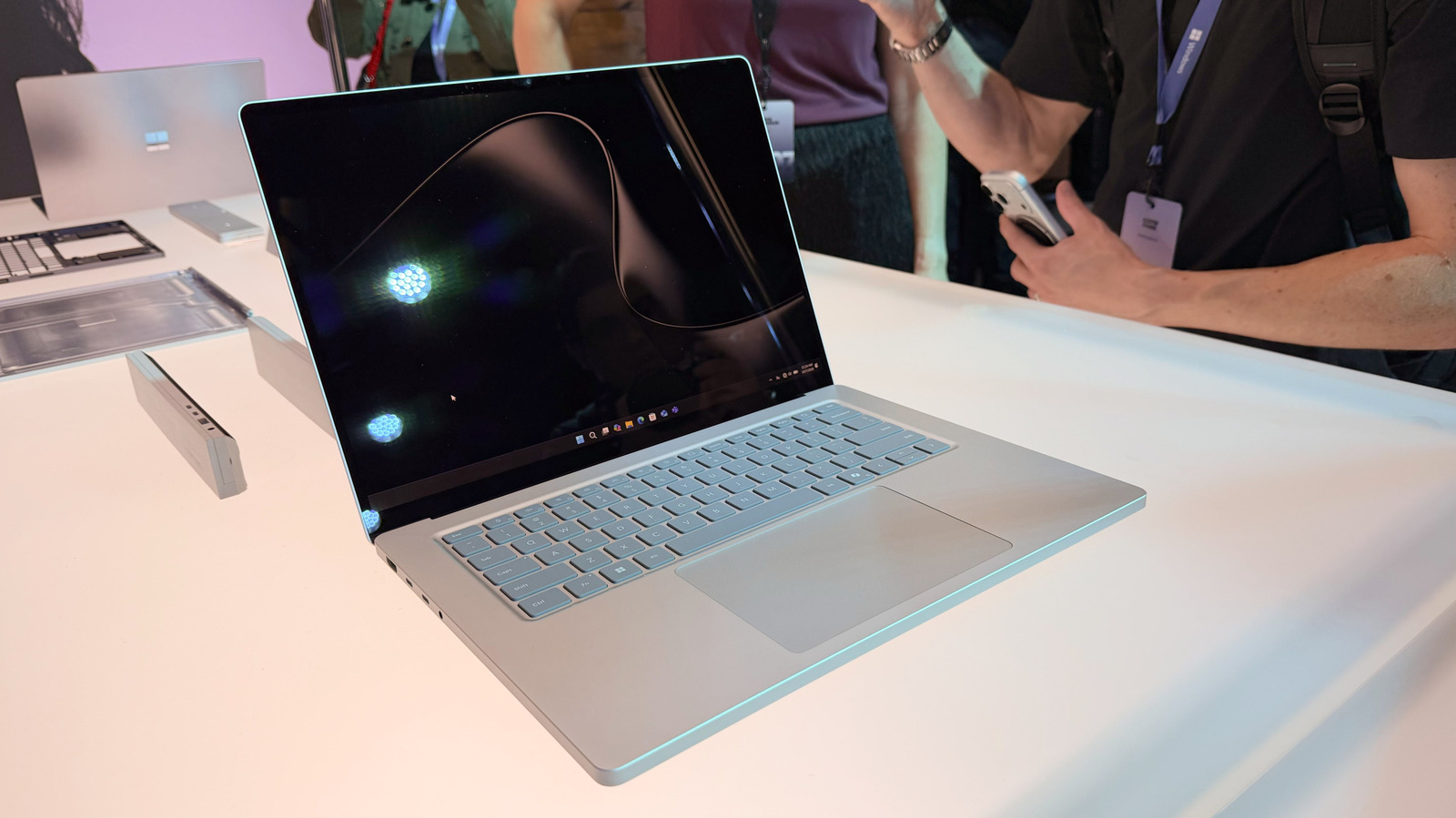
Under studio lighting, the device’s CNC-machined aluminum chassis exhibits a matte, low-gloss glow that speaks to precision milling rather than decorative flair. There are no flex points in the keyboard deck, no creaking hinges, and no superfluous branding. Reviewers who have handled pre-production units frequently compare the device’s physical presence to a sturdy Volvo: solid, reassuring, safe, and engineered to endure years of rigorous daily use without degradation.
The screen assembly features an extraordinarily bright panel with tight bezel tolerances, offering color accuracy and luminance metrics that rival or exceed competing creative workstations. Despite packing desktop-grade components, the chassis manages to remain remarkably thin, challenging historical assumptions about the physical dimensions required to cool high-performance silicon.
The NVIDIA RTX Spark Integration
The defining architectural feature of the Surface Laptop Ultra is its internal processing matrix, anchored by NVIDIA’s cutting-edge RTX Spark technology. For years, Windows ultraportables faced a severe limitation: thin-and-light chassis configurations could not dissipate the thermal load generated by discrete enterprise-grade GPUs without introducing deafening fan noise and severe thermal throttling.
NVIDIA’s RTX Spark architecture addresses this bottleneck through advanced power-scaling algorithms and ultra-dense chip packaging. Designed to accelerate tensor operations, large language model (LLM) fine-tuning, ray tracing, and complex rendering pipelines, the RTX Spark module allows the Surface Laptop Ultra to deliver workstation-class graphical and computational throughput within a mobile thermal envelope.
The 128GB RAM Imperative for AI Developers
While standard consumers and corporate office workers rarely utilize more than 16GB or 32GB of RAM, the modern artificial intelligence landscape has fundamentally altered memory requirements for developers.
Running local open-source large language models (such as LLaMA variants or Mistral architectures), processing massive vector databases, and compiling expansive containerized environments demand monumental memory bandwidth and capacity. By offering configurations scaling all the way up to 128GB of RAM, Microsoft and NVIDIA have effectively transformed the Surface Laptop Ultra from a standard developer laptop into an indispensable edge-computing and prototyping station. AI engineers can now run, test, and debug sophisticated machine learning pipelines locally while on a flight or working from a client site, without requiring an active cloud connection or tethering to a stationary desktop rig.
Official Statements and Industry Perspective
While Microsoft has maintained a measured communications strategy ahead of the device’s official commercial rollout, industry insiders and company executives have emphasized the shifting demographic of the modern power user.
In early briefings accompanying the device’s soft reveal, hardware division representatives highlighted the blurring lines between consumer expectations and enterprise requirements. "Professional users no longer want to compromise," noted one senior product manager close to the development cycle. "They demand the computational capacity of a heavy tower workstation, the graphical power of a dedicated rendering rig, and the battery life and chassis thickness of a lifestyle notebook. The Surface Laptop Ultra is our answer to that impossible triad."
Third-party developers who have gained early access to evaluation units have similarly praised the hardware’s quiet composure under load. Dr. Elena Vance, a senior machine learning researcher testing a pre-production unit, remarked:
"For years, our team has had to carry heavy, loud gaming laptops to conferences and client meetings simply because the RAM and VRAM requirements for local model testing left us no other choice. The Surface Laptop Ultra changes that equation completely. Being able to spin up local inference models on a machine this refined, with this level of tactile build quality, represents a major leap forward for mobile engineering."
Competitors in the Windows OEM space—such as Dell, Lenovo, and HP—are reportedly monitoring the reception of the Surface Laptop Ultra closely. Microsoft’s willingness to compete directly in the ultra-high-end developer and creator tier signals a tightening of standards across the entire Windows ecosystem, pushing competitors to elevate both their software-hardware integration and thermal engineering practices.
Future Outlook: The Road Ahead for High-End Windows Mobile Workstations
As the technology sector accelerates deeper into the era of localized artificial intelligence, edge computing, and distributed software development, the hardware requirements of professionals will continue to escalate. The introduction of the Surface Laptop Ultra serves as a bellwether for where the premium laptop market is heading over the next three to five years.
1. The Normalization of High-Capacity Mobile RAM
Just as 8GB of RAM transitioned from a standard configuration to an entry-level bottleneck over the past decade, 16GB and 32GB thresholds are rapidly proving insufficient for heavy multitasking and local AI workflows. By successfully packing up to 128GB of RAM into a portable chassis without sacrificing battery integrity or structural rigidity, Microsoft has established a new benchmark for what enterprise users should expect from a mobile workstation. Expect rival manufacturers to aggressively match or attempt to surpass these memory ceilings in upcoming product cycles.
2. The Resurgence of the Traditional Clamshell Form Factor
The industry’s brief flirtation with overly complex mechanical designs—such as dual-screen foldables, sliding panels, and precarious articulating hinges—has yielded valuable lessons. While innovation remains vital, enterprise buyers and professional developers prioritize reliability, structural integrity, and ergonomic predictability above all else. The Surface Laptop Ultra proves that innovation does not require bizarre physical gymnastics; true innovation can occur entirely beneath the surface, driven by superior thermal engineering, material science, and silicon integration.
3. Market Positioning and Commercial Viability
As the Surface Laptop Ultra transitions from hands-on previews to full commercial availability, its primary hurdle will undoubtedly be its price point. Configurations featuring top-tier processors, expanded storage, and the maximum 128GB RAM allotment paired with NVIDIA’s RTX Spark will occupy the absolute pinnacle of the pricing hierarchy.
However, for corporate procurement departments, venture-backed AI startups, and independent software architects who calculate productivity in hours saved and computational throughput achieved, the investment is easily justified. If Microsoft can maintain rigorous quality control, ensure stable driver support for the specialized NVIDIA architecture, and deliver on its battery-life promises, the Surface Laptop Ultra may well redefine the gold standard for professional Windows computing for years to come.