Executive Overview
The landscape of artificial intelligence has undergone a seismic shift. What began as experimental scaffolding and proof-of-concept scripts in 2023 has rapidly matured into a crowded, highly specialized ecosystem of orchestration frameworks. Today, developers and enterprise architects are no longer experimenting with toy projects; they are designing the core cognitive architecture that will govern production systems for years to come.
However, a critical disconnect plagues the industry: most framework evaluations measure the wrong metrics. GitHub stars, leaderboard benchmark scores, and "ease of first-run" rankings tell an engineering team almost nothing about how a framework will behave when a multi-agent workflow hits an obscure edge case at 2:00 a.m. on a Sunday. A framework designed for open-ended, creative collaborative research will inevitably fracture in a tightly regulated, deterministic compliance pipeline. Conversely, a framework optimized for rigid state-machine branching will feel like bureaucratic software overhead for a lightweight conversational assistant.
To solve this architectural challenge, enterprise teams must abandon one-size-fits-all evaluations. This comprehensive guide outlines a structured, decision-tree-based approach designed to map a workload’s actual requirements to the ideal production framework, while providing an unvarnished examination of the trade-offs inherent to every path.
Detailed Chronology: The Evolution of Agentic Architectures
To understand why the framework ecosystem looks the way it does today, we must examine how the underlying engineering paradigms have evolved over the past several cycles.
Phase 1: The Prompt-and-Pray Era (Pre-2023)
In the early days of large language model adoption, developers interacted with models monolithically. A single massive prompt tried to handle tool selection, task planning, context management, and output formatting simultaneously. While effective for simple, isolated queries, this paradigm collapsed as soon as tasks required multi-step execution or real-time error recovery. Models would hallucinate tool arguments, lose track of their objective mid-stream, or fail catastrophically when an API returned an unexpected payload.
Phase 2: The Scaffolding Boom (2023–2024)
As foundation models grew more capable, the community realized that raw intelligence required structural scaffolding. This era saw the explosive growth of early orchestration libraries. Developers began chaining prompts together, introducing basic memory buffers, and writing imperative loops to let models call external APIs. Libraries emerged to abstract these patterns, making it possible to spin up rudimentary multi-agent loops with minimal code. However, these early tools lacked robust state management, making debugging an exercise in deciphering thousands of lines of unstructured log output.
Phase 3: The Production-Grade Era (2025–2026)
By 2026, the requirements shifted from rapid prototyping to enterprise-grade reliability, security, and observability. Organizations demanded determinism, audit trails, type safety, and fault tolerance. In response, the ecosystem bifurcated into specialized architectural camps. Some frameworks embraced explicit state machines and graph theory, while others leaned into conversational paradigms or lightweight, type-safe Python abstractions. Choosing a framework is no longer about picking the most popular GitHub repository; it is about aligning an engineering team’s mental model with the correct runtime mechanics.
Supporting Context & Metrics: When Do You Actually Need Multi-Agent Systems?
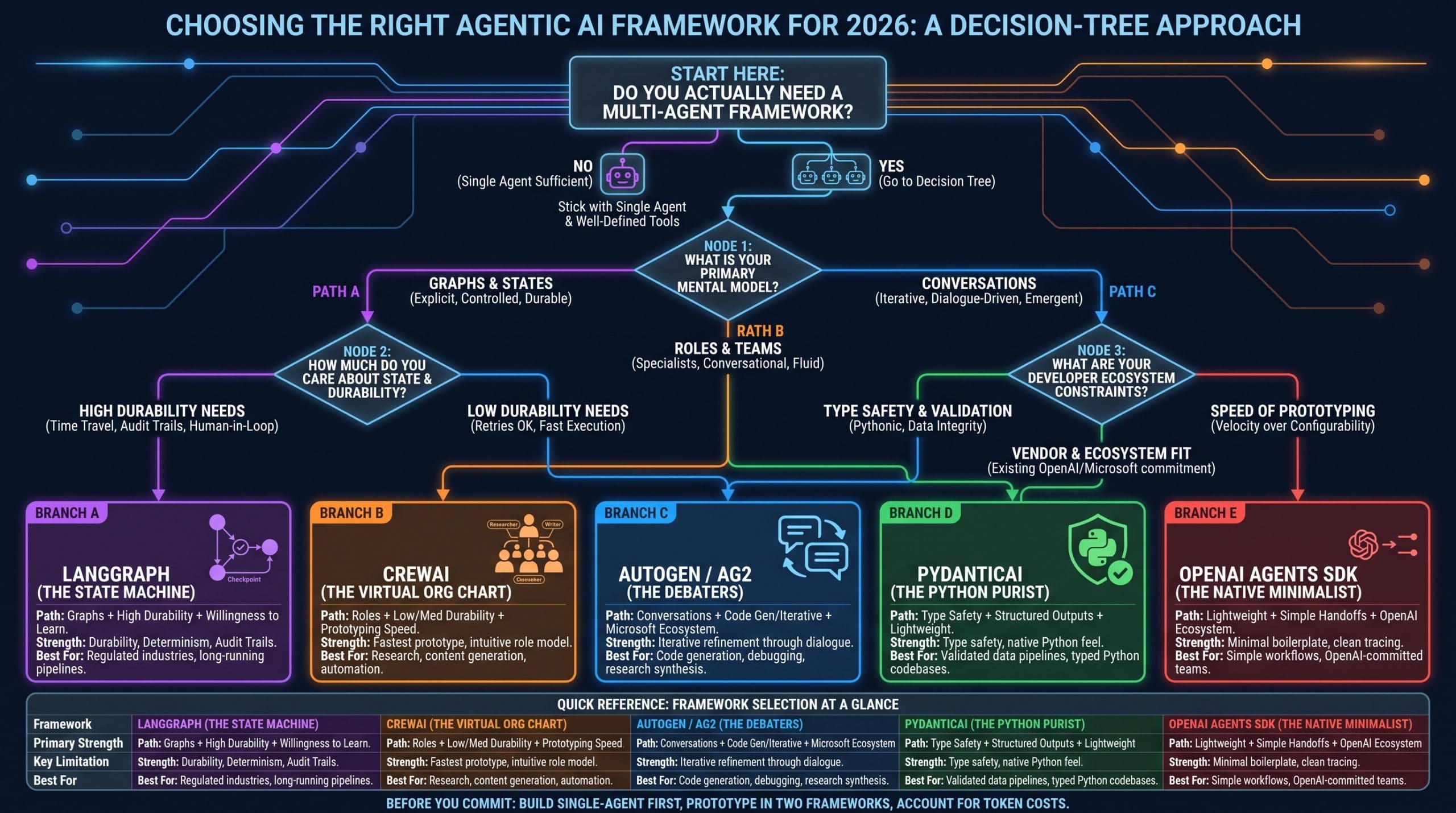
Before evaluating frameworks, enterprise architects must confront a fundamental question: Does your task actually require a multi-agent architecture?
The single most common mistake engineering teams make is introducing orchestration complexity prematurely. A single agent, backed by well-defined tools and a rigorously crafted system prompt, can handle a surprisingly vast array of tasks. Single-agent systems are dramatically easier to debug, monitor, reason about, and maintain.
Architects should only reach for a multi-agent framework when a single agent hits a clear, insurmountable limitation. Typical triggers include:
- Cognitive Overload: The system prompt required to manage all instructions, tools, and edge cases becomes too large, leading to attention degradation and instruction drift in the underlying model.
- Conflicting Personas: The workflow requires distinct phases—such as aggressive code generation followed by hyper-critical security auditing—that benefit from isolated, specialized system prompts and restricted tool access.
- Parallel Workstreams: The task demands simultaneous, asynchronous execution streams that must later be synthesized by a coordinator.
If none of these triggers apply, build a single-agent system first. Add orchestration complexity only when concrete operational bottlenecks demand it.
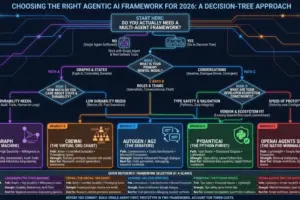
The Decision Tree: Three Nodes That Narrow the Field
When multi-agent orchestration is genuinely required, engineering teams can navigate the framework maze by evaluating three core architectural nodes.
Node 1: What Is Your Primary Mental Model?
How do your engineers naturally conceptualize the work the system needs to perform?
- Option A: Graphs and States. Your workflow features defined steps, explicit conditional transitions, and strict rules for failure handling, retries, and human-in-the-loop approvals. You view the process as a flowchart.
- Option B: Roles and Teams. Your workflow maps to human organizational structures—a researcher, a writer, a reviewer—handing tasks back and forth. Coordination is fluid and conversational.
- Option C: Conversations. Your workflow is iterative and dynamic. Agents converse, critique, and refine outputs until a quality threshold is met. Structure emerges from dialogue rather than pre-determined paths.
Node 2: How Much Do You Care About State and Durability?
What happens when a workflow runs into issues mid-execution?
- High Durability Needs: Workflows run for minutes or hours. You must be able to pause execution, inspect intermediate states, roll back errors, collect audit trails, and require human sign-off before sensitive transitions.
- Low Durability Needs: Workflows execute rapidly (seconds to minutes). If a failure occurs, restarting the entire pipeline from scratch is computationally and financially trivial.
Node 3: What Are Your Developer Ecosystem Constraints?
What are your team’s technological preferences and organizational constraints?
- Type Safety & Validation: Your team relies on strict Python typing. Data integrity at function boundaries is absolute.
- Vendor Ecosystem Fit: Your infrastructure is tightly coupled to specific enterprise platforms, such as Azure OpenAI or proprietary APIs.
- Prototyping Velocity: You need to transition from concept to functional multi-agent prototype within hours, prioritizing speed over deep configurability.
Deep Dive: The Five Framework Branches
Mapping these decision nodes leads directly to five distinct framework branches currently dominating enterprise production environments.
Branch A: LangGraph — The State Machine
- Path: Graph-based mental model + High durability needs + Investment in a steep learning curve.
- Overview: Originating as an evolution of the LangChain ecosystem, LangGraph models workflows as explicit directed graphs. Nodes represent functions, and edges represent conditional transitions. State is modeled as a typed dictionary that flows through the graph, capable of being persisted at any checkpoint.
- Key Advantages: Because state is explicit and fully serializable, LangGraph supports advanced features like "time travel"—the ability to pause an execution mid-stream, inspect state, modify variables, and resume. Human-in-the-loop approvals are native, making it the premier choice for regulated industries such as banking compliance, legal document processing, and healthcare.
- Trade-offs: LangGraph requires exhaustive explicitness. Defining schemas, specifying nodes, wiring edges, and configuring checkpointers demands significant boilerplate code. Teams must invest genuine time to master its mental model.
Branch B: CrewAI — The Virtual Org Chart
- Path: Role-based mental model + Low-to-medium durability needs + Prioritizing prototyping speed.
- Overview: CrewAI structures orchestration around the metaphor of a corporate team. Developers define agents as specialists with distinct roles, backstories, and goals, assign them specific tasks, and assemble them into a working "crew."
- Key Advantages: This metaphor feels instantly intuitive because it mirrors human knowledge work. Declarative configurations allow teams to go from a conceptual idea to a working prototype in under two hours.
- Trade-offs: The organizational metaphor creates boundaries. Because coordination relies on role handoffs rather than explicit state transitions, constraining a misbehaving agent that enters a loop is challenging. Debugging requires parsing unstructured agent dialogue rather than inspecting structured state variables.
Branch C: AutoGen / AG2 — The Debaters
- Path: Conversational mental model + Iterative refinement workflows + Microsoft ecosystem integration.
- Overview: AutoGen (formalized under governance as AG2) is built on multi-agent dialogue. Agents converse in natural language to converge on a result—for instance, a coder agent writes a script, an executor agent runs it, and a reviewer critiques the output in an ongoing loop.
- Key Advantages: Ideal for code generation, software debugging, and data analysis where iterative refinement through discussion is the natural shape of the problem. It integrates seamlessly with Azure enterprise environments.
- Trade-offs: Conversational drift can occur. In multi-turn dialogues, agents can occasionally enter circular reasoning patterns that require careful prompt engineering and strict termination conditions to interrupt.
Branch D: PydanticAI — The Python Purist
- Path: Lightweight tool execution + Strict type safety + Structured data outputs.
- Overview: PydanticAI adopts a minimalist posture. Rather than acting as a heavy orchestration monolith, it applies a FastAPI-style developer experience to agents, combining typed inputs and outputs with robust Pydantic data validation.
- Key Advantages: For teams already writing typed Python, PydanticAI feels completely native. Data integrity is enforced at every execution boundary without requiring engineers to learn foreign abstractions or graph schemas.
- Trade-offs: PydanticAI is strictly un-opinionated regarding complex multi-agent orchestration. Teams requiring durable workflows with advanced checkpointing must build that layer independently.
Branch E: OpenAI Agents SDK — The Native Minimalist
- Path: Lightweight tool execution + Simple handoffs + Commitment to the OpenAI ecosystem.
- Overview: Designed for seamless integration with OpenAI’s API infrastructure, this SDK provides clean abstractions for agents, tools, and handoffs with minimal boilerplate, complemented by built-in tracing.
- Key Advantages: Unmatched speed-to-production for simple, linear multi-agent workflows relying on OpenAI models.
- Trade-offs: Heavy vendor lock-in. Migrating away from OpenAI infrastructure or incorporating open-source model weights requires substantial architectural refactoring.
Official Industry Metrics & Comparative Analysis
| Framework | Primary Strength | Key Limitation | Best Production Fit |
|---|---|---|---|
| LangGraph | Durability, determinism, audit trails | Steep learning curve, verbose setup | Regulated industries, long-running workflows |
| CrewAI | Rapid prototyping, intuitive role metaphor | Harder to constrain misbehaving agents | Research pipelines, content automation |
| AutoGen / AG2 | Iterative refinement via dialogue | Conversational drift, unpredictable paths | Code generation, Microsoft enterprise environments |
| PydanticAI | Type safety, native Python developer feel | Not a full orchestration framework | Validated data pipelines, typed Python codebases |
| OpenAI Agents SDK | Minimal boilerplate, native tracing | Vendor lock-in, limited orchestration scope | Simple workflows, OpenAI-committed teams |
Future Outlook: The Next Horizon in Agentic Engineering
As we look toward the remainder of the decade, the agentic AI framework landscape will continue to consolidate. Several emerging trends are set to redefine production architectures:
- Standardized Interoperability Protocols: Just as OpenAPI standardized REST APIs, the industry is moving toward universal messaging and state schemas, allowing agents built in LangGraph to seamlessly communicate with crews running in CrewAI.
- Deterministic-Probabilistic Hybrids: Future enterprise systems will increasingly separate deterministic business logic (handled by traditional code and state machines) from probabilistic reasoning (handled by foundation models), bridging the gap between wild creativity and enterprise stability.
- Native Observability and Governance: Frameworks will no longer treat tracing and compliance as bolt-on middleware. Real-time cost governance, token usage caps, and automated compliance auditing will be baked directly into agent runtimes.
Conclusion: Strategic Recommendations for Engineering Leaders
Before committing capital and engineering hours to a specific framework, leadership teams should observe three practical rules:
- Build Single-Agent First: Validate core logic on a single agent to uncover actual domain constraints before introducing orchestration overhead.
- Prototype in Parallel: If requirements straddle two architectural branches, build a proof-of-concept in both frameworks to expose edge-case vulnerabilities early.
- Factor in Token Economics: Multi-agent architectures multiply token consumption exponentially. Calculate operational costs under load before finalizing production deployment.
Ultimately, the correct framework is not the one with the most marketing momentum or the largest community; it is the tool that makes your specific system failure modes easiest to anticipate, prevent, and recover from. Define your constraints first, and let your workload dictate your architecture.