Executive Overview
For years, the gold standard of search engine marketing relied on the precision of manual intervention: exact-match keywords, specific bid adjustments, and granular placement control. Today, the paradigm has shifted. Google’s transition toward AI-driven ecosystems—specifically Performance Max (PMax) and AI-powered search—has empowered advertisers with unprecedented scale. However, this scale comes with a significant trade-off: a loss of granular control.
The modern advertiser is no longer just a "bid manager"; they are an "AI architect." In an intent-driven landscape, simply relying on negative keywords is an obsolete strategy. Modern AI doesn’t just look for keywords; it interprets intent, context, and user behavior. To succeed, advertisers must move beyond what they want to target and master the art of what they must exclude. By implementing robust guardrails—ranging from text guidelines to automated asset management—brands can ensure that Google’s machine learning works for their bottom line rather than eroding their premium positioning.
Detailed Chronology: From Keywords to Intent
The history of digital advertising is a story of narrowing the gap between intent and action. In the early days, the focus was entirely on the query. If a user typed "cheap laptop case," the advertiser knew exactly what to bid on.
The Fallacy of Negative Keywords
Historically, "negative keywords" were the ultimate safety net. If a brand sold high-end, luxury tech accessories, they would simply list "cheap," "discount," or "clearance" as negative keywords to prevent their ads from appearing to bargain hunters.
However, in today’s era of AI, this is no longer sufficient. If a user is searching for a "high-quality protective sleeve," the AI may infer that this user is a "high-intent" buyer for a premium product. If that same user, however, is a budget-conscious student searching for a "laptop case" without the qualifier "cheap," the AI—uninformed of the brand’s positioning—might serve the luxury ad to a user who has no intention of paying a premium. The intent is hidden, not explicit. Because the AI is optimized for conversions, it will prioritize volume over brand alignment unless explicitly instructed otherwise.
The Rise of Guardrails
The evolution of Google Ads has seen the introduction of "Text Guidelines" and "Asset Optimization." These tools represent a fundamental shift: instead of telling the machine which words to ignore, we are now providing the machine with a "Brand Identity Map." By explicitly defining what the brand stands for—and what it strictly rejects—advertisers can guide the AI to seek out the right customer personas rather than just the highest conversion probability.
Supporting Context & Metrics: Navigating the Settings
To regain control over automated systems, advertisers must perform a deep audit of their account settings. The interface is increasingly complex, with vital controls often buried in "Advanced Settings" menus.
1. Text Guidelines and Asset Optimization
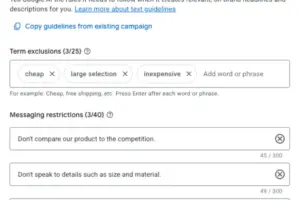
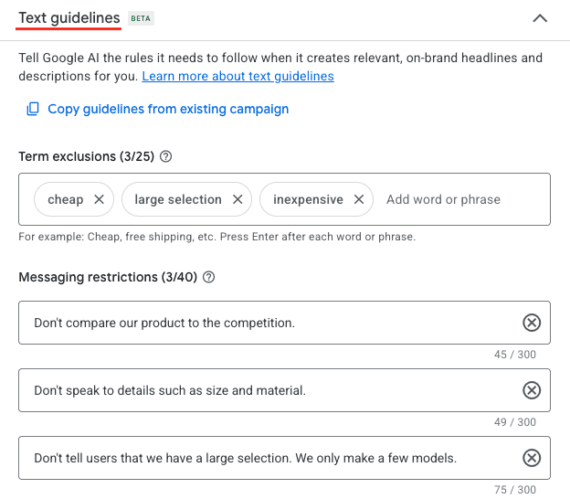
Text guidelines serve as the "Terms of Service" for your brand. In campaigns like Performance Max, Google dynamically generates ad copy based on your landing page and assets. Without guardrails, the AI might inadvertently associate your premium brand with terms like "inexpensive," "large selection," or "competitor comparisons."
By utilizing text guidelines, you can mandate:
- Term Exclusions: Prohibiting the AI from using specific adjectives that dilute your brand.
- Messaging Restrictions: Preventing the AI from making unauthorized claims, such as price comparisons or aggressive discount language.
2. The Hidden Impact of Account-Level Automated Assets
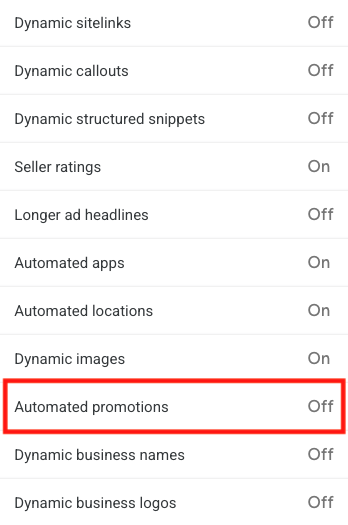
Perhaps the most overlooked area of the Google Ads interface is "Account-level automated assets." Many advertisers are unaware that Google, by default, may pull data from their site to create automated promotions or dynamically populate sitelinks.
If you are a luxury retailer, an "Automated Promotion" that pulls a 10% discount from a hidden clearance page can be catastrophic for your brand image. To take control:
- Navigate to the "Ads & Assets" section.
- Click on "Assets."
- Select "Account-level automated assets."
- Navigate to "Advanced settings" to toggle off features like "Automated promotions" or specific dynamic sitelinks that do not align with your current strategy.
3. The "Added by Google AI" Filter
Advertisers should regularly audit what the machine has done on their behalf. By clicking the "Assets" tab and filtering by "Added by: Google AI," you can view every piece of copy, image, or video Google has generated. If you see images that aren’t representative of your quality or copy that violates your guidelines, you must remove them immediately to "teach" the model the boundaries of your brand.
Official Perspective: The Balancing Act of Automation
Google’s internal documentation often highlights the benefits of "Optimized Targeting" and "Audience Expansion," frequently citing data suggesting that these features can drive up to 20% more conversions. From an algorithmic perspective, this is true: the AI finds more people who are likely to click or buy.
However, the "advertiser’s perspective" is often at odds with the "platform’s perspective." Google’s incentives are aligned with maximizing total auction volume and conversion count. The advertiser’s incentive is to maximize profitable volume and brand equity.
When we talk to industry experts, the consensus is clear: Never let the AI run wild on day one.
"Optimized targeting is a powerful tool," notes one industry veteran, "but it is a blunt instrument. If you turn it on before the algorithm has learned your ‘ideal’ customer through actual conversion data, you are essentially telling the machine, ‘Go find anyone who might click.’ That is a recipe for wasted ad spend and low-quality leads."
The golden rule for modern performance marketing is to allow a campaign to reach "conversion maturity" before enabling expansion features. Once the AI has a statistically significant pool of data on who your customers actually are, you can then switch on optimized targeting to find lookalikes, but always with the guardrails mentioned above in place.
Future Outlook: The Autonomous Advertiser
As we look toward the future, the role of the search marketer will continue to evolve into that of an "AI Auditor." We are moving away from the era of manual bid management and into the era of Governance.
The Era of "Brand Safety 2.0"
In the coming years, we anticipate that Google will offer more sophisticated, granular control panels. We will likely see "Brand Personality" profiles, where advertisers can upload their brand voice, tone, and specific visual constraints, allowing the AI to act as a digital brand ambassador rather than just a conversion engine.
Predictive Guardrails
We also expect the integration of predictive analytics into these guardrails. Future systems will likely warn advertisers: "Your current targeting settings are likely to result in a 15% increase in ‘low-quality’ traffic based on your current asset library."
Final Recommendations for the Modern Marketer
- Stop "Set and Forget": If you are relying on PMax without checking your automated asset settings, you are effectively paying Google to ignore your brand guidelines.
- Audit Your Assets Weekly: The "Added by Google AI" filter should be part of your weekly workflow.
- Prioritize First-Party Data: The more data you feed the AI about your best customers (via offline conversion tracking and CRM integration), the less the AI will rely on generic, low-intent traffic.
The machine is not your enemy, nor is it your replacement. It is a powerful engine that requires a skilled pilot to set the coordinates. By focusing on intent, enforcing strict guardrails, and auditing the machine’s creative output, you can ensure that your advertising budget drives not just growth, but the right kind of growth. In the age of AI, the most important word in advertising is no longer "keyword"—it is "control."