Executive Overview
In the rapidly evolving landscape of Retrieval-Augmented Generation (RAG) systems, developers often obsess over embedding model selection, vector database performance, and large language model (LLM) prompt engineering. Yet, the foundational bottleneck of almost any RAG pipeline resides further upstream: the document chunking strategy.
When building an enterprise-grade information retrieval system, engineers routinely encounter source documents that far exceed the context windows of embedding models and LLMs. To bridge this gap, raw texts must be segmented into digestible fragments, or "chunks." However, treating chunk size and overlap merely as arbitrary configuration parameters—such as a default 512-token slice with a 50-token overlap—is a recipe for retrieval failure. Poor boundary definitions can quietly sabotage an entire AI application, causing the retrieval engine to completely bypass the precise passage containing an answer, or worse, to surface a fragment that is mathematically relevant to a vector query but stripped of the surrounding context required to make it semantically useful.
A chunking strategy dictates the exact logical rules by which a document is partitioned. When these boundaries align naturally with the semantic contours of the source material, vector search and downstream generation flourish. Conversely, when poor slicing practices fracture critical clauses, shatter cross-references, or break structural dependencies, advanced interventions like neural rerankers and sophisticated prompt tuning cannot fully reconstruct the lost context.
No single chunking method serves as a universal panacea. The optimal configuration is inextricably tied to the unique topology of the documents and the nuanced demands of the retrieval task. This article explores a structured decision-tree framework designed to help engineers systematically evaluate document properties, balance performance trade-offs, and implement the precise chunking methodology required for production-grade RAG deployments.
Detailed Chronology: The Evolution of Document Segmentation in RAG
To understand why modern RAG architectures demand nuanced chunking frameworks, it is helpful to trace how document preprocessing has evolved alongside the maturation of transformer-based language models.
Era 1: The Fixed-Size Naive Approach
In the early days of vector search and semantic embeddings, document preprocessing was treated as an afterthought. Borrowing from traditional text-mining pipelines designed for keyword indexing and bag-of-words models, early practitioners relied exclusively on fixed-size token or character splitting. The foundational assumption was straightforward: if a chunk is cut mid-thought, a designated overlap window will catch the bleeding text and preserve the continuity.
As vector databases scaled, however, engineers quickly realized the severe limitations of this approach. Fixed-size chunking operates in complete defiance of document syntax, frequently cleaving complex legal clauses, separating questions from their corresponding answers in FAQs, or splitting tables mid-row. While fast and computationally trivial, naive splitting introduced high noise-to-signal ratios in retrieval results.
Era 2: Structural and Semantic Awareness
As LLMs advanced and context windows expanded from 512 tokens to tens of thousands of tokens, the industry recognized that document semantics must dictate boundaries. This realization spawned structural parsers capable of recognizing Markdown headers, HTML tags, code blocks, and PDF layout hierarchies. Document-based chunking emerged as a reliable standard for structured corpora, ensuring that an entire function definition or a distinct section remained unified.
Simultaneously, researchers began experimenting with semantic chunking—leveraging embedding distance metrics to detect natural topic shifts sentence by sentence. This allowed systems to dynamically vary chunk sizes based on informational shifts rather than arbitrary token counts.
Era 3: The Modern Multi-Tiered and Agentic Paradigm
Today, enterprise RAG systems ingest heterogeneous data lakes containing a chaotic mix of financial spreadsheets, unstructured legal contracts, messy transcripts, and multi-language technical documentation. A single static strategy can no longer handle this complexity.
This modern era is characterized by advanced, context-aware techniques. Late chunking preserves document-wide dependencies by embedding entire texts before segmenting; hierarchical chunking addresses multi-granularity retrieval by indexing both broad summaries and granular child chunks; and agentic chunking dynamically delegates ingestion strategies based on real-time document classification. The industry has shifted from treating chunking as a mechanical preprocessing script to recognizing it as a core cognitive architecture of the retrieval system.
Supporting Context & Metrics: The Mechanics of Chunking Assumptions
Every chunking strategy is built upon a fundamental assumption about the underlying text. When a strategy matches the document’s natural structure, its computational overhead is justified by a dramatic uplift in retrieval precision. When it does not, it introduces unnecessary latency and complexity without improving generation quality.
Comparative Taxonomy of Chunking Strategies
| Strategy | Core Structural Assumption | Best Suited For | Primary Trade-Off |
|---|---|---|---|
| No Chunking | Content fits entirely within the context window and represents a single atomic topic. | Short FAQ entries, product specs, individual configuration files. | None (bypasses preprocessing). |
| Fixed-Size Chunking | Boundary placement is trivial because overlap windows will patch mid-thought cuts. | Rapid prototyping where deployment speed outweighs precision. | Completely ignores syntax, grammar, and semantic meaning. |
| Recursive Chunking | Paragraph and sentence delimiters serve as safe proxies for semantic boundaries. | General-purpose, reasonably uniform textual corpora. | Less semantically precise than embedding-distance methods. |
| Document-Based Chunking | Structural markers (headers, tags, code blocks) align with semantic boundaries. | Markdown files, HTML documents, code repositories, structured PDFs. | Vulnerable to poorly authored documents where headers fail to track topics. |
| Semantic Chunking | Topic shifts can be algorithmically detected via sentence-to-sentence embedding distances. | Unstructured prose with unpredictable thematic transitions. | Requires careful threshold tuning to stabilize chunk counts. |
| Late Chunking | A fragment’s true meaning depends on the broader document context, not isolated text. | Legal contracts, academic papers, and technical specs with cross-references. | Demands resource-intensive long-context embedding models. |
| Adaptive Chunking | Information density varies wildly within the same file, requiring variable sizing. | Mixed-density reports containing dense data tables and sparse narratives. | Increases indexing pipeline complexity. |
| Hierarchical Chunking | End users will query both macro-level themes and micro-level specifics. | Enterprise knowledge bases requiring multi-faceted retrieval. | Requires maintaining two synchronized index layers. |
| LLM-Based Chunking | Only a generative model possesses the reasoning to find subtle logical breakpoints. | High-stakes legal, financial, or medical compliance documents. | Maximum compute cost and latency per ingested document. |
| Agentic Chunking | Document collections are too heterogeneous for a single static ingestion rule. | Large, messy enterprise data lakes mixing varied media and formats. | Requires upfront classification overhead and caching logic. |
Working Through the Decision Tree: A Step-by-Step Architectural Framework
To eliminate guesswork during system design, engineers can navigate a rigorous six-question decision tree. This sequential evaluation maps document properties directly to the optimal chunking architecture.
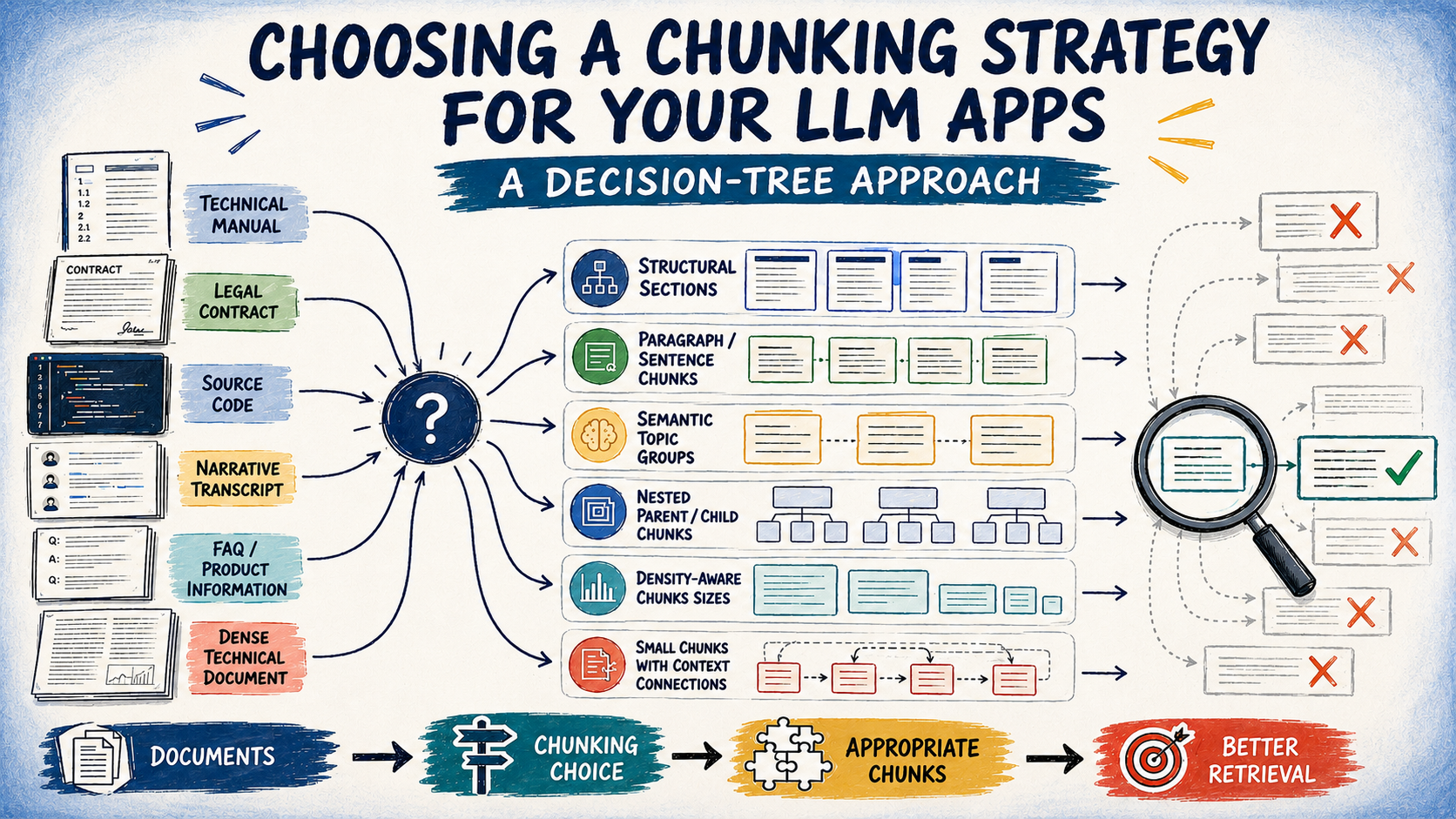
[Start Ingestion]
       │
       ▼
Q1: Does the document fit ──► YES ──► [Skip Chunking]
    in context & single topic?
       │
       NO
       ▼
Q2: Is there a reliable ─────► YES ──► [Document-Based Chunking]
    internal structure?
       │
       NO
       ▼
Q3: Do chunks require cross- ──► YES ──► [Late Chunking]
    document global context?
       │
       NO
       ▼
Q4: Does info density vary or ─► YES ──► [Adaptive / Hierarchical]
    require multi-granularity?
       │
       NO
       ▼
Q5: Is retrieval quality ────► HIGH ──► [LLM-Based or Semantic Chunking]
    valued over cost/latency?
       │
       LOW / BUDGET-CONSTRAINED
       ▼
Q6: Is the corpus ──────────► MIXED ──► [Agentic Chunking]
    heterogeneous?
       │
       UNIFORM ──► [Recursive Chunking]
Question 1: Does the Document Need Chunking at All?
Short, self-contained assets—such as customer support FAQs, atomic product descriptions, or isolated configuration snippets—frequently fit comfortably inside a single embedding model’s context window while addressing exactly one queryable intent.
- The Action: If the text sits well within model limits and remains strictly unified in subject matter, embed the document whole and skip chunking. Artificially splitting a coherent, self-contained record introduces unnecessary retrieval overhead and risks atomizing vital context. If the document exceeds size thresholds or touches multiple subjects, proceed to Question 2.
Question 2: Does the Document Have a Clear Internal Structure?
Many modern documents arrive pre-formatted with explicit structural markers: Markdown headings (#, ##), HTML tags (<article>, <section>), PDF semantic layouts, or programmatic function and class declarations in source code.
- The Action: If the file possesses a 非常に reliable structure that mirrors its logical information units, deploy document-based chunking. Parse the file according to its format specifications to keep structural elements intact. If formatting is inconsistent, missing, or fails to correlate with semantic flow, move to Question 3.
Question 3: Do Chunks Need Context From Elsewhere in the Document?
Certain domains feature heavy cross-referencing, where a definition established in Section 1 dictates the interpretation of variables or terminology in Section 8. Standard chunking strips away these distant dependencies.
- The Action: If downstream retrieval relies heavily on global document relationships, implement late chunking. Pass the entire document through a long-context embedding model first to capture global token representations, then derive chunk-level embeddings from that enriched vector space. If individual fragments can stand completely on their own without semantic degradation, advance to Question 4.
Question 4: Does Information Density Vary, or Do You Need Multiple Levels of Granularity?
Enterprise files often exhibit chaotic density profiles. For instance, an annual financial report might feature dense tables of raw numbers followed by highly narrative management discussions. Furthermore, users may issue broad, sweeping queries alongside hyper-specific lookup requests.
- The Action: If density fluctuates sharply, deploy adaptive chunking to compress dense sections into smaller chunks while expanding sparse narratives. If users require both macro-level summaries and microscopic data points, implement hierarchical chunking (parent-child retrieval), where small child chunks are retrieved for precision, but the parent chunk is passed to the LLM for expanded context. If neither condition applies, proceed to Question 5.
Question 5: Does Retrieval Quality Matter More Than Cost and Latency?
This step addresses the fundamental economic trade-off of RAG engineering.
- The Action: If retrieval accuracy is paramount and budgets support heavy compute overhead per document, leverage LLM-based chunking to prompt an intelligent model to discover logical breakpoints and atomic propositions. If quality is critical but per-document LLM calls are cost-prohibitive, utilize semantic chunking based on sentence-embedding distance thresholds. If speed, economy, and high-throughput ingestion are prioritized, advance to Question 6.
Question 6: Is This One Document Type, or a Heterogeneous Collection?
Enterprise data repositories rarely contain a single file format. A corporate knowledge base typically mixes structured spreadsheets, legal PDFs, unstructured transcripts, and raw code repositories.
- The Action: If the corpus is a messy collection of mixed document types requiring bespoke strategies, deploy agentic chunking. An intelligent routing agent inspects each incoming file, classifies its genre, and assigns the appropriate parsing strategy. If the corpus is relatively uniform, recursive chunking serves as the optimal default, splitting content hierarchically across paragraph, sentence, and word boundaries until target sizes are achieved.
Official Statements and Expert Insights
Industry practitioners and leading AI researchers emphasize that preprocessing remains the silent killer of RAG performance.
Dr. Harrison Chase, creator of LangChain, has repeatedly noted in architectural reviews that "developers spend 90% of their time tuning prompt templates while ignoring the fact that the vector database is receiving fragmented, context-starved text chunks that make correct generation mathematically impossible."
Similarly, vector database architectures from pioneers like Pinecone and Weaviate emphasize that vector search can only surface what preprocessing provides. As enterprise RAG transitions from experimental prototypes to mission-critical production environments, automated data ingestion pipelines are increasingly incorporating multi-modal parsers and semantic boundary detection to eliminate early-stage data degradation.
Recognizing and Mitigating Common Chunking Pitfalls
Even meticulously engineered pipelines can exhibit failure modes once deployed against messy, real-world data. Recognizing these operational symptoms allows engineering teams to implement targeted remedies before system performance degrades.
| Operational Symptom | Root Architectural Cause | Recommended Remediation |
|---|---|---|
| Mid-Sentence Cleaving: Chunks consistently terminate abruptly mid-sentence or slice data tables in half. | Applying a structure-blind, fixed-size splitting strategy to structured text. | Migrate to recursive or document-based chunking rather than blindly increasing overlap windows. |
| Volatile Chunk Counts: Semantic chunking produces wildly erratic chunk counts across uniform documents. | Miscalibrated similarity threshold parameters driving the embedding distance calculations. | Tighten the distance threshold sensitivity, or route non-compliant documents to LLM-based boundary detection. |
| Erratic Chunk Sizing: Document-based chunks range wildly from single-line headers to multi-page essays. | Unreliable authoring practices where Markdown headers fail to track true topic boundaries. | Combine structural parsing with a secondary recursive chunking pass inside oversized sections. |
| Compute Budget Exhaustion: Agentic chunking pipelines blow past financial budgets during mass ingestion. | Repeating per-document LLM analysis on every pipeline execution or re-index cycle. | Implement robust caching layers for classification decisions and execute collection-level profiling. |
| Zero Performance Gain: Advanced hierarchical or adaptive chunking adds severe system latency without improving answers. | Deploying hyper-complex strategies against a small, homogeneous, highly structured corpus. | Simplify the architecture by falling back to standard recursive chunking. |
Future Outlook: The Next Generation of Context Retrieval
As artificial intelligence systems march toward native multi-modality and ultra-long context windows exceeding millions of tokens, the traditional definition of "chunking" is undergoing a profound philosophical transformation.
In the near future, static chunking scripts may be entirely superseded by native long-context embedding models equipped with late-interaction mechanisms (such as ColBERT-style architectures) and end-to-end differentiable retrievers. These emerging systems eliminate the need for hard segmentation boundaries altogether, allowing vector search to operate over continuous, unsegmented representations while dynamically attending to relevant token spans on the fly.
Until these end-to-end architectures achieve mainstream enterprise ubiquitency and cost parity, rigorous chunking strategy selection remains an essential discipline. By methodically evaluating document topology, leveraging structured decision frameworks, and continuously monitoring retrieval diagnostics, engineering teams can build RAG systems that deliver exceptional accuracy, predictable latency, and robust enterprise reliability.