Executive Overview
The extraordinary scaling of modern Transformer architectures—spanning everything from dense language models to massive multimodal networks—has fundamentally altered the relationship between machine learning theory and hardware execution. Historically, deep learning research prioritized mathematical elegance and algorithmic expressiveness, often leaving hardware implementation details to framework abstractions. However, as models stretch into hundreds of billions of parameters and process context lengths extending past 100,000 tokens, the performance bottleneck has shifted. The primary limitation is no longer arithmetic intensity—the sheer number of floating-point operations (FLOPs) a GPU can crunch—but memory bandwidth and kernel-launch overhead.
A standard Transformer layer is constructed from a predictable sequence of familiar, highly modular operations: linear projections, multi-head attention blocks, layer normalizations, element-wise activation functions, and residual additions. In a naive or direct execution framework, running these layers means launching a separate accelerator kernel for every individual operation. Each operation writes its intermediate tensor out to device memory (typically high-bandwidth memory, or HBM) and reads it right back for the next step.
While mathematically rigorous, this architecture spends a disproportionate amount of time simply shuffling data across silicon rather than performing useful arithmetic. Modern systems engineering has responded to this crisis through a trifecta of hardware-software co-design: FlashAttention-style tiled kernels, operator fusion, and advanced graph compilation via frameworks like PyTorch’s torch.compile().
By keeping intermediate values close to the arithmetic logic units (ALUs), reorganizing work into memory-efficient blocks, and capturing static execution paths using CUDA Graphs, engineers can drastically reduce memory traffic. These optimizations leave the underlying model weights and mathematical output virtually unchanged—though subtle numerical differences can emerge due to altered operation ordering and precision—while delivering dramatic speedups in both prefill and decode phases.
Detailed Chronology of Inference Optimization
The journey toward modern kernel-level optimization did not happen overnight; it is the culmination of years of iterative engineering designed to squeeze every drop of performance out of specialized silicon accelerators like GPUs and AI-specific ASICs.
Phase 1: The Eager Execution Paradigm and the Memory Wall
In the early days of deep learning frameworks, including early versions of PyTorch, "eager execution" was the undisputed king. Operations were executed line-by-line as they were encountered in Python. While this offered exceptional debugging ergonomics and flexibility, it created a severe architectural liability for deep neural networks.
Every time a developer wrote a standard gated Multi-Layer Perceptron (MLP) block—such as the SwiGLU architectures popularized by modern decoder-only models:
$$mathbfy = mathbfWtextdownbig(operatornameSiLU(mathbfWtextgatemathbfx) odot mathbfW_textupmathbfxbig)$$
the eager backend would systematically launch separate kernels:
- A matrix multiplication for the gate projection.
- A pointwise activation kernel for SiLU.
- A separate matrix multiplication for the up-projection.
- An element-wise multiplication kernel.
- A final matrix multiplication for the down-projection.
At each of these computational boundaries, intermediate tensors were pushed out to global HBM and immediately pulled back. Because memory bandwidth scaling has historically lagged far behind compute FLOP scaling—a phenomenon known in systems engineering as the "Memory Wall"—these round-trips crippled hardware utilization.
Phase 2: The Attention Explosion and FlashAttention
As sequence lengths scaled from 512 tokens to 4K, 32K, and beyond, the multi-head attention mechanism became the primary computational bottleneck. Ordinary attention, combined with an additive attention mask, evaluates:
$$operatornameAttention(mathbfQ,mathbfK,mathbfV) = operatornamesoftmaxbig(fracmathbfQmathbfK^topsqrtd + mathbfMbig)mathbfV$$
A naive implementation explicitly materializes the attention-score matrix $mathbfQmathbfK^top$. For a sequence length $T$, this matrix consumes $T^2$ elements per head. Computing this matrix, writing it out to global HBM, and reading it back for the softmax reduction saturates the communication channels between streaming multiprocessors (SMs) and device memory.
The introduction of FlashAttention revolutionized this space by applying tiling algorithms. Instead of materializing the $T^2$ matrix in global memory, FlashAttention loads blocks of queries, keys, and values into fast on-chip SRAM, computes local attention scores, incrementally updates softmax normalization statistics, and accumulates the final output. This algorithmic breakthrough reduced memory read/write complexity from quadratic $O(T^2)$ down to linear $O(T)$, transforming long-context inference economics.
Phase 3: Paged Memory Management and Dynamic Serving
Even with fast attention kernels, serving large language models (LLMs) concurrently presented a massive memory fragmentation challenge: the Key-Value (KV) cache. Because requests finish at unpredictable times and generate tokens sequentially, contiguous memory allocations resulted in immense amounts of wasted, reserved space.
The introduction of PagedAttention (championed by systems like vLLM) decoupled logical token sequences from physical GPU memory by organizing storage into fixed-size blocks managed via block tables. This innovation allowed non-contiguous physical memory blocks to be mapped seamlessly into logical sequences, slashing memory waste and enabling massive concurrency without sacrificing attention kernel efficiency.
Phase 4: Graph Compilation and Operator Fusion (torch.compile)
Most recently, the ecosystem has moved toward automated compilation pipelines. Rather than requiring developers to hand-write low-level CUDA or Triton kernels for every custom model architecture, frameworks introduced graph capture engines. TorchDynamo captures Python control flow, and TorchInductor (the default backend for PyTorch’s torch.compile()) analyzes the computational graph, performs graph rewriting, handles buffer reuse, and automatically fuses pointwise and reduction operations into single, unified kernels.
Supporting Context, Code, and Performance Metrics
To fully understand how these layers interact in production, we must examine the actual code pathways and performance tradeoffs governing modern inference.
1. Operator Fusion in Practice: GatedMLP
Consider the baseline implementation of a SwiGLU GatedMLP block in PyTorch:
import torch
import torch.nn as nn
import torch.nn.functional as F

class GatedMLP(nn.Module):
    def __init__(self, hidden_size, intermediate_size):
        super().__init__()
        self.gate_proj = nn.Linear(hidden_size, intermediate_size, bias=False)
        self.up_proj = nn.Linear(hidden_size, intermediate_size, bias=False)
        self.down_proj = nn.Linear(intermediate_size, hidden_size, bias=False)

    def forward(self, x):
        gate = F.silu(self.gate_proj(x))
        up = self.up_proj(x)
        return self.down_proj(gate * up)

model = GatedMLP(hidden_size=16, intermediate_size=32).eval()
print("Baseline output shape:", model(torch.randn(2, 4, 16)).shape)
While this reference implementation is clean and readable, it suffers from the un-fused kernel launch overheads discussed earlier. When optimized backends process this, they combine projections, fuse the SiLU activation with the element-wise multiplication, and optimize memory layouts to prevent unnecessary tensor transpositions.
However, fusion is not a silver bullet. If a matrix multiplication is exceptionally large, it will naturally dominate execution time, rendering minor pointwise fusions negligible. Furthermore, aggressive fusion can cause high register pressure on the GPU, reducing occupancy and hurting overall performance.
2. Fused Residual and Normalization Blocks
Another prime target for fusion is the combination of residual connections and Root Mean Square (RMS) normalization. Conceptually, a fused residual-RMSNorm block can be written as:
import torch

def residual_rms_norm(x, residual, weight, eps=1e-6):
    x = x + residual
    variance = x.float().pow(2).mean(dim=-1, keepdim=True)
    normalized = x * torch.rsqrt(variance + eps).to(x.dtype)
    return normalized * weight, x

normalized, updated_residual = residual_rms_norm(
    torch.randn(2, 4, 16), torch.randn(2, 4, 16), torch.ones(16)
)
print("Normalized shape:", normalized.shape, "Residual shape:", updated_residual.shape)
A specialized fused kernel reads each input tensor exactly once, performs the combined addition, variance reduction, and scaling on-chip, and writes out the two required outputs. Eager PyTorch, by contrast, would generate multiple intermediate buffers in HBM.
3. Leveraging FlashAttention via PyTorch SDPA
Modern PyTorch provides native access to hardware-accelerated attention paths through the scaled dot-product attention API:
import torch
import torch.nn.functional as F
from torch.nn.attention import SDPBackend, sdpa_kernel

if not torch.cuda.is_available():
    raise RuntimeError("This example requires a CUDA GPU")

device = "cuda"
dtype = torch.float16

q = torch.randn(2, 16, 512, 64, device=device, dtype=dtype)
k = torch.randn(2, 16, 512, 64, device=device, dtype=dtype)
v = torch.randn(2, 16, 512, 64, device=device, dtype=dtype)

with torch.no_grad(), sdpa_kernel([SDPBackend.FLASH_ATTENTION, SDPBackend.CUDNN_ATTENTION], set_priority=True):
    output = F.scaled_dot_product_attention(q, k, v, is_causal=True)

print("SDPA Output shape:", output.shape)
4. Paged Attention with vLLM
When deploying models at scale, integrating paged memory management ensures that serving engines do not succumb to memory fragmentation during long generation loops:
from vllm import LLM, SamplingParams

attention_backend = "TRITON_ATTN"

llm = LLM(
    model="Qwen/Qwen2.5-1.5B-Instruct",
    dtype="float16",
    block_size=16,
    attention_backend=attention_backend,
)

sampling_params = SamplingParams(
    temperature=0.7,
    top_p=0.95,
    max_tokens=64,
)

prompts = [
    "Q: What is the capital of France?nA:",
    "Q: Who wrote 'Pride and Prejudice'?nA:",
]

outputs = llm.generate(prompts, sampling_params)
for output in outputs:
    print(f"Prompt: output.prompt!r")
    print(f"Output: output.outputs[0].textn")
5. Compiler Optimization with torch.compile and CUDA Graphs
To automate fusion without writing custom CUDA code, torch.compile captures computational graphs and optimizes them via TorchInductor:
import torch
import torch.nn as nn
import torch.nn.functional as F

class GatedMLP(nn.Module):
    def __init__(self, hidden_size, intermediate_size):
        super().__init__()
        self.gate_proj = nn.Linear(hidden_size, intermediate_size, bias=False)
        self.up_proj = nn.Linear(hidden_size, intermediate_size, bias=False)
        self.down_proj = nn.Linear(intermediate_size, hidden_size, bias=False)

    def forward(self, x):
        gate = F.silu(self.gate_proj(x))
        up = self.up_proj(x)
        return self.down_proj(gate * up)

if not torch.cuda.is_available():
    raise RuntimeError("This example requires a CUDA GPU")

model = GatedMLP(hidden_size=1024, intermediate_size=4096).eval().to(device="cuda", dtype=torch.float16)
x = torch.randn(1, 128, 1024, device="cuda", dtype=torch.float16)

compiled_model = torch.compile(
    model,
    backend="inductor",
    mode="reduce-overhead",
)

with torch.inference_mode():
    expected = model(x)
    for _ in range(3):
        actual = compiled_model(x)

torch.cuda.synchronize()
torch.testing.assert_close(actual, expected, rtol=1e-2, atol=1e-2)
print("Compiled output matches eager output:", tuple(actual.shape))
Official Statements and Industry Consensus
Industry leaders across hardware vendors and framework maintainers have repeatedly emphasized that raw floating-point performance numbers (such as peak teraflops) are increasingly vanity metrics for transformer inference.
According to systems engineering documentation from major accelerator developers and core PyTorch maintainers:
"As models grow deeper and context lengths expand, execution efficiency is dictated almost entirely by memory bandwidth utilization and kernel launch latency. Operator fusion and tiled attention kernels eliminate redundant round-trips to high-bandwidth memory, shifting the performance bottleneck from memory movement back to pure arithmetic capability."
Furthermore, compiler architects note that while automatic graph compilation tools like TorchInductor bridge a massive gap by generating fused Triton kernels on the fly, developers must remain mindful of graph breaks, dynamic shape shifts, and memory workspace allocations. The consensus is clear: future scaling of foundational models relies just as heavily on compiler design and memory orchestration as it does on silicon manufacturing nodes.
Future Outlook
The landscape of deep learning hardware acceleration is moving rapidly toward tighter integration between compilers, memory managers, and execution runtimes. Several key trends define the horizon:
- Fully Compiled End-to-End Stacks: Moving forward, eager execution will largely be relegated to debugging and prototyping phases. Production inference pipelines will rely entirely on ahead-of-time (AOT) and just-in-time (JIT) compilation frameworks that compile entire model graphs into cohesive execution plans before deployment.
- Hardware-Agnostic Kernel Generation: Tools utilizing languages like Triton and MLIR (Multi-Level Intermediate Representation) are diminishing the need for hand-written CUDA code, allowing optimized fusion and attention strategies to propagate seamlessly across diverse hardware accelerators (GPUs, TPUs, and specialized neural processing units).
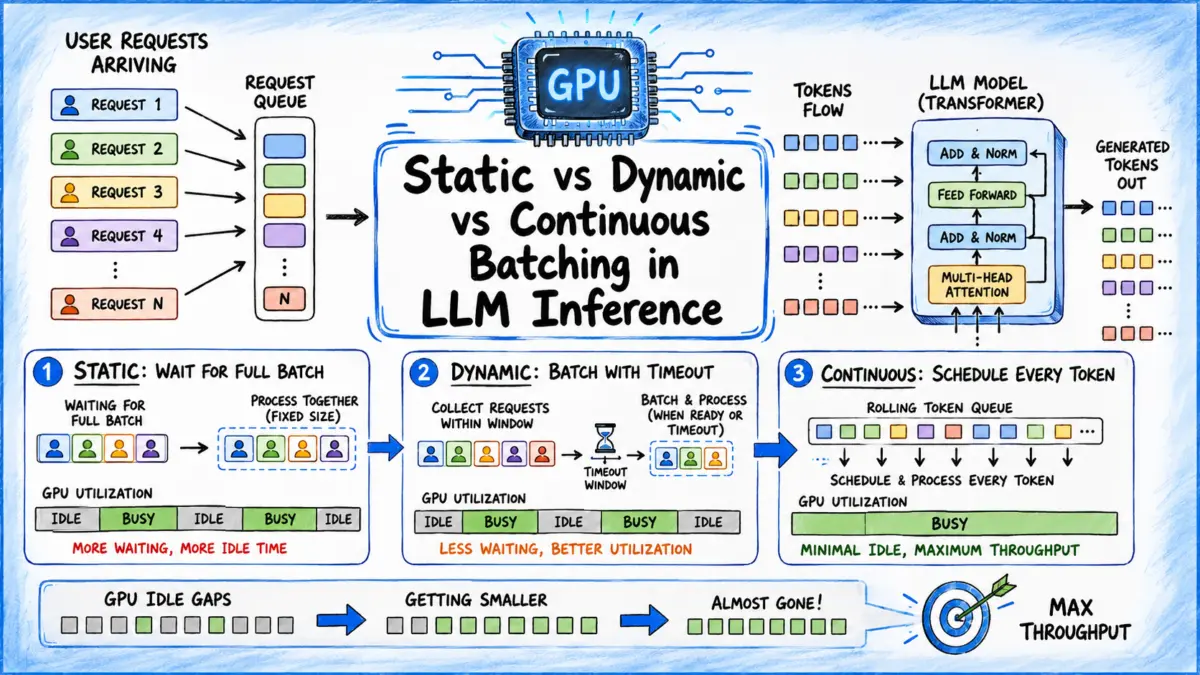
- Dynamic Shape Handling without Recompilation: A major frontier in compiler research is eliminating compilation stalls caused by dynamic batch sizes and variable sequence lengths, enabling continuous batching environments to enjoy zero-overhead kernel execution.
- Intelligent Memory Hierarchy Orchestration: As on-chip SRAM capacities expand and hardware architectures adopt unified memory spaces, future kernels will feature even more aggressive fusion, blurring the lines between memory storage, normalization, and matrix multiplication.
By mastering fast attention kernels, operator fusion, and graph compilation, machine learning engineers can unlock unprecedented throughput, lower latency, and dramatically reduce the infrastructure costs associated with deploying state-of-the-art transformer models at global scale.