Executive Overview
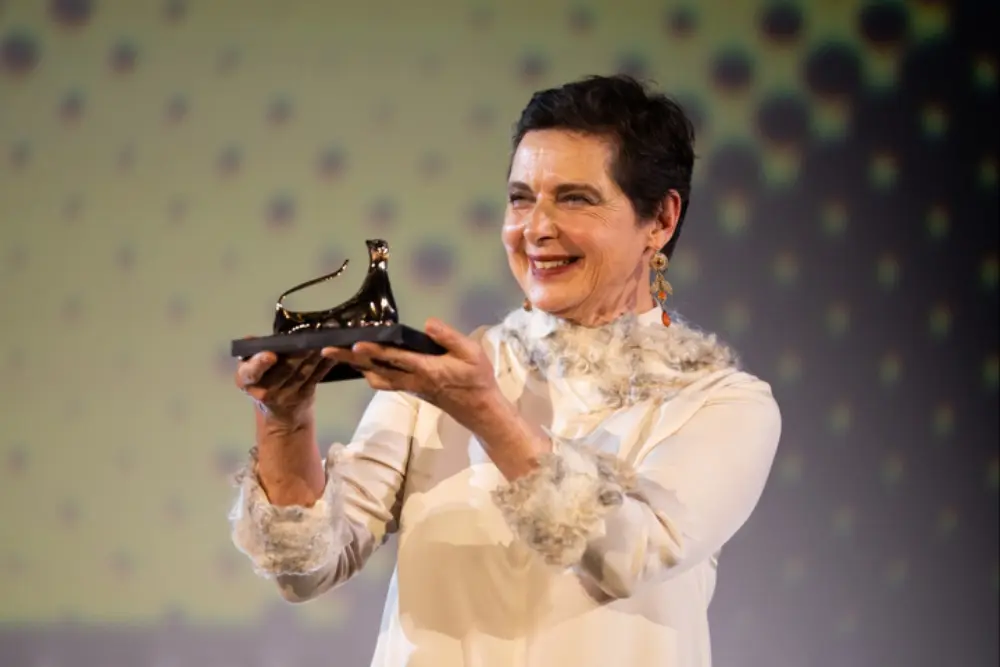
At the prestigious Locarno Film Festival, veteran actress, filmmaker, and behavioral scientist Isabella Rossellini was honored with the Excellence Award, a milestone that bridges a profound familial legacy with her multifaceted career. Best known internationally for her iconic roles in groundbreaking auteur cinema, Rossellini used her acceptance speech and subsequent masterclass to reflect on a lifetime spent defying expectations. From navigating the formidable shadows of her parents—legendary director Roberto Rossellini and cinematic icon Ingrid Bergman—to pivoting toward a master’s degree in Animal Behavior and Conservation in her fifties, Rossellini’s journey is one of relentless curiosity and reinvention.
This comprehensive report examines the trajectory of Rossellini’s career: her early days in the high-fashion modeling circuit, her transition into daring cinematic territories with directors like David Lynch, her pioneering work in low-tech science communication through her web series Green Porno, and her ongoing evolution as a creator who views the natural world not through a political lens, but through a biological one.
Detailed Chronology: From Neorealism’s Shadow to the Runway and Beyond
A Familial Foundation and Early Hesitations
Born into cinema royalty, Isabella Rossellini’s early exposure to the arts was both a privilege and a burden. Though she initially worked behind the scenes as a costume designer on her father’s productions, she never initially envisioned herself in front of the camera as an actress. Her first cinematic appearance came almost by accident when her mother, Ingrid Bergman, was cast in the Roman production A Matter of Time. Rossellini took a small role simply to spend quality time with her mother.
However, entering the film industry under the weight of her lineage proved difficult. Discouraged by harsh early critical reception—particularly following her work in the film The Meadow—Rossellini sought refuge and validation outside of cinema.
The Fashion Icon and the Wisdom of Richard Avedon
In her late twenties, Rossellini found unexpected reassurance in the fashion world, becoming a globally recognized model at age 27. Her striking resemblance to her mother, combined with a unique poise, caught the eye of legendary photographers like Richard Avedon.
Reflecting on her modeling days, Rossellini recalled Avedon’s unique perspective:
"Models are like silent movie stars. You have no lines, but I shoot the emotion."
This foray into high fashion not only restored her confidence following early cinematic critiques but also laid the groundwork for her eventual return to acting. When filmmakers approached her, buoyed by her burgeoning profile and famous parentage, her attitude shifted to a pragmatic "Why not?"
The David Lynch Era and Blue Velvet (1986)
Rossellini’s cinematic breakthrough arrived when she crossed paths with visionary director David Lynch. Their initial meeting over dinner involving members of the De Laurentiis family was marked by an amusing gaffe. Upon meeting her, Lynch remarked, "You look like Ingrid Bergman," prompting exasperated tablemates to reply, "You idiot, she is her daughter!"
When Lynch handed her the script for Blue Velvet, it included a personal note asking her to read it and decide if she wanted to take on the controversial role of Dorothy Vallens. Captivated by the material, Rossellini asked to rehearse to ensure her interpretation aligned with Lynch’s distinct vision. His validation—"You got it right"—ushered in a defining era of daring, boundary-pushing cinema.
Lynch, who was not yet a household name at the time, was building a mysterious cinematic universe where plot took a backseat to sensory and emotional atmosphere. Though Blue Velvet polarized audiences—drawing equal parts fierce hatred and intense adoration—it cemented Rossellini as a fearless performer willing to embrace the avant-garde. Working with composer Angelo Badalamenti further enhanced the project, with Rossellini playfully noting of her musical performances: "It sounds like I sing very well, but that’s movie magic."
Navigating Studio Politics and Mid-Career Marginalization
As her career progressed, Rossellini collaborated with a pantheon of acclaimed directors, including Robert Zemeckis, David O. Russell, Taylor Hackford, and James Gray on Two Lovers. Working with Gray introduced her to the intense worlds of Method acting, recalling how anxious she felt watching Joaquin Phoenix insist on sleeping for real during scenes, contrasting sharply with the fast-paced, budget-conscious neorealist traditions she grew up admiring.
Yet, institutional ageism threatened to derail her momentum. When she turned 42, cosmetics giant Lancôme chose not to renew her contract, deeming her "too old." Film work similarly dried up, driven by the pervasive industry myth that middle-aged women commanded no viable audience.
Reflecting on this difficult transitional period, Rossellini credits her insatiable curiosity and a pivotal piece of advice from Robert Redford—who told her outright, "You can be a director"—with helping her pivot. Redford later commissioned her to create content for the Sundance Channel, empowering her to take creative control of her narrative. (In a poetic twist of industry justice, Lancôme rehired her two decades later.)
Supporting Context & Metrics: The Intersection of Biology and Art
Late-Blooming Milestones
Rossellini frequently jokes about her propensity for doing everything a decade behind schedule, a byproduct, she suggests, of growing up in the shadow of globally famous parents:
- Modeling Career Begun: Age 27
- Acting Career Begun: Age 22
- Master’s Degree Earned: Age 55 (Animal Behavior and Conservation)
- Directorial Debut: Age 50s
The Science of Green Porno and Low-Tech Filmmaking
Rather than fading from the spotlight, Rossellini leaned into her lifelong passion for animals. Even as a child, she was known for bringing stray dogs home. In her fifties, she formalized this passion by earning a master’s degree in Animal Behavior and Conservation from Hunter College.
This academic pursuit birthed her critically acclaimed, highly popular web series Green Porno and Seduce Me, which explored complex animal mating rituals with humor, educational rigor, and a distinctly DIY aesthetic. Devoid of high-tech digital wizardry, Rossellini drew inspiration from early cinema pioneer Georges Méliès.
"I know nothing about computers. I don’t speak that language, so I made these films the way I knew how: super low-tech. I watched a lot of Méliès. It was a no-tech technique. Animals, to me, they fascinate me. I have a farm and when I decided to make films myself, they became my muses."
Official Statements and Personal Philosophy
Speaking candidly during her Locarno masterclass and press engagements, Rossellini emphasized that her artistic endeavors are driven by scientific fascination rather than political agendas:
-
On the Inspiration Behind Her Work:
"I am just fascinated by biology and diversity. When someone says: ‘It’s against nature to be gay or trans’—it’s not! I don’t sit down to write something political or poetic, but I discover that earthworms are hermaphrodites. I am just always so surprised. That’s my inspiration—not politics."
-
On Familial Legacy and the Locarno Excellence Award:
"The prize I’m receiving tonight is for excellence, which is something I haven’t heard very often… I’m very proud of it and, above all, so moved because my father received this back in 1948 for his film Germany, Year Zero. And then, four years ago, my brother Renzo [Rossellini], who was a great producer of Fellini and Scola. Being on par with my father and my brother fills me with so much emotion."
-
On Artistic Style Over Trends:
"I never think about someone’s ‘style.’ I think about what I want to say."
Future Outlook: Farms, Friends, and Evolutionary Shorts
As she looks toward the future, Rossellini shows no signs of slowing down, though her priorities remain firmly rooted in both her artistic vision and her rural lifestyle.
She is currently developing a new series of short films titled The Survival of the Friendliest. Shifting the cultural and scientific narrative away from the traditional Darwinian focus on "survival of the fittest," this upcoming project highlights the evolutionary importance of cooperation and social bonding among domestic animals. True to form, Rossellini plans to play all the roles herself while progressively increasing her focus on directing.
Balancing these creative ambitions with her personal life presents unique dilemmas. When queried by an audience member at Locarno about the current political climate in the United States, Rossellini admitted to weighing her options:
"It’s difficult right now and we are thinking of going back [to Europe], but I have sheep, chickens, I have land. Should I abandon everything? For now, I’m staying. I just hope things will improve."
Whether tending to her farm animals, collaborating with visionary modern filmmakers like Alice Rohrwacher (La Chimera), or earning critical accolades for her supporting turn in Edward Berger’s Conclave, Isabella Rossellini continues to redefine what it means to age gracefully and creatively in the public eye. Her journey proves that true artistic excellence is not bound by chronological timelines, traditional formulas, or industry expectations—it is fueled by a lifelong, unyielding wonder at the natural and cinematic worlds.