Executive Overview
Despite the official holiday retail frenzy still weeks away, major players in the maker space are already aggressively competing for consumer attention. Chief among them is Bambu Lab, a brand synonymous with high-speed, reliable, and user-friendly consumer-grade additive manufacturing. Eschewing traditional retail schedules, Bambu Lab has launched its early Black Friday sale event well ahead of schedule, running continuous discounts through December 1.
The early-bird promotions target some of the company’s most sought-after multi-color and multi-material 3D printing systems. At the forefront of these markdowns is the Bambu Lab P2S, a fully enclosed powerhouse now retailing at $649—down $100 from its standard $749 MSRP. Alongside the P2S, heavier-hitting enterprise and prosumer models, including the X2D and the ultra-sophisticated H2C, have also received notable price adjustments.
For hobbyists, designers, and small-business owners looking to step up their rapid prototyping game, this unexpected sales launch represents an ideal window to acquire advanced hardware. However, navigating Bambu Lab’s expanding catalog requires a clear understanding of your specific production needs. This report provides a detailed breakdown of the discounted hardware, comparative analysis of the top models, critical buying considerations, and a look at where the broader 3D printing market is heading as the holiday shopping season accelerates.
Detailed Chronology: The Evolution of Bambu Lab’s Early Holiday Strategy
October to November: Breaking Traditional Retail Timelines
Historically, Black Friday represented a compressed, 48-hour sprint of doorbuster deals immediately following Thanksgiving. Over the past half-decade, however, supply chain pressures, shifting consumer habits, and intense online competition have stretched the "Black Friday season" across entire months.
Bambu Lab’s decision to open its dedicated holiday sales page weeks in advance reflects a broader industry shift. By capturing early-season shoppers—particularly independent creators and prototyping studios trying to secure capital equipment before end-of-year project deadlines—manufacturers can smooth out manufacturing and shipping bottlenecks.
The early sale rollout centers squarely on ecosystems equipped with the AMS (Automatic Material System) 2 Pro. This upgraded filament-management hub not only coordinates seamless color-swapping during long prints but also incorporates integrated drying capabilities to protect hygroscopic engineering filaments from ambient moisture degradation.
By bundling these hardware packages early, Bambu Lab is positioning its machines not just as holiday gift items, but as essential productivity investments for the professional design community.
Supporting Context & Metrics: Breaking Down the Bambu Lab Lineup
To determine which early Black Friday deal offers the best value, prospective buyers must look beyond the initial price drop and examine the hardware specifications, thermal capabilities, and workflow efficiencies of each machine.
Below is an in-depth breakdown of the primary models featured in the current promotional event, designed to help you choose the right tool for your specific workflow.
1. The Value Champion: Bambu Lab P2S
- Sale Price: $649 (Regularly $749 | Savings: $100)
- Included Core Accessories: AMS 2 Pro unit, fully enclosed chassis, AI error detection.
- Build Volume: 256 x 256 x 256 mm.
Performance & Target Audience:
For the vast majority of hobbyists, cosplayers, and light prototyping professionals, the P2S stands out as the most pragmatic purchase of the sale. Out of the box, it delivers reliable multi-color execution thanks to the included AMS 2 Pro. Its fully enclosed chamber enables successful printing with engineering-grade thermoplastics like ABS and ASA, mitigating warping and lifting issues associated with open-frame printers.
Limitations to Consider:
While highly capable, the P2S features a single-nozzle architecture and lacks active chamber heating. This means that while it can handle standard engineering filaments, ultra-demanding exotic composites or high-temperature polymers may push the machine past its thermal comfort zone. Furthermore, single-nozzle multi-color printing inherently requires filament purging during color transitions, leading to waste material (purge towers or poop buckets) and extended print times on complex, multi-shade jobs.
2. The Mid-Tier Specialist: Bambu Lab X2D
- Price Point: Approximately $140 more than the P2S (varies by regional bundles).
- Core Enhancements: Dual-nozzle or secondary support architecture, active 65°C chamber heating, identical 256mm³ build volume.
Performance & Target Audience:
The X2D bridges the gap between consumer-level convenience and industrial capability. By introducing active chamber heating up to 65°C, the X2D creates a thermally stable internal environment that dramatically reduces residual stresses in large parts printed with engineering polymers like polycarbonate, nylon, and reinforced composites.
Furthermore, the inclusion of a secondary nozzle or auxiliary support system makes the X2D a stellar choice for users who frequently print complex geometries requiring specialized, dissolvable support materials (such as PVA or BVOH). This eliminates the tedious manual post-processing of breaking away stubborn supports from intricate overhangs.
3. The Industrial Flagship: Bambu Lab H2C
- Price Point: Nearly three times the cost of the P2S.
- Weight & Footprint: 32.5 kg (more than twice the weight of the P2S).
- Core Technology: Advanced hotend-swapping system, "limitless in color quantity" capability, hyper-optimized purge management.
Performance & Target Audience:
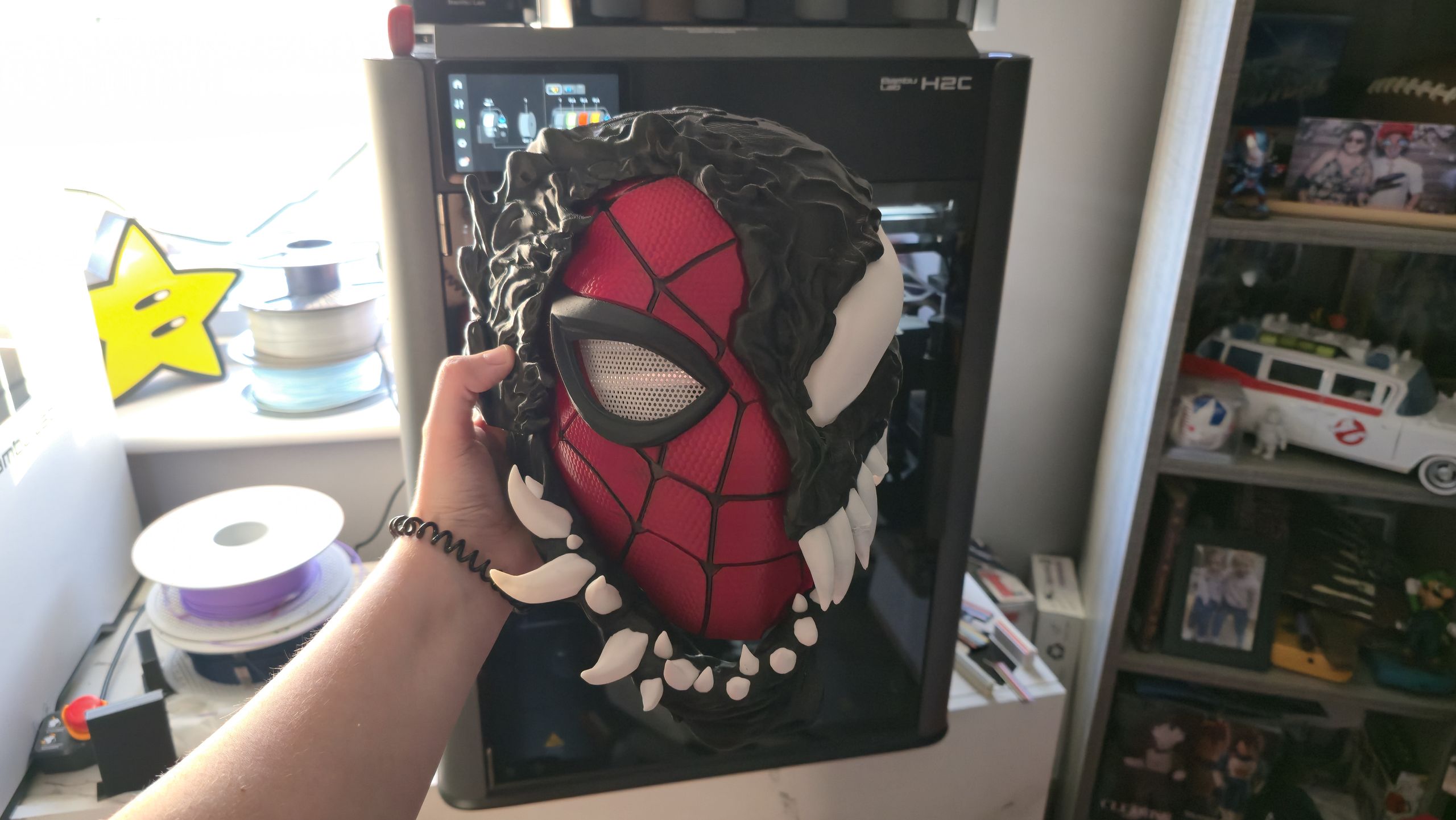
At the apex of Bambu Lab’s current technological offerings sits the H2C. Reviewers have described its multi-color potential as virtually limitless, praising its revolutionary engineering.
The standout feature of the H2C is its innovative hotend-swapping mechanism. Traditional multi-color printers cycle filament back and forth through a single melt zone, purging significant amounts of material at every color change. The H2C’s mechanical hotend-switching approach dramatically slashes purge waste and accelerates production timelines.
In rigorous benchmark testing, complex multi-color models that required over three days (72+ hours) of continuous printing on legacy multi-material systems executed in just over 24 hours on the H2C. For small manufacturing bureaus, design agencies, and commercial operations where time translates directly to billable revenue, the H2C justifies its heavyweight price tag.
Official Statements & Industry Expert Insights
Industry reactions to early promotional campaigns highlight how far consumer 3D printing has evolved from its niche, tinkering-heavy origins into a streamlined appliance market.
"Our reviewer loves the Bambu Lab H2C, which she describes as being ‘limitless in colour quantity.’ While the upfront cost is substantial, the efficiency gains in hotend-swapping technology redefine what is possible for high-throughput multi-color desktop manufacturing." — Creative Bloq Hardware Evaluation Team
Design analysts point out that the inclusion of the AMS 2 Pro across these promotional bundles marks a vital milestone in solving one of desktop 3D printing’s oldest friction points: material degradation. Filament exposed to ambient humidity absorbs water vapor, leading to bubbling, stringing, and catastrophic structural failure during prints. By integrating active drying directly into the multi-material ecosystem, manufacturers are shifting the responsibility of material conditioning from aftermarket accessories directly into the core machine architecture.
Furthermore, safety and automation features—such as standard AI error detection across the P2S, X2D, and H2C platforms—reflect a maturing industry standard. Users no longer need to monitor first layers with a handheld camera or risk catastrophic "blob of death" print failures destroying print heads; machine-vision algorithms now pause jobs autonomously upon detecting anomalies.
How to Choose: A Practical Buying Matrix
With multiple tiers on sale, deciding which Bambu Lab system to invest in requires an honest assessment of your workflow demands, material requirements, and budget constraints.
Ask Yourself These Three Questions:
- What is my primary application?
- If you are printing artistic miniatures, cosplay props, architectural mockups, or general household items, the P2S at $649 provides all the multi-color capability you will ever need at a heavily discounted price point.
- Do I rely heavily on dissolvable supports or high-temperature engineering plastics?
- If your workload involves functional mechanical parts, jigs, fixtures, or industrial prototypes requiring engineering filaments (Nylon, PC) and dissolvable supports, step up to the X2D to leverage its 65°C active chamber heating and secondary toolhead options.
- Is 3D printing a core revenue generator for my business?
- If you run a micro-factory, direct-to-consumer product shop, or rapid prototyping studio where machine downtime and material waste eat into profit margins, the efficiency, speed, and waste-reduction of the H2C make it a worthwhile commercial investment.
Future Outlook: The Trajectory of Multi-Color Additive Manufacturing
As the holiday shopping season unfolds, the competitive landscape of desktop 3D printing is experiencing a seismic shift. Brands like Bambu Lab, Creality, Prusa, and Anycubic are racing to democratize multi-material and multi-color printing, transforming what was once an exotic, experimental feature into an expected baseline requirement.
The integration of smart filament dryers, AI-driven failure detection, and advanced toolhead-switching mechanics points toward an inevitable future: lights-out, autonomous desktop manufacturing. As these technologies migrate down from industrial server rooms to consumer desktops, the barrier between digital 3D modeling and physical realization continues to shrink.
For consumers tracking current holiday promotions, locking in hardware discounts ahead of the official holiday rush ensures uninterrupted project workflows through the winter months. Whether you opt for the budget-friendly entry of the P2S or the industrial prowess of the H2C, the current early Black Friday landscape offers unprecedented value for creators ready to bring their digital visions to life in full color.