Executive Overview
In the rapidly evolving landscape of modern filmmaking, the marriage of real-time 3D technology and physical set design has fundamentally transformed how stories are told on screen. Nowhere is this more evident than in SNTIENT 2.0, a groundbreaking short film produced by the Fashion Innovation Agency at the London College of Fashion in collaboration with creative studio Dandelion + Burdock.
Set within a dystopian future where humanity has retreated into digital simulations while leaving automated caretakers behind in the physical world, the narrative explores themes of isolation, beauty, and systemic decay. Yet, the true marvel of SNTIENT 2.0 lies not just in its speculative plot, but in its pioneering use of virtual production techniques. By anchoring a physical, gritty sci-fi "pod" set against a massive, pixel-mapped LED wall driven by Unreal Engine 5, the production team managed to bypass the traditional limitations of green screens and expensive post-production visual effects (VFX).
Utilizing cutting-edge hardware—including the Blackmagic URSA Cine 17K 65 camera and prototype anamorphic lenses—alongside clever in-camera optical tricks, the creators achieved a rare synthesis of old-school filmmaking resourcefulness and futuristic tech. This report explores the meticulous execution behind SNTIENT 2.0, detailing how real-time rendering, dynamic lighting, and artistic adaptability converged to redefine independent sci-fi production.
Detailed Chronology: From Concept to In-Camera Realization
The journey of bringing SNTIENT 2.0 to the screen required an agile pipeline that could bridge high-concept fashion narratives with heavy-duty technical execution.
Phase 1: Conceptualization and the Limitations of Generative AI
The visual foundation of the film hinged on a stark contrast: an oppressive, resource-depleted cityscape viewed through the window of a solitary robotic inhabitant. According to Dickon Knowles, Director of Content at Dandelion + Burdock, the initial visual starting point was a bleak, sci-fi environment carrying immense narrative weight.
Before committing to a real-time 3D environment, the production explored alternative methodologies. Initially, the team experimented with generative AI approaches to create the backdrop plates for the LED wall. However, these methods immediately hit technical roadblocks. Resolution constraints and a lack of consistent visual fidelity hindered the AI-generated plates from holding up under professional cinematic scrutiny. Consequently, the team pivoted back to a robust, pre-existing Unreal Engine pipeline, which provided the high-resolution flexibility and crisp detail required for LED wall projection.

Phase 2: On-Set Optimization and Real-Time Adjustments
Building a digital city is one challenge; making it read accurately through a camera lens on an LED wall is an entirely different discipline. Early tests revealed that the original environment’s general wash of heavy fog and desaturated tones fell flat when captured by the sensor, fighting against the LED panels’ need for rich blacks and high contrast.
To resolve this, Knowles dynamically reworked the atmosphere on the fly. He replaced the generic fog with detailed VDB (Volumetric Database) fog, carefully reducing its overall density while boosting color saturation—particularly within the illuminated windows of the digital skyscrapers. Because Unreal Engine 5 operates in real time, these adjustments were executed instantly. The crew did not have to endure agonizing render farms or wait hours to see if a color grade worked; they simply tweaked the digital assets and observed the results immediately on the physical wall.
Phase 3: Physical-Virtual Integration and Camera Execution
With the digital environment stabilized, the physical production took center stage inside a tightly confined studio space. The narrative beats were deliberately minimalist: a robotic protagonist wakes up, a mechanical window-shutter rises, and she looks out at the world. Condensing world-building and character motivation into a concise runtime demanded absolute precision from cinematographer Ben Saffer and his virtual production outfit, Supervision VP.
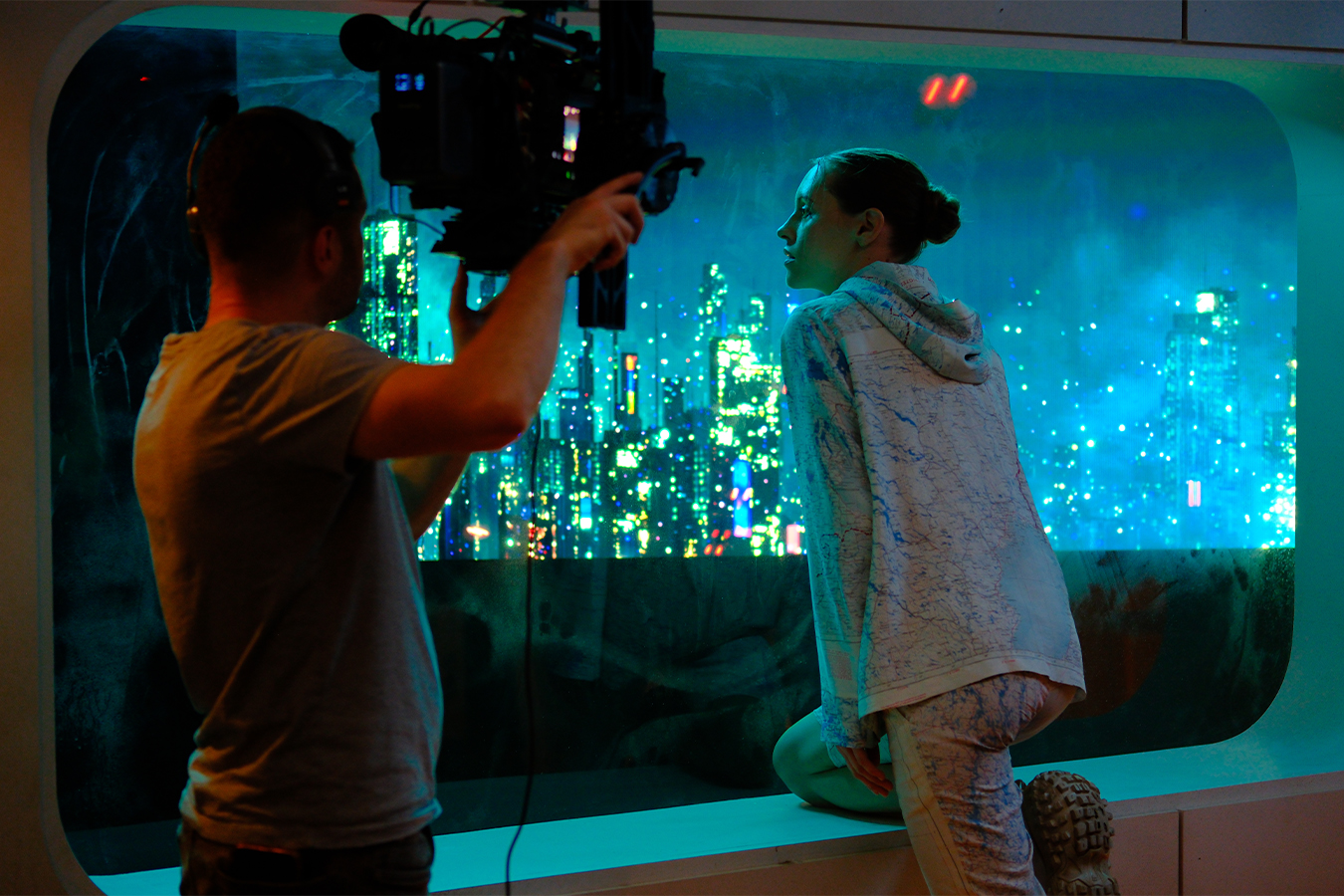
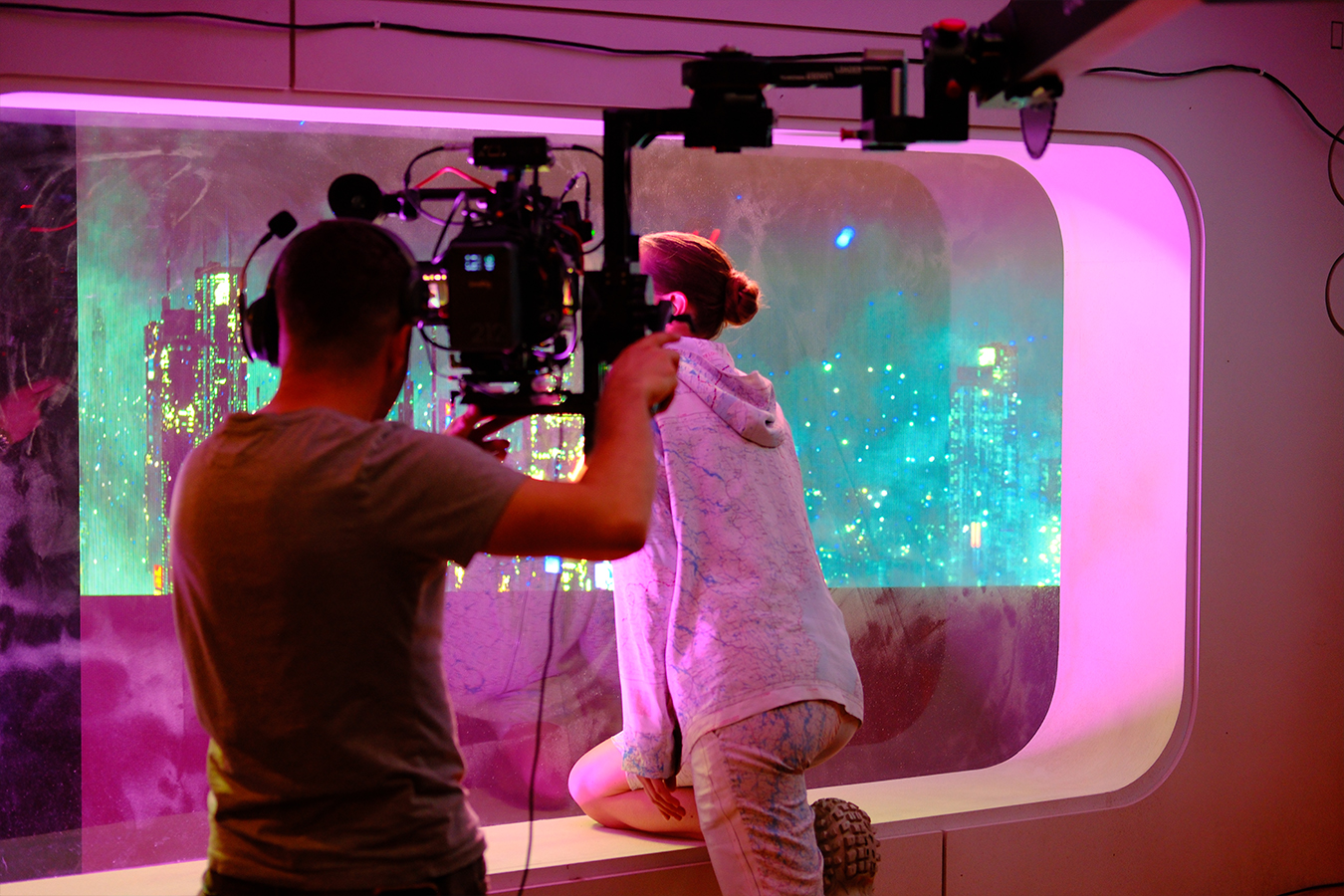
Rather than relying on a traditional green screen—which forces actors to imagine their surroundings and creates unnatural lighting mismatches—the LED wall acted as both background and primary light source. The city’s digital lights cast authentic reflections across the performer’s face, skin, and the physical props inside the set.
To capture the restricted space without introducing unflattering barrel distortion from extreme wide-angle glass, the production utilized Blackmagic’s massive-sensor URSA Cine 17K 65 camera paired with prototype Atlas Lens Co. anamorphic glass. This hardware selection allowed the crew to capture sweeping vistas of the set and the virtual backdrop simultaneously, anchoring the performer authentically within her environment.
Supporting Context & Metrics: The Mechanics of Modern Virtual Production
The technical architecture underpinning SNTIENT 2.0 reflects a broader industry shift toward In-Camera Visual Effects (ICVFX). Understanding the metrics and hardware choices sheds light on why virtual production is becoming the preferred workflow for independent and studio productions alike.

| Production Component | Traditional Approach | SNTIENT 2.0 Virtual Production Approach |
|---|---|---|
| Background Generation | Green screen with post-production composite | Real-time Unreal Engine 5 environment on LED wall |
| Set Lighting | Studio fixtures, diffusers, and post-color grading | Dynamic, bi-directional lighting emitted directly from the LED volume |
| Camera Hardware | Standard 4K/8K digital cinema cameras | Blackmagic URSA Cine 17K 65 large-format sensor |
| Lenses | Standard spherical primes/zooms | Prototype Atlas Lens Co. anamorphic lenses |
| Environmental Effects | Post-production CGI fog and shutter animations | Real-time VDB fog and pixel-rendered mechanical shutter mechanisms |
Overcoming Budget Constraints Through Pixels
One of the most innovative engineering solutions deployed during the shoot involved a simple narrative requirement: a rising mechanical shutter that unveils the city outside. Constructing a fully functional, heavy-duty mechanical shutter on a modest indie budget would have been physically impractical, while adding it entirely in post-production would have stripped away the actor’s ability to react to the changing light in real time.
The solution was entirely digital yet executed practically. The LED wall itself served as the shutter, programmatically rising to reveal the city asset stored in Unreal Engine. For reverse angles, the crew utilized a secondary, mobile LED wall mounted on wheels to complete the fourth wall of the pod. Because the scene parameters were running in real time, the technical operators could rapidly adapt, render, and animate assets for alternative camera angles on demand.
Blending High-Tech with Lo-Fi Experimentation
Despite the reliance on advanced real-time engines and 17K sensor arrays, SNTIENT 2.0 retained a distinctly tactile, human element through analog experimentation.
Cinematographer Ben Saffer injected organic imperfections into the crisp digital imagery by utilizing tactile, lo-fi techniques in front of the lens. Toward the conclusion of the film, as the protagonist gazes toward the window, Saffer held a plastic Polly Pocket toy directly in front of the camera lens, sweeping a smartphone flashlight across it from the side to manufacture unique, unpredictable optical light leaks and refractions. Similar physical experiments involving cling film and household materials ensured that the film avoided feeling overly clinical, preserving a gritty, handmade cinematic texture.
Official Statements and Industry Insights
The collaborative nature of SNTIENT 2.0 brought together academic institution backing, specialized creative software engineering, and seasoned cinematography. Key industry figures weighed in on the philosophy driving the project:
-
Dickon Knowles (Director of Content, Dandelion + Burdock) on the narrative visual baseline:
"That gave us our visual starting point. A bleak, oppressive sci-fi environment with the potential for transformation… We tried a couple of generative approaches to creating the city plate for the wall, but resolutions were an issue and the visual fidelity wasn’t there, which is why we reverted back to our existing Unreal Engine version."
-
Knowles on the sensory immersion achieved via ICVFX:
"The city lights reflect on the performer’s face and on the surfaces of the props and set… There is a level of visual immersion that is hard to capture in a studio without the LED wall to illuminate the space."
-
Ben Saffer (Cinematographer and Founder of Supervision VP) on real-time capture efficiency:
"You’re doing it all in camera and capturing everything together at once, and you’re not having to guess at anything… It was nice to get that in camera."
Future Outlook: What SNTIENT 2.0 Signals for Digital Art and Fashion Film
The intersection of fashion, technology, and narrative filmmaking pioneered by institutions like the London College of Fashion’s Fashion Innovation Agency points toward a fascinating horizon for creative media. Projects like SNTIENT 2.0 prove that virtual production is no longer the exclusive domain of multi-hundred-million-dollar Hollywood blockbusters like The Mandalorian or Fallout.
By democratizing access to real-time engines like Unreal Engine 5 and pairing them with agile LED volume setups, mid-tier and indie studios can achieve cinematic fidelity that once required massive physical builds or protracted, budget-draining post-production pipelines.
As virtual production hardware continues to decrease in cost while increasing in resolution—exemplified by massive sensor platforms like the Blackmagic URSA Cine 17K—we can expect creative disciplines like fashion film, advertising, and independent sci-fi to lean even heavier into real-time environments. The ability to manipulate lighting, weather, architecture, and atmosphere with the click of a mouse while the cameras are actively rolling heralds a permanent paradigm shift: the boundary between what is real on set and what is rendered in pixels has effectively dissolved.