Executive Overview
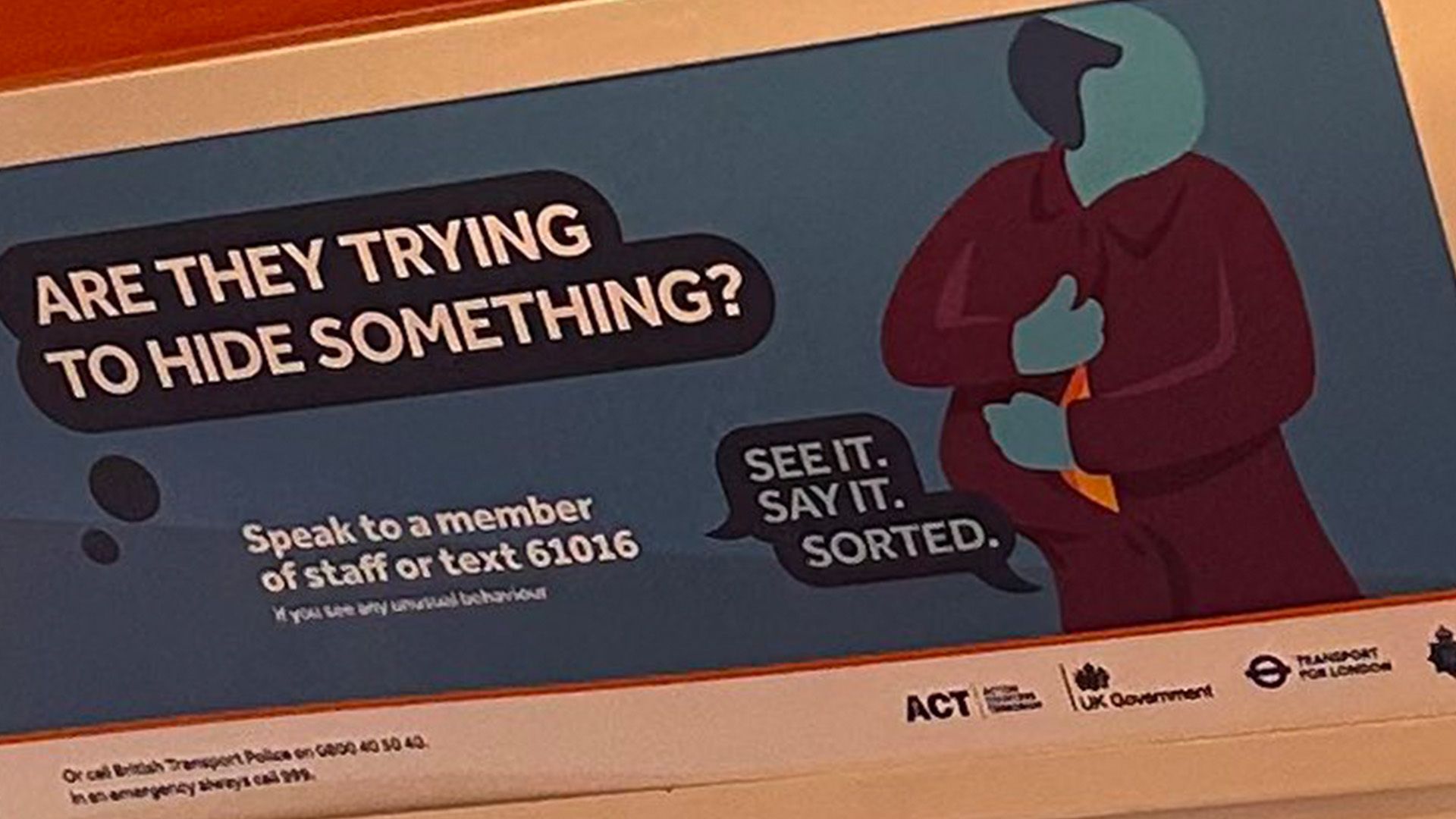
In the fast-paced, high-volume environment of public transit advertising, visual communication must be instantly intelligible, unambiguous, and culturally sensitive. Yet, a recent campaign deployed across the Transport for London (TfL) network dramatically proved how disastrously these principles can fail when paired with controversial design choices. Commuters navigating the capital’s underground and overground train network were left stunned, confused, and deeply offended by a public safety announcement (PSA) poster that featured stark, minimalist graphics alongside the provocative tagline: "Are they trying to hide something?"
What followed was an immediate digital firestorm on social media platforms like X (formerly Twitter), where users interpreted the featureless, abstract illustration not as the intended depiction of a man looking over his shoulder, but rather as a woman wearing a hijab. Set against a probing, accusatory headline, the unintended optical illusion sparked accusations of institutional islamophobia, xenophobia, and fear-mongering.
The ensuing fallout forced TfL into a defensive posture, first investigating the posters, then claiming they were the result of illegal flyposting, before subsequently facing pushback from online sleuths pointing to official news coverage and possible law enforcement ties. This incident serves as a striking case study in the perils of "Corporate Memphis"—the ubiquitous, hyper-simplified art style favored by tech companies and public entities alike—and underscores how poor design execution can turn a routine public messaging campaign into a full-scale public relations crisis.
Detailed Chronology: How the Controversy Unfolded
The Initial Discovery on the Network
The controversy began quietly on a late October weekend when commuters boarding London’s trains began noticing a new style of poster integrated into the standard rotation of public service announcements. Designed to prompt public vigilance, the advertisement featured a flatly rendered, featureless graphic character accompanied by the bold, interrogative heading: "Are they trying to hide something?"
Within hours, photographs of the poster began circulating online. However, instead of engaging with the intended safety message—presumably encouraging passengers to report suspicious items, behavior, or security threats—viewers became fixated on the artwork itself.
Due to the extreme abstraction characteristic of modern vector art styles, the silhouette and framing of the illustration caused many commuters to perceive the figure as a woman wearing a traditional Islamic headscarf, or hijab. Coupled with the suspicious and probing nature of the copy, the visual was rapidly reinterpreted not as a generic warning about vigilance, but as an offensive cultural dog-whistle that appeared to target Muslim women.
Social Media Amplification and Public Backlash
As the images spread across X, outrage mounted exponentially. Users expressed shock that such a campaign could be approved for public display in a city as diverse and multicultural as London.
One prominent user decried the campaign, writing: "Disgusting insinuation in this campaign. Absolutely appalling." Another drew dystopian comparisons, stating: "Suspicion, paranoia and ethnically ambiguous abstract art—1984 is here in full force." Meanwhile, others highlighted the sheer absurdity of the visual failure, with one user joking, "This is a wonderful Rorschach test," pointing out how the image forced viewers to project their own interpretations onto a completely blank canvas of facial features.
It took considerable time and intense scrutiny for some users to discern the original design intent. One viral post noted: "It took me ages to see the balding man. TfL accidentally created its own version of this image," comparing the confusing optical illusion to famous psychological puzzles where a single graphic can be interpreted in multiple entirely different ways.
TfL’s Reactive Stance and Conflicting Explanations
As public pressure intensified, Transport for London found itself compelled to issue public responses. Initially, representatives informed concerned citizens on social media that the posters were actively being investigated.
Shortly thereafter, TfL shifted its narrative dramatically, claiming that the controversial posters were entirely unauthorized and had been installed illicitly across their network. In a now-deleted statement posted to X, TfL elaborated:
"Our media partner, our teams and contractors have been instructed to inspect trains and remove any unauthorised posters that are found on our network. The incident has been reported to the British Transport Police as flyposting is an illegal activity."
However, this explanation only served to muddy the waters further. Online investigators and vigilant commuters quickly pushed back against TfL’s official stance, pointing out that mainstream news sources had previously covered the rollout of these exact posters—including variant designs within the same campaign family. Furthermore, rumors and counter-claims began to circulate suggesting that the British Transport Police (BTP) themselves may have had a direct operational link to the campaign’s commissioning or rollout. This contradiction left the public questioning whether TfL was attempting to scapegoat third-party actors to distance itself from a monumental creative failure, or if an unprecedented security breach had indeed taken place.
Supporting Context & Metrics: The Design Flaws of "Corporate Memphis"
At the heart of this controversy lies a deeper aesthetic and communication problem: the dominance and ultimate failure of Corporate Memphis (also known as "Alegria" or the "Big Tech style") in public-facing institutional campaigns.
What is Corporate Memphis?
Characterized by flat vector graphics, exaggerated limb proportions, bright or pastel color blocking, and a deliberate absence of facial features or distinct racial and ethnic markers, Corporate Memphis was popularized in the late 2010s by tech giants like Facebook and Google. Its primary commercial appeal is neutrality. By stripping away identifying characteristics—such as age, specific ethnicity, hair texture, and detailed facial expressions—designers aimed to create a universal human cipher that any audience could supposedly project themselves onto.
The Pitfalls of Hyper-Abstraction in PSAs
While neutrality works well for abstract software onboarding illustrations or corporate user manuals, applying Corporate Memphis to high-stakes Public Service Announcements is fraught with risk. When an art style relies entirely on minimal geometric shapes and ambiguous silhouettes, it loses the nuance required for sensitive communication.
In the case of the TfL poster:
- The Rorschach Effect: Because the figure lacked facial features, hair, or defined structural anatomy, viewers filled in the blanks based on their own cognitive biases, cultural anxieties, and immediate visual cues.
- Contextual Clash: The accusatory tagline—"Are they trying to hide something?"—immediately activated a paranoid frame of mind. When paired with a silhouette that could be misread as religious headwear, the neutral vector art ceased to be neutral; instead, it became charged with xenophobic implications.
- Loss of Agency: Good public messaging relies on clear, undeniable clarity. If a viewer has to spend minutes deciphering whether an illustration depicts a balding man looking backward or a veiled woman, the primary safety message is entirely lost in translation.
Official Statements and Institutional Accountability
The handling of the TfL ad controversy highlights systemic vulnerabilities in how large public sector organizations vet, approve, and audit creative assets before they reach the public sphere.
The Breakdown in Quality Assurance
Transport networks handle millions of daily passengers representing every conceivable demographic. Consequently, advertising and public information campaigns undergo rigorous multi-layered review processes designed to catch offensive, ambiguous, or polarizing content. The fact that this poster bypassed these safety checks—or, conversely, if TfL’s claim of "unauthorized flyposting" is true, that security protocols across rolling stock were so lax that rogue posters could be easily integrated into official frames—points to a profound institutional failure.
The Crisis Communications Misstep
TfL’s decision to delete its initial explanatory posts on social media and point fingers at the British Transport Police further eroded public trust. In modern crisis communications, transparency and swift, definitive accountability are vital. By offering shifting explanations—ranging from investigating an official asset to claiming illegal flyposting by unknown bad actors—TfL transformed a design controversy into an institutional credibility test. Media watchdogs and civil liberties groups have since called for a full audit of how transit advertising inventory is managed and monitored across the capital’s network.
Future Outlook: The Year of the Cancelled Ad and Lessons Learned
The TfL incident is far from an isolated event. Across the global creative industries, 2026 has rapidly earned a reputation as "the year of the cancelled ad." From high-profile brand campaigns sparking digital culture wars—such as Sydney Sweeney’s polarizing commercial driving generational divides—to tone-deaf public sector messaging, contemporary audiences are increasingly intolerant of creative negligence.
Key Takeaways for the Advertising and Design Sectors
- The Death of False Neutrality: Designers must recognize that "neutral" art styles like Corporate Memphis are not culturally invisible. In emotionally charged socio-political climates, minimalism often invites misinterpretation rather than universal resonance.
- Rigorous Contextual Stress-Testing: Creative agencies working with public institutions must test their campaigns against worst-case semantic interpretations. If a neutral tagline can be weaponized or misread alongside an abstract visual, the concept must be sent back to the drawing board.
- Heightened Scrutiny of Public Assets: Transit authorities must overhaul their physical security and digital asset management to ensure that rogue materials cannot be deployed, and conversely, that approved campaigns are subjected to unbiased, diverse focus-group reviews prior to public installation.
Ultimately, TfL’s poster fiasco serves as a stark warning to creatives and institutions alike. In an era defined by hyper-vigilance, digital documentation, and deep social sensitivity, ambiguity in public advertising is no longer just a creative shortcoming—it is a major liability. Unless brands and public bodies commit to intentional, clear, and culturally aware visual communication, the fallout from poorly executed design will continue to play out loudly in the court of public opinion.