
Executive Overview
For over a century, urban architecture has been defined by a silent, static conversation between brands and pedestrians. From the hand-painted wooden panels of the early 20th century to the glowing, programmatic LED monoliths towering over Times Square, Piccadilly Circus, and Shoreditch High Street, the traditional billboard has operated on a strict one-way frequency. Advertisers broadcast; audiences absorb—or, more frequently in the modern era, resolutely ignore.
In our current hyper-digitized landscape, cultural critics often point out our collective posture: eyes locked downward, illuminated by the cold blue glow of pocket-sized smartphones. As satirized in films like Adam McKay’s Don’t Look Up, humanity has developed an impressive capacity to ignore massive realities looming directly overhead in favor of micro-distractions. For the advertising industry, this downward gaze has represented an existential threat. If consumers refuse to look up at physical infrastructure, physical outdoor advertising loses its potency.
Yet, a profound technological shift is quietly brewing on the horizon. The rapid maturation of augmented reality (AR) and smart eyewear—devices capable of projecting high-definition information, interactive media, and spatial graphics directly into our fields of view—is poised to rewrite the rules of urban engagement. Rather than rendering physical billboards obsolete, smart glasses are uniquely positioned to revitalize them.
By bridging the physical-digital divide, upcoming wearable technology promises to transform static hoardings into interactive portals. As pioneering physical-digital hybrid spaces like London’s Electric Garden demonstrate, brands are already experimenting with bridging the gap between passive screens and immersive environments. When paired with the predictive intelligence of AI-driven smart glasses, tomorrow’s urban landscape will not abandon physical signage—it will weaponize it, turning every street corner into a layer of rich, contextual, and deeply interactive media.

Detailed Chronology: The Evolution of Urban Advertising and Wearable Tech
To understand where outdoor advertising is heading, it is necessary to trace the parallel trajectories of out-of-home (OOH) media and wearable computing over the past century.
The Analog Era: Billboards as Art and Information (1900–1990s)
- Early 20th Century: Standardized billboard sizing emerges, led by the standardization of poster panels in the United States and Europe. These early signs rely purely on static imagery, typography, and illustration.
- The Mid-Century Boom: Post-war consumerism fuels a massive expansion of roadside billboards along expanding highway networks, establishing the foundational metric of "impressions"—counting how many vehicles pass a given sign per day.
- The Late 20th Century: Vinyl printing technologies replace hand-painted canvas advertisements, drastically reducing production times and allowing for hyper-realistic photographic displays that dominate urban skylines.
The Digital Pivot: Screens and Friction (2000s–2010s)
- Early 2000s: The introduction of Large Format Digital (LFD) screens. Billboards transition from paper and glue to dynamic LED grids capable of changing advertisements multiple times per minute and running rudimentary animations.
- The QR Code Promise (2010s): Advertisers attempt to bridge the physical-digital gap by stamping QR codes onto physical posters. While functional, the technology fails to achieve mainstream habituation; stopping mid-commute to haul out a smartphone, unlock it, open a camera app, and scan a pixelated square proves too high a friction barrier for everyday consumers.
- The Immersive Shift (Late 2010s–2020s): Experiential OOH takes root. Brands realize that screens alone are insufficient, leading to massive multi-sensory installations where digital displays act as gateways to physical, walkable brand worlds.
The Wearable Revolution and Spatial Computing (2020s and Beyond)
- 2021–2023: Early consumer smart glasses enter the market, focusing primarily on audio integration, discreet photography, and rudimentary heads-up displays (HUDs). Simultaneously, spatial computing headsets establish the feasibility of persistent, anchor-based digital overlays in physical space.
- 2024–Present: Advancements in micro-LED projection, lightweight battery density, and onboard multimodal artificial intelligence (AI) push smart glasses closer to everyday aesthetic viability. Tech giants and nimble startups alike race to solve the ultimate design challenge: how to deliver seamless augmented reality without encumbering the user.
- The Near Future Horizon: Industry analysts project that as prescription-ready, all-day AR glasses achieve mass-market adoption, the physical world will transform into an interactive canvas. Billboards will cease to be flat planes of ink or light; instead, they will function as spatial anchors for personalized, voice-activated, and context-aware digital experiences.
Supporting Context & Metrics: The Death of Friction and the Rise of Immersive OOH
Why have past attempts to make billboards interactive—such as NFC tags, Bluetooth beacons, and QR codes—largely fallen flat? The answer lies in human psychology and behavioral friction.
Market research consistently shows that consumer patience in public spaces is exceptionally low. Commuters navigating a busy underground station or crossing a bustling metropolitan avenue are operating under cognitive load. Asking them to alter their physical trajectory, extract a mobile device, and manually parse a code creates an unacceptable amount of friction.
Smart glasses eliminate this friction entirely. Because the core utility of augmented eyewear is to keep the user’s eyes up, engaged, and oriented toward the world around them, any digital interaction must align with this natural posture. Nobody wears high-tech eyewear to stare at their shoes; they wear it to enhance their immediate environment.

+--------------------------------------------------------------------------+
|                     The Friction Curve in OOH Advertising                |
+--------------------------------------------------------------------------+
|                                                                          |
|  HIGH FRICTION (Low Engagement)                                          |
|  [Static Billboard] ➔ [Stop walking] ➔ [Pull out phone] ➔ [Scan QR Code]   |
|                                                                          |
|  LOW FRICTION (High Engagement)                                          |
|  [Physical Billboard] ➔ [Smart Glasses AR Overlay] ➔ [Instant Interaction] |
|                                                                          |
+--------------------------------------------------------------------------+
The Shift in Out-of-Home (OOH) Economics
According to global media intelligence reports, the Out-of-Home advertising sector has proven remarkably resilient in the digital age, largely because it cannot be blocked by browser extensions. Global OOH spending routinely exceeds $40 billion annually, with digital OOH (DOOH) accounting for a rapidly growing share.
However, return on investment (ROI) attribution has always been OOH’s Achilles’ heel. While digital banner ads can track click-through rates and conversions down to the millisecond, billboards rely heavily on algorithmic estimations and foot-traffic modeling.
Augmented reality smart glasses change this equation fundamentally. With AR integration:
- Direct Attribution: Advertisers can track granular interaction data (e.g., how many users gazed at a billboard, how many triggered an embedded video trailer, or how many requested walking directions to a nearby retail hub).
- Dynamic Personalization: A single physical billboard shell can display a baseline visual campaign while smart glasses project targeted, demographic-, or context-specific overlays tailored to the individual viewer.
- Utility-Driven Engagement: Advertising transforms from a shouting match into a helpful service layer. A movie poster does not just display a release date; when viewed through smart glasses, it becomes an instant ticketing portal, a trailer player, and a GPS routing engine.
Official Statements and Industry Perspectives
Forward-thinking designers, urban planners, and experiential marketers are already preparing for this convergence of physical architecture and spatial computing.

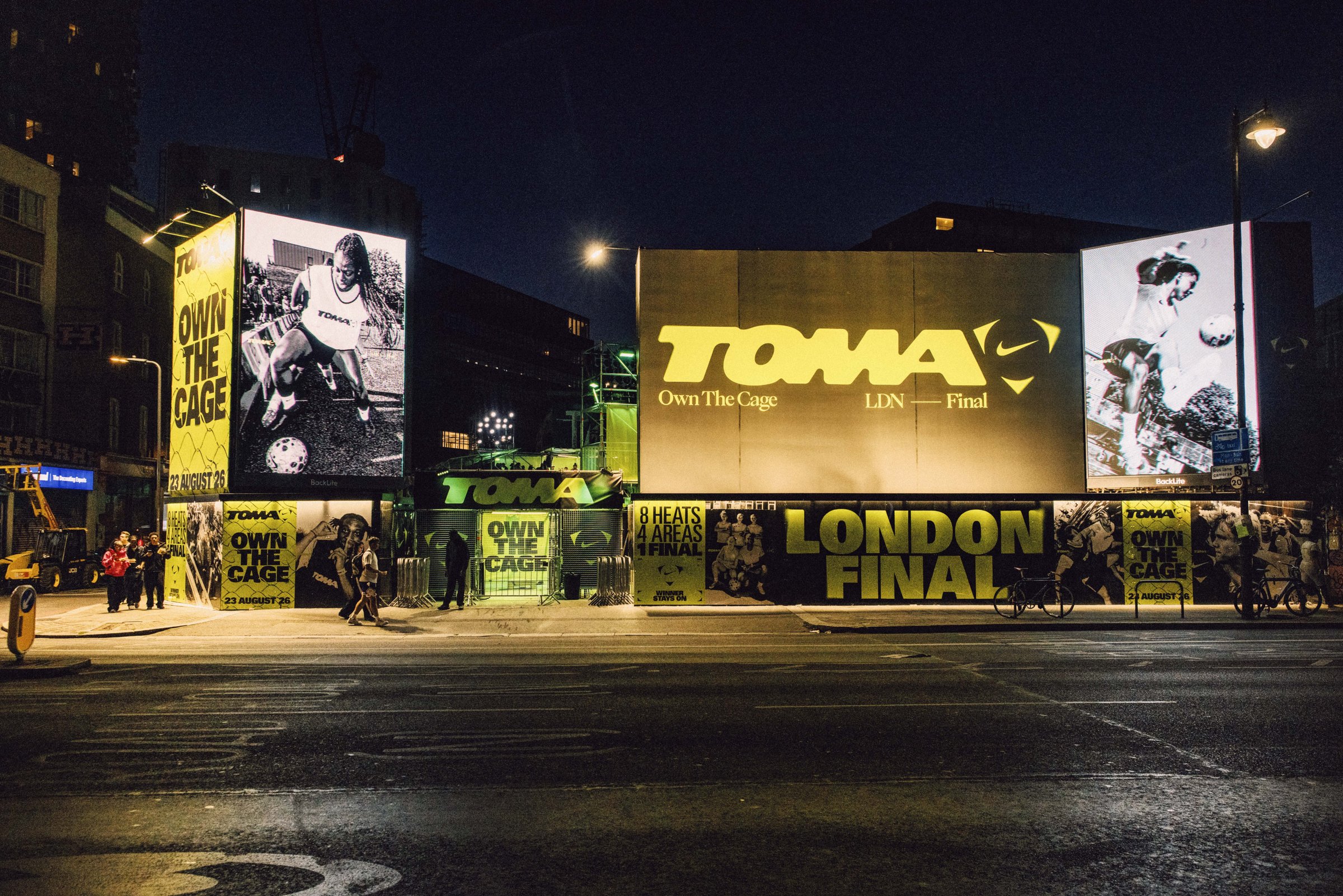
Alex Ezen, co-founder of Electric Garden—the groundbreaking 21,000-square-foot open-air site located on Shoreditch High Street in East London—summarizes the changing philosophy of spatial marketing:
"A screen can capture attention, but a physical experience gives people a reason to stop, take part, and share it."
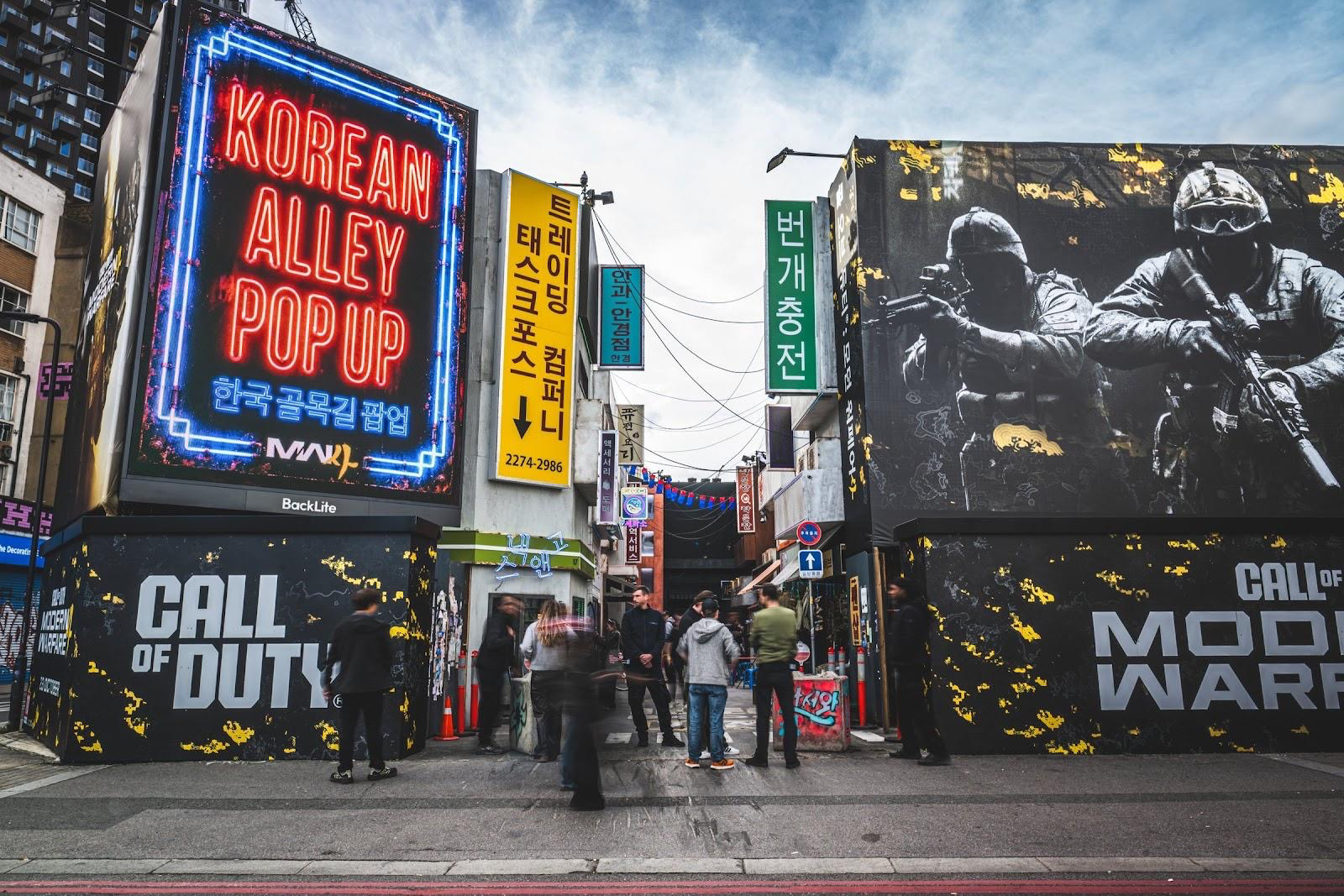
Electric Garden represents the physical precursor to what smart glasses will achieve digitally. Situated behind a colossal row of digital screens, the site allows major entertainment brands to run high-impact video campaigns on the surface while constructing an immersive, walkable physical world behind them. For its high-profile launch campaign promoting Activision’s Call of Duty, the space was transformed into a neon-drenched, Seoul-inspired alleyway complete with authentic convenience store facades, plastic street stools, and immersive code-breaking missions for visitors.
Industry analysts suggest that smart glasses will democratize this concept, removing the need for millions of dollars in physical construction. Tom May, an award-winning design journalist and author of The 50 Greatest Designers, notes the design implications of this imminent technological shift:
"Smart glasses could deliver something similar without anyone needing to build an alleyway. That will make the brief for designers all the harder, of course, but personally, that’s the kind of challenge I’d relish."
As creative agencies pivot from flat graphic design to spatial interaction design (IxD), the boundaries between industrial architecture, UI/UX design, and cinematic storytelling will effectively dissolve. Creative directors will no longer simply design what a poster looks like; they will architect how a physical object behaves when intercepted by an artificial intelligence algorithm operating inside a pair of everyday glasses.
Future Outlook: The Smart-City Landscape
Looking ahead toward the middle of the 21st century, the integration of smart glasses and physical urban infrastructure will redefine the urban experience in three distinct phases:
1. The Contextual Layer (2026–2030)
In the immediate future, smart glasses will act as passive interpreters of the physical environment. Pointing your gaze at a theatrical billboard will prompt an onboard multimodal AI assistant to whisper a summary of reviews, pull up showtimes at the nearest independent cinema, and project a non-intrusive green navigation line down the pavement directing you to the box office. Advertisers will compete not just for visual real estate, but for the contextual relevance of their metadata.
2. The Collaborative AR Environment (2030–2035)
As spatial mesh mapping becomes ubiquitous, physical billboards will serve as shared multi-user canvases. Friends walking down a city street wearing AR eyewear will be able to look at the same physical hoarding and see completely different, interactive layers—perhaps a multiplayer puzzle integrated into a beverage ad, or shared social annotations left by other travelers. The physical billboard becomes merely the anchor; the narrative unfolds entirely in shared mixed reality.
3. The Ethical and Regulatory Battlefield (2035 and Beyond)
This hyper-augmented future will inevitably spark intense regulatory battles regarding visual pollution, data privacy, and public space monetization. Just as municipal governments currently regulate billboard sizing, brightness, and zoning laws, future city councils will have to establish "attention zoning" ordinances. Questions will arise: Do private corporations have the right to project commercial overlays onto public statues or historic brick buildings? Can citizens opt out of commercial AR feeds entirely, establishing "ad-free" zones within their personal smart optics?
Conclusion
The narrative that digital technology inevitably destroys physical media is proving to be a false dichotomy. Just as vinyl records have thrived in the era of music streaming, and physical books have coexisted with e-readers, physical urban infrastructure possesses an inherent grounding power that pixels alone cannot replicate.
Billboards have survived for more than a century because human beings are biological creatures who navigate physical spaces. Rather than replacing the humble billboard, smart glasses are set to unleash its ultimate evolution. By stripping away the friction of interaction and fusing physical architecture with AI-driven augmented reality, our streets are destined to become living, breathing, interactive galleries. For designers, marketers, and urban dwellers alike, the future of advertising will no longer be about looking down at our screens—it will be about looking up at a world transformed.