Executive Overview
The deployment of Large Language Models (LLMs) at enterprise scale faces a relentless, structural bottleneck. While hardware accelerators like the NVIDIA H100 GPU achieve phenomenal theoretical performance for matrix math, they sit largely idle during standard autoregressive text generation. Because models generate responses one token at a time, billions of parameters must be continuously transferred from high-bandwidth GPU memory into processing cores for every single token produced. This architecture renders standard LLM inference strictly memory-bandwidth bound rather than compute-bound.
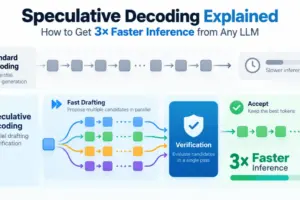
Enter speculative decoding: a paradigm-shifting inference strategy that sidesteps this bottleneck without retraining models, altering weights, or degrading output quality. By pairing a lightweight "draft" model to rapidly generate candidate sequences with a high-capacity "target" model to evaluate those tokens in parallel, speculative decoding achieves a real-world speedup of 2x to 3x.
This article explores the mechanics of speculative decoding, investigates why it unlocks hardware-level efficiency, examines modern architectural evolutions—such as Medusa, Eagle, and Prompt Lookup Decoding—and outlines practical considerations for deployment in production environments.
Detailed Chronology of the Autoregressive Bottleneck and Its Solution
To understand the genius of speculative decoding, one must trace the evolutionary history of how language models generate text and why engineers hit a brick wall regarding latency.
Phase 1: The Autoregressive Imperative
From the inception of modern transformer architectures, text generation has been fundamentally autoregressive. To produce a response, an LLM processes the input prompt, runs a full forward pass across its parameter weights, and samples a single token. That token is then appended to the context window, and the entire neural network computes all over again to output the next token.
This loop—read memory, compute, output one token, repeat—has defined LLM serving for years. For short generations, this latency is imperceptible. However, as applications evolved to demand instant feedback (such as live coding assistants, real-time voice agents, and customer service bots), this sequential bottleneck became untenable.
Phase 2: Diagnosing the Memory Wall
For a long time, hardware engineers and software practitioners debated whether the solution lay in adding more raw compute. However, structural performance analyses revealed a deeper truth: the GPU’s arithmetic logic units (ALUs) were not the limiting factor.
Modern accelerators possess massive parallel processing capabilities, but loading a 70-billion-parameter model from VRAM into the processor takes a fixed amount of time. When a model generates just one token per memory load, the arithmetic intensity is extremely low. The GPU spends the vast majority of its clock cycles waiting for memory transfers.
Phase 3: The Birth of Speculative Decoding
Recognizing that parallel evaluation is vastly more efficient on modern hardware than sequential token generation, researchers independently formulated speculative decoding (published formally in late 2022 by teams at Google and Stanford).
The breakthrough insight was simple: What if we let a tiny model guess the next few words, and let the giant model grade the homework all at once?
This split-brain approach transformed inference. Instead of forcing the target model to bear the heavy memory-loading penalty for every single token, the system leverages a small draft model to output a sequence of candidate tokens in a fraction of the time. The target model then ingests this entire batch in a single forward pass, validating or rejecting the guesses mathematically.
Supporting Context & Mechanics: Inside the Speculative Loop
The efficiency of speculative decoding relies on a rigorous statistical framework that guarantees mathematical equivalence to standard decoding.
The Two-Model Symphony
- The Draft Model: A small, lightweight neural network (e.g., a 1B parameter model) designed to run at lightning speed. It generates a sequence of $K$ candidate tokens autoregressively. Because of its compact size, these tokens are produced rapidly.
- The Target Model: The primary, high-capability model (e.g., a 70B parameter model). It processes the entire candidate sequence in a single forward pass. Because modern tensor cores process batched tokens with minimal overhead compared to single tokens, the target model’s evaluation cost remains nearly identical to a standard single-token pass.
The Verification Algorithm
Once the draft model outputs $K$ tokens, the target model scores the entire block. A probabilistic validation step occurs sequentially across the candidate tokens:
- Acceptance: If the target model assigns a probability to a candidate token that is equal to or greater than the draft model’s probability, the token is automatically accepted.
- Correction: If the draft model was overly confident compared to the target model, the token is accepted probabilistically based on the ratio of their probabilities. If rejected, a corrected token is sampled from an adjusted distribution.
This mathematical adjustment ensures that the final output distribution is provably identical to what the target model would have produced on its own. Quality is never sacrificed for speed.
[Prompt] ---> [Draft Model] ---> (Generates K Candidates)
                                      |
                                      v
                             [Target Model] ---> (Batch Verification)
                                      |
            +-------------------------+-------------------------+
            | (All Accepted)                                    | (Some Rejected)
            v                                                   v
[K + 1 Tokens Generated for Cost of 1 Pass]        [Corrected Token Sampled & Loop Resets]
Measuring Performance Metrics
The real-world efficacy of this loop is dictated by the acceptance rate—the percentage of draft tokens that pass the target model’s scrutiny.
- High Acceptance (70% – 80%): Typical for well-matched model pairs on predictable text (e.g., code, structured data, formal prose). Yields a 2x to 3x speedup.
- Low Acceptance (< 40%): Occurs when the draft model and target model disagree frequently, or when generating highly creative, chaotic text. In the worst case, draft overhead introduces a minor latency penalty, making speculative decoding slower than standard execution.
Modern Architectures: Beyond the Basic Two-Model Setup
While the classic two-model pipeline revolutionized inference, managing two distinct model weights in memory introduced engineering friction. Recent research has yielded advanced techniques that eliminate the standalone draft model altogether.
1. Medusa: Multi-Head Self-Drafting
Rather than running an external model, Medusa modifies the target model itself by attaching multiple lightweight prediction heads directly to its final transformer layer. Each head is trained independently to predict tokens at varying offsets into the future (e.g., $t+1, t+2, t+3$).
- Advantage: The target model drafts its own candidate sequences natively during a single forward pass, eliminating inter-model communication overhead and memory fragmentation.
2. Eagle: Hidden-State Extrapolation
Eagle (Extrapolation Algorithm for Greater Language-model Efficiency) recognizes that output tokens alone may lack sufficient context for accurate drafting. Instead, Eagle predicts future tokens based on the target model’s internal hidden states.
- Advantage: Hidden states encapsulate rich semantic and contextual vectors, resulting in significantly higher acceptance rates on complex, domain-specific, or multi-turn conversational text.
3. Prompt Lookup Decoding
For environments where running even a small secondary model is prohibitive, Prompt Lookup Decoding requires zero additional models. It acts as a heuristic-based string matcher, scanning the immediate prompt and conversation history for repeating n-grams that are likely to appear in the model’s output.
- Advantage: Extremely effective for document summarization, code refactoring, and structured extraction tasks where the output heavily echoes input phrasing.
Official Industry Integration & Framework Adoption
Speculative decoding has rapidly transitioned from an academic computer science paper into a foundational pillar of modern LLM serving infrastructure. Major open-source inference engines now offer it as a native, plug-and-play configuration.
- vLLM: The high-throughput serving framework supports speculative decoding natively, allowing administrators to pair a draft model with a target model via straightforward command-line flags or configuration files.
- Hugging Face Text Generation Inference (TGI): TGI incorporates multi-model speculative execution to optimize GPU utilization across enterprise clusters.
- llama.cpp: Edge deployment frameworks have integrated speculative decoding, enabling resource-constrained local hardware (such as Apple Silicon MacBooks) to run large models at interactive, human-like speeds.
Production Trade-Offs: When NOT to Use It
Engineers must evaluate operational trade-offs before enabling speculative decoding globally:
- Batch Serving vs. Single-User Latency: Speculative decoding shines in low-batch, latency-sensitive scenarios (e.g., chat interfaces). In heavily batched production environments processing thousands of concurrent requests, speculative decoding can saturate VRAM bandwidth and hurt overall throughput.
- VRAM Overhead: Maintaining two sets of model weights in memory simultaneously requires careful GPU memory sizing, particularly for large target models like 70B parameter variants.
Future Outlook
As language models continue to scale into hundreds of billions—and eventually trillions—of parameters, the physical constraints of memory bandwidth will only intensify. Brute-force hardware acceleration alone cannot solve the autoregressive bottleneck.
The industry is moving toward native hardware-software co-design where speculative execution, self-drafting heads (like Medusa), and speculative retrieval mechanisms are built directly into the core runtime environment. Furthermore, advancements in speculative decoding for multimodal architectures (vision-language and audio-language models) are already underway, promising similar speedups for models processing images and video streams.
Ultimately, speculative decoding represents a fundamental shift in how we think about generation constraints. By proving that sequential text generation can be transformed into a parallel verification problem, the AI community has unlocked a sustainable pathway toward real-time, ultra-low-latency intelligence.