Executive Overview
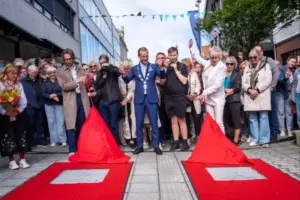
In a weekend that underscored the soaring international prestige and cultural self-confidence of Scandinavian cinema, Norwegian acting luminaries Anders Danielsen Lie and Anne Marie Ottersen were officially inducted into the prestigious Haugesund Walk of Fame. The high-profile unveiling ceremony took place during the opening weekend of the Norwegian International Film Festival in Haugesund, an event that has steadily evolved into a vital nexus for Nordic storytelling and global film trade.
The festival committee honored both performers for their monumental contributions to "building the professionalism and high standards of Norway’s acting community, both on the theatre stage and in the film and television industry." By receiving this enduring accolade, Danielsen Lie and Ottersen cement their places alongside an elite pantheon of Norwegian cultural icons, including Liv Ullmann, Pål Sverre Hagen, Renate Reinsve, Kristoffer Joner, and Ane Dahl Torp.
For Danielsen Lie, the honor represents a poignant full-circle moment in a career that defies conventional trajectories—balancing a thriving medical practice as a physician with a celebrated, boundary-pushing international acting career. Meanwhile, for Ottersen, whose career spans more than five decades of commanding stage and screen performances, the induction is a permanent tribute to a life dedicated to the craft of storytelling. Together, their recognition mirrors the broader trajectory of Norwegian cinema: an industry transitioning from regional acclaim to an undeniable global powerhouse characterized by critical triumphs, institutional support, and unprecedented international momentum.
Detailed Chronology: From Local Roots to Global Stages
To understand the weight of the Haugesund Walk of Fame induction, one must examine the divergent yet equally extraordinary paths that brought Anders Danielsen Lie and Anne Marie Ottersen to this milestone.
The Accidental Auteur: Anders Danielsen Lie’s Unconventional Ascent
Anders Danielsen Lie’s cinematic journey began more than three decades ago with the release of the 1990 film Herman, which premiered in Haugesund when he was just a child actor. Yet, acting was initially a secondary passion rather than a destined vocation. As Danielsen Lie candidly reflected during the festival, he fully intended to leave the world of make-believe behind when he enrolled in medical school.
The trajectory of contemporary Norwegian cinema shifted definitively when filmmaker Joachim Trier cast Danielsen Lie in his 2006 feature directorial debut, Reprise.
"I think there are several ‘before’ and ‘after’ moments in my career, with the first being Reprise," Danielsen Lie told Variety. "If it weren’t for that film, I would never have worked as an actor."
Following Reprise, Danielsen Lie’s creative partnership with Trier yielded Oslo, August 31st (2011), widely regarded as a watershed moment in modern Nordic realism and the definitive turning point in his career. His haunting, deeply internalized performance as a recovering drug addict navigating a day of existential reckoning in Oslo brought him critical acclaim across European festival circuits.
However, it was his subsequent collaborations with Trier that truly detonated his international profile. The Worst Person in the World (2021) became a global cultural phenomenon, earning Academy Award nominations and captivating audiences worldwide with its raw, witty, and profoundly empathetic exploration of modern romance and quarter-life crisis. This momentum shows no signs of slowing; Danielsen Lie’s recent work in Trier’s latest cinematic exploration, Sentimental Value, has further cemented his status as one of Europe’s most compelling cinematic faces.
A Life on Stage and Screen: Anne Marie Ottersen’s Historic Legacy
While Danielsen Lie represents the vanguard of contemporary Norwegian crossover success, Anne Marie Ottersen embodies the deep-rooted bedrock of the nation’s theatrical and cinematic heritage.
Ottersen’s journey into the upper echelons of Norwegian arts began in 1970 when she officially joined the prestigious National Theatre (Nationaltheatret). Over the next five decades, she established herself as a chameleon of the stage, effortlessly transitioning between high tragedy and sharp contemporary drama. Her transition to the screen proved equally formidable. She earned critical acclaim and the coveted Amanda Award—Norway’s premier film prize—for her tour-de-force performance in the socially resonant classic Wives – Ten Years Later.
Never resting on her laurels, Ottersen continues to challenge herself creatively well into her later career. Her latest cinematic venture, The Pension Heist, directed by Gunnbjörg Gunnarsdóttir, is scheduled for release in October, proving that her artistic appetite remains as voracious as ever.
Supporting Context & Metrics: The Evolution of the Haugesund Walk of Fame
Established in 2015, the Haugesund Walk of Fame was modeled after international cinematic landmarks like Hollywood’s Walk of Fame to honor the giants of Norwegian film and television. When actors Kristoffer Joner and Ane Dahl Torp became its very first recipients nearly a decade ago, the initiative was designed to give physical permanence to the fleeting magic of performance.
The inclusion of Danielsen Lie and Ottersen highlights the rigorous criteria upheld by the festival’s selection committee. Inductees are evaluated not merely on box-office success, but on their ability to elevate the aesthetic and professional standards of Norwegian storytelling.
The broader context of this year’s festival is defined by unprecedented tailwinds. Norwegian cinema is experiencing a golden age on the global stage, propelled by historic international breakthroughs. Most notably, the global triumph of Sentimental Value—securing an Academy Award win and multiple nominations—has signaled to international distributors and streaming giants that Norwegian narratives possess universal resonance.
According to industry metrics, this international momentum is no accident. It is the culmination of decades of strategic public and private investment in national film infrastructure, paired with an increasingly daring generation of filmmakers and performers who refuse to be bound by traditional geographic or thematic limitations.
Official Statements and Personal Reflections
The emotional resonance of the Haugesund induction was palpable during the acceptance speeches and press interviews given over the festival’s opening weekend.
Reflecting on his busy schedule and the surreal nature of his dual life as both a practicing physician and an international movie star, Anders Danielsen Lie expressed a healthy dose of bemusement:
"Do I look back? I haven’t had much time to reflect on this yet because my life is so hectic at the moment. But I do remember releasing Herman in Haugesund more than 30 years ago, so it feels full circle to receive this honor here."
Discussing the profound impact of his collaboration with Joachim Trier, Danielsen Lie noted the paradoxical nature of his success:
"I think there are several ‘before’ and ‘after’ moments in my career… It’s always hard to say exactly why a film is loved by the audience, but they both tell stories that are relatable to many people. They are very entertaining films, but they also have an almost therapeutic quality to them. I’m a bit surprised I have an international career, because I’ve always been ambivalent about acting—but hopefully that adds an extra layer of complexity to my work!"
Turning to the structural factors driving the current boom in Norwegian cinema, Danielsen Lie pointed to institutional support as a foundational pillar:
"I think there are several reasons for that. One is that we have great funding opportunities for films with limited commercial potential. I think Norwegian cinema as a whole has much more self-confidence now, which has been built up over many years. What we see now is the end result of a long evolution."
For Anne Marie Ottersen, the recognition offered a poignant reflection on the ephemeral nature of live performance versus the permanence of cinematic and public honors:
"It was totally unexpected, but [it made me] very happy. In theater, most of what we do is gone with the wind once the performance is over. But now I’m written in stone, and that will last almost forever."
Looking back on a career spanning over half a century, Ottersen radiated profound gratitude:
"The best thing I can say about my career is that I have been lucky to do so many different things. There have been difficult periods, of course, but I have the best job in the world, and I’m still working. I’m so happy about that."
Future Outlook: The Horizon of Norwegian Cinema
As the Norwegian International Film Festival in Haugesund continues its run through August 28, the inductions of Anders Danielsen Lie and Anne Marie Ottersen serve as both a celebration of past achievements and a bold statement about the future.
The bridge built between generations—symbolized by Ottersen’s institutional theater roots and Danielsen Lie’s modern, globally mobile auteur-driven cinema—demonstrates the robust health of Norway’s cultural ecosystem. With robust funding mechanisms designed to protect artistic integrity, a growing institutional self-confidence, and a new wave of international accolades following successes like Sentimental Value, Norwegian storytelling is well-positioned to command the global stage for decades to come.
As their names are literally written in stone along the Haugesund waterfront, Danielsen Lie and Ottersen remind us that while performances may fade with the final curtain call or the rolling of credits, true artistic excellence leaves an indelible mark on the cultural consciousness of the world.