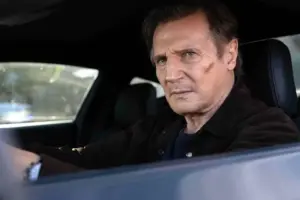
In the storied tradition of high-octane Hollywood counter-culture road movies—echoing the rebellious ethos of 1970s classics like Vanishing Point and Steven Spielberg’s The Sugarland Express—comes The Mongoose. Directed by veteran stunt coordinator Mark Vanselow in his feature-film debut, the movie attempts to channel a dual lineage of American cinema: the fast-paced, law-evading fugitive thriller and the gritty, psychological exploitation subgenre exploring veterans returning from foreign conflicts out of step with civilian society.
Headlined by Liam Neeson as a decorated war hero thrust onto the wrong side of the law, The Mongoose boasts high-horsepower thrills, anchored by a sleek Shelby Super Snake, and a star-studded supporting cast featuring Marisa Tomei, Ving Rhames, and Michael Chiklis. However, despite its cinematic pedigree and explosive vehicular choreography, the film’s screenplay—penned by Thompson Evans—ultimately stalls under the weight of its own uncritical reverence. Rather than navigating the messy, morally ambiguous territory of its spiritual predecessors, the film opts for a frictionless narrative where its protagonist is universally adored, sanitized of complications, and entirely insulated from narrative jeopardy.
This critical review examines the mechanics of The Mongoose, analyzing its structural choices, character dynamics, action choreography, and thematic shortcomings. While the production delivers on kinetic spectacle, it sacrifices emotional resonance and narrative tension by refusing to challenge its audience or its invincible hero.
Detailed Chronology: The Road to the Shelby Super Snake
The Mongoose wastes no time plunging the audience into the heart of the action, utilizing an in medias res opening that catches up with protagonist Ryan “Fang” Flanagan (Liam Neeson) as he expertly shatters a police roadblock. From this high-velocity starting point, the narrative loops backward through a series of desaturated, flashback-heavy sequences to unpack the complex web of trauma and circumstance that placed Fang behind the wheel of a glossy red muscle car.
The Ghosts of Afghanistan and Civilian Disconnect
Years prior, in 2005, Special Forces Commander Fang and his loyal team—consisting of soldiers Tanker (Ving Rhames) and Munch (Marcus Thomas)—were captured behind enemy lines in Afghanistan. Though the men successfully engineered a daring and ingenious escape, victory came at an agonizing human cost: the life of their comrade, Wiz (Ryan Morgan).
Two decades later, Fang remains haunted by severe Post-Traumatic Stress Disorder (PTSD). While his marriage to Tara (Marisa Tomei) dissolved under the strain of his psychological wounds, the two have maintained an amicable, supportive bond. The fragile peace of Fang’s post-military existence shatters, however, when Tara reaches out from a hospital bed after suffering severe physical abuse at the hands of her current romantic partner, Todd (Brett Tucker), a high-powered and influential Arkansas attorney.
Despite Tara’s explicit plea that he avoid a violent confrontation—and her assurances that Todd will not be home—Fang agrees to visit Todd’s sprawling Arkansas mansion to retrieve her personal belongings. Predictably, the narrative tension snaps when Todd unexpectedly returns. Wielding a firearm and aggressively asserting his legal right to execute an intruder on his own property, Todd instigates a fatal scuffle. In the chaotic aftermath, Todd lies dead, Fang’s getaway vehicle has been sabotaged with slashed tires, and local law enforcement is closing in fast.
The Cross-Country Pursuit
Left with few alternatives, Fang commandeers a stunning, high-performance red Shelby Super Snake. Armed only with a handgun left behind in the glove compartment by the deceased Todd, Fang embarks on a desperate cross-country flight that soon transforms into a national media spectacle.
The pursuit is initially handled with tactical restraint by James Tilton (Maurice Marvel Meredith), a former Marine leading the initial dragnet. Tilton approaches the situation with psychological sensitivity, attempting to negotiate a peaceful surrender. However, as the high-speed chase crosses state lines into Texas, Fang’s pursuers trade diplomacy for aggression. Enter Major Walter Pope (Michael Chiklis), a ruthless military adversary determined to apprehend the fugitive at any cost, utilizing overwhelming and excessive force.
To survive, Fang must rely on a modern-day support network. Tanker and Munch run high-stakes interference to draw military helicopters off his trail, while the Shelby’s advanced AI assistant, Helene (voiced by Stella Stocker), helps him navigate fuel shortages and logistical hurdles. Meanwhile, CNN anchor Laura Coates—appearing as herself—broadcasts round-the-clock coverage of the pursuit. By broadcasting the harrowing context of Fang’s wartime trauma, the abuse suffered by Tara, and the questionable professional backgrounds of his adversaries, Coates inadvertently transforms the fugitive into a folk hero. The public rallies behind him, providing spontaneous ground support, safe harbor, and adoration as the authorities close in.
Supporting Context & Metrics: The Anatomy of a Modern Chase Movie
To fully understand the cultural and industrial positioning of The Mongoose, one must examine the cinematic lineage it seeks to emulate and the box-office and critical metrics surrounding its production.
The Exploitation Roots of the 1970s
During the heyday of American International Pictures and Roger Corman’s New World Pictures, low-budget exploitation cinema frequently trafficked in two distinct narrative veins:
- The Outlaw Road Movie: Films like Vanishing Point (1971) and The Sugarland Express (1974) captured the anti-authoritarian zeitgeist of post-Vietnam America, celebrating drivers who thumbed their noses at institutional control.
- The Alienated Veteran Thriller: Movies like Rolling Thunder (1977) and later blockbusters like First Blood (1982) explored the profound alienation felt by soldiers returning from war zones to a society that neither understood nor adequately supported them.
The Mongoose attempts to fuse these historical archetypes into a contemporary narrative. Yet, while its predecessors were defined by moral ambiguity, institutional critique, and tragic outcomes, The Mongoose operates as an uncritical power fantasy. Its script is deeply indebted to the surface aesthetics of these older films—complete with desaturated memory montages and roaring engines—while stripping away the grit, subversion, and structural critique that made them compelling.
Star Power and Production Metrics
Directed by seasoned stunt coordinator Mark Vanselow, the film relies heavily on practical vehicular stunts, utilizing the Shelby Super Snake as a central character in its own right. Vanselow’s background ensures that individual action sequences—particularly highway pursuits and roadblock evasions—possess kinetic energy.
Despite a stellar ensemble cast, the film’s production metrics reveal an over-reliance on star power to carry a featherweight script.
- Liam Neeson: Continuing his prolific late-career run as an action lead, Neeson infuses Fang with a gentle, disarming demeanor that stands in stark contrast to his character’s lethal military background.
- Marisa Tomei: Despite delivering a grounded and emotionally resonant performance during her limited screen time, Tomei’s character is structurally sidelined to serve primarily as a sounding board for the fugitive hero.
- Ving Rhames & Marcus Thomas: Providing tactical backup, Rhames and Thomas function similarly to their past action-ensemble roles, executing diversionary tactics that keep the plot moving.
- Michael Chiklis: As Major Walter Pope, Chiklis embraces the antagonist role with relish, serving as the narrative’s sole dissenting voice against the unearned adulation heaped upon the fugitive.
Official Statements & Cast Perspectives
While traditional press tours for The Mongoose have emphasized the film’s status as a high-octane tribute to the armed forces, critics and industry observers have noted the ideological uniformity of its narrative presentation.
Honoring the Troops vs. Narrative Realism
In promotional materials, the filmmakers have consistently framed The Mongoose as a "respectful nod" to the sacrifices made by military men and women. Screenwriter Thompson Evans reportedly structured the project to ensure audiences remained firmly aligned with Fang’s moral compass from the opening frame to the credits.
However, this commitment to unalloyed heroism creates a peculiar narrative dynamic. As noted in early reviews, when pursuing officer James Tilton asks Fang for a list of demands during an early negotiation standoff, "racial harmony" is unironically included among them. This moment encapsulates the film’s broader ideological approach: rather than grappling with real-world complexity, the screenplay endows its protagonist with platitudes so universally virtuous that every secondary character instantly pledges allegiance to his cause.
The Cast on Their Roles
- Liam Neeson has spoken in past interviews about the unique physical and emotional demands of playing aging heroes grappling with past trauma. In The Mongoose, Neeson plays against type in quiet moments—such as a gentle sequence attempting to coax a stubborn tabby cat out from under a bed—showcasing a warmth that makes his character instantly likable, even if it muddies the psychological consistency of a hardened Special Forces veteran.
- Michael Chiklis reportedly leaned into the unapologetic villainy of Major Walter Pope, recognizing that in a film where nearly everyone else bends over backward to praise the protagonist, playing the sole adversarial force provides a necessary narrative friction.
- Marisa Tomei brings emotional gravity to Tara, elevating standard expositional scenes through sheer talent, though critics have lamented that her role remains tethered to a trope of distressed or supportive female characters unworthy of her full dramatic range.
Future Outlook & Critical Legacy
As The Mongoose enters its theatrical and streaming lifecycle, it occupies a fascinating space in contemporary action cinema. It serves as a textbook example of a modern studio picture engineered for maximum audience comfort, deliberately avoiding any narrative risks that might alienate viewers or complicate its core message of patriotic reverence.
Will There Be a Franchise Extension?
Given the open-ended nature of the film’s finale—which concludes without explicitly revealing Fang’s ultimate legal or personal fate, having already fully vindicated him in the "court of public opinion"—industry analysts have questioned whether The Mongoose is intended to launch a recurring franchise.
However, unlike multi-film action properties that rely on evolving character arcs and escalating stakes, The Mongoose wraps its narrative in such complete absolution that a sequel would struggle to find narrative tension. Fang achieves total moral and public victory before the credits roll; there are no institutional walls left to scale or skeptics left to convert.
The Verdict on Stunt-Driven Cinema
Mark Vanselow’s transition from stunt coordination to feature-film direction highlights a growing trend in Hollywood: action specialists stepping behind the camera to prioritize practical, kinetic filmmaking over CGI spectacle. In this regard, The Mongoose succeeds in delivering functional, high-speed thrills, particularly during the first and second acts.
Ultimately, however, The Mongoose serves as a cautionary tale about the limits of frictionless storytelling. While honoring the sacrifices of military personnel is a noble sentiment, a cinematic tribute requires more than sleek muscle cars, desaturated flashbacks, and universal, unearned adoration. Without emotional weight, narrative peril, and moral complexity under the hood, even the most powerful Shelby Super Snake will eventually spin its wheels in neutral.