The paradigm of artificial intelligence is undergoing a profound decentralization. For years, the deployment of intelligent AI agents capable of autonomous file manipulation, reasoning, and context retrieval required extensive API integrations, costly cloud infrastructure, and perpetual subscription models tied to centralized third-party providers. However, recent advancements in open-weight models, coupled with robust local runtime engines like Ollama, have shattered these barriers.
This article explores a comprehensive engineering blueprint for constructing a fully localized, secure AI project assistant using Python, Ollama, and the advanced tool-calling architecture of the Qwen3 language model. Running entirely on local hardware without sending a single byte of data to external servers or requiring API keys, this system bridges the gap between raw machine intelligence and practical local file systems. By implementing rigorous path-validation mechanisms, strict context management, and dual-layered memory tracking, developers can deploy production-grade, privacy-first AI agents directly onto their local machines.
Detailed Chronology: Building and Configuring the Local AI Agent Ecosystem
The development lifecycle of a production-grade local tool-calling agent requires a methodical, step-by-step implementation process. Each phase—from foundational runtime setup to dynamic loop execution—ensures that the model operates within strict safety parameters while maintaining high cognitive flexibility.
Phase 1: Environment Initialization and Model Acquisition
The foundational infrastructure relies on Ollama, a lightweight orchestration framework designed to run open-weight large language models locally. Developers must first install Ollama and verify their local Python environment (ideally Python 3.10 or newer).
The chosen model for this architecture is Qwen3 (4B parameters), a compact yet remarkably capable open-weight model engineered natively to handle complex tool-calling schemas. Executing the initial download requires allocating approximately 2.5 GB of disk space:
ollama run qwen3:4b
Once downloaded, developers initialize a dedicated virtual environment to maintain dependency isolation:
Phase 2: Context Window Optimization and Hardware Offloading
Context length dictates the volume of text—including tool definitions, conversation histories, and tool execution outputs—that the model can process simultaneously. Because tool interactions rapidly consume token capacity, managing the context window is critical. Ollama automatically assigns a default context window depending on available VRAM, but developers can expand this limit up to 32K tokens by restarting the Ollama server session:
OLLAMA_CONTEXT_LENGTH=32000 ollama serve
Verifying hardware acceleration (ensuring models successfully offload to the GPU via the PROCESSOR diagnostic column) guarantees optimal inference speeds during complex, multi-step agent loops.
Phase 3: Architectural Design of Security-First Tools
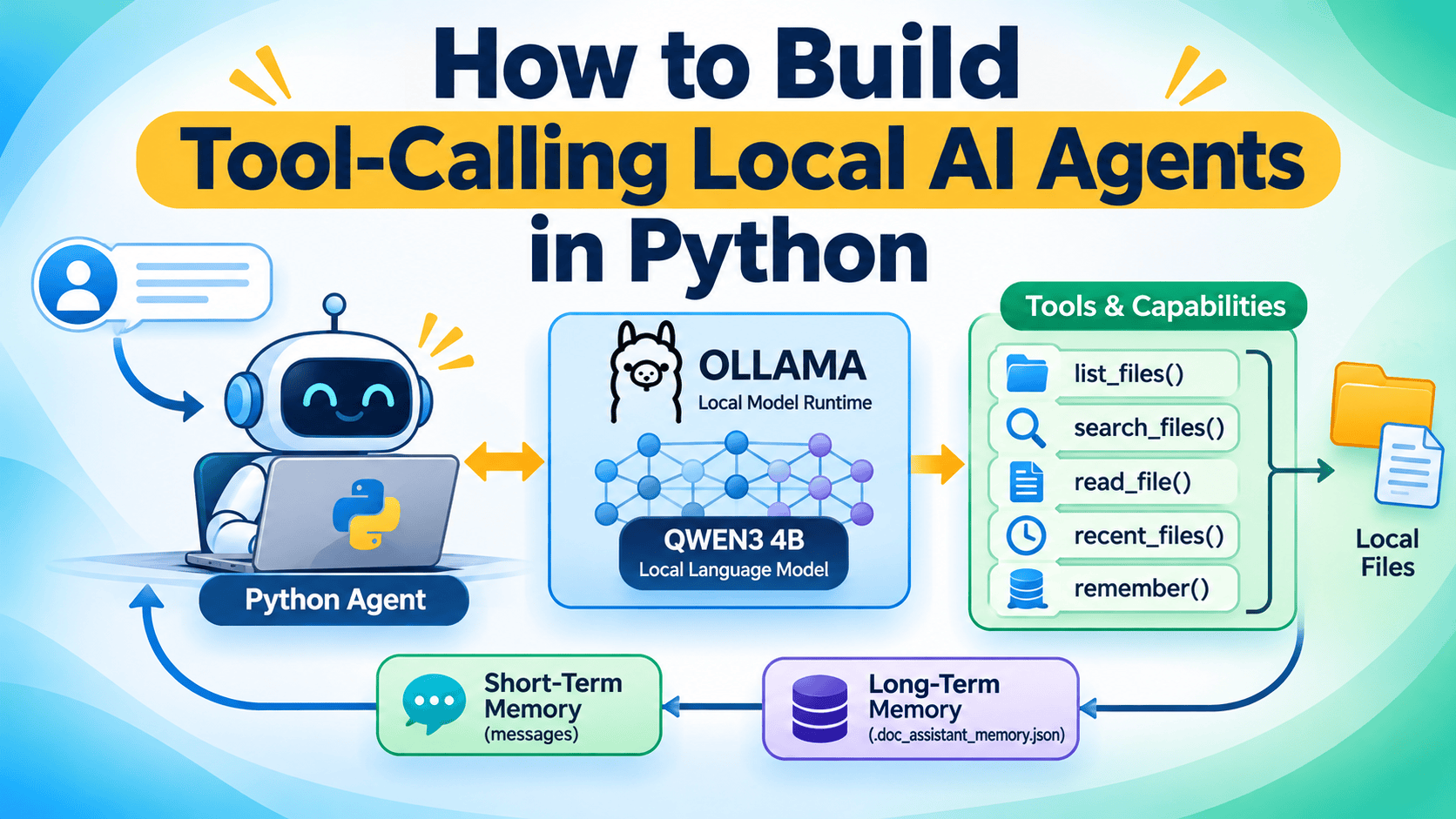
A language model cannot natively interact with host file systems; it requires explicit programmatic wrappers, commonly referred to as "tools." To prevent unauthorized system access, the agent is restricted to five core tools:
list_files: Catalogs the immediate contents of a specified directory.
search_files: Executes case-insensitive substring searches across text files.
read_file: Fetches specific line ranges from targeted files.
recent_files: Identifies files modified within a rolling temporal window.
remember: Persists vital metadata across sessions.
import json
import sys
import time
from datetime import datetime
from pathlib import Path
from ollama import chat

MODEL = "qwen3:4b"
ROOT = Path(".").resolve()
MEMORY_FILE = Path.home() / ".doc_assistant_memory.json"
TEXT_SUFFIXES = ".md", ".txt", ".csv", ".json", ".py", ".rst"
MAX_RESULTS = 20
MAX_TOOL_CHARS = 3000
To eliminate malicious path traversal attempts (such as injections attempting to access ../../secrets.txt), a robust path-sanitization wrapper is embedded into every file operation:
def safe_path(relative: str) -> Path:
    path = (ROOT / relative).resolve()
    if not path.is_relative_to(ROOT):
        raise ValueError("that path is outside the folder")
    return path
Phase 4: Constructing the Agent Execution Loop
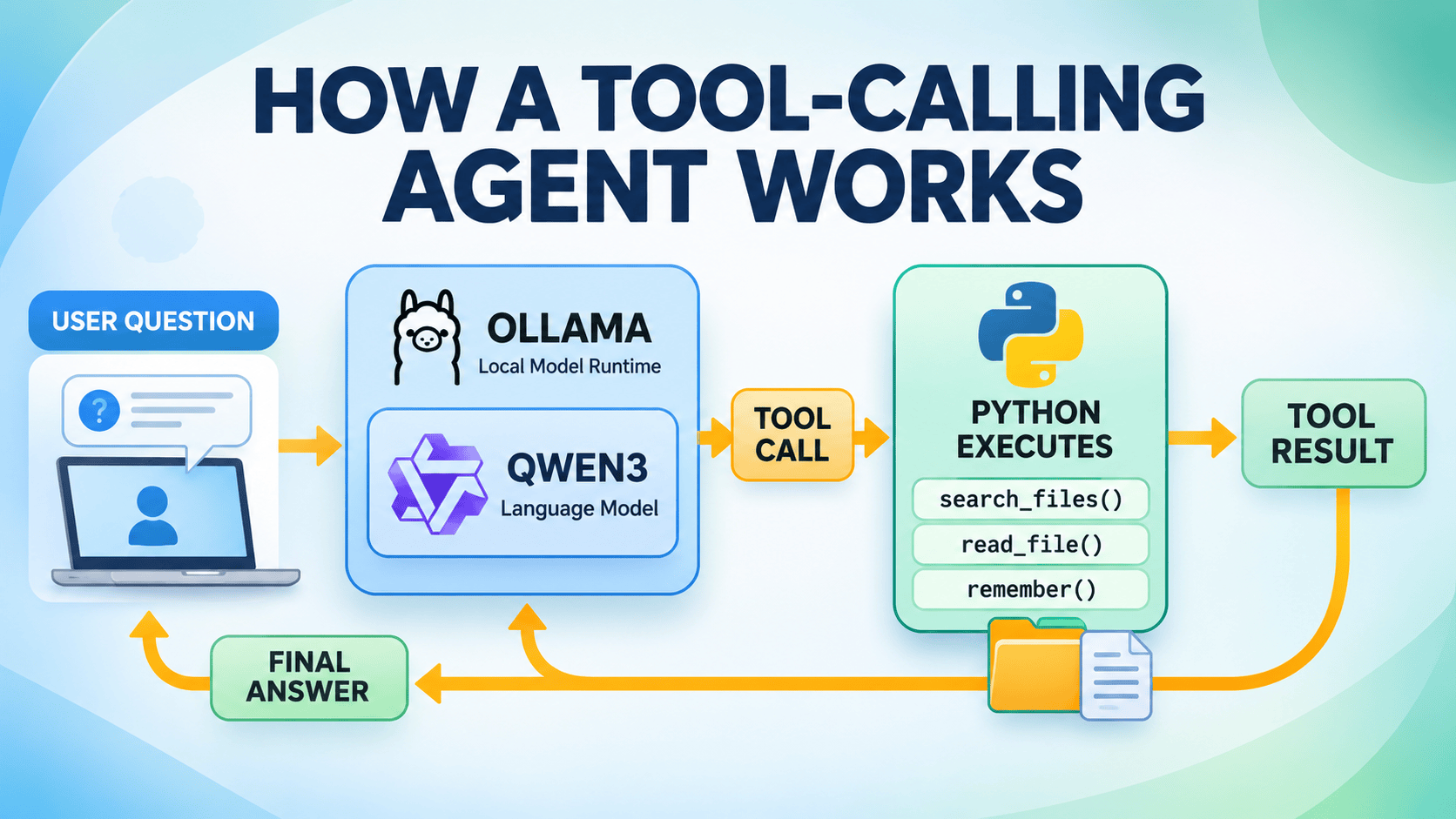
The core engine of the agent operates within a recursive turn-based loop (run_turn). When a user issues a command, the model evaluates whether a tool is required. If a tool call is generated, the Python script intercepts the request, executes the corresponding function safely, and feeds the resulting text back into the message stack.
def run_turn(messages: list, max_steps: int = 8) -> str:
    for _ in range(max_steps):
        response = chat(
            model=MODEL,
            messages=messages,
            tools=list(TOOLS.values()),
            options="temperature": 0,
        )
        messages.append(response.message)
        if not response.message.tool_calls:
            return response.message.content
        for call in response.message.tool_calls:
            name = call.function.name
            arguments = call.function.arguments
            print(f"  [tool] name(arguments)")
            messages.append(
                "role": "tool", "tool_name": name, "content": run_tool(name, arguments)
            )
    return "Stopped: the agent used too many tool steps."
To overcome the stateless nature of large language models, the agent incorporates two distinct memory tiers:
Short-Term Context Memory: Handled via a dynamic history buffer that tracks recent conversation turns while utilizing a pruning function (trim) to preserve system prompts and structural coherence.
Long-Term Persistence Memory: Managed through an external JSON file (.doc_assistant_memory.json) situated safely outside the project root. Facts saved via the remember tool are injected directly into the system prompt upon startup, ensuring cross-session continuity.
Supporting Context & Metrics: Performance, Constraints, and Security
Deploying local tool-calling agents introduces specific performance tradeoffs that developers must navigate carefully. Unlike cloud-hosted models running on multi-node GPU clusters, local deployment on consumer-grade hardware (such as Apple Silicon M-series chips or dedicated NVIDIA GPUs) requires strict resource governance.
Quantitative Architectural Metrics
Metric Component
Standard Configuration Limit
Engineering Rationale
Model Parameter Scale
4 Billion Parameters (qwen3:4b)
Optimal balance between local inference speed, memory footprint, and tool-calling precision.
Max Context Window
32,000 Tokens
Accommodates extensive multi-turn code exploration without prematurely overflowing memory.
Tool Result Character Cap
3,000 Characters (MAX_TOOL_CHARS)
Prevents single massive log or file reads from dominating the context window.
Maximum Search Results
20 Matches (MAX_RESULTS)
Ensures search returns remain concise and directly actionable for the model.
Max Execution Steps
8 Iterations (max_steps)
Halts infinite looping if a model becomes trapped in a recursive tool-calling cycle.
Security and Sandboxing Considerations
A critical concern in local AI agent engineering is privilege escalation. Because autonomous models generate their own functional arguments, a poorly engineered execution loop could theoretically execute destructive system commands. By strictly enforcing path.is_relative_to(ROOT) boundaries, maintaining read-only access for core exploration tools, and routing all exceptions back to the model as textual error messages rather than crashing exceptions, developers build resilient systems capable of self-correction.
Official Statements and Industry Perspective
Leading voices in machine learning architecture emphasize that the transition toward local, tool-capable agents represents a fundamental maturation of AI deployment strategies.
"The future of developer tooling is not tethered to remote, proprietary black-box APIs," notes prominent AI systems architecture research. "By combining open-weight models like Qwen3 with structured local execution loops, developers reclaim absolute sovereignty over their data, their codebases, and their infrastructure privacy. Tool-calling transforms passive language models into active, operational agents capable of true computational leverage."
Furthermore, engineering frameworks focusing on local execution underscore the importance of precise function descriptions (docstrings). Because small language models rely entirely on semantic function signatures to determine tool selection, the clarity and exactness of type hints and parameter documentation serve as the primary programming interface for the agent’s cognitive capabilities.
Future Outlook: The Evolution of Local Autonomous Systems
As open-weight model architectures continue to scale downward in computational requirements while scaling upward in reasoning efficiency, local AI agents are poised to become standard fixtures in software engineering environments.
Future iterations of local tool-calling architectures will likely incorporate several advanced capabilities:
Asynchronous Multi-Tool Parallelism: Expanding execution loops to run independent tool requests concurrently, dramatically accelerating codebase exploration.
Fine-Grained Write Operations with User-in-the-Loop Safeguards: Extending agent functionality to safely refactor code, commit changes, and execute automated test suites with mandatory human-approval gates.
Vector-Enhanced Hybrid Search: Integrating lightweight local vector embeddings (such as ChromaDB or FAISS) alongside traditional keyword-matching tools to improve semantic document
retrieval across massive project repositories.
By mastering the principles of local tool calling, developers are no longer passive consumers of centralized AI services; they are architects of sovereign, highly tailored intelligent systems built to operate securely on their own terms.